Good hallway lighting is simple. Fit wall lights about 2 m apart, with the centre of each light about 160 cm above the floor. In a passage too narrow for wall lights, use a row of small flush ceiling lights instead. Keep every light warm at 3000K. Do those three things and the narrowest passage in your home starts to feel like part of the house, not the gap between rooms.
The hallway is the first thing a guest walks through and the last thing you see at night. Yet most Indian homes light it with one tube light or a single bare bulb. The result is flat, glary and a little cold. The guide below fixes that, one plain idea at a time, with the sums for a real 6 m passage. Good corridor lighting needs the right fittings in the right places, not many of them.
Key takeaways
- Wash the walls. Wall lights make a narrow hallway feel brighter and taller. A bulb in the middle of the ceiling leaves the walls dark.
- Space evenly. One light every 1.8 to 2.4 metres keeps the floor free of dark patches.
- Stay slim. In a passage near 1 m wide, choose a light that stands 10 cm or less off the wall.
- Keep the head clear. Anything hanging should leave at least 210 cm (about 7 ft) below it.
- Stay warm. 3000K warm white feels welcoming. Cool white feels like a hospital corridor.
What is the best hallway lighting for an Indian home?
A row of warm wall lights, mounted at the same height down the corridor, with one ceiling light if the hallway is long or has no windows. Most homes need nothing more.
Wall light works better than ceiling light in a hallway for one reason. Hallways are narrow. Light thrown onto the walls bounces back into the space, so the corridor feels brighter and more open. Light from a single ceiling point drops mostly onto the floor and leaves the walls in shadow.
Ceiling light still has a job. In a long or windowless passage, it fills the middle. In a tall entrance hall, it becomes the one piece people remember.
7 hallway lighting ideas that work
1. A row of up and down wall lights
The up-and-down light is the hardest-working idea on the list. An up-and-down light throws one beam to the ceiling and one to the floor, so every light draws two soft lines on the wall. Repeat it down the corridor and the hallway gets a rhythm.
Our up down wall light does this with two hand-blown opal borosilicate glass shades on a 304-grade stainless steel frame in satin brass finish. The light stands 15 cm off the wall, so keep it for a passage 1.2 m wide or more. Two G9 holders; bulbs not included, so fit 3000K warm-white LEDs.
Prefer clear glass? Our ribbed glass wall light sets clear borosilicate glass rods in a 45 cm brushed gold half-cylinder, with two E14 holders that light the wall up and down. The light stands 12.5 cm off the wall. Bulbs not included; fit 3000K warm-white LEDs.
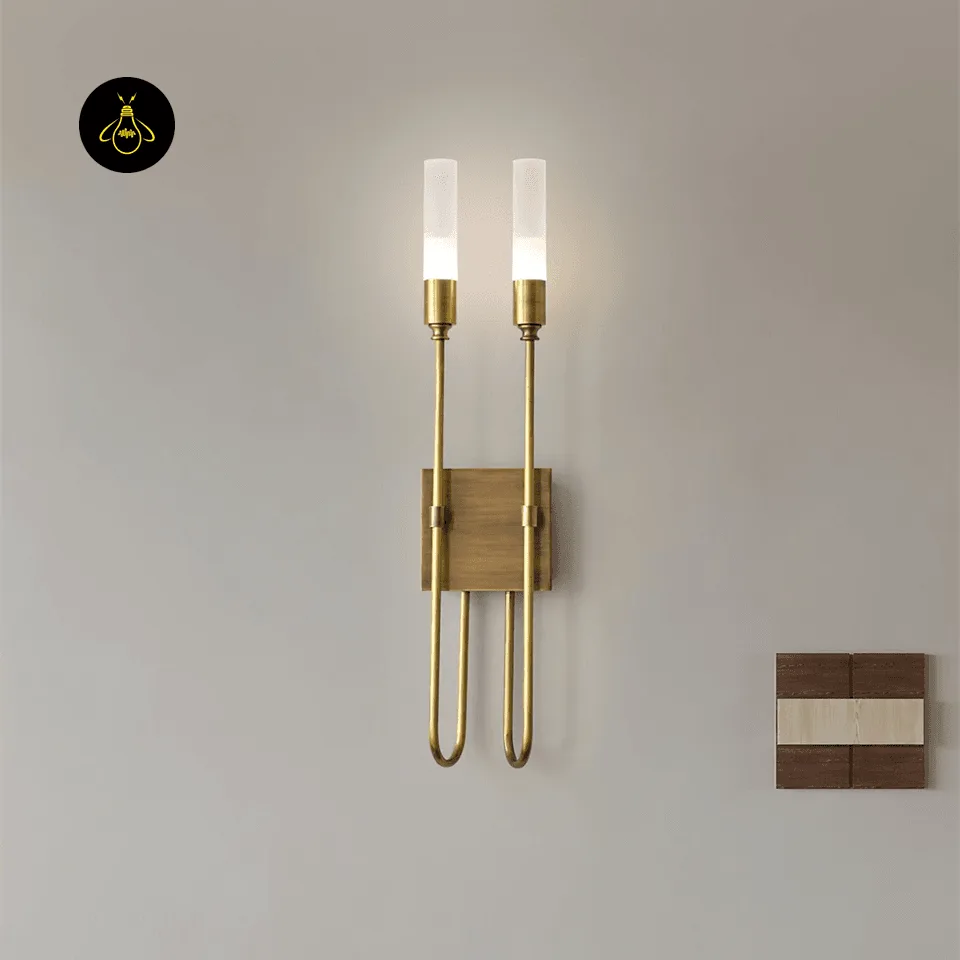
Our candle wall light sets a clear borosilicate glass tube on a glossy black stainless steel base, 46 cm tall, with a warm 3000K built-in LED. At 15.1 cm off the wall, the candle light also needs the wider passage.
2. Natural stone that glows from inside
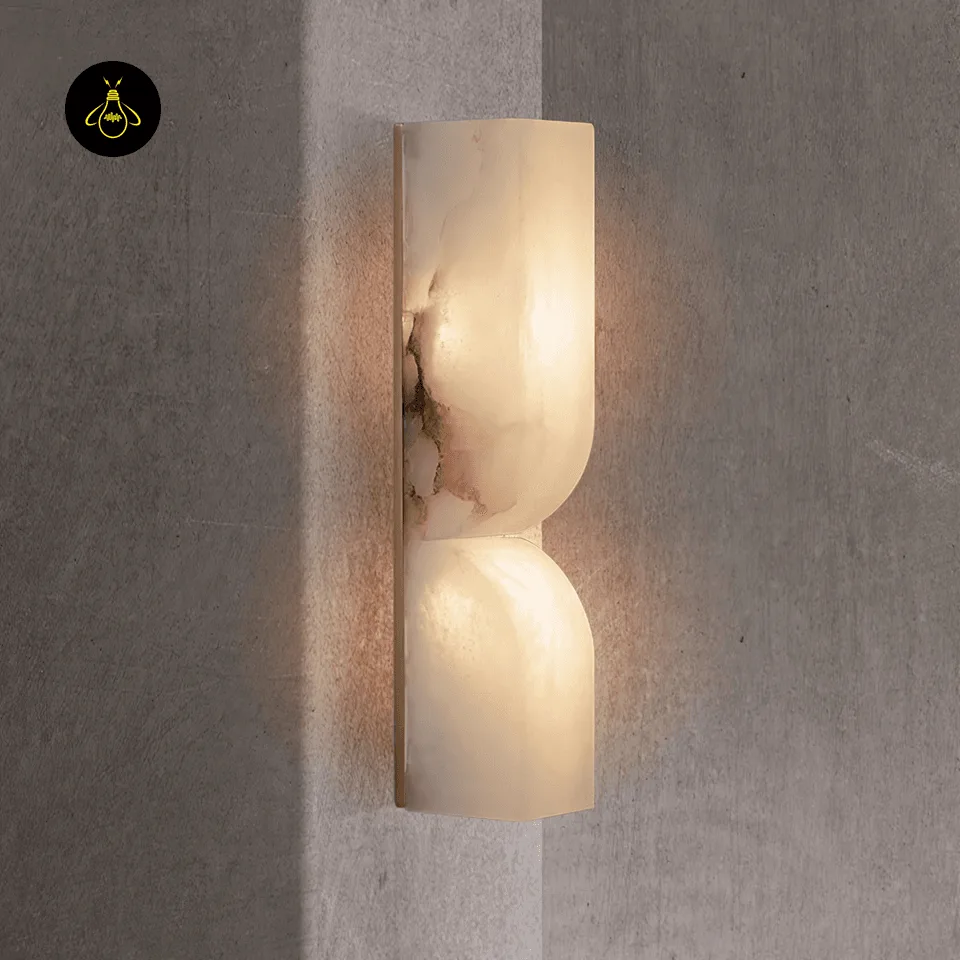
Alabaster is stone formed beneath the earth. Our craftsman reads its veins before he cuts, so each piece keeps its own pattern. Switch it on and the stone glows from inside. In a hallway you walk past every day, that glow never gets boring.
The alabaster wall light in our up-and-down design is only 8 cm wide and 6.5 cm deep, which suits a tight corridor. For a single line of light, the tube wall light is a 40 cm cylinder of alabaster just 5 cm across, and it stands 11.5 cm off the wall. Both carry a built-in 3000K LED, and alabaster lights with a built-in LED are rated IP65.
3. Slim lights for very narrow passages
Some passages are barely a metre wide. Here, anything that sticks out gets knocked. Choose a light that hugs the wall.
Our slim LED wall light is a 60 cm matte black bar of 304-grade stainless steel that sits just 3.6 cm off the wall. The bar mounts upright or flat, and its built-in 3000K LED washes the wall from behind. For stone instead of steel, the fluted alabaster wall light is 30 cm tall and only 5 cm deep, with a built-in 3000K LED. The linear alabaster wall light is a 50 cm capsule of real alabaster, 10 cm wide, with a G9 holder. Bulb not included; fit a 3000K warm-white LED.
4. Hallway ceiling lights that sit close
For hallway ceiling lights, go flat or nearly flat. A low-hanging light in a corridor with a standard 9 to 10 ft ceiling becomes something to duck under.
Our alabaster disc ceiling light is one of the cleaner modern ceiling lights for hallway use: a 30 cm disc of real stone, only 5 cm deep, with a built-in 12W LED at 3000K. For a wide hallway, space two along the centre line.
For a narrow passage or a landing, go smaller. Our hallway ceiling light in real alabaster is only 12 cm across. The stone drum glows warm in 3000K light, and a row of them about 2 m apart lights the whole corridor, as the sum below shows. For warmer, earthier stone, our mini ceiling light is the same 12 cm in real travertine, with an opal borosilicate glass globe and a warm 3000K LED. Prefer a plain stone drum? Our cylindrical ceiling light is 12 cm of honed travertine under a round wood canopy, with a G9 holder (bulb not included). Want a stone bowl with a soft glass globe? Our ceiling light for passage pairs real travertine with a wood canopy, and it is 15 cm wide.
5. A chandelier for a hallway with height
If your hallway opens into a double-height entrance, you have room for drama. A chandelier for hallway spaces like this should hang so its bottom sits at least 210 cm above the floor, and higher where people walk under it.
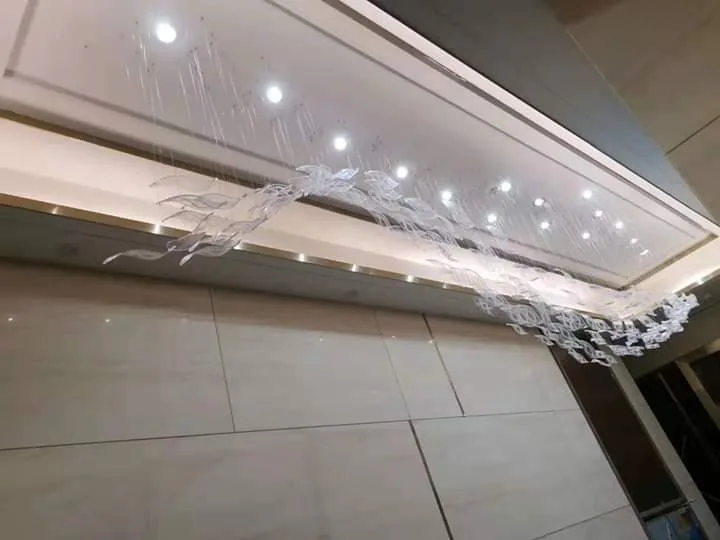
In a corridor with a normal ceiling, choose a flush mount chandelier instead. Ours uses real K9 crystal raindrops close to the ceiling. The single-step size hangs 20 cm, so a 275 cm ceiling still leaves 255 cm of clear height. For tall entrances, our foyer chandelier guide covers size and height in detail.
6. Pendants in a row
Three or four small pendants in a line turn a long hallway into a path. Keep them the same height and evenly spaced, about 2 metres apart. Our pendants hang on 1.5 m of cord or rod as standard, shortened at installation to the height you need.
Height decides the pendant. Our cylinder pendant light in its 31 cm size fits a normal 275 cm ceiling, with 34 cm left for the wire. The reeded glass lantern pendant has a 75 cm cage of clear reeded borosilicate glass and brass-finish 304-grade stainless steel, so the lantern needs a ceiling of at least 285 cm. See more ideas in our hallway pendant light guide, or browse all hanging lights.
7. A hallway lamp on the console
Many Indian homes keep a console table or shoe cabinet near the door. A hallway lamp on top of it is the warmest light in the passage, because it sits at eye level. Leave that lamp on when everyone else has gone to bed.
Pick a lamp that stays below the mirror or art above it. Keep it warm: a holder lamp needs a 3000K warm-white LED bulb, which is not included.
How high and how far apart should hallway lights be?
Most guides put the centre of a wall light 152 to 168 cm above the finished floor, so the glow sits near eye level. Our wall light height guide shows the tile sum. With a ceiling of 3 m or more, go a little above 168 cm.
Space lights 1.8 to 2.4 metres apart (6 to 8 feet). Closer than that and the wall looks busy. Further and you get dark gaps between pools of light.
Keep at least 210 cm clear below any hanging light. Put the first light 1 m from the door, so nobody walks in from the dark.
| Hallway type | Best light | Tip |
|---|---|---|
| Narrow, under 1.2 m wide | Slim wall lights | Pick lights 10 cm deep or less |
| Long, no windows | Wall lights plus flush ceiling lights | One light every 1.8–2.4 m |
| Wide entrance passage | Up-and-down wall lights plus a pendant row | Keep pendants at one height |
| Double-height entrance | Chandelier | Bottom at least 210 cm above the floor |
Lighting for hallway ceiling: how many lights does a narrow passage need?
A narrow passage needs two or three small flush ceiling lights, not one big one. Take a real passage, 6 m long and 1.2 m wide, under a 275 cm ceiling.
- Floor area: 6 × 1.2 = 7.2 sq m, or about 78 sq ft.
- Light on the floor: India’s code IS 3646 lists 100 to 150 lux for corridors. Lux tells you how much light lands on a surface, like a rain gauge for light. One lux is one lumen on each square metre, so 7.2 × 100 = 720 lumens and 7.2 × 150 = 1,080 lumens.
- A second check: Hunker gives 5 to 10 lumens per sq ft. So 78 × 5 = 390 lumens, and 78 × 10 = 780 lumens. Plan near 1,000 lumens and both checks pass.
- Light from the fitting: Ledvance gives 80 lumens or more per watt for an LED. Three 6W lights make 3 × 6 × 80 = 1,440 lumens at the LED. Two 12W lights make 2 × 12 × 80 = 1,920 lumens. Stone and opal glass hold some of that back, so treat these as upper marks. Our product pages list watts, not lumens.
- Headroom: 275 − 210 = 65 cm of ceiling depth to spend. Under a 20 cm false ceiling, 255 − 210 = 45 cm. A 13 cm flush light fits both.
One light does not spread far enough. We worked the floor point by point for this passage, treating each LED as a small point 265 cm above the floor, with no bounce from the walls.
| Ceiling lights | Where (from one end) | Floor at the end, as a share of the centre |
|---|---|---|
| 1 | 3 m | 29% |
| 2 | 1.5 m and 4.5 m | 60% |
| 3 | 1 m, 3 m and 5 m | 60% |
So choose three 12 cm lights at 6W, or two 15 cm lights at 12W. Both choices give enough light on paper and keep the ends bright.
We counted our own range on 6 November 2026. Of the 25 lights in Hallway Wall Lights, 16 state their depth, and only 2 stay at 10 cm or less: the 5 cm fluted alabaster light and the 3.6 cm slim bar. The other 14 stand 11 to 25 cm off the wall. Of our 16 stone ceiling lights, 5 are 15 cm wide or less. A passage near 1 m wide has few wall light choices, which is why the ceiling row matters.
Why do wall lights work so well in a passage?
The reason starts with the shape of the space. A passage is long and tight, so your eyes see mostly walls. Bright walls therefore make the whole passage feel bright, even when the floor gets the same light.
The standards agree. EN 12464-1, the European workplace lighting standard, asks for 75 lux on corridor walls and 50 lux on the ceiling, as well as 100 lux for the corridor. Research backs the feeling too. The Flynn lighting studies of the 1970s found that light on walls gives an impression of higher light levels. A 2011 study in the journal Human Factors found light walls and ceilings make a room appear higher. The study found ceiling lightness did not change apparent width, so a bright passage feels taller and more open, not truly wider.
Science explains the bounce. A surface sends back a share of the light that hits it, and that share is called reflectance. Gustafs, a surface maker, puts a bright white near 85 out of 100 and an anthracite grey near 5. So a white wall returns about 17 times more light than a dark wall, and paint colour matters as much as the bulb.
Distance does the rest. Light from a small source falls to a quarter each time the distance doubles, which is called the inverse square law. A wall light sits right on the wall it lights. A ceiling light sits more than 2 m above the floor, which is why one ceiling light cannot reach both ends.
Depth is a question of shoulders. US access rules limit wall objects to 10.2 cm (4 inches) between 69 cm and 203 cm above the floor, because people cannot always see them coming. Those rules do not bind an Indian home, but the logic holds. In a 100 cm passage, a 15 cm light leaves 85 cm to walk through. Guides differ on spacing, 2.4 m in one and closer in others, and the choice is simple: low-watt lights go closer, stronger lights go further.
Warm or white light for a hallway?
Warm. Every time. 3000K warm white makes wood, stone and skin look good. Warm light also feels calm at night, when the hallway is the path to the bedroom.
Cool white (5000–6500K) has its place in a garage or a store room. In a home hallway it feels harsh and makes walls look grey. Every integrated LED we make is 3000K, and we suggest the same for every bulb you fit.
Hallway lighting and Vastu
Vastu has always given weight to the entrance and the path into a home. The common advice is simple: keep the entrance and the passage well lit, with no dark corners, and use warm light rather than glare.
Natural materials fit that thinking well. Stone grounds a space. Warm light calms it. A light shaped by hand carries the care of the person who made it. We don’t promise luck. We believe a bright, warm hallway simply makes coming home feel better.
Nature gives the stone. Hands shape it. Light connects the rooms.
A passage joins every room in your home, and light joins the passage to the people who walk through it. We start with the material. Travertine formed beneath the earth over a very long time. Our mini ceiling light keeps that stone in a 12 cm ring, with its own pits and mottling left alone.
Then come the hands. A craftsman reads each piece before he cuts it. On the ceiling light for passage, a 15 cm bowl of travertine meets a real wood canopy, so two natural materials meet at the ceiling. On our 12 cm hallway ceiling light, alabaster glows from inside at 3000K, and the light is rated IP65 because alabaster with a built-in LED is sealed.
Our craftsmen have made these lights in our own factory in India since 2015. Every metal part is 304-grade stainless steel, with a lifetime warranty against rust on those parts for orders from 4 October 2026. Steel matters near a front door, where humid monsoon air comes in. Custom pieces take 15 to 20 working days, spares stay available for 10+ years, shipping is free across India, and EMI is available on eligible cards. Our certifications are open to read.
Warm light on a natural material, in a passage with no dark corners, is the kind of harmony Vastu has always valued.
See every light made for corridors in our hallway wall lights collection. Lighting the stairs too? Read our staircase lighting guide. For the rooms the hallway leads to, see our living room lighting ideas and bedroom lighting ideas.
FAQs
What is the best lighting for a narrow hallway?
Slim wall lights 10 cm deep or less, spaced 1.8 to 2.4 metres apart, or a row of small flush ceiling lights about 2 m apart. Keep them warm at 3000K.
What lighting for hallway ceiling suits a 1.2 m wide passage?
Two or three flush ceiling lights, 12 to 15 cm wide. A 6 m passage takes three 6W lights or two 12W lights, planned for the 100 to 150 lux India’s IS 3646 lists for corridors.
Which hallway ceiling lights suit a low ceiling?
Flush or semi-flush lights that sit close to the ceiling. A 5 cm stone disc or a flush mount crystal chandelier lights the passage without anything hanging into your path.
How many lights does a hallway need?
Roughly one light for every 2 metres of length. A 6 m corridor usually needs three wall lights, placed 1 m, 3 m and 5 m from one end.
Can I hang a chandelier in a hallway?
Yes, if the bottom of the chandelier stays at least 210 cm above the floor. In a corridor with a normal ceiling, a flush mount chandelier is the safer choice.
Are your hallway lights dimmable?
No. None of our lights are dimmable. Our built-in LEDs give a fixed warm 3000K glow, and holder lights take a 3000K bulb, not included.
Nature gives the material.
Human hands give it meaning.
Vastu inspires harmony.
Light brings it to life.
That is JagMag.
A hallway is a short walk. Light it well and it becomes part of how your home feels. Shop hallway wall lights. Not sure? Video-call us with your corridor size and we will suggest the right lights.
Sources
- Infralens, IS 3646:2009 quick reference (a summary, not the BIS text), read 6 Nov 2026.
- Trilux, Corridors, entrance halls, cloakrooms (EN 12464-1 values), read 6 Nov 2026.
- US Access Board, Guide to the ADA Standards: Protruding objects, read 6 Nov 2026.
- Oberfeld and Hecht, Human Factors 2011: surface lightness and perceived room size, read 6 Nov 2026.
- Electrical Contractor, The psychology of light (Flynn studies), read 6 Nov 2026.
- Hunker, Hallway lighting fixtures, read 6 Nov 2026.
- Ledvance, Lumens to watts, read 6 Nov 2026.
- Gustafs, Light reflection values, read 6 Nov 2026.
- HyperPhysics, Inverse square law for light, read 6 Nov 2026.