
Most Indian houses look fine by day and go flat after sunset. The gate is a dark gap. The main door hides in shadow. One bright tube light on the boundary wall shines straight into the road. Good outdoor home lighting fixes all three with a few warm, shielded lights, each placed for one job.
Below we light one real kind of house front, zone by zone: the gate, the main door, the compound wall and a balcony. You will see the count, the light, the height and the rain rating for each spot, with the sums worked out.
The house we are lighting
Take a common plot that is 30 feet wide. 30 × 0.3048 = 9.14 m of front wall. A 3 m gate sits in the middle, between two brick pillars. The gap leaves 9.14 − 3.0 = 6.14 m of compound wall, or 3.07 m on each side of the gate.
Behind the wall is a main door under a small porch, and above it one balcony that faces the road. Four zones, so four jobs:
- Gate: show the latch and welcome a visitor.
- Main door: light faces, keys and the step.
- Compound wall: draw a soft line, not glare into the road.
- Balcony: make a warm place to sit in the evening.
Studio Matrx, an Indian lighting design studio, gives the main rule in its facade lighting guide: “No glare, ever.” You should see the lit wall, not the bulb. Every choice below follows that rule. Our outdoor wall lights are built for these four spots.
Zone by zone: what goes where
| Zone | Our pick for this house | How many | Height and size |
|---|---|---|---|
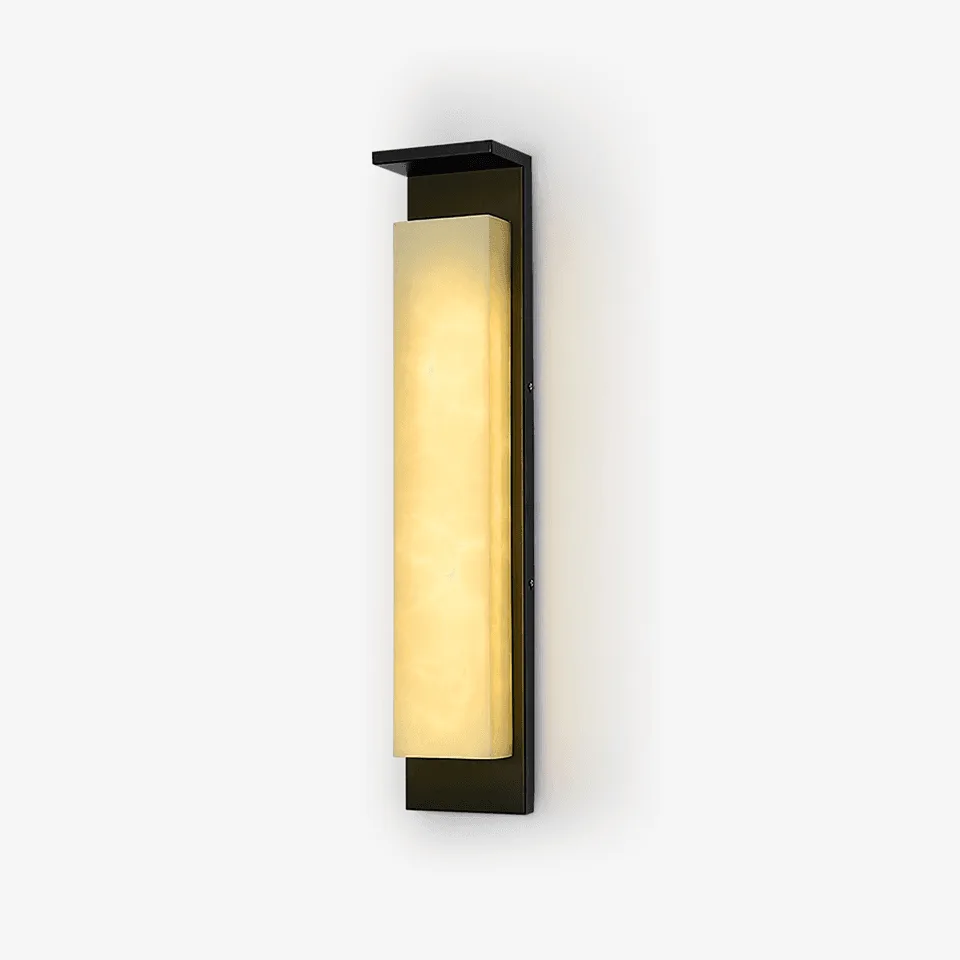
| Gate pillars | Alabaster outdoor wall light, built-in 3000K LED | 2, one per pillar | 70 cm tall, fixed 180–200 cm from the ground |
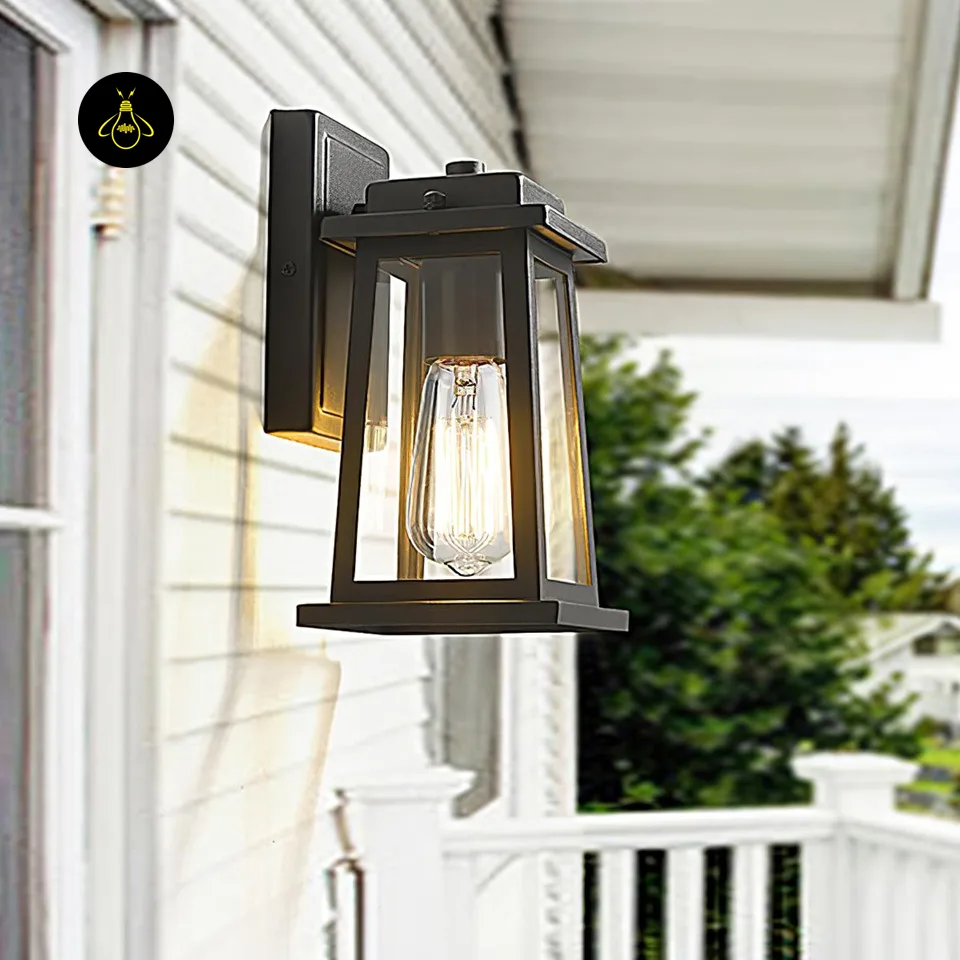
| Main door | Outdoor wall lantern, E27 holder | 1, beside the door | 28 cm tall, fixed 150–170 cm above the floor |
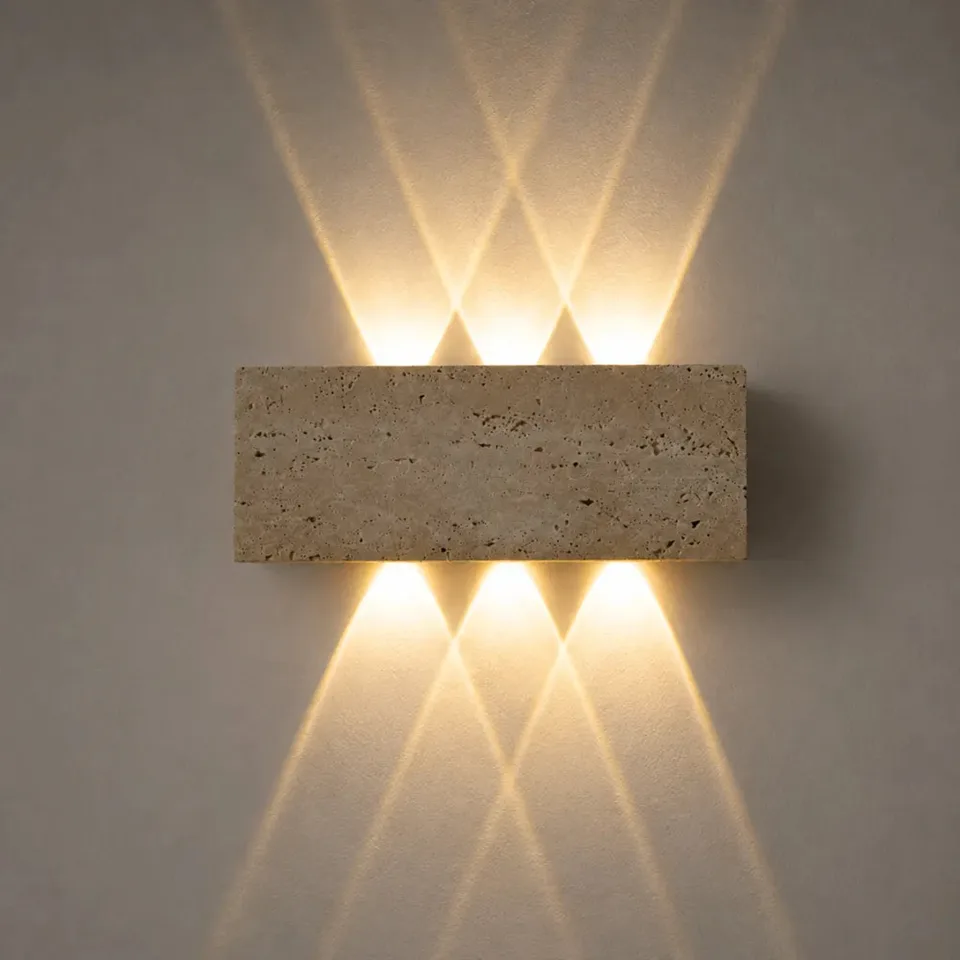
| Compound wall | Travertine up and down light, built-in LED | 2, one per wall run | 22 cm wide, sits 5 cm off the wall |
| Balcony | Outdoor wall lantern, E27 holder | 1 | 28 cm tall, same 150–170 cm band |
Add the column: 2 + 1 + 2 + 1 = 6 lights for the whole front. The heights come from each product’s own fitting note, not from a general rule. The two lanterns are sold without a bulb; fit a 3000K warm-white LED.
Gate. One light on each pillar, matched as a pair, tells a visitor where to walk. The 70 cm alabaster light suits a pillar. The stone glows from inside, so the eye meets a soft panel, not a bare bulb. Our gate lights guide covers pillar sizes in more detail.
Main door. The door should be the brightest point of the front, because that is where people stop, find keys and look at faces. Studio Matrx calls downlight from a porch soffit “the safest, glare-free way to light an entrance”. The lantern beside the door adds a visible glow and a warm pool on the step. For a wide double door, a pair of our tall alabaster sconces (94 cm, fixed 180–200 cm up) frames it instead.
Compound wall. Each 3.07 m run gets one up and down light at its centre. 3.07 ÷ 2 = 1.54 m from each end. The 1.54 m spacing is this house’s own choice, not a standard. The light sends three beams up and three down, so the wall itself glows and nothing points at the road. Rust is the worry on a boundary wall, and our compound wall light guide shows what 20 listings say about it.
Balcony. One warm lantern on the back wall is enough to sit out with tea. Festive strings belong to Diwali, and our balcony lights guide covers the rest.
Why six small lights beat one floodlight
Light spreads out as it travels. The inverse square law says the light landing on each square metre at 2 m is one fourth of what lands at 1 m. Double the distance and you get a quarter of the light.
Now work it out for the front of our house:
- A floodlight on the house lights the gate path 4 m away. You want the same light 8 m away, at the road.
- The distance doubles: 8 ÷ 4 = 2.
- The light per square metre falls by 2 × 2 = 4 times.
- So the floodlight must be 4 times stronger to light the road as well as the path.
A source that strong glares into every passing driver’s eyes and your neighbour’s window. Six low lights, each close to what it lights, need far less output and keep the bulb out of view. The glare rule and the physics point the same way.
Which rain rating each spot needs
An IP rating is two numbers for how well a light keeps out dust and water. IP65 means sealed against dust and against jets of water, like rain blown sideways in the monsoon.
- Walls open to rain: IP65 or higher, says the Studio Matrx guide.
- A deep chajja or porch soffit, which stops most rain but not blown rain: IP44 to IP54.
- A covered verandah or balcony ceiling: IP44.
Our house needs IP65 at the gate and the compound wall, where rain hits directly. We counted our own outdoor range on 22 November 2026. All 9 of our 9 outdoor lights are rated IP65. Any of them can go in any of the four zones. Four of the 9 use alabaster, two use glass and one uses travertine.
Warm or white light outside?
Colour temperature, measured in kelvin, tells you whether white light looks yellow like a diya or blue like noon sky. Studio Matrx advises “warm white, 2700K to 3000K” for a home and warns that “cool 4000K+ light on a house facade looks like a car park.”
Every built-in LED we make is 3000K, and we suggest a 3000K bulb for every holder. Our warm white vs cool white guide explains the difference indoors too.
Rust, wiring and safety
The frame decides whether a light rusts. Our outdoor lights use 304 stainless steel for their steel parts, and that steel carries a lifetime rust warranty. A built-in LED carries 1 year, for orders from 4 October 2026 (see our legal policies). Our monsoon rust guide explains why.
Wiring matters as much as the light. An outdoor wiring guide from Vinayak Electricals advises a 30 mA RCCB and an MCB on every outdoor lighting circuit. An RCCB is a switch that cuts the power when current leaks to earth. Keep every joint in a sealed junction box, and let a licensed electrician do the fixed wiring. We help free on a video call while you install.
The JagMag way to light a house front
Nature gives the stone: alabaster and travertine form in the earth over ages, and no two pieces share the same veins. Our craftsmen cut and hone each piece by hand in our own factory in India, where we have made lights since 2015. Each alabaster panel then sits in a 304 stainless steel frame that will not rust. Light then does the rest, turning a plain front wall into a warm welcome. In Vastu thinking, a well-lit entrance invites people in; we see it simply as a calm, safe way home.
Nature gives the material. Human hands give it meaning. Vastu inspires harmony. Light brings it to life. That is JagMag.
See all our outdoor wall lights, with free shipping across India and custom sizes in 15–20 working days. Not sure what your house needs? Video-call us with a photo of your gate.