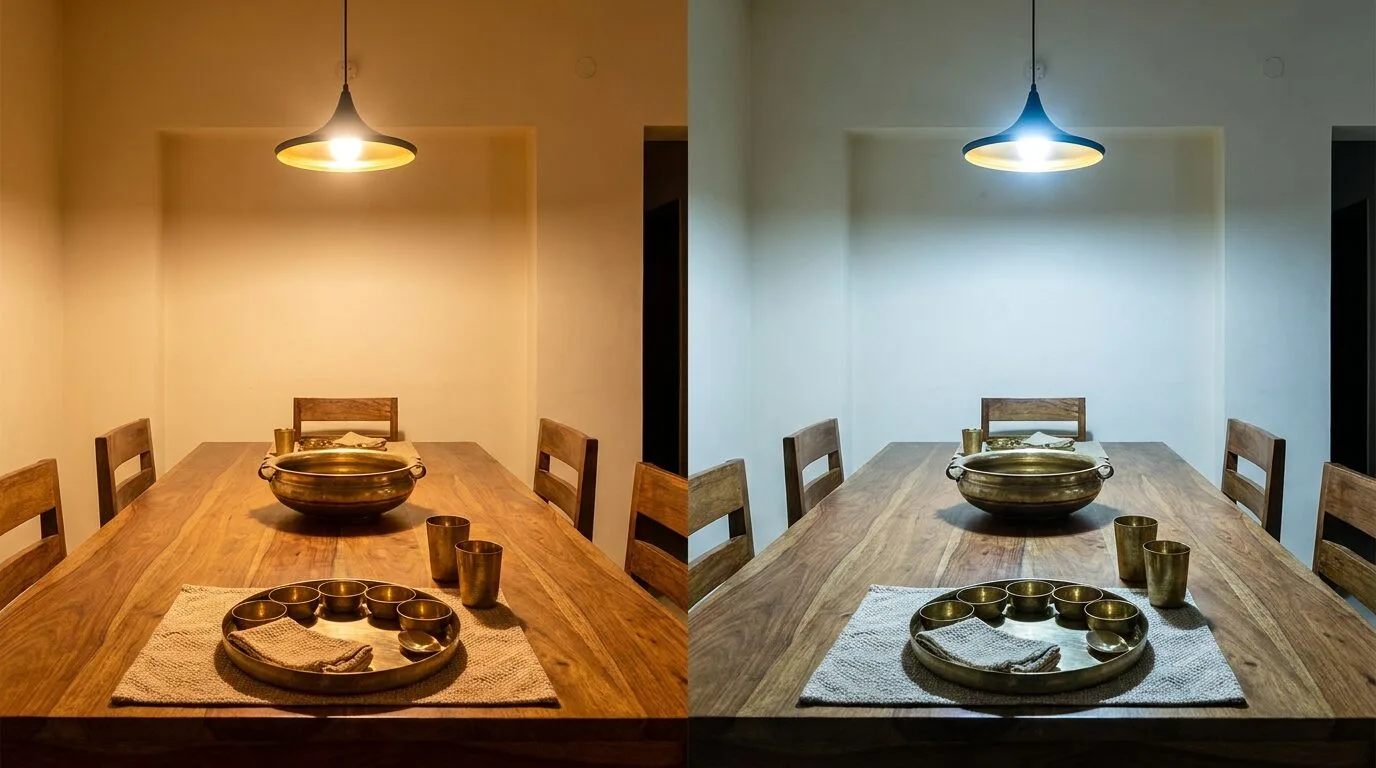
Your family sits down to dinner at 9 at night. The new LED above the table is bright and white, like a shop counter. The dal looks grey. Nobody stays at the table after the meal.
You go to buy another bulb. One box says “cool daylight”. The next box says “6500K”. A third box says only “white”.
Warm white vs cool white is one of the simplest choices in lighting. The labels make it look hard. The price of a wrong pick is every evening under the wrong light.
Below, you will see what the numbers mean, what 28 bulb listings sold, and why every built-in LED we make is 3000K warm white.
The short answer
For a home in the evening, choose warm white: about 3000K on the box. Cool white, around 6500K, looks blue, and blue light at night can hold back the body’s sleep signal. Of 28 LED bulb listings we read on 24 October 2026, 16 sold cool white and only 2 sold warm white alone.
What is really going on: warm white vs cool white
By the numbers
- Light colour is measured in Kelvin (K). Higher numbers look cooler and bluer.
- In a 6.5-hour test, blue light moved the body clock by 3 hours; green light moved the body clock by 1.5 hours.
- In 2016, a US doctors’ association advised 3000K street LEDs over 4000K ones.
- India gave out about 37 crore LED bulbs under the UJALA scheme by March 2025.
- Of 28 LED bulb listings we read on 24 October 2026, only 1 gave a Kelvin number.
- 111 of our 115 lights with a built-in LED state 3000K on the page.
Kelvin is a number for the colour of white light. A low number, like 3000K, looks warm and a little yellow, like an old bulb. A high number, like 6500K, looks cool and blue, like the sky at noon.
The US Department of Energy puts the rule in one line: higher K numbers look bluer, and lower K numbers look warmer. Warm white is the light most like the old yellow bulb your parents used.
The evening is where the colour matters most. Harvard Health reports a test where people sat for 6.5 hours under blue light or green light. Blue light kept melatonin, the body’s sleep signal, down about twice as long.
Blue light also moved the body clock by 3 hours, against 1.5 hours for green light. 3 ÷ 1.5 = 2, so blue light pushed the clock twice as far.
Doctors made a similar call for streets. In 2016, the American Medical Association asked cities to choose warmer 3000K LEDs over harsher 4000K ones.
India moved to LED bulbs fast. Government figures from March 2025 show that UJALA had given out about 37 crore LED bulbs. Those bulbs save about 48 billion units of power a year. 48 billion units ÷ 37 crore bulbs is about 130 units saved per bulb each year.
Saving power is a real win. The colour on the box still decides how your evening feels.
How to check it yourself
- Look for the K number on the box or listing. Warm white is around 3000K; cool daylight is around 6500K.
- If the box says only “white”, ask for the K number before you pay.
- Read the colour words. “Cool white” and “cool daylight” are the blue-white kinds.
- Match the room. Use warm white in the bedroom, living room and dining room; use cool white where you read or chop food.
- For a light with a bulb holder, buy the bulb in the K number the maker gives. Our pages say 3000K.
We read 28 LED bulb listings on IndiaMART on 24 October 2026. 16 sold cool white or cool daylight, which is 57%. 5 sold natural white, 2 sold warm white only, and 2 offered more than one colour. Only 1 of the 28 gave a Kelvin number.

Side by side
| What you care about | JagMag lights | LED bulb listings (28 read) |
|---|---|---|
| Light colour | 3000K warm white | Cool white on 16 of 28 |
| Kelvin number on the page | 354 of 410 products | 1 of 28 |
| Warm white | 111 of 115 built-in LEDs say 3000K | Warm white only on 2 of 28 |
| Choice of colour | One colour: 3000K | More than one colour on 2 of 28 |
Where the other side is better
Cool white has its place. ENERGY STAR calls cool white good for kitchens and work spaces, and daylight good for reading. A study table or a shop counter can need that crisp light.
Bulb sellers also give you more choice. 5 of the 28 listings sold natural white, and 2 offered more than one colour. We make one colour only, 3000K, and our lights are not dimmable.
Related: rechargeable table lamp or plug-in, and what 12 battery lamp listings show.
What we do at JagMag
Our policies describe every built-in LED module we fit as 3000K warm white. Our product pages show the number on 111 of 115 such lights; the other 4 pages do not show it yet. For lights with a holder, each page tells you to fit a 3000K warm-white LED, as the bulb is not included.
Take our linen cloth pendant light. The holder is E27, and the limit is 60 W. We suggest a 6–8 W LED at 3000K. The linen glows warm, and the bulb runs far cooler than an old 60 W one.
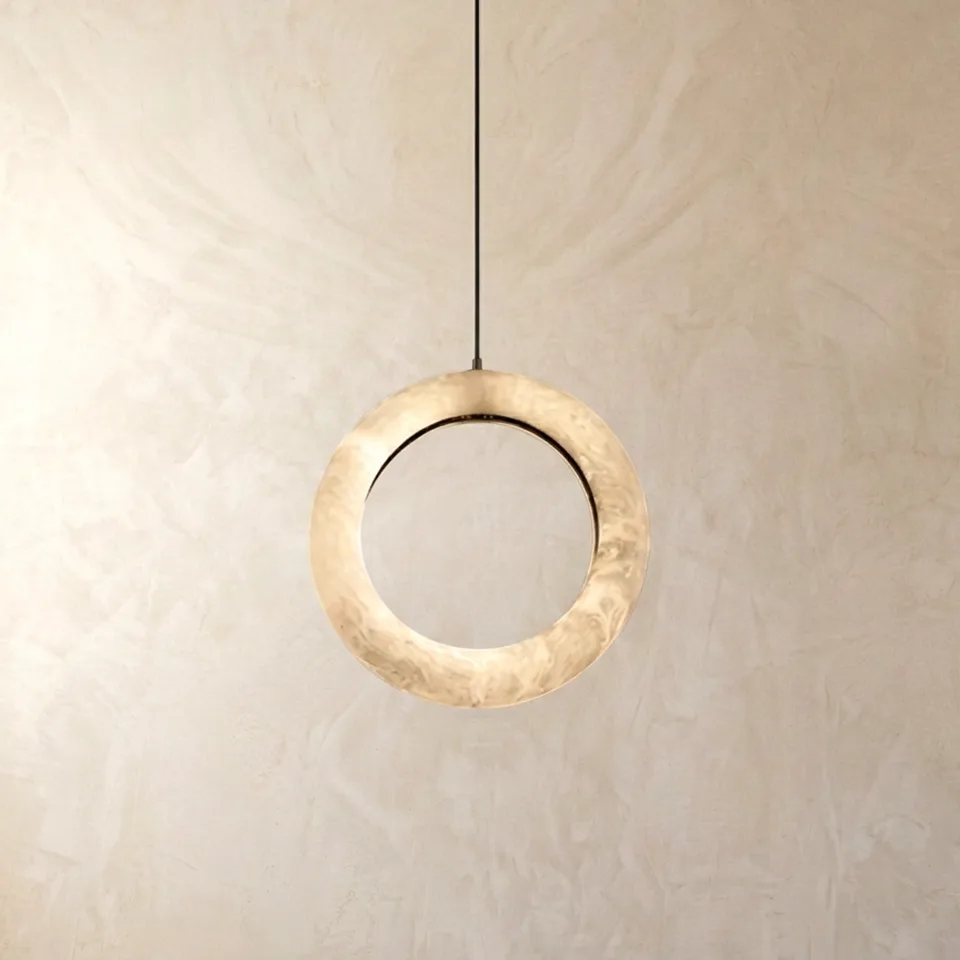
Our alabaster ring pendant light shows why. The ring is natural alabaster, 20 cm across and 20 cm tall. Our craftsmen cut, carve and polish the stone by hand in our Greater Noida factory. A 12 W built-in LED at 3000K makes the stone glow from inside, and the light weighs 3 kg.
The built-in LED carries a 1-year warranty, and every stainless steel part carries a lifetime warranty against rust, on orders from 4 October 2026. Both are written in our legal policies. We have made lights in our own factory since 2015.
Warm light and natural stone together make the calm, grounded room that Vastu thinking has always valued. Our Vastu lighting tips go further.
Shopping now? Want that 3000K glow at sofa height? See our table lamps for living room.
FAQs
Warm white vs cool white: which is better for a home?
Warm white, about 3000K, suits most rooms in the evening; cool white suits kitchens, desks and work areas. Warm white is the usual pick for most indoor rooms.
What does 3000K mean on a bulb box?
3000K is the colour of the light on the Kelvin scale, and it means warm white. Higher numbers, such as 6500K, look cooler and bluer.
Is cool white light bad for sleep?
Blue-rich light late at night can shift your body clock. In one test, blue light moved the body clock by 3 hours, against 1.5 hours for green light.
How many LED bulbs sold online are warm white?
In our study of 28 IndiaMART listings on 24 October 2026, only 2 sold warm white alone. 16 sold cool white or cool daylight.
Are JagMag lights dimmable?
No, none of our lights is dimmable. Built-in LEDs glow at 3000K warm white, and holder lights take a 3000K LED that you buy.
Nature gives the material. Human hands give it meaning. Light brings it to life.
See our pendant lights, the modern LED chandeliers or our bedside table lamps, all made for 3000K warm white. Fitting a bulb? Read bulb holder types and our guide to the fabric lamp shade. Still stuck on warm white vs cool white for one room? Video-call us and show us the room.
Sources
- IndiaMART, LED bulb listings (28 listings read 24 October 2026; 1 opened in full)
- IndiaMART listing: LED 30 W bulb, cool daylight (read 24 October 2026)
- Harvard Health: Blue light has a dark side (updated 24 July 2024)
- US Department of Energy: Lighting fact sheet (2021)
- ENERGY STAR: Light bulb colour guide
- NPR: AMA on bluish-white LED streetlamps (21 June 2016)
- News On AIR: 37 crore LED bulbs under UJALA (11 March 2025)