

The best living room lighting ideas start with one rule: light the room in layers, never from one bright light in the middle of the ceiling. One light overhead for the whole room. Two or three lower lights on the walls, the tables and the floor. Keep every one at 3000K warm white. That is how a hall starts to feel like a home in the evening. Picking lights for living room walls, tables and ceiling gets easy once you think in layers.
Your living room does more jobs than any other room. Guests sit here. Children do homework here. The family watches a match here, and on Diwali the whole house gathers here. One tube light cannot do all of that. Here’s how to light it well, one simple idea at a time. These hall lighting ideas work in a city flat and in a family bungalow alike.
Key takeaways
- Use three layers. Ambient light overhead, task light where you read, accent light for mood.
- Stay warm. 3000K warm white feels calm and makes skin, wood and stone look good. Cool white feels like an office.
- Light the walls, not just the floor. A lit wall makes a room look bigger and softer.
- Give each layer its own switch. Then one room can be bright for guests and quiet for a film.
Why does one ceiling light make a living room feel flat?
A single ceiling light throws light straight down. The centre of the room is bright, the corners go dark, and faces get hard shadows. It is also either on or off, with nothing in between.
Good living room lighting uses three layers instead:
- Ambient: soft light for the whole room, from a chandelier, a pendant or a ceiling light.
- Task: focused light where you read or work, from a floor lamp with a reading arm or a table lamp beside the sofa.
- Accent: a glow that shapes the room, from wall lights beside the TV, a fireplace or a piece of art.
In the evening, switch off the overhead light and keep only the low lights on. The room shrinks to a warm, close circle. That is the whole trick, and it needs no gadgets.
8 living room lighting ideas for Indian homes
1. Hang one chandelier as the centre of the room
Every living room needs one light that people notice. Over a coffee table or in the middle of the hall, a chandelier does that job. Our sputnik chandelier has 13 arms with reeded wood domes and natural alabaster balls, 70 cm across. The stone glows from inside, so the light feels warm even when the room is full.
Prefer opal glass? The brass chandelier carries eight opal borosilicate glass globes, 70 cm wide, on a brass-finish 304 stainless steel frame. For more shapes, browse our living room chandeliers, or all chandeliers.
2. Size it to the room, not to your heart
Here’s the easy rule. Add the room’s length and width in feet. The total, in inches, is a good chandelier width. A 14 × 16 ft hall suits a chandelier about 30 inches (75 cm) wide. Keep the bottom at least 7 ft (213 cm) above the floor where people walk. Our living room chandelier size guide has a full table.
3. Frame the TV wall or fireplace with a pair of wall lights
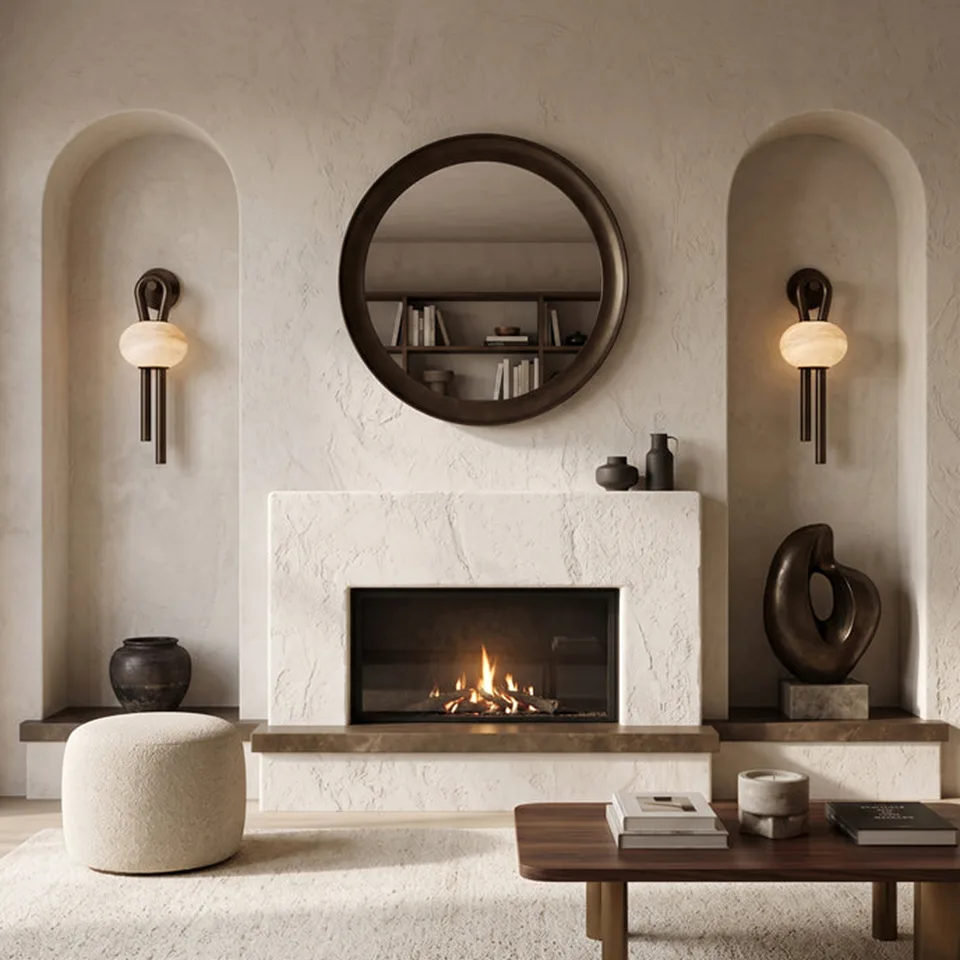
Two matched wall lights on either side of a TV unit, a fireplace or a mirror make the whole wall look planned. Fix them about 165–180 cm from the floor, so the light washes the wall and stays out of your eyes.
The oval alabaster wall light is a hand-cut pebble of natural stone in an antique bronze-finish arm, 53 cm tall, with a built-in 3000K LED. Every stone has its own veins, so no two lights match exactly. Want the light to go up and down the wall? Our up down wall light has two hand-blown opal borosilicate glass shades on a satin brass-finish frame. See all living room wall lights or our wider range of wall lights.
4. Put a floor lamp beside the reading chair
The armchair in the corner is where someone reads the paper every morning. Give it its own light. The LED floor lamp with reading light does two jobs: a ring that sends soft light up to the ceiling, and a gooseneck arm you aim at the page. It is 150 cm tall with a built-in 3000K LED.
Want a sculpture that also lights the corner? The alabaster floor lamp holds two natural stone cylinders inside a matte black oval frame, 167.5 cm tall. Browse more floor lamps for living room corners, or all floor lamps.
5. Add table lamps at sofa height
A table lamp on a side table or console puts light at eye level, where a ceiling light never reaches. That low glow is what makes a room feel lived-in. The tripod table lamp sets a dark teak wood amphora on an antique gold-finish stainless steel tripod, under a raw silk shade, 67 cm tall. Teak grows for decades before it reaches our bench, and warm light brings its grain alive.
Use a pair on a console for a formal look, or one beside the sofa for an easy one. See our table lamps for living room, or all table lamps.
6. Hang pendants over the sofa corner or the bar
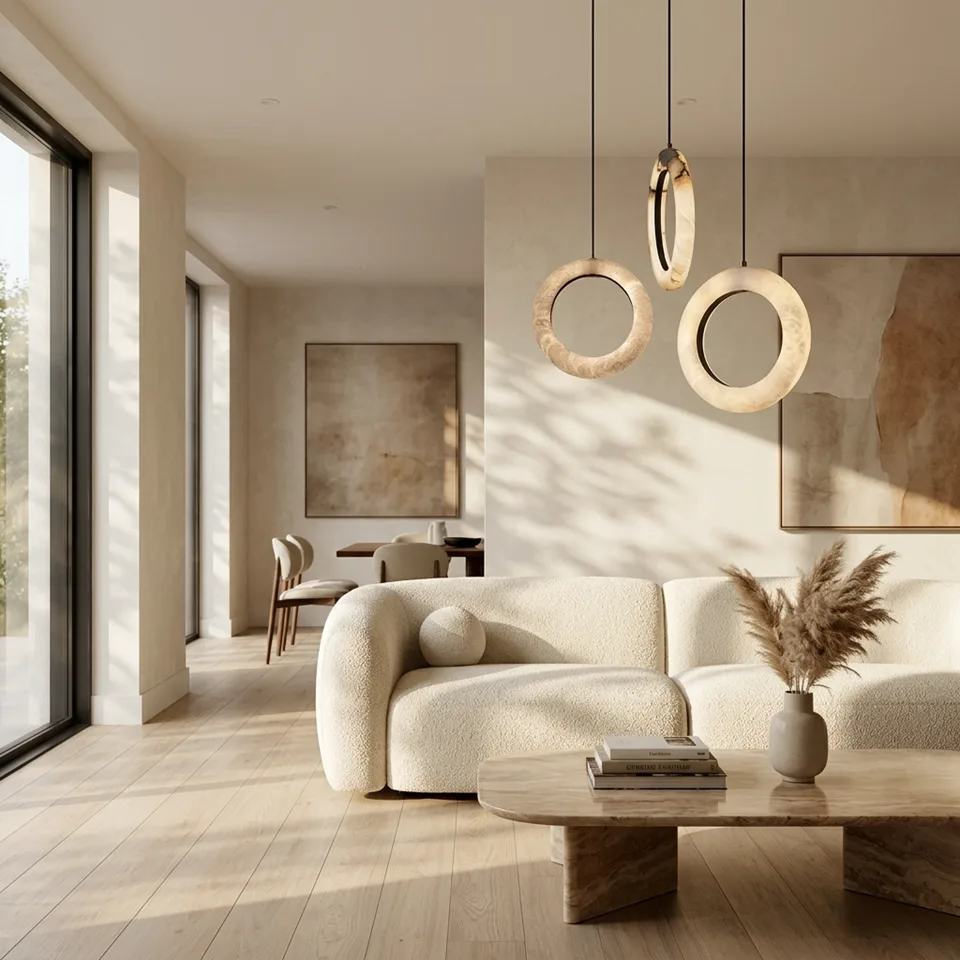
No side table for a lamp? Hang the light instead. A group of small pendants at different heights over a sofa corner, a bar counter or a window seat looks like art, even when it is off. The alabaster ring pendant light is a thick ring of natural stone, 20 cm across, lit from inside by a built-in 12W LED at 3000K. Hang three at staggered drops for the look above. Browse our hanging lights for living room spaces, or all hanging lights.
7. Keep every light at 3000K warm white
Mixing colours is the most common mistake in Indian halls: a cool white tube light, a yellow lamp and a blue-white LED strip all in one room. The room looks patchy. Pick 3000K warm white for every layer. All our built-in LEDs are 3000K, and our lights with a bulb holder come without a bulb, so fit a 3000K warm-white LED in each. Our lights are not dimmable, so the layers and switches do the job a dimmer would.
8. Choose materials that soften the light
Natural materials change light before it reaches your eyes. Alabaster glows from inside. Opal borosilicate glass turns a bulb into a soft ball of light. Teak and rattan warm it up. Linen and silk spread it evenly. In a living room where people sit for hours, that softness matters more than raw brightness.
It also fits Vastu thinking. Vastu has always valued natural materials, warm light and a space that feels balanced. We don’t promise luck from a light. We do believe stone, wood and warm light make a hall feel grounded and calm.
Hall light design: where should each light go?
| Light | Where to fit it |
|---|---|
| Chandelier or ceiling light | Centred over the seating or coffee table; bottom at least 7 ft (213 cm) above the floor |
| Wall lights | In pairs, 165–180 cm from the floor, either side of the TV, fireplace, mirror or art |
| Floor lamp | Beside the reading chair, behind the shoulder of the person reading |
| Table lamp | On a side table or console; shade bottom at eye level when seated |
| Pendants | Over a sofa corner or bar counter; bottom 75–90 cm above a counter, or above head height where people walk |
Lighting a hall with a low ceiling? Our guide to ceiling light for hall choices compares flush, semi-flush and chandelier options. For more wall ideas, see wall lights for living room looks.
Why buy living room lights from JagMag?
Because we make them. Every light is made in our own Greater Noida factory, where we have been making lights since 2015. Every metal part is 304-grade stainless steel with a lifetime warranty against rust, on orders from 4 October 2026. Custom sizes and finishes take 15–20 working days; importers take 60–120. Free shipping across India, EMI available, and spares for 10+ years.
FAQs
What are the best living room lighting ideas for an Indian home?
Use three layers: one chandelier or ceiling light for the whole room, a floor or table lamp where you read, and a pair of wall lights for mood. Keep them all at 3000K warm white, each on its own switch.
How many lights does a living room need?
Usually four to six. One overhead light, a pair of wall lights, and one or two lamps cover most 12 × 14 ft to 16 × 20 ft halls.
Which colour light is best for a living room?
3000K warm white. It makes faces, wood and stone look natural and keeps the room calm in the evening. Avoid cool white in a living room.
Which modern lights for living room spaces look good when switched off?
Lights made of real materials: alabaster, teak, opal borosilicate glass or rattan. They look like decor in the day and glow at night.
How high should wall lights be in a hall?
About 165–180 cm from the floor, in pairs. At that height the light washes the wall without shining into the eyes of people on the sofa.
What lighting works in a small living room?
Move light off the floor. Wall lights, one semi-flush ceiling light and a slim floor lamp in a corner keep the floor clear, so the room feels bigger.
Ready to light your living room? Start with the one light everyone will notice: browse living room chandeliers, or ask us on WhatsApp and we’ll help you plan the whole room.