Cane lights make a room feel calm before you switch them on. Switch them on and the weave throws its pattern across your ceiling and walls. The best cane lights for an Indian home use real handwoven cane or rattan, a warm 3000K bulb, and a 304-grade stainless steel frame that never rusts. Pick the shape for the room. Let the weave do the rest.
Rattan is a climbing palm that grows in tropical forests, including India’s north-east. Its stem is cut, dried, steamed and bent. Its outer skin is peeled into thin strips of cane. Then a pair of hands weaves it, row by row, for hours. No machine does this part. That is why no two shades are exactly the same, and why the light coming through them feels so alive.
Key takeaways
- Real fibre only. Every shade here is real cane or rattan, woven by hand. Never a plastic weave printed to look like it.
- Cane and rattan are one plant. Rattan is the whole stem. Cane is its peeled skin, woven into that open, hexagon pattern.
- Warm light suits the weave. A 3000K warm-white LED makes the fibre glow honey-gold. Cool white makes it look dry and grey.
- Keep it indoors. Our cane and rattan lights are IP20 indoor lights. They belong in dry rooms, not on an open balcony.
Cane or rattan: what is the difference?
People use the two words for the same lights, and that is mostly fair. They come from one plant.
Rattan is the round stem of the palm. Steamed and bent, it makes the ribs, rings and rods of a shade. Our rattan sunburst pendant light is built this way: open rattan rods fanned into two stepped rings, 60 cm across.
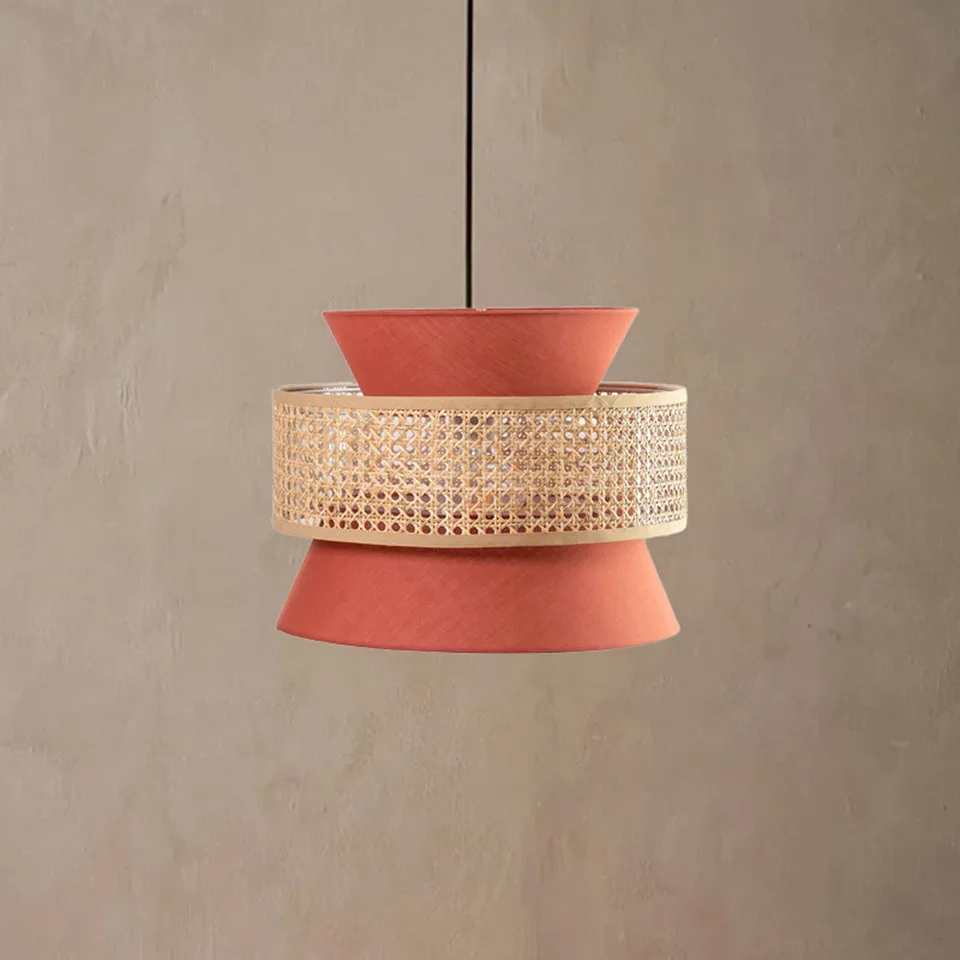
Cane is the glossy outer skin, peeled into flat strips. Woven tight, it becomes the classic cane webbing you know from old Indian chairs and charpais. Our cane hanging lights wrap a band of that webbing between two cotton cones, 45 cm wide.
And wicker? Wicker is not a material. It is the weaving itself. A wicker lamp can be woven from rattan, cane, bamboo or another natural fibre. So when you search for a cane lamp, a rattan lamp or a wicker lamp, you are really asking the same question: which handwoven light suits my room?
Why do rattan lights feel so warm?
Here’s the thing. A glass shade lets light pass straight through. A woven shade breaks it up.
Every gap in the weave lets a little light out. Every strand holds a little back. So the room fills with soft, broken light, and the walls carry the pattern of the weave. Switch on a cane pendant at dinner and you will see it: a gentle net of shadows across the ceiling.
The fibre itself glows too. Under a 3000K warm-white LED, rattan turns honey-gold. That is why we never pair these shades with cool white light. It flattens the fibre and makes the room feel like an office.
Rattan lights also bring something an Indian home already knows. Cane chairs on a verandah. A jute charpai in the courtyard. A bamboo chik on the window. A handwoven light simply brings that feeling indoors, to the ceiling.
Cane pendant lights for the dining table and living room
Most of our cane lights are pendants, and for good reason. Hung above a table, a woven shade throws its pattern exactly where people sit together.
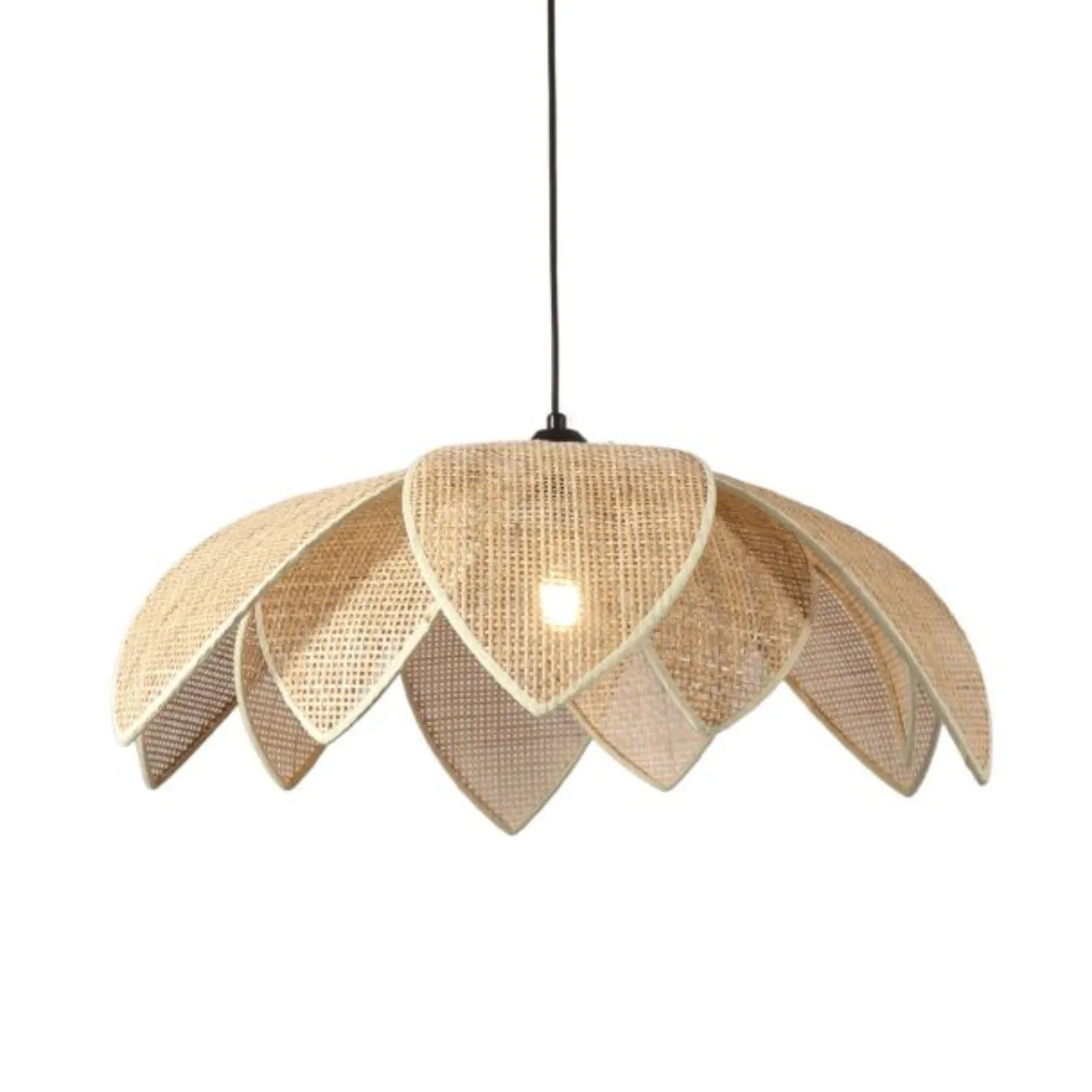
- Over the dining table: one wide shade or two smaller ones. The cane pendant light Mariella opens like a lotus, 65 cm wide, in fine cane webbing. The rattan hat pendant light is a 70 cm handwoven saucer that spreads light wide and low.
- In the living room: a round shade that glows all the way round. The rattan globe pendant light comes in 40, 50 and 60 cm. The rattan hanging lamp comes in four sizes, from 35 to 60 cm.
- For a big room or a high ceiling: the rattan ceiling light is an 80 cm woven dome with tiered shades inside it. It fills a double-height hall without feeling heavy.
- For a bedroom or a reading corner: something smaller. The rattan flower pendant light is a 30 cm bloom of cane petals. The cane frame pendant light is a low 18-inch woven ring, only 15 cm tall.
- For a calm, Japanese feel: the japanese rattan pendant light stacks woven drums 40 cm wide. The Nukano rattan pendant light has a soft, shaggy wabi-sabi weave.
- For colour with your cane: the silk pendant light stacks two cane drums with rust-red and deep-blue raw silk tiers between them, Ø 40 or 50 cm.
- For a softer colour: the pink ceiling light sets a blush-pink raw silk cone over a handwoven cane drum, Ø25 or 30 cm.
Every one of these takes an E27 bulb. The bulb is not included, so fit a 3000K warm-white LED. LEDs stay cool, which is kind to natural fibre. None of our lights is dimmable.
Quick size rule: over a dining table, choose a shade about half to two-thirds the table’s width. Hang its bottom 75–90 cm above the tabletop. In a walk-through space, keep it at least 210 cm above the floor.
Want to see them all in one place? Browse our cane and rattan pendant lights, or the full range of pendant lights.
A rattan lamp for the console or the corner
Not every room has a ceiling point where you want it. That is where a rattan lamp helps. Plug it in, and the weave glows at eye level.
Our rattan table lamp Milos is a tall piece: 105 cm overall, with a woven wicker shade 60.5 cm high on a sculptural travertine base. Stone below, fibre above. Put it beside a sofa, at the end of a console or in an empty corner of the living room, and that corner comes alive in the evening.
Prefer wood with your weave? See our wooden and rattan table lamps, or the full range of table lamps.

What about bamboo lights?
Bamboo is a grass, not a palm, but it sits in the same natural-fibre family. Split into rods or thin strips, it weaves into large, airy shades.
The bamboo hanging light is a 60 cm woven dome for a kitchen or dining table. The bamboo pendant light is a 109 cm (43-inch) flared shade of bamboo rods that throws striped shadows across a room. If you like rattan, you will probably like these too.
Straw is a grass too. Shopping now? Our straw lamp is a 48 cm wavy pendant of hand-woven natural grass fibre, made for a round dining table.
Which cane light suits which room?
| Room | Good choice | Why it works |
|---|---|---|
| Dining room | A wide cane or rattan pendant, 50–70 cm | The pattern falls on the table, where the family sits |
| Living room | A rattan globe pendant, or a tall rattan lamp in a corner | Soft light all round, no glare in the eyes |
| Double-height hall | An 80 cm woven dome or a large bamboo shade | Fills the volume without looking heavy |
| Bedroom | A small cane pendant, 30–45 cm, beside or above the bed | A quiet glow for the end of the day |
| Kitchen island | Two or three smaller woven pendants in a row | Even light along the counter, warm look |
Will cane crack, fade or get hot?
Mostly no, if you treat it like the natural fibre it is. Here is the honest answer.
- Heat: use an LED bulb. A 3000K LED runs cool, so it will not scorch the weave. Avoid old incandescent bulbs inside a tight cane shade.
- Moisture: keep it in a dry room. Cane can take normal Indian humidity indoors, but not steam, rain or a wet balcony. These are IP20 indoor lights.
- Colour: natural cane slowly deepens towards honey over the years. That is the fibre ageing, not a fault. Keep it out of harsh direct sun to slow it.
- Cleaning: switch off, then dust with a soft dry brush or a hair dryer on cool. Never soak it.
- Metal parts: the canopy, holder and frame are 304-grade stainless steel, with a lifetime warranty against rust on those stainless parts (orders from 4 October 2026).
Natural fibre, warm light and Vastu
Vastu looks at how a space, its elements and its light shape the way we live in it. A woven shade brings a plant-grown material into the room. Warm 3000K light brings the gentle side of fire, the element of light. Together they make a room feel grounded and calm, the kind of harmony Vastu has always valued.
We don’t promise luck or wealth from a lamp. We believe a room with natural materials and warm, soft light simply feels better to come home to.
Why buy cane lights from a maker
We are a manufacturer, not a trader. We make our lights in our own Greater Noida factory, and have done since 2015.
- Fast: in-stock lights leave within 4 working days. Made-to-order pieces take 12–15 working days. A custom size or finish takes 15–20 days. Importers usually take 60–120.
- Built to stay: 304-grade stainless steel parts that never rust, and spares for 10+ years.
- Easy to buy: free shipping across India, and EMI on eligible cards.
- Checked: CE, UL and ZED certified. DPIIT-recognised.
Love natural materials? Our guide to wooden lights covers teak, walnut and oak, and our dining room lighting ideas show where a woven pendant fits best.
FAQs
Are cane lights good for Indian homes?
Yes, indoors. Cane handles normal Indian humidity well in a dry room, and its warm, woven look suits Indian interiors. Keep it away from steam, rain and harsh direct sun.
What is the difference between a cane lamp and a rattan lamp?
They come from the same plant. Rattan is the whole palm stem, used for ribs and rods; cane is its peeled outer skin, woven into flat webbing. Many lights use both.
Which bulb should I use in a rattan light?
A 3000K warm-white E27 LED. The bulb is not included. LEDs stay cool, which protects the fibre, and warm white makes the weave glow honey-gold. Our lights are not dimmable.
Can I use a wicker lamp outdoors?
No. Our cane, rattan and wicker lights are IP20 indoor lights. For a verandah or gate, choose one of our IP65 outdoor lights instead.
Can you make a cane light in a custom size?
Yes. A custom size or finish takes 15–20 working days from our Greater Noida factory. Importers usually take 60–120 days. Ask us on WhatsApp with your room size.
Ready to bring a handwoven light home? Shop cane and rattan pendant lights.