Natural fibres are long, thin threads and strips that grow in nature. Our lights mostly use plant fibres, and bamboo, cane, rattan and jute are the four we use most. Today 22 of our 453 lights have a shade of plant strips, rods or rope, and 16 of them use these four.
In the last post we wrote about natural wood. A tree takes many years to grow its grain. The plants in this post grow much faster.
Natural fibres come from grasses, palms and plant stems. Wood reaches our bench as a solid block. Natural fibres reach us as long strips, rods and threads.
In this post we explain where each fibre comes from. We show how our craftsmen weave it by hand, and what light does with a woven shade. Nature gives the material, and human hands shape it. Plant fibres follow that idea from our story very closely.
Four plant fibres, four ways of growing
Bamboo is a grass. Some kinds of bamboo grow close to a metre in one day. A new bamboo stem reaches its full height in one season of three to four months.
Rattan is a climbing palm from tropical forests. Its stem is long and thin, and stays almost the same width from end to end. Cane comes from the same plant. Cane is the thin outer skin of the rattan stem, peeled off in strips.
Jute is a tall plant grown in the monsoon. Its fibre lies just under the skin of the stem. Farmers soak the stems in water until the fibre comes loose, and then strip it out. India grows more jute than any other country, much of it in West Bengal.
Each plant grows in its own way. So each fibre reaches us in its own form: a strip, a skin, a rod or a rope.
Our craftsmen weave every row by hand
A loose fibre has no shape of its own. A person has to give it one. We do that work in our own factory.
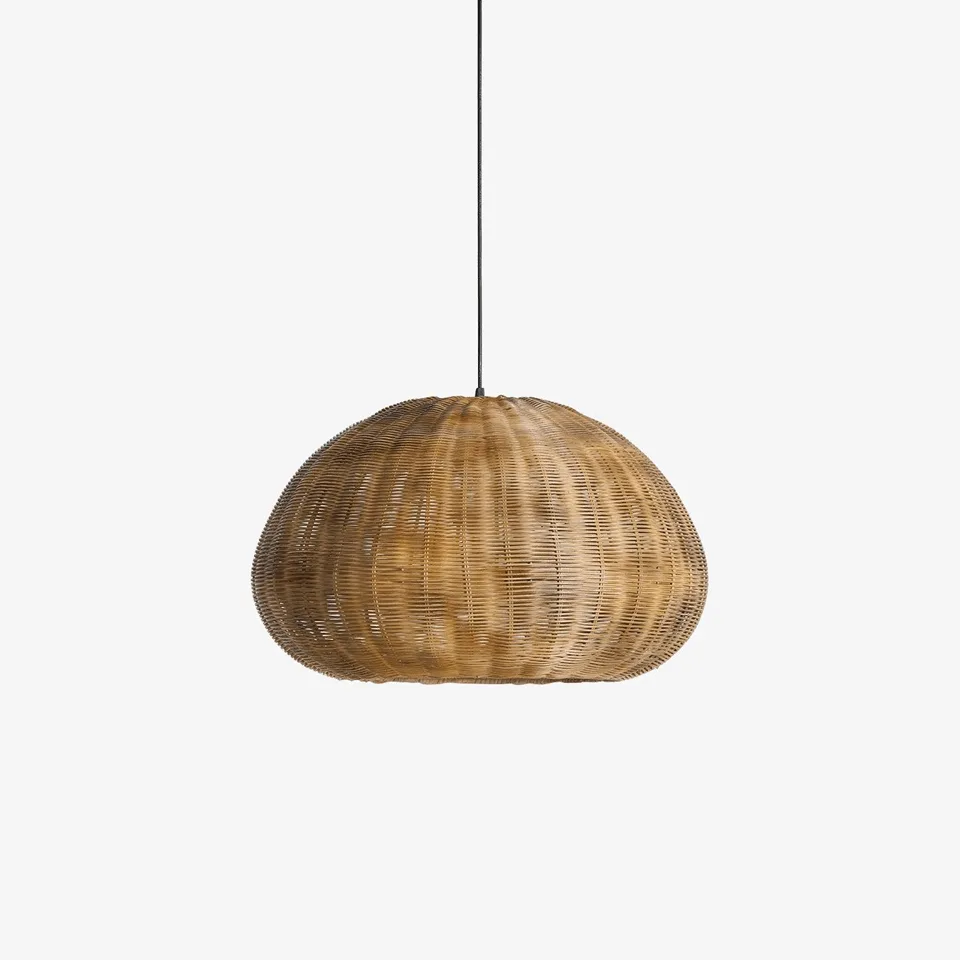
For our bamboo hanging light, a craftsman splits bamboo into thin strips. He weaves the strips, row by row, over the ribs of a 60 cm dome. He pulls each row tight by hand. We leave the bamboo in its own honey-tan colour, with no dye and no coating.
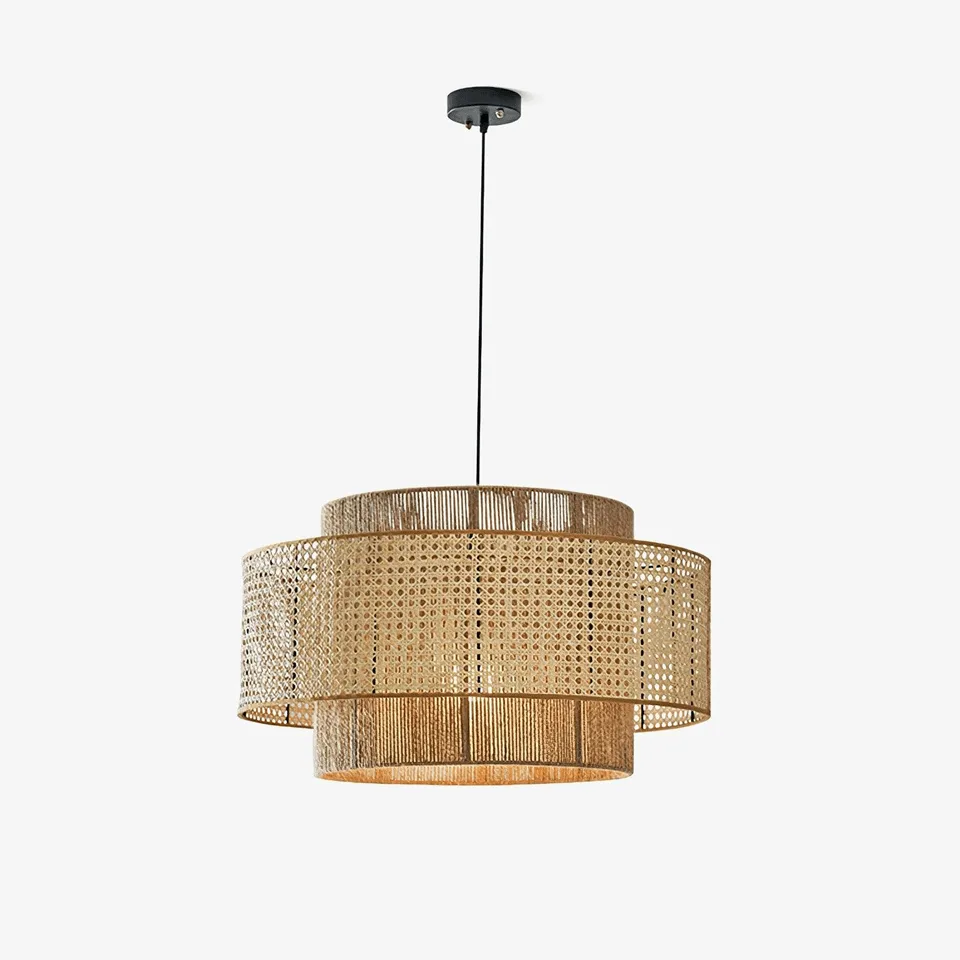
For our Mariella cane pendant light, he weaves cane into an open webbing. He cuts each petal from the webbing, curves it and binds its edge. Then he sets the petals, one tier over the other, into a 65 cm lotus. One shade is enough for a dining table up to 180 cm long.
Our Japanese rattan pendant light brings two fibres together. A cane drum sits between two drums of natural jute rope. The jute is wound around its ring strand by strand.
No machine does this weaving. A pair of hands pulls every row, so every shade carries small changes. Patient human effort holds each one together.
The weave lets light through and draws on your walls
A solid shade hides the bulb. A woven shade lets the light out through hundreds of small gaps. That is why woven shades suit hanging lamps so well.
Switch on a fibre light and two things happen. The fibre itself turns a warm gold. The gaps throw a pattern of light and shadow across your ceiling and walls.
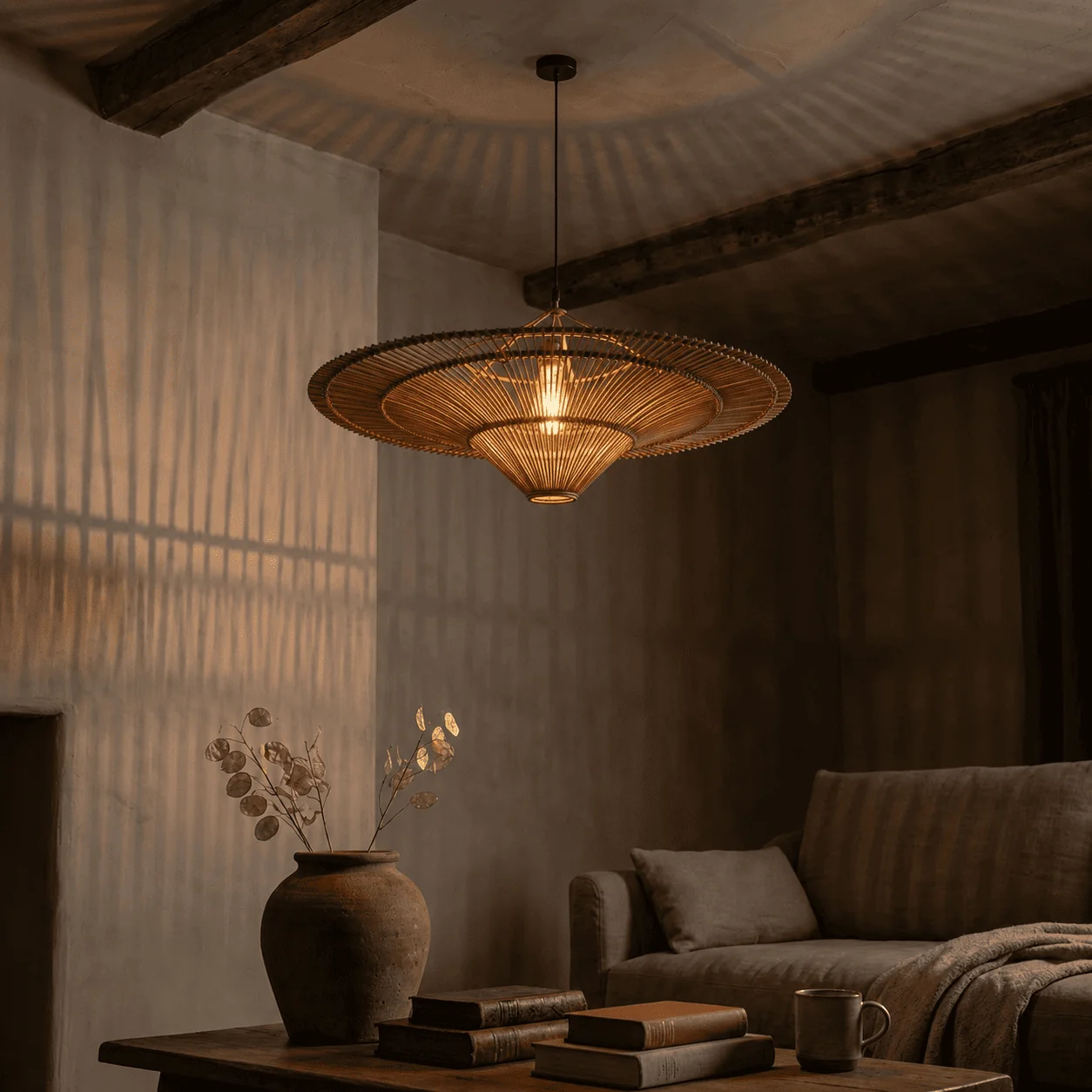
Each weave draws its own pattern. Our rattan sunburst pendant light uses hundreds of thin rattan rods, set side by side and bound by hand. Its light comes out in long stripes, like rays. The bamboo dome gives a soft, dappled light. The cane lotus throws overlapping petal shadows.
We suggest a 3000K warm-white LED for every fibre shade. Warm light keeps the honey colour of the fibre true.
We use real natural fibres, never a plastic copy
Today 16 lights in our catalogue use bamboo, cane, rattan or jute. Every one of them uses the real plant fibre. Fifteen are pendant lights, from 25 cm to 109 cm wide. The other is our tall Milos table lamp, with a woven rattan shade on a travertine base.
Plastic strips made to look like rattan are easy to find. We do not use them. A plastic strip looks the same on every shade. A real fibre changes a little in tone and thickness from strip to strip, and light shows those changes.
Natural fibres also keep a room close to nature. Vastu thinking values that closeness. We take it as inspiration, not as a promise.
Bamboo, cane and jute all grow from the soil. In the next post we go one step deeper, to the soil itself. We turn to terracotta and clay.
FAQs
What is the difference between cane and rattan?
Rattan is the whole stem of a climbing palm. Cane is the thin outer skin of that stem, peeled off in strips. Many of our shades use both.
What are natural fibres?
Natural fibres are threads and strips that come from plants or animals. Our shades mainly use plant fibres: bamboo, cane, rattan and jute in 16 lights, and raffia, straw, hemp or natural fibre rope in six more.
Will my woven light look exactly like the photo?
The shape and size will match the photo. The weave and tone will change a little, because a person weaves each shade from a natural fibre.
Nature gives the material.
Human hands give it meaning.
Vastu inspires harmony.
Light brings it to life.
That is JagMag.
With you.
Read next: What is terracotta? Clay from the earth, shaped into light
Bring a woven light into your room: explore our cane and rattan pendant lights →