
You see a woven pendant online. Honey colour, a soft weave, a warm glow in the photo. You order it for the dining table.
The box comes. The strands feel smooth and shiny. Every strand is the exact same colour. The shade bends like a plastic basket.
You switch it on in the evening. The glow is there, but the shade looks flat and too perfect. Your guest asks if the lamp is cane. You are not sure what to say.
You check the listing again. The page said “wicker”. The page never said what the strands were made of.
Below, you will learn how real rattan material differs from plastic rattan. You will also learn five easy checks, and when plastic is the better pick.
The short answer
Real rattan comes from a climbing palm, and the world has about 600 kinds of it. Plastic rattan is plastic strands shaped to look like that palm. For a light inside your home, pick real rattan, and read the material line before you pay.
What is really going on with rattan material
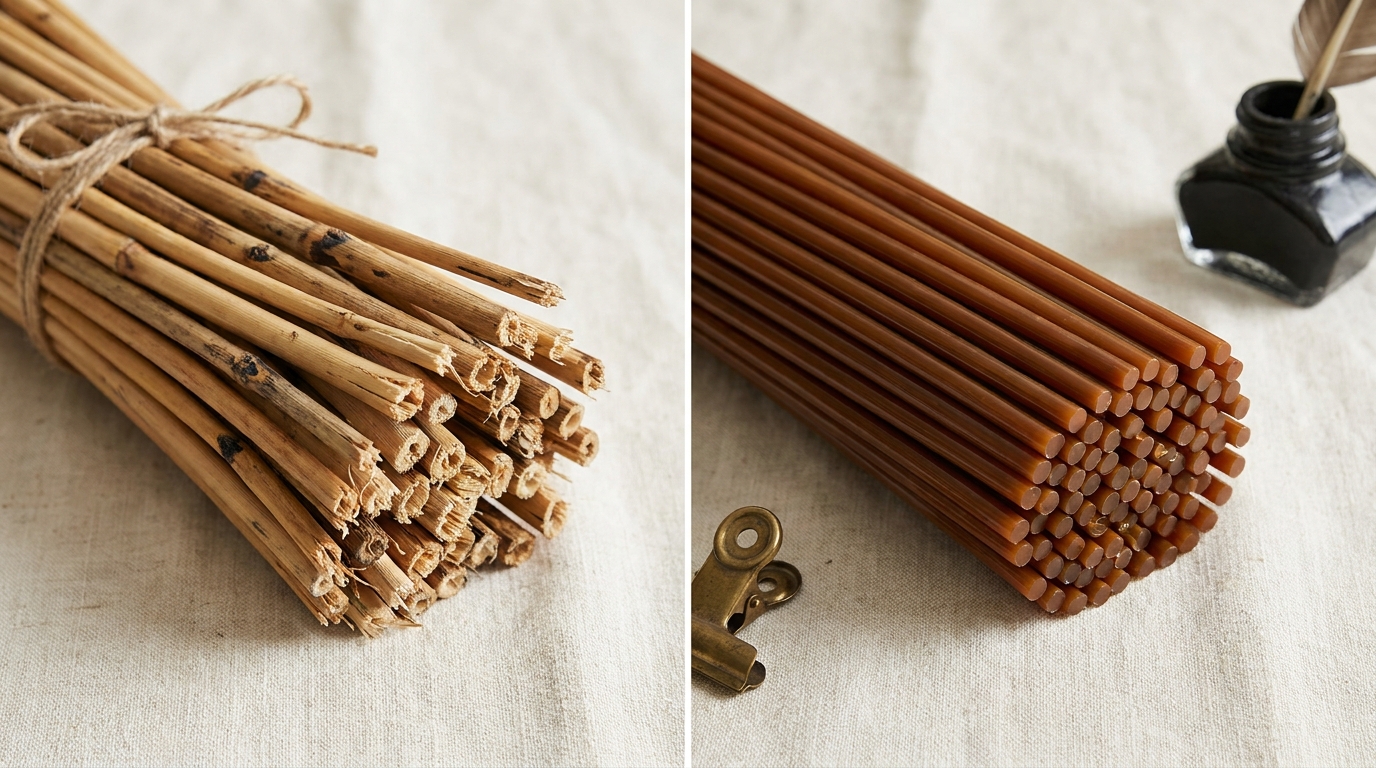
Rattan is a spiny palm that climbs up forest trees like a rope. Rattan grows in India too. Down To Earth reported that one kind grows in every district of Tamil Nadu.
Rattan also gives work to village families. Cutting, carrying and drying the stems is mostly done by hand, so the trade creates rural jobs.
Cane is the thin outer skin of the rattan stem. Workers cut the skin into long strips. Weavers use cane strips for fine, tight patterns. Rattan stems are light but strong, so the weave holds its shape over a frame.
Wicker is not a material at all. Wicker is a way of weaving. A weaver can weave rattan, cane or plastic, and all three can be called wicker.
Plastic rattan is made in a factory. Most of it is polyethylene, a plastic from the same family as many water tanks. Some is PVC, the plastic used in electrical pipes. Sellers call it synthetic rattan, poly rattan or PE rattan.
Plastic rattan was made for the garden. Water cannot get inside a plastic strand, so rain does not rot it. Real rattan soaks up damp air, so real rattan belongs indoors.
The trouble is the name on the page. Many listings say only “wicker” or “rattan style”. The Alibaba seller guide tells sellers to name the material, because the word “wicker” alone confuses buyers.
So the label will not always tell you. Your eyes and hands can.
How to check it yourself
- Read the material line: it should say “natural rattan” or “cane”, not only “wicker” or “rattan style”.
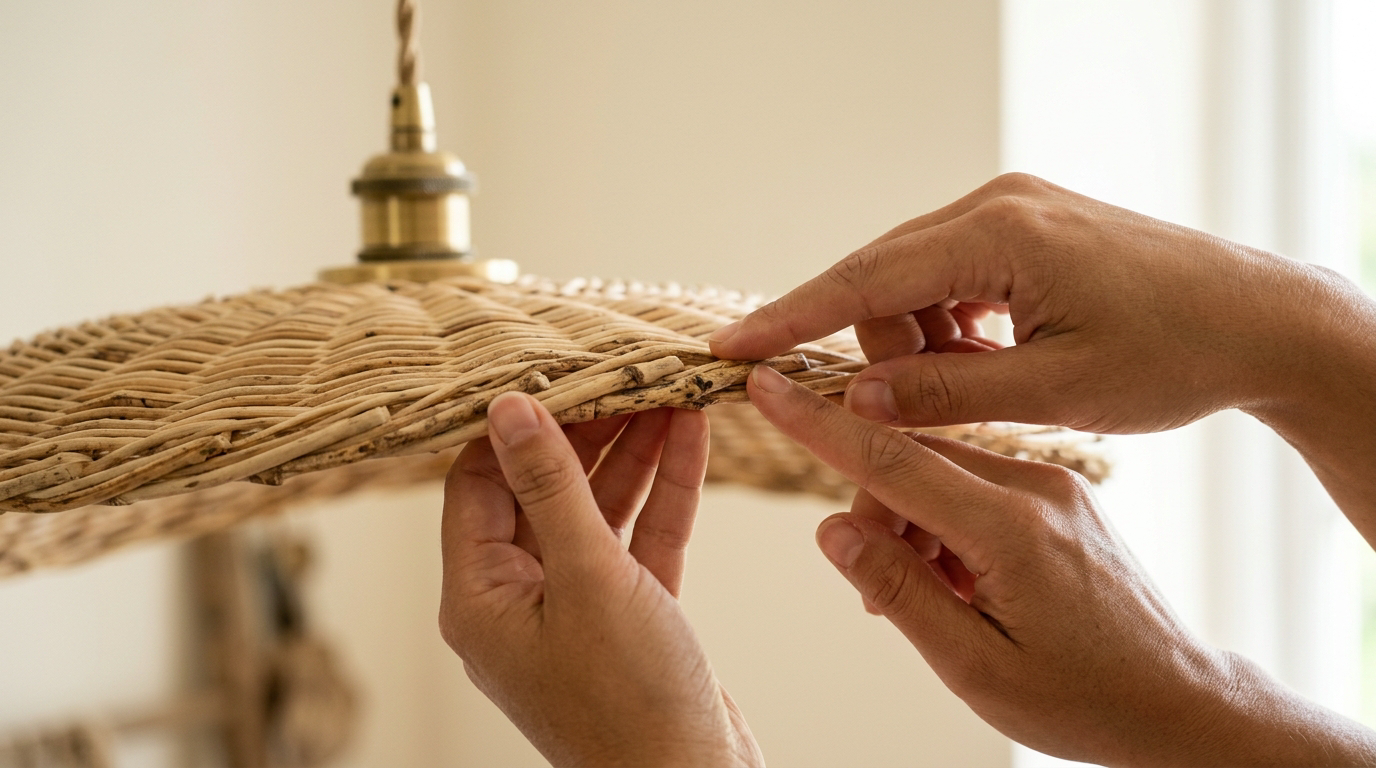
- Look close at the strands: real rattan shows small marks and gentle colour changes, while plastic looks the same everywhere.
- Touch a strand: real rattan feels dry and a little rough, while plastic feels smooth and slippery.
- Press a strand gently: real rattan bends a little and springs back, while a poor copy feels stiff or snaps.
- Ask the seller in writing what the strands are made of and what metal holds the shade.
Once you know what you are holding, the two kinds are easy to compare.
Side by side
| What you care about | JagMag cane and rattan lights | Plastic rattan lights |
|---|---|---|
| What the strands are | Natural rattan and cane | Plastic shaped like rattan |
| How it looks up close | Small marks, colour changes a little | Same colour and shine everywhere |
| Material named on the page | Yes, “natural rattan” | Sometimes only “wicker” |
| Rain and open terraces | Indoor rooms only | Made for gardens and rain |
| What holds the shade | Stainless steel that never rusts | Check the listing |
Plastic rattan does win in some places, and you should know where.
Where plastic rattan is better
Outdoors. Rain does not rot plastic rattan, because water cannot get in. Real rattan is for rooms with a roof and walls.
Strong sun. Good plastic rattan has added protection against fading in sunlight.
Spills. A splash wipes straight off a plastic strand.
Is your light going on an open terrace? Then choose plastic rattan, or a sealed light from our outdoor wall lights. Inside the home, the real plant wins.
What we do at JagMag
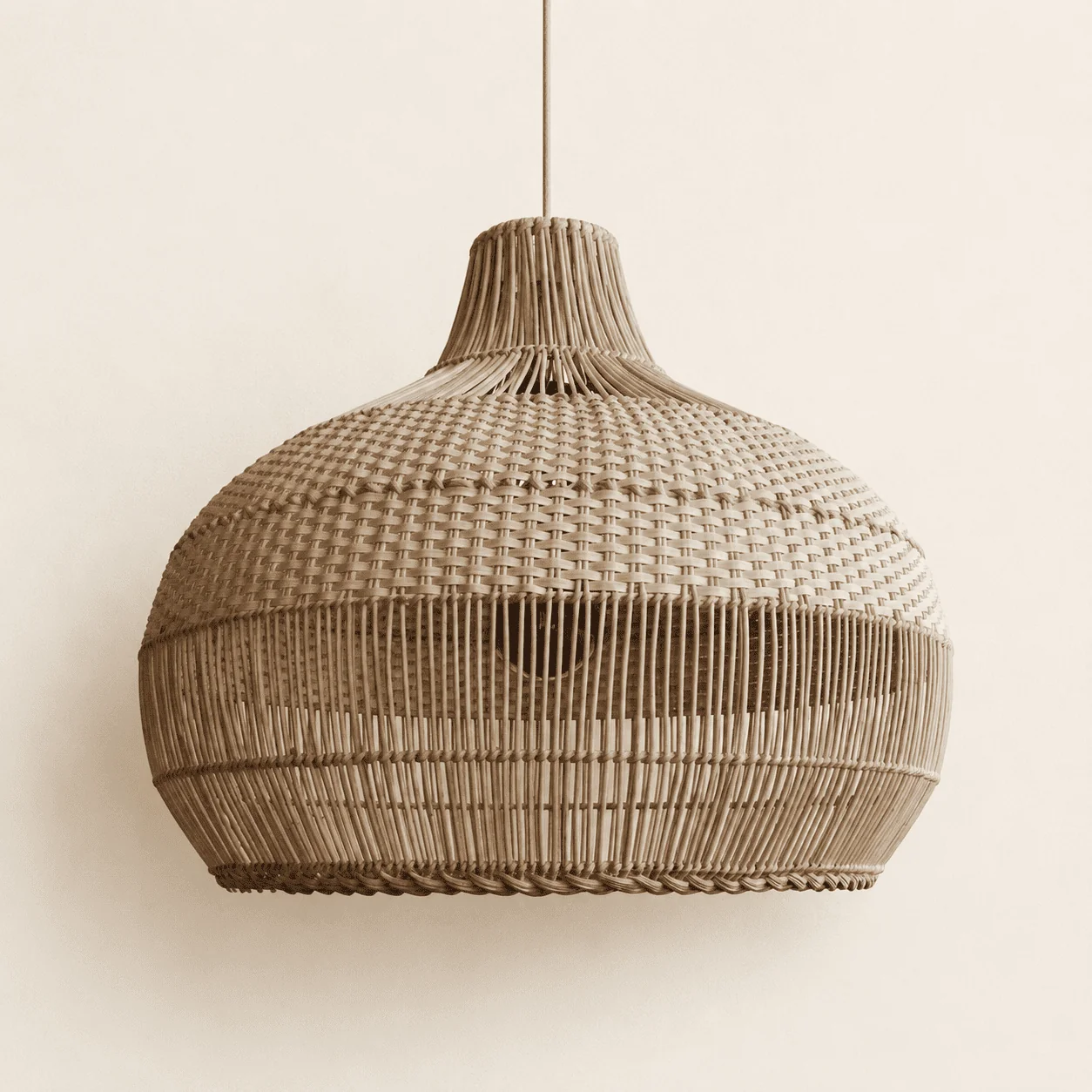
Our cane and rattan pendant lights use the real plant. The shade of our Rattan Hanging Lamp is natural rattan, woven by hand, and each lamp varies slightly.
Each shade is woven by hand over a steel frame in our own factory in Greater Noida. A weaver pulls every strand over and under with their fingers. So no two shades come out exactly the same. Rattan sits in our Fibre family of natural materials, next to jute and linen.
The frame is 304 stainless steel, the same grade as a good kitchen sink. Stainless steel does not rust. Our Legal Policies give the steel parts a lifetime warranty against rust, for orders from 4 October 2026. The paint or finish on top is not part of that warranty.
Our Rattan Hanging Light follows the same rule: natural rattan and cane on a stainless steel frame. We keep spare parts for 10 years and more.
Both lamps carry the IP20 rating, the rating for indoor rooms. Hang them in the dining room, the hall or the bedroom. Keep them away from a shower or an open window in the monsoon.
Each of these lamps takes one E27 bulb, the common screw-in kind. The bulb is not included. Fit a 3000K warm-white LED for a soft golden glow through the weave.
Natural fibre and warm light bring earth and fire into a room. Vastu thinking has always valued that kind of harmony.
Want more on picking a woven light for each room? Read our guide to cane lights and rattan lamps. Real stone has the same look-alike problem, so see our real vs faux alabaster comparison too.
FAQs
What is rattan material made of?
Rattan material comes from a spiny climbing palm that grows in tropical forests, including in India. Cane is the thin outer skin of the same palm, cut into strips for weaving.
Is synthetic rattan the same as plastic rattan?
Yes, synthetic rattan, poly rattan and PE rattan are all plastic strands shaped to look like real rattan. Most are polyethylene, and some lower grades are PVC.
Is natural rattan good for a lamp?
Yes, natural rattan is a good choice for a lamp inside your home. Light passes through the open weave and throws a soft pattern on the walls.
Can I use a rattan lamp outdoors?
No, keep a natural rattan lamp indoors, because damp air and rain harm the plant fibre. For an open terrace, choose plastic rattan or a sealed outdoor light.
How do I clean a cane or rattan light?
Switch the light off and wipe it with a cloth and a mild, pH-neutral cleaner. Never spray anything straight onto the weave.
Nature gives the material. Human hands give it meaning. Light brings it to life.
See our cane and rattan pendant lights, all woven from the real plant. Not sure which one fits your room? Talk to us on WhatsApp.
Sources
- Down To Earth: Tamil Nadu must sustainably manage its rattans (15 June 2020)
- Desser: How to identify high-quality rattan, wicker and cane
- Leisure Touch: Differences between PE, PVC and PU rattan materials
- Alibaba.com Seller Blog: Natural vs synthetic woven materials
- Beliani: Polyrattan and rattan material description