
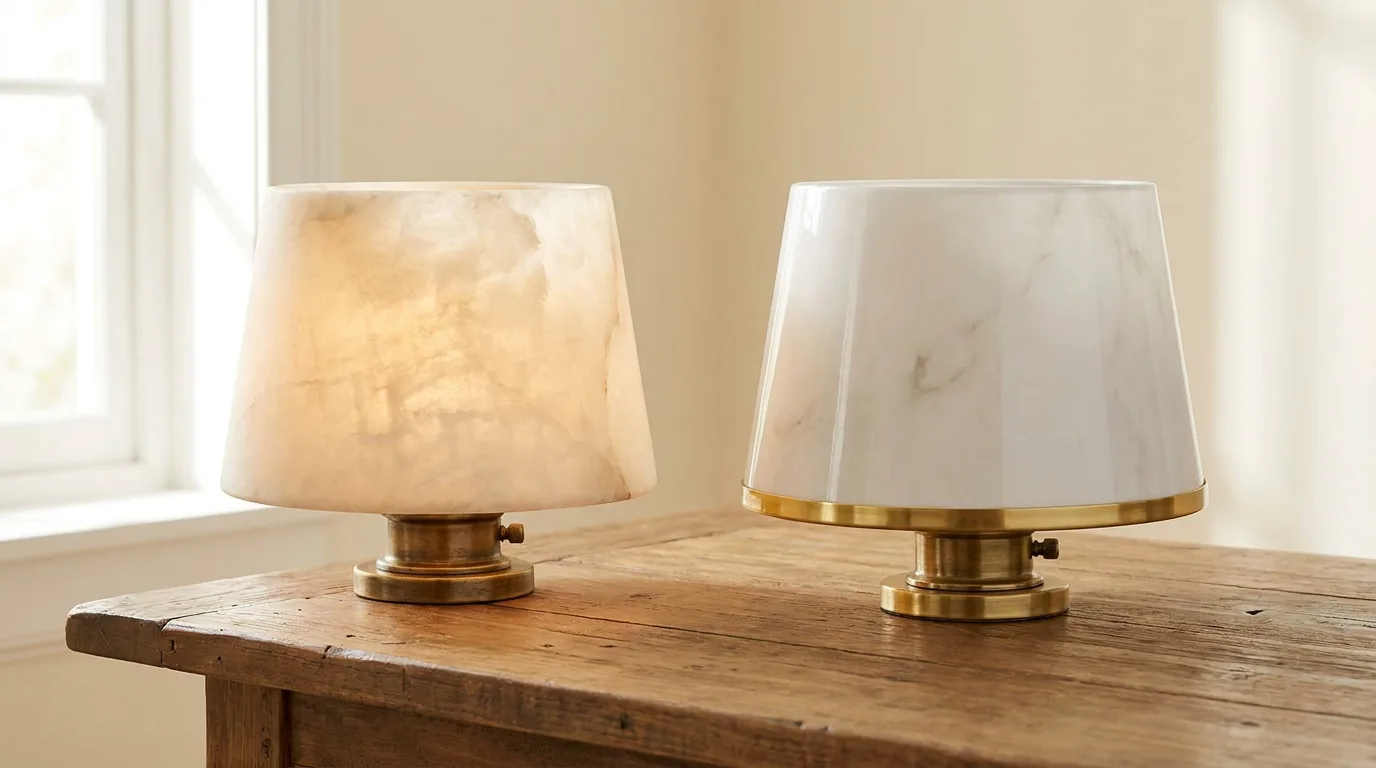
You love the look. A soft white glow, cloudy veins, a light that seems to come from inside the stone.
Then you see two listings. Both say “alabaster”. One is a fraction of the other’s weight. Which one is real?
Here is the honest answer on faux alabaster. Much of it is resin, acrylic, PVC or white glass sold under the stone’s name. Real alabaster is a soft natural stone, cut and shaped by hand. At JagMag Lights, every piece we sell as alabaster is real stone, made in our own factory in Greater Noida.
Quick answer: is faux alabaster real stone?
No. Faux alabaster is a man-made material made to look like alabaster.
Indian suppliers list “faux alabaster” sheets made of acrylic/PVC [5] and “alabaster stone” panels made of polyester resin [4]. Real alabaster is a fine-grained form of gypsum or calcite [2], soft enough to scratch with a fingernail [1].
JagMag Lights is a decorative lighting manufacturer in Greater Noida, Uttar Pradesh. It cuts its alabaster lights from real stone, so no two pieces share the same veins.
Faux alabaster vs real alabaster, side by side
| Point | JagMag (real alabaster) | Faux alabaster (resin, acrylic/PVC, white glass) | Why it matters |
|---|---|---|---|
| What it is | Natural stone: fine-grained gypsum or calcite [2] | Polyester resin [4], acrylic/PVC [5], or white glass sold as “alabaster glass” [3][7] | The name on the listing does not tell you the material |
| Veins when lit | Veins and cloudy patches appear, and brightness is uneven [6] | Resin lights evenly, because its pattern sits on the surface [6] | Switch it on and the stone shows itself |
| Two pieces side by side | Differ in veins, tone and glow [6] | Two panels that match exactly came from one mould [6] | Real stone never repeats |
| Touch | Cool, and stays cool for a few seconds [6] | Room temperature, warms almost at once [6] | A two-second test in your hand |
| Weight | Heavy; a large real-stone chandelier is far heavier than a resin one [6] | A fraction of the weight [6] | Light weight in a “stone” light is a warning sign |
| Can it bend? | No. It is stone | One resin panel listing says it “can be bent to fit curved surfaces” [4] | A curved, seamless “stone” sheet is almost always resin |
| Metal parts and warranty | 304 stainless steel, lifetime warranty against rusting, orders from 4 Oct 2026 [8] | Depends on the seller; ask | The stone needs a frame that lasts as long as it does |
What is faux alabaster made of?
Here’s the thing. “Alabaster” has become a look, not a material.
On IndiaMART, one New Delhi supplier lists a “Designer Acrylic/pvc Faux Alabaster Stone”. The material field reads “Acrylic/pvc” [5].
Another supplier lists a “Backlit Alabaster Stone”. Its material is “high molecular polyester resin”, sold as a “cost-effective alternative to expensive natural stone” [4]. Notice the title says “stone”. The material line says resin.
Then there is glass. “Alabaster glass” is a decorative white glass [3]. It is glass, not stone. One Amazon.in listing title reads “Alabaster Glass Light Shade Frosted Glass Shade” [7].
None of these is wrong to sell. Resin, acrylic and white glass are real materials. The trouble starts when the word “alabaster” is all you read.
What makes real alabaster glow?
Alabaster is stone formed beneath the earth. It is a fine-grained, translucent form of gypsum or calcite [2].
That translucency is why it has been carved into lampshades and even thin windows for centuries [2]. Light passes into the body of the stone, not just across its face.
So when you switch it on, the stone changes. Veins and cloud marks you barely saw by day come up from inside [6]. The glow is a little uneven. That is the stone, not a flaw.
Resin and acrylic cannot do this the same way. A printed or cast pattern sits near the surface, so the light comes through flat and even [6].
How our craftsmen shape real alabaster
Real stone asks for patience. Every block is different.
Our craftsman reads each block before he cuts it. Where should it be cut? Which part should be smoothed thin enough for light to pass? Which vein should stay exactly where nature put it?
That is how our alabaster pendant light is made: a 400 mm cylinder of hand-cut stone, only 50 mm across, lit by a warm 3000K LED.
The hours go into reading and shaping, one movement at a time. A mould cannot make those choices. A person can.
Natural stone and warm light also sit well with Vastu thinking. Earth in the material, fire in the glow. We don’t promise luck. We do think a real material makes a room feel more grounded.
How to tell if alabaster is real: 6 checks
- Read the material field, not the title. The title can say “alabaster stone” while the material says resin or acrylic [4][5].
- Do the touch test. Stone stays cool for a few seconds. Resin warms almost at once [6].
- Switch it on. Real alabaster shows veins and uneven brightness when lit. Resin lights evenly [6].
- Compare two pieces. If two shades match vein for vein, they came from one mould [6].
- Feel the weight. A large “stone” light that feels light is telling you something [6].
- Ask for it in writing. Ask the seller to write “natural alabaster stone” on the invoice. A maker who cuts real stone will.
One test we don’t suggest: scratching it. Real alabaster is soft enough to mark with a fingernail [1], so the test damages the very stone you want.
Where they win
Faux alabaster is not a bad material. It does some things better, and you should know them.
- Toughness. Real alabaster is soft, with a Mohs hardness of 1.5–2, and can be scratched with a fingernail [1]. Resin panels are sold “for durability and longevity” [4].
- Big, seamless and curved. Resin panels can be bent to fit curves and joined seamlessly [4]. For a backlit wall or a long bar counter, that can be the right call.
- Matching panels. Moulded panels match exactly [6]. If you want a uniform look, real stone will not give it to you.
- Weight. A resin fixture is a fraction of a stone one [6]. That makes ceiling fixing easier.
Real alabaster also asks for gentle care. Dust it with a soft, dry cloth. Skip wet mops and chemical cleaners.
Proof from our work
Our alabaster light range is cut from real stone in our own factory. It covers wall sconces, pendants, table lamps, chandeliers and IP65 outdoor sconces.
- Real stone, every piece. The alabaster wall light in honey stone is a stack of real alabaster on a 450 mm sconce, and no two stacks glow the same.
- Veins that show when lit. The alabaster disc wall light is one disc of real stone about 1 cm thin, so every vein shows when the LED behind it is on.
- Plug in, no wiring to chase. The linear alabaster wall light is a 50 cm capsule of real stone on a plug-in cord, so you can light a bedside wall without cutting into it.
- Spare parts for 10+ years. A stone piece or glass shade can be replaced, because we make them ourselves [9].
- Transit damage sorted. Report it with photos within 24 hours of delivery, and a damaged part such as an alabaster piece is replaced after verification [11].
- Fast, made here. In-stock lights dispatch in 4 working days; made-to-order in 12–15 [10]. A custom size takes 15–20 working days [9].
- Checked and certified. We are CE, UL and ZED certified, and a DPIIT-recognised startup [9]. See our certifications.
Want to see how other materials compare? Read mild steel vs stainless steel lights and imported lights vs made in India. For another stone that glows, see our guide to marble lighting.
FAQs
What is faux alabaster made of?
Faux alabaster is usually resin, acrylic or PVC made to look like alabaster stone. Indian supplier listings show “faux alabaster” in acrylic/PVC and “alabaster stone” panels in polyester resin.
How can you tell if alabaster is real?
Real alabaster feels cool, is heavy, and shows uneven veins when lit. Resin warms quickly in your hand, lights evenly, and two moulded pieces can match exactly.
Is alabaster glass real alabaster?
No. Alabaster glass is a decorative white glass, not stone. It can look similar, but it does not have the veins that run through real alabaster.
Is real alabaster better than resin for lights?
Real alabaster gives a warmer, uneven glow with veins that never repeat. Resin is lighter and can bend, so it suits large, curved, seamless panels better.
Why is real alabaster so soft?
Alabaster is a fine-grained form of gypsum, with a Mohs hardness of about 1.5 to 2. That softness lets craftsmen carve it, but it also means it needs gentle cleaning.
Are JagMag alabaster lights real stone?
Yes. Every JagMag light sold as alabaster is real alabaster stone, cut by hand in our Greater Noida factory. Each piece has its own veins.
Nature gives the material. Human hands give it meaning. Vastu inspires harmony. Light brings it to life. That is JagMag.
Ready to see real stone glow? Browse our alabaster lighting, start with the 400 mm alabaster pendant, or check our certifications.
Shopping now? See real stone glow twice in the double alabaster pendant light, two hand-cut alabaster domes on 304 stainless steel.
Not sure which piece fits your room? Video-call us and we will walk you through the stone.
Sources
- CAMEO, Museum of Fine Arts Boston – Alabaster (Mohs 1.5–2, scratched with a fingernail)
- Wikipedia – Alabaster (gypsum and calcite types, translucency, lampshades)
- CAMEO, Museum of Fine Arts Boston – Alabaster glass (a decorative white glass)
- IndiaMART listing – “Backlit Alabaster Stone”, material: polyester resin
- IndiaMART listing – “Designer Acrylic/pvc Faux Alabaster Stone”, material: acrylic/PVC
- Modern Chandelier – How to tell if an alabaster chandelier is real stone or resin
- Amazon.in listing – “Alabaster Glass Light Shade Frosted Glass Shade”
- JagMag Lights – Legal Policies, 4.1A rust warranty
- JagMag Lights – FAQ (certifications, spare parts, custom lead time)
- JagMag Lights – Shipping Policy (dispatch times)
- JagMag Lights – Refund Policy (transit damage within 24 hours)