You buy a table lamp with a soft cream shade. The listing says “fabric”. You like it, and it fits the corner of your bedroom.
A few months later, you see a brown mark on the shade, right above the bulb. You open the listing again. You find no word on what the cloth is. You find no word on which bulb is safe inside it.
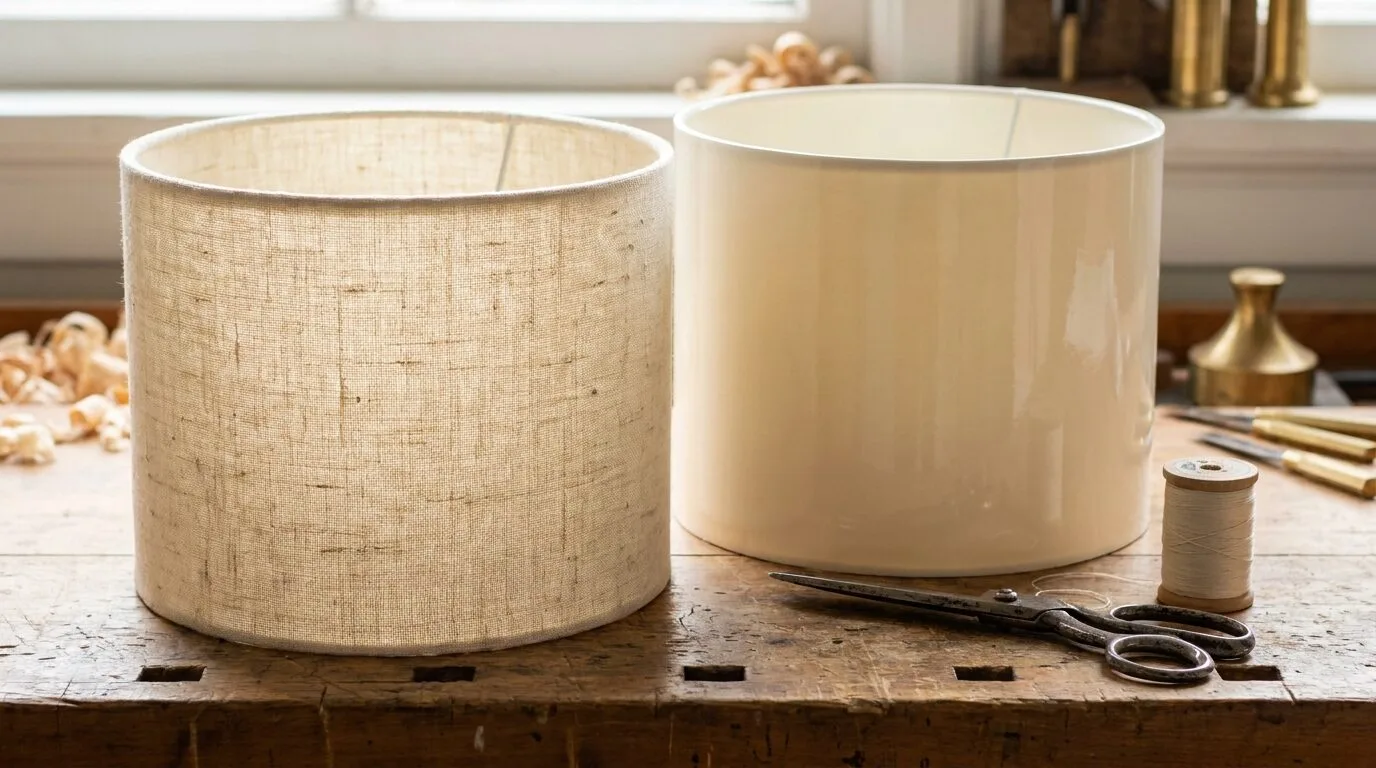
A fabric lamp shade can be linen, silk, cotton, or cloth glued onto a plastic sheet. In a photo, they can look alike. The listing is where the difference should show.
Below, you will see what to check before you buy, with numbers from 14 shade listings we read and 49 fabric lights we make.
The short answer
Buy a fabric lamp shade that names its fibre and its wattage limit. Linen, silk and cotton are real fibres; the word “fabric” alone tells you nothing. On 24 October 2026 we read 14 shade listings: 9 did not name the fibre, and 0 gave a wattage limit. On our side, 38 of our 49 fabric-shade lights state a wattage limit.
What is really going on with a fabric lamp shade
By the numbers
- Linen is made from the flax plant. Britannica notes that linen is stronger than cotton.
- One silkworm cocoon holds roughly 1 km of silk thread.
- India made 38,913 tonnes of raw silk in 2023-24, up from 31,906 tonnes in 2017-18.
- An old incandescent bulb turns about 90% of its power into heat and only 10% into light.
- Of 14 shade listings we read on 24 October 2026, 9 did not name the fibre.
- Of our 49 fabric-shade lights, 29 name the fibre on the page: linen on 15 and silk on 10.
A lamp shade has two jobs. The shade softens the light for your eyes. The shade also sits a few centimetres from a hot bulb.
The fibre decides how the light comes through. Linen shows its weave when the lamp is on, with small thick threads in the cloth. Silk gives a smooth, even glow.
Some shades have two layers. One listing in our study said so plainly: cotton cloth on a plastic shade. A plastic layer is not wrong, but you should know it is there.
Heat is the second half of the story. The US Department of Energy says an old incandescent bulb gives about 90% of its power as heat. So a 60 W bulb puts 60 × 0.9 = 54 W of heat right under your shade.
An LED changes the sum. The same report says LEDs use up to 90% less energy. An 8 W LED in the same holder draws 60 − 8 = 52 W less power.
Silk is also an Indian story. Government data reported by IANS shows 38,913 tonnes of raw silk in 2023-24. The figure was 31,906 tonnes in 2017-18. 38,913 − 31,906 = 7,007 tonnes more, which is 22% more silk in 6 years.
How to check it yourself
- Read the material line. Look for a fibre name: linen, silk, cotton or jute. “Fabric” alone is not a fibre.
- Find the wattage limit. A clear listing gives a number, such as “60 W max”. If there is no number, ask before you buy.
- Do the bulb sum. Divide the LED wattage by the limit. On our linen pendant, 8 ÷ 60 = 0.13, so the bulb uses about one-seventh of the limit.
- Check the size in cm. You need the shade’s width and height to see if it suits your table or ceiling.
- Ask where it was made and who keeps spares. A maker can answer both questions in one line.
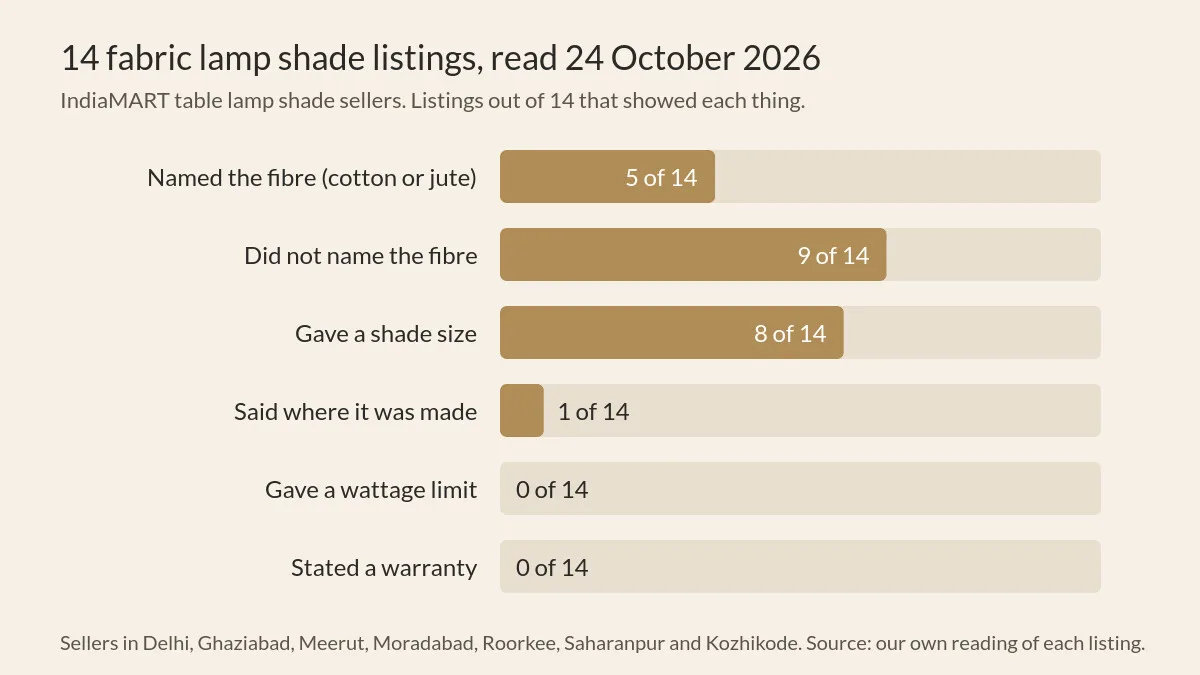
We checked 14 fabric shade listings on IndiaMART on 24 October 2026. Only 5 named the fibre (4 cotton, 1 jute). 8 gave a size. 1 said where it was made. None gave a wattage limit, and none stated a warranty.
Side by side
| What you care about | JagMag fabric lights (49) | Wholesale shade listings (14 read) |
|---|---|---|
| Fibre named | 29 of 49 | 5 of 14 |
| Wattage limit given | 38 of 49 | 0 of 14 |
| Size given | 44 of 49 | 8 of 14 |
| Where it was made | 49 of 49 (India) | 1 of 14 |
| Warranty stated | Lifetime rust cover on steel parts | 0 of 14 |
Where the other side is better
Wholesale sellers sell a loose shade for a lamp you already own. We sell complete lights, and none of our 33 spare parts is a fabric shade.
Their range of styles is wide: crochet, macrame, velvet and printed shades sit on one page. And 5 of the 14 listings did name a real natural fibre.
We are not perfect either. 20 of our 49 fabric-shade pages still say only “fabric”. We are telling you, because you should ask us the same questions.
What we do at JagMag
Our linen cloth pendant light is a 35 cm dome of natural linen. The wavy hem is bound in twisted cord, and a turned wood cap sits on top. The frame ribs are 304-grade stainless steel, the same steel grade as a good kitchen sink.
Shopping now? For a bedside, our fabric table lamp wraps an E14 bulb in a slim cylinder of woven linen on a 304 stainless steel stem, and its page names the 40W limit.
The holder is E27, and the limit is 60 W. We suggest a 6–8 W LED in 3000K warm white. The bulb is not included, so you choose it.

Silk takes patience. On our pleated silk saucer pendant, real silk is gathered by hand into a saucer 60 cm across. The work happens in our own factory, where we have made lights since 2015.
Every steel part carries a lifetime warranty against rust on orders from 4 October 2026, as our legal policies state. We keep spares for 10+ years, and a custom size takes 15–20 working days.
Natural fibre and warm light also bring the kind of calm, grounded room that Vastu thinking has always valued.
Shopping now? Want a linen or raw silk shade beside the sofa? See our table lamps for living room.
FAQs
What is the best fabric for a lamp shade?
Linen, silk and cotton are the most common natural fibres for a fabric lamp shade. Linen shows its weave when lit, and silk gives a smooth glow. Whatever you pick, the listing should name the fibre and give a wattage limit.
Is “fabric” the same as cotton or linen?
No. “Fabric” only means cloth, and it does not tell you the fibre. In our study of 24 October 2026, 9 of 14 shade listings did not name the fibre.
Which bulb is safe inside a fabric shade?
Use an LED that stays under the wattage limit printed for the light. On our linen cloth pendant, the limit is 60 W and we suggest a 6–8 W LED in 3000K warm white.
Why does an old bulb make a shade hot?
An old incandescent bulb turns about 90% of its power into heat. A 60 W bulb therefore gives about 54 W of heat under the shade.
Does India make its own silk?
Yes. India made 38,913 tonnes of raw silk in 2023-24 and is the world’s second-largest silk producer.
Nature gives the material. Human hands give it meaning. Light brings it to life.
See our fabric pendant lights, the fabric chandeliers or our table lamps with linen and silk shades. Choosing a bulb next? Read warm white vs cool white. Want a natural weave in a different form? Compare real rattan and plastic rattan. Not sure? Video-call us.
Shopping now? See a finely pleated cream fabric shade on a real burl wood base in our pleated shade table lamp.
Sources
- IndiaMART, table lamp shade listings (14 fabric shade listings read 24 October 2026; 2 opened in full)
- IndiaMART listing: 16 inch cotton table lamp shade (read 24 October 2026)
- IndiaMART listing: fabric decorative table lamp shade (read 24 October 2026)
- Britannica: Linen
- Britannica: Silk
- IANS: India’s raw silk production rises steadily (14 April 2025)
- US Department of Energy: Lighting fact sheet (2021)