
Japandi lighting is warm, simple light made from natural materials: stone, wood, paper, raw silk and woven cane, in calm shapes with nothing extra. It joins two ideas, the Japanese love of quiet, imperfect things and the Scandinavian love of warm, useful homes. For an Indian home, that means one honest material per light, a warm 3000K glow, and a shape that rests the eye.
A Japandi lamp is not about looking grand. It is about feeling calm. A piece of travertine with its pits still showing. A walnut cap turned on a lathe. Paper panels set into a wood frame, one joint at a time. Here is how to choose the right one, room by room.
Key takeaways
- Real materials only. Stone, wood, paper, linen, silk and cane. Never a print or a coating made to look like them.
- Warm light, always. A 3000K warm-white LED makes stone glow and wood turn golden. Cool white makes both look grey.
- Low and soft beats high and bright. Pendants hung low over a table, lamps at eye level, wall lights that wash the wall.
- One simple shape per light. A dome, a disc, a drum, a lantern. Let the material do the talking.
What is Japandi lighting?
Japandi is a mix of “Japanese” and “Scandi”. Japanese design gives it calm lines, low light and respect for natural flaws. Scandinavian design gives it warmth, wood and comfort. Together they make rooms that feel quiet but never cold.
In lighting, this comes down to three rules. Use a natural material you can touch. Hide the bulb, so there is no glare in your eyes. Keep the light warm and low, where life happens: over the table, beside the bed, on the wall of a passage.
Here’s the thing. Japandi is not a colour you paint on. It comes from the material. That is how we work too. We start with the stone, the wood or the fibre, and let light reveal it.
Japandi vs wabi sabi: what is the difference?
Wabi sabi is the older Japanese idea underneath Japandi. It finds beauty in things that are natural, imperfect and a little worn: a stone with open pores, wood with a knot, a hand-wound rope that is not perfectly even.
Japandi takes that idea and makes it calmer and more practical. A wabi sabi lamp leans raw and textured. A Japandi lamp leans clean and simple. Most good pieces sit somewhere between the two.
Our wabi sabi table lamp shows the raw side well: a base of stacked natural wood under a shade of hemp rope wound by hand, 40 cm tall. No two bases match, because no two pieces of wood do.

Which materials make a light feel Japandi?
Every natural material does something different with light. This table shows what we use and what happens when you switch it on.
| Material | Where it comes from | What light does with it | A piece to see |
|---|---|---|---|
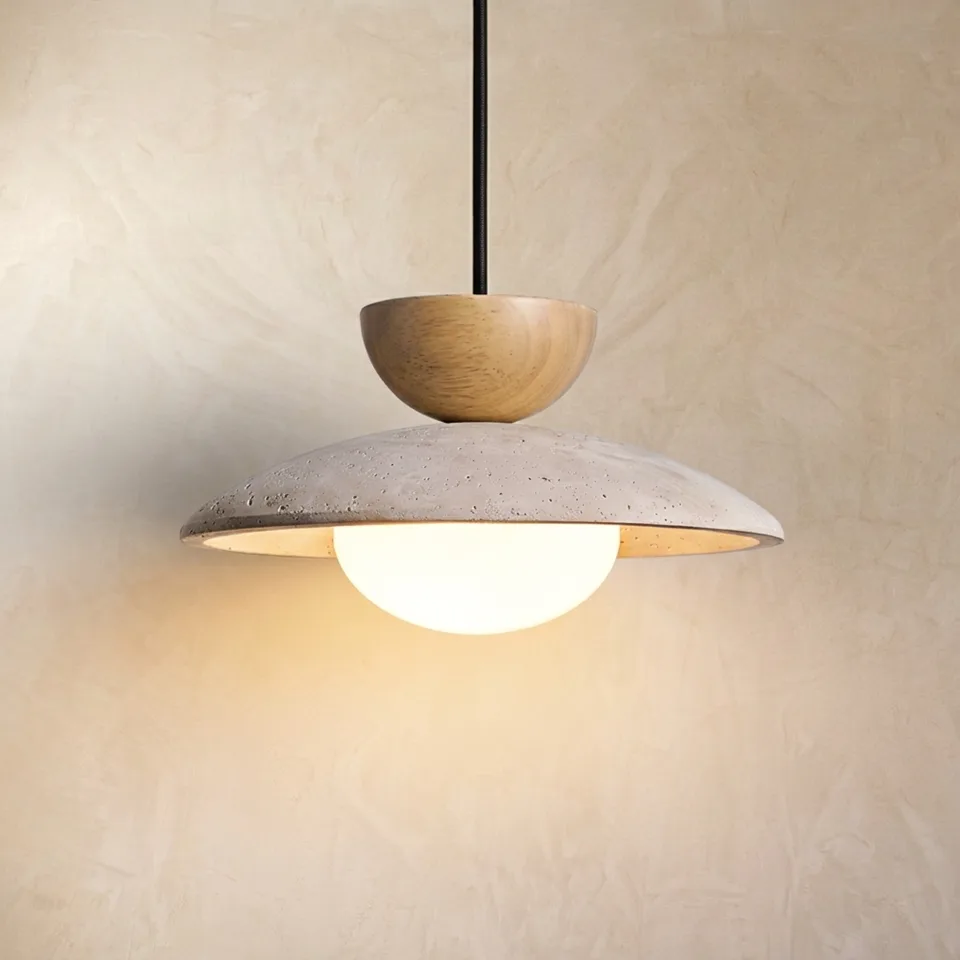
| Travertine | Stone formed beneath the earth, full of tiny pits | Glows warm and honey-toned; every pit and band shows | Travertine globe pendant light, 25 cm |
| Walnut and oak | Wood that took years to grow its grain | The grain turns golden under warm light | Layered wood pendant light, 33 cm |
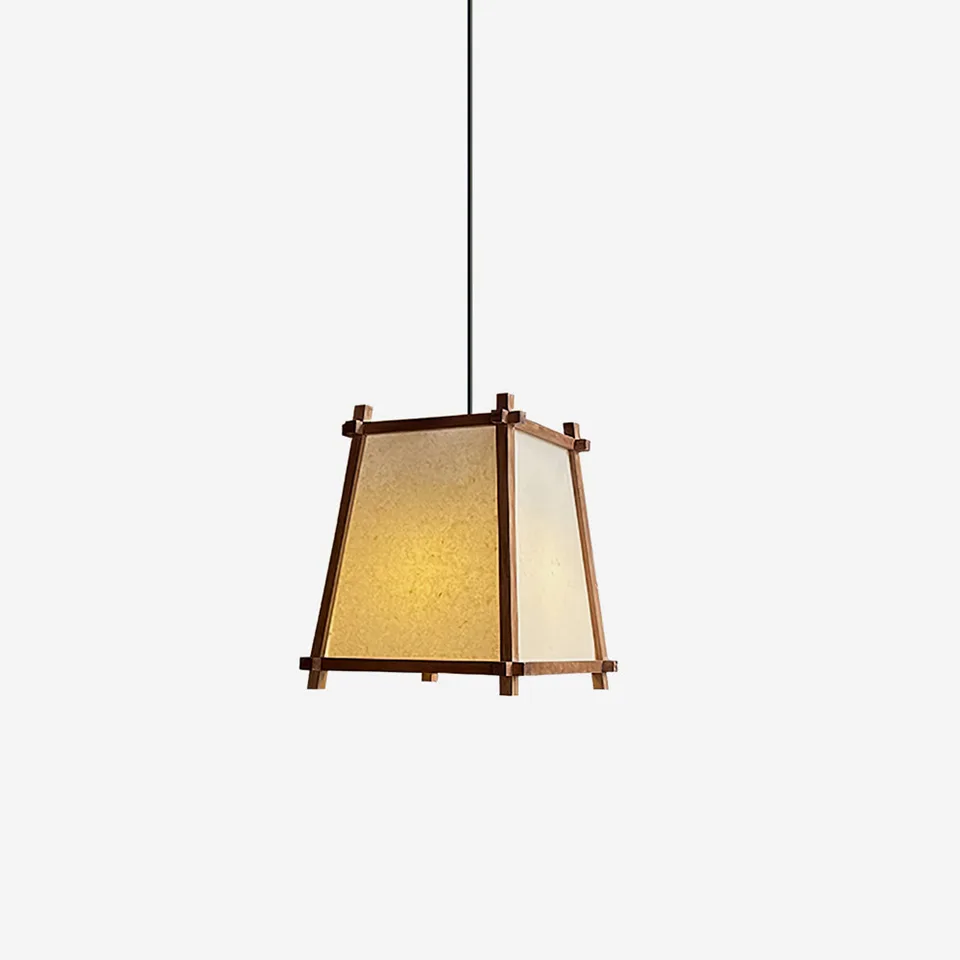
| Paper | Plant fibre pressed into thin sheets | Softens the bulb into an even lantern glow | Wood lantern pendant light, 35 cm |
| Raw silk and linen | Natural fibre, woven into cloth | Spreads light into a soft, cloud-like glow | Japanese pendant lamp, 40 cm raw silk dome |
| Rattan cane | Grown from the soil, woven by hand | Throws a gentle pattern of shadows | Japanese rattan pendant light, 40 cm drum |
Under the material, every metal part we use is 304-grade stainless steel, with a lifetime warranty against rust on those parts (orders from 4 October 2026). The steel is the quiet frame. The natural material is the hero.
Japandi ceiling light ideas for every room
Over the dining table
Hang two or three small pendants in a row, 75–85 cm above the table top. The travertine globe pendant light works well here: a wide stone shade, a natural wood cap, and an opal borosilicate glass globe that hides the bulb. It takes an E27 bulb, not included; fit a 3000K warm-white LED.
Want one bigger piece instead? The layered wood pendant light stacks three flared tiers of walnut and oak tones, 33 cm across. Warm light falls onto the table in soft rings between the layers.
In the living room
A Japandi chandelier keeps the shape simple and the material natural. Our walnut chandelier sets eight pleated raw silk shades around a solid walnut column, 87 cm wide. For a lighter look, hang one large fabric piece, like the Japanese fabric cloud pendant light in 35 cm or 61 cm.
In the bedroom
Free up your nightstand with a slim pendant on each side of the bed. The travertine cylinder pendant light is a stone tube 30 cm tall and just 4 cm wide, with a built-in 3000K warm-white LED, so there is no bulb to buy.
Prefer the wall? A travertine cylinder wall light washes soft light up and down the wall (3 W + 3 W, 3000K). It is 28 cm tall, on a walnut-tone wood backplate.
In a study or reading corner
Paper and wood make the gentlest reading light. The wood lantern pendant light has a tapered wood frame, cross-lap joints at every corner and fibre-flecked paper panels, 35 cm wide and 40 cm tall. Each joint is cut and fitted by hand in our Greater Noida factory.
On the wall beside a desk, a teak wood bowl wall light turned from solid teak (27 cm) spreads an amber glow across the ringed grain.
How do you choose a Japandi lamp? 5 simple checks
- Is the material real? Ask what it is made of. Travertine should be travertine, not a stone-printed resin. Wood should be solid wood or real ply.
- Can you see the bulb? A Japandi light hides it behind stone, opal glass, paper or fabric. No glare.
- Is the light warm? Use 3000K warm white. Most of our holder lights come without a bulb, so fit a 3000K warm-white LED.
- Is the size right for the spot? Small pendants of 15–25 cm suit bedsides and rows over a table. A single piece of 40–60 cm suits a living room or a big table.
- Will it last? Look for a stainless steel frame that will not rust, and a maker who keeps spare parts.
Why buy Japandi lights from the people who make them?
A craftsman looks at the material before deciding how to work with it. Where should the stone be cut? Which part of the wood should be polished, and which knot left alone? We answer those questions ourselves, in our own Greater Noida factory, where we have made lights since 2015.
- Made in India, in our own factory. Not imported, not traded.
- Custom in 15–20 working days. Your size or finish. Importers usually take 60–120 days.
- Spares for 10+ years. One shade, one canopy, one part.
- Free shipping across India. Pay by UPI, card, net banking or EMI on eligible cards.
We are CE, UL and ZED certified, and DPIIT-recognised. Browse all our pendant lights, table lamps and wall lights to find more natural-material pieces. And if you love wood most of all, our guide to wooden lights goes deeper into teak, walnut and oak.
Frequently asked questions
What is Japandi lighting?
Japandi lighting is warm, simple lighting made from natural materials like stone, wood, paper, linen and cane. It mixes Japanese calm with Scandinavian warmth. Keep the light at 3000K and the bulb hidden.
What is the difference between a Japandi lamp and a wabi sabi lamp?
A wabi sabi lamp celebrates raw, imperfect texture, like hand-wound rope or stone with open pores. A Japandi lamp is cleaner and calmer in shape. Both use real natural materials and warm light.
Which bulb suits a Japandi light?
A 3000K warm-white LED. Our lights with a bulb holder come without a bulb, and our lights with a built-in LED are 3000K warm white only. None of our lights dim, so pick a lower-wattage bulb for a softer glow.
Does Japandi lighting work in a small Indian flat?
Yes. Small pendants of 15–25 cm and slim wall lights add warmth without crowding a room. Stone and wood also keep a small space feeling grounded, the kind of harmony Vastu has always valued.
Can I use a Japandi pendant in a bathroom or outdoors?
No. Our stone, wood, paper and fabric pendants are indoor lights rated IP20, made for dry rooms. For a bathroom or an outdoor wall, choose an IP65 light instead.
Can you make a Japandi light in a custom size?
Yes. We make custom sizes and finishes in 15–20 working days in our own factory. Send us your room size and where the light will hang, and we will suggest the right piece.
Nature gives the material. Human hands give it meaning. Light brings it to life. Start with one piece: a travertine pendant over your table or a wabi sabi lamp by your bed. Not sure on size? Ask us on WhatsApp.