
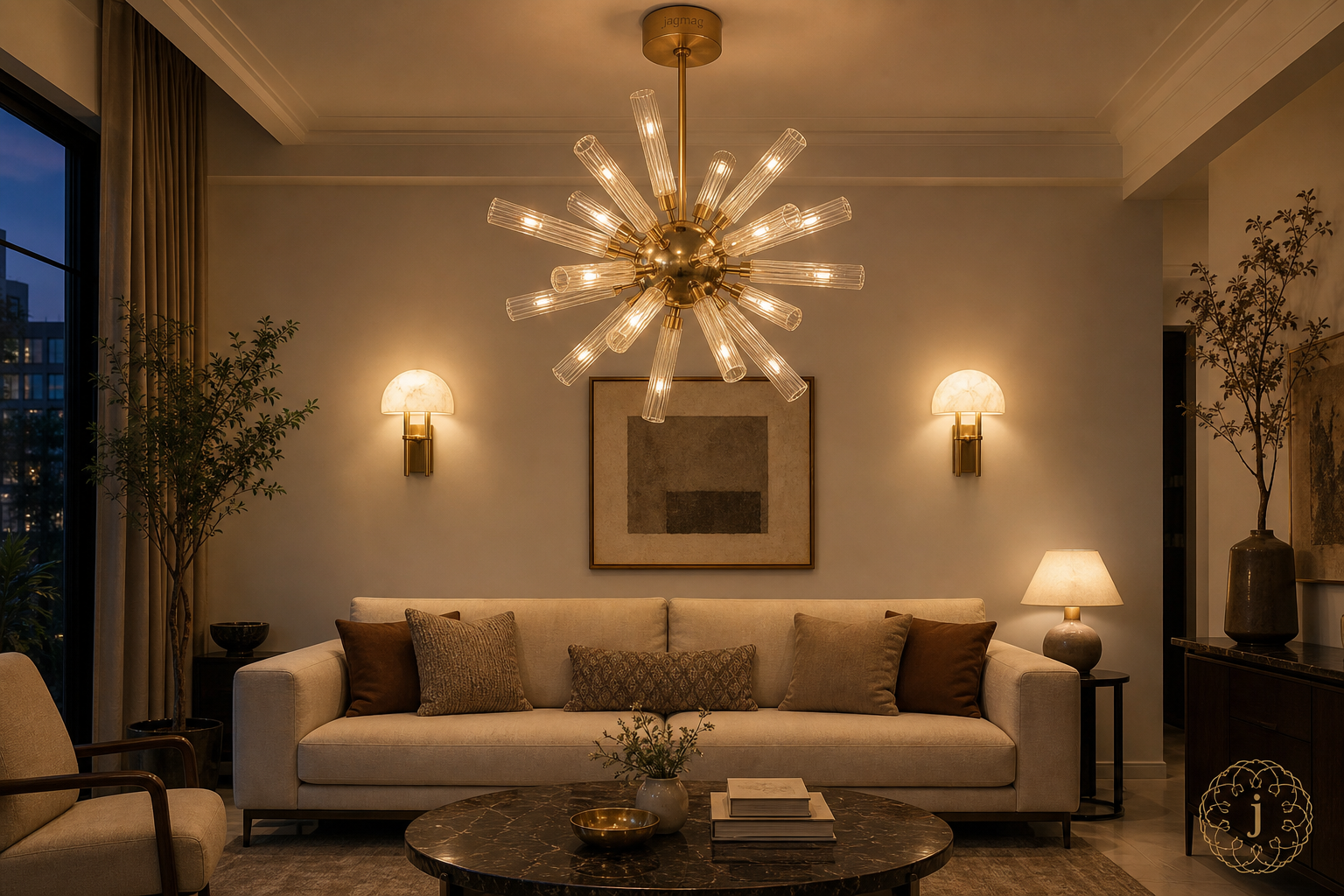
It is the last hour before guests arrive. You dim the lights, and your chandelier comes alive overhead — that lovely centre of attention you fell for. But the corners of the room stay flat and dark, and the whole space suddenly feels half-finished, like a sentence that trails off. Then you flick on a pair of wall lights either side of the sofa, and the room exhales. Soft pools of light climb the walls, faces look warmer, the chandelier finally has company. That is the quiet magic of matching wall lights and chandeliers — not making them identical, but making them feel like they belong to the same beautiful story.
Most of us shop for the chandelier first and forget the walls until the room feels strangely cold. The good news: getting these two to sing together is far easier than it looks, and it has very little to do with technical specs. It is about mood, proportion, and a touch of restraint.
The one rule that changes everything: sisters, not twins
Here is the idea designers come back to again and again — your wall lights and chandelier should look like sisters, not twins. They share a family resemblance, a similar spirit, but they are not carbon copies of each other. A room where every fixture matches exactly can feel like a showroom: correct, but a little lifeless. A room where the pieces simply relate — same warm metal, echoing curves, the same gentle glow — feels collected, layered, like it came together over time.
So the goal was never to find a wall light that copies your chandelier. It is to find one that feels like it grew up in the same house.
The little mistakes that make a room feel off
You have probably walked into a space that looked expensive yet somehow uneasy, without being able to say why. Usually it comes down to a few small things.
The most common is scale gone wrong — a grand crystal chandelier paired with tiny, timid sconces that disappear on a big wall, or chunky wall lights crowding a delicate fixture overhead. Size mismatches are far more jarring than a small difference in style, so trust your eye: the wall lights should feel like a natural supporting act, never shrinking away and never shouting back.
The next is too many metals at once. A little contrast is gorgeous, but five finishes in one room start to argue. Pick one finish to lead — the one your chandelier already wears — and let everything else fall in behind it. And finally, mismatched light colour: one fixture glowing warm and honeyed while another runs cold and blue will quietly ruin the harmony, no matter how pretty the pieces are.
How to actually pair them (the easy version)
Start with the chandelier, because it is the star and it sets the tone for the whole room. Look at three things about it: its finish (warm brass, soft gold, matte black, polished chrome), its shape language (is it all soft curves and droplets, or clean straight lines?), and its glow. Then choose wall lights that nod to at least one of those, ideally two.
Match the finish first — that single shared metal tone is the thread that ties a room together and does most of the heavy lifting. Echo the shape next: a curvy chandelier loves wall lights with a soft, rounded silhouette; a crisp, geometric fixture wants sconces with the same confident lines. You do not need all three to line up. One strong shared trait reads as intentional; trying to match everything is what tips a room into that flat, matchy feeling.
One gentle bit of science, then we will move on: keep every bulb in the same warm-white family — somewhere around 2700K to 3000K, the colour of late-afternoon sunlight. Mixing warm and cool light in one room is the fastest way to make beautiful fixtures look cheap. That is genuinely the only number you need to remember.
Styles we love together
If your home leans warm and classic, there is nothing like a chandelier in brass or aged gold with wall lights in the same honeyed tone. Our Wood & Brass Chandelier Arlo has that lovely organic warmth, and it pairs beautifully with the sculptural, gallery-like Designer Wall Light Payson on the flanking walls — same warmth, different scale, instantly cohesive.
For something softer and more romantic — bedrooms, reading nooks, a calm hallway — the Alabaster Dome Wall Sconce Akner throws a gentle, diffused glow that feels like candlelight, supporting an overhead fixture without ever competing with it. And if you want a little quiet drama, the Green Marble Wall Light Verde Duo brings a rich material accent that echoes a jewel-toned crystal chandelier wonderfully. You can see the full range in our wall lights collection.
Ideas by room
In the living room, let the chandelier own the centre and place matching wall lights either side of the sofa, the fireplace, or a favourite piece of art. They fill the lower half of the room with warmth, so evenings feel intimate instead of cavernous — and you rarely need the harsh overhead light on at all.
In the dining room, the chandelier hangs over the table as the showpiece; a pair of understated sconces on the wall behind keeps the whole room glowing while everyone lingers over dinner. In the bedroom, skip the bedside lamps and let two matching wall lights frame the headboard — same family as your overhead fixture, lovely for reading, and they free up the nightstands. And along a staircase or hallway, wall lights that echo the chandelier in the entryway turn an ordinary passage into a moment.
So which should you buy?
If you want the simplest, most foolproof path: choose your chandelier first, note its metal finish, then pick wall lights in that same finish but in a simpler, smaller design. That single move — shared finish, supporting scale — gets you most of the way to a room that looks professionally pulled together. For most homes we would start with the warm, versatile Arlo chandelier and the Payson wall lights as a safe, gorgeous default.
Still deciding on the centrepiece? Our guide to matching lamps with chandeliers and our guide to choosing wall lights are the perfect next reads, and if finish is your sticking point, the chandelier colour and finish guide will make the decision feel obvious.
A few real questions people ask
Do my wall lights have to match my chandelier exactly?
No — and they probably shouldn’t. Aim for sisters, not twins: a shared metal finish or a similar shape is plenty. An exact match can make a room feel like a showroom, while pieces that simply relate to each other feel collected and warm.
Should the wall lights be the same brand or collection as the chandelier?
It helps but isn’t necessary. What matters is that the finish, the shape language, and the warmth of the light feel connected. You can mix sources freely as long as those three threads agree.
What if my chandelier and wall lights are different metals?
A little mixing can look intentional and rich — just keep one finish clearly dominant and treat the second as an accent. If you’re unsure, matching the wall lights to the chandelier’s finish is always the safe, elegant choice.
How many wall lights should I add to a room with a chandelier?
Pairs almost always look best — two flanking a sofa, a bed, a fireplace, or a mirror. They create balance and let the chandelier stay the star while the walls carry the cosy, lower-level glow.
What bulbs should I use so everything matches?
Use the same warm-white bulbs throughout — around 2700K to 3000K, the colour of sunset light. Keeping every fixture in the same warm family is the single biggest thing that makes a room feel harmonious.