
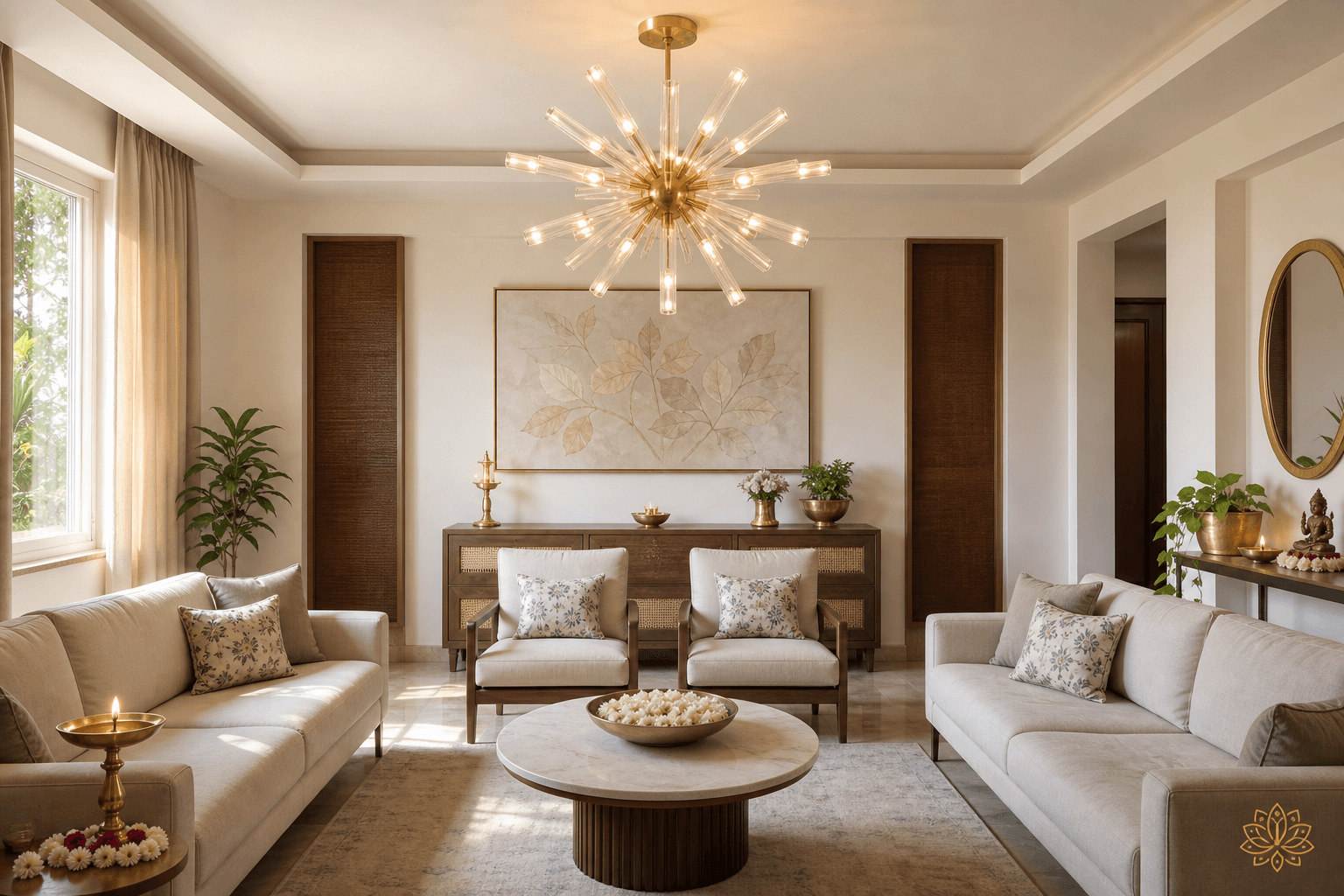
There’s a particular feeling you get walking into a home that’s lit just right. The entrance glows like it’s expecting you. The living room feels warm without being harsh. Light pools softly over the dining table where everyone gathers. Nothing is too bright, nothing is too dim — the whole place simply feels calm, generous, and somehow lucky. That feeling is what most people are really chasing when they ask about Vastu for chandeliers.
Vastu isn’t about superstition or rigid rules that ruin a beautiful room. At its heart it’s an old, sensible idea: light should flow into a home the way good energy does — freely, warmly, and without dark pockets where it gets stuck. Get that right, and a chandelier does more than decorate a ceiling. It makes the room feel like a place you want to come home to.
The little things that quietly make a room feel off
Most of us choose a chandelier for how it looks, then live with the surprises. A gorgeous fixture hung so low over the dining table that it cuts the room in half. A cold, bluish “white” bulb that turns a cosy living room into a waiting room. A grand crystal piece floating directly over the bed, beautiful by day and faintly oppressive at night. Or the most common one of all — a dim, neglected entrance that’s the first thing guests see and the first thing Vastu warns against.
None of these are about luck, really. They’re about balance. And the lovely thing is that the Vastu instinct and the designer instinct almost always agree: keep the light warm, keep it flowing, and put it where the room actually lives.
Vastu for chandeliers, the simple way to think about it
If you remember nothing else, remember this: light loves the north and east. Fixtures and brightness in these directions are considered the most auspicious — they’re tied to clarity, growth and prosperity, and happily, the north and east also catch the gentlest natural daylight. Keep the home well lit overall with no gloomy corners, lean your brightest fixtures toward the north and east, and avoid making the south-east your main source of light. The south can take strong, confident lighting (it’s linked to drive and a rewarding career), while the soft, serene north-east is where calm, ambient light belongs.
That’s the whole framework. Everything below is just applying it, room by room, with fixtures that happen to be beautiful.
Where light belongs, room by room
The entrance — never let it be dark. Vastu is unusually firm here, and for good reason: a gloomy doorway is the first thing that greets you and your guests, and a dim welcome sets a heavy tone. A bright, warm fixture in the foyer or over the stairwell does the opposite — it says come in, you’re welcome. For double-height entrances and staircases, a cascading piece like our K9 Crystal Raindrop Chandelier for high ceilings and staircases fills the vertical space with light that moves and sparkles as you climb — exactly the kind of generous, flowing brightness this spot is meant to have.
The living room — bright, open and warm. This is where the family actually lands, so Vastu asks for generous, even illumination here, not theatrical shadows. Let one warm central fixture do the heavy lifting and keep accent lights as a supporting act. A piece like the Modern Brass 8-Light Opal Globe Chandelier is made for this — eight soft opal globes throw a clean, honey-warm glow across the whole room without a single hard glare, so the space feels bright, settled and alive. If you’re still weighing options, our guide to chandeliers for the living room walks through size and placement in plain language.
The dining room — the heart of the table. If there’s one place Vastu actively loves a chandelier, it’s here. A light centred over the dining table is associated with abundance and family harmony, and honestly, it just feels right — everyone’s face softly lit, the food looking its best, conversation drawn into one warm circle. A Crystal Raindrop Flush-Mount Chandelier does this beautifully, scattering gentle light across the table without crowding the room. Hang it roughly 30 to 36 inches above the tabletop so it warms the food and never blocks a sightline. For more on getting the proportions perfect, see our dining room chandelier guide.
The bedroom — soft, grounded, restful. Here Vastu turns the dial down, and so should you. Avoid a heavy fixture hanging directly over the bed, and skip harsh overhead glare; reach instead for soft, warm light placed a little to the side. A warm fabric-shaded piece like our 6-Light Gold & Walnut Fabric Chandelier gives that grounded, golden hush a bedroom wants — the kind of light you read by, not the kind that keeps you awake. A warm yellow glow is especially favoured for a master bedroom in the south-west, where it’s linked to stability and a settled, close relationship.
The pooja corner — the one place colour is welcome. Soft white or warm yellow light suits a prayer space, with the traditional diya glowing in the south-east. It’s also the one spot where Vastu doesn’t mind a touch of colour, while living areas and bedrooms are happiest in clean, warm white.
The glow itself matters as much as the spot
You can place a chandelier perfectly and still get the feeling wrong if the light is cold. Vastu — and every designer we know — leans warm: a soft, golden-white glow (think candlelight to warm sunlight, roughly 2700–3000K on a bulb box) makes living and resting areas feel calm and inviting. Save bright, neutral light for the kitchen and study where you need focus, and keep red, blue and green decorative lights out of living rooms and bedrooms, where they tend to feel restless. If you’d like to match the metal and finish to your room’s mood too, our chandelier colour and finish guide is a good next read.
Our favourites, if you want a confident pick
For the dining table, the Crystal Raindrop Flush-Mount is the easy yes — auspicious placement, beautiful light, available in fourteen sizes so it fits almost any table. For a welcoming entrance or staircase, the Long Raindrop K9 Crystal turns the very spot Vastu cares about most into the showpiece of the home. And for an everyday living room that should simply feel warm and bright, the Modern Brass 8-Light Globe is hard to beat.
Place light where the room lives, keep it warm, and let the north and east carry the brightness. Do that, and your home won’t just look good — it’ll feel right the moment you walk in.
Vastu for chandeliers: your questions, answered
Which direction is best for a chandelier as per Vastu?
North and east are considered the most auspicious for lighting overall, so they’re a safe bet for brightness. The dining table is the classic exception — a chandelier centred over it is welcomed wherever the table sits, as it’s tied to abundance and togetherness.
Is a chandelier good in the bedroom according to Vastu?
Yes, as long as it’s soft and not hung directly over the bed. Choose a warm, gentle fixture placed slightly to the side, and a warm yellow glow rather than cool white — especially in a south-west master bedroom, where warm light is linked to stability and rest.
What light colour does Vastu recommend for chandeliers?
Warm white — a soft golden glow (around 2700–3000K) for living, dining and bedroom spaces. Keep red, blue and green decorative lights out of those rooms; the one place a little colour is welcome is the pooja corner.
Can I put a crystal chandelier over my dining table?
Absolutely — it’s one of the most Vastu-friendly choices there is. Centre it over the table and hang it roughly 30 to 36 inches above the surface so it warms the food and never blocks the view across the table.