
Your room is 10 by 12 feet. The bed, the cupboard and one chair already fill it. You cannot knock down a wall, so you search for how to make a room look bigger and hope for a trick that works.
Light and paint are the two tricks that cost no floor at all. Below you will see the numbers behind both: how pale walls send light back into the room, how high a ceiling light can hang, and how big it should be.
The short answer
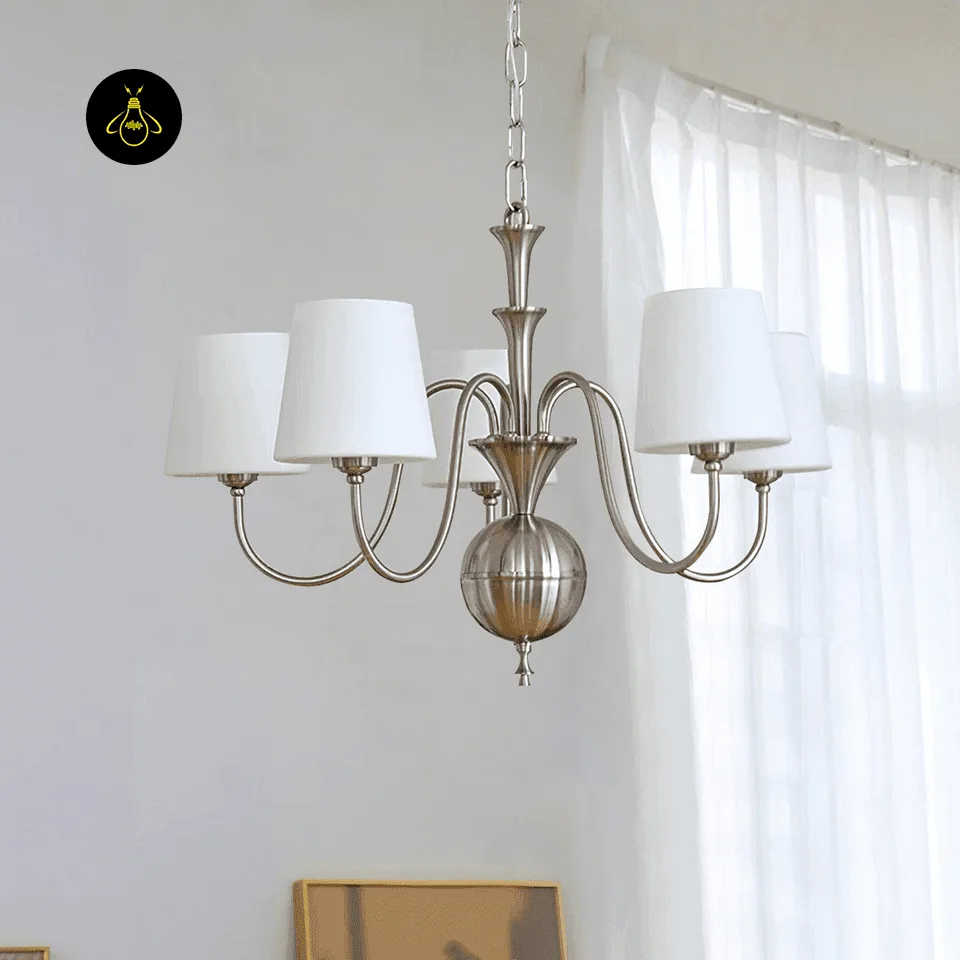
Paint the ceiling and walls in pale colours, light the walls as well as the floor, and keep the ceiling light small and high. A white paint with an LRV of about 83 sends back roughly ten times more light than a deep navy with an LRV of about 8. In a 10 × 12 ft room, a chandelier about 56 cm wide that sits close to the ceiling leaves the most open space under it.
How to make a room look bigger with paint and light: the numbers guides use
Paint makers grade colours by light reflectance value, or LRV. Sherwin-Williams explains the scale: 0 means a colour absorbs all light, and 100 means it reflects all light. Benjamin Moore lists White Dove at 83.16 and Hale Navy at 8.36.
Lighting standards ask for pale rooms too. The European standard EN 12464-1, as Trilux reports it, suggests a reflectance of 0.7 to 0.9 for ceilings, 0.5 to 0.8 for walls and 0.2 to 0.4 for floors. A reflectance of 0.8 means the surface sends back 80% of the light that lands on it.
Size and height come next. Lighting Reimagined and Maxim Lighting both use one rule for a chandelier: add the room’s length and width in feet, and read the answer in inches. For headroom, the US Access Board asks for at least 80 inches, or 203 cm, along walking paths. Many lighting guides prefer 7 feet, or 213 cm.
| What to plan | The number | Source |
|---|---|---|
| Ceiling reflectance | 0.7–0.9 | EN 12464-1 (Trilux) |
| Wall reflectance | 0.5–0.8 | EN 12464-1 (Trilux) |
| White paint vs navy | LRV 83.16 vs 8.36 | Benjamin Moore |
| Chandelier width | length + width in ft = inches | Maxim Lighting |
| Headroom under a light | 203 cm minimum, 213 cm preferred | US Access Board; Lighting Reimagined |
| Indian room height | 2.75 m minimum | Model Building Bye-Laws 2016 |
The last row matters for Indian homes. The Model Building Bye-Laws set 2.75 m as the lowest height for a habitable room. Our guide to standard ceiling height in India covers the rule in detail.
How big and how high should the light be in a small room?
Take a bedroom of 10 × 12 ft with a 2.75 m ceiling. Work through the sum step by step.
- Width: 10 + 12 = 22. The light should be about 22 inches across. 22 × 2.54 = 55.9 cm, so about 56 cm.
- Headroom: 7 ft × 30.48 = 213.4 cm. The ceiling is 275 cm. 275 − 213.4 = 61.6 cm. The light, from ceiling to its lowest point, should stay inside about 62 cm.
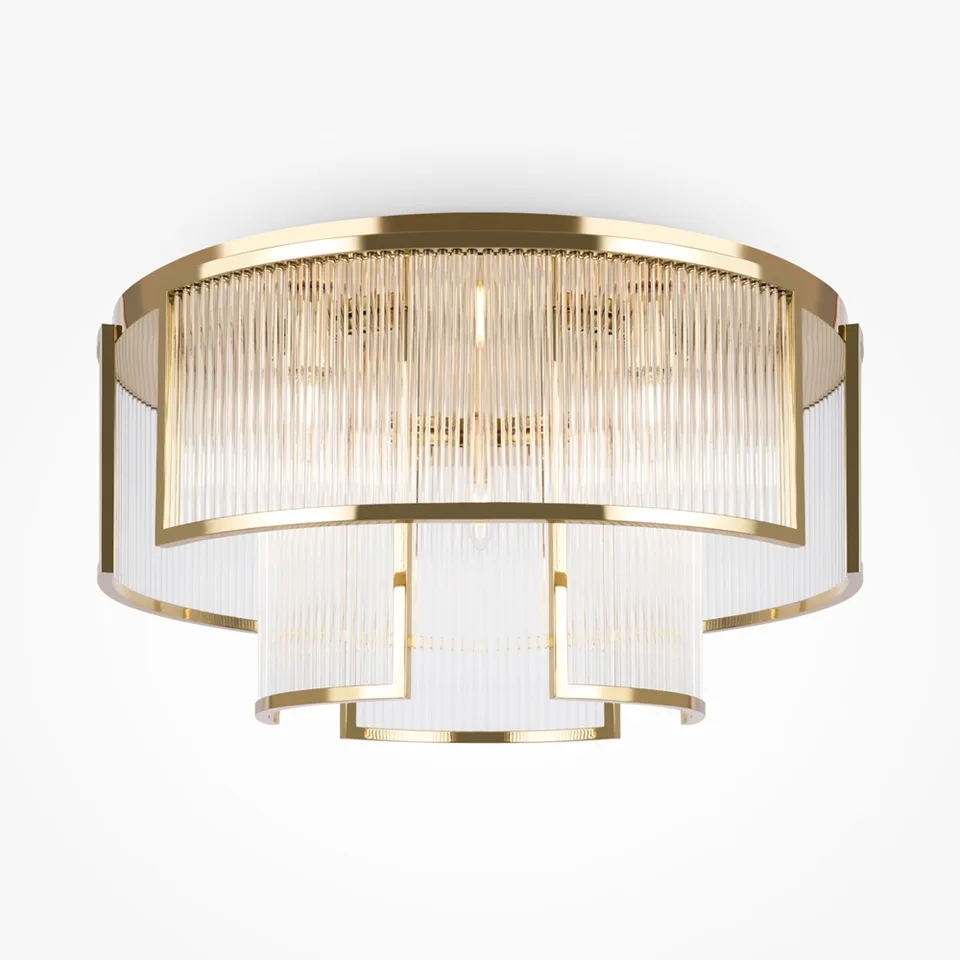
- Check with a real piece: our fluted glass chandelier sits 33 cm below the ceiling. 275 − 33 = 242 cm. The lowest glass stays 28.6 cm above the 7 ft line.
- Bigger room check: a 12 × 14 ft hall gives 26 inches. 26 × 2.54 = 66 cm.
Now the paint sum. Light bounces from wall to wall many times. Physicists who study light boxes add those bounces up, and the total grows by about 1 ÷ (1 − reflectance).
- Pale room, average reflectance 0.7: 1 ÷ 0.3 = 3.33. The bounces lift the light to about 3.3 times the direct light.
- Dark room, average reflectance 0.3: 1 ÷ 0.7 = 1.43.
- Compare them: 3.33 ÷ 1.43 = 2.33. The same lamp gives the pale room roughly 2.3 times more light.
A real room has doors, windows and furniture, so treat 2.3 as a direction, not an exact figure. We also counted our own range. On 1 Nov 2026, 17 of our 19 small chandeliers measured 65 cm across or less, so most fit the 56–66 cm band from the sum above.
Why light walls and a high light make a room feel larger
The logic runs in a short chain. Pale walls send light back. Bright walls mark where the room ends. The eye sees the edges clearly and reads the space as wide.
Research backs the chain. A NIST review of John Flynn’s lighting studies reports that wall lighting and wall washing gave people a stronger sense of spaciousness. Wall washing means a light that spreads evenly down a wall, like morning sun on a white house. A 2010 study by Oberfeld, Hecht and Gamer found that lighter ceilings and lighter walls both made a room look taller, while a lighter floor made no real difference. A pair of wall lamps is a simple way to light the walls, and it takes no floor.
The science of distance adds one more step. Light spreads out as it travels, so the light on a surface falls with the square of the distance. Twice as far means one quarter of the light, a rule NASA shows with a simple card and graph paper. A light hung low brightens the table under it but leaves the upper walls and ceiling dim. A light close to the ceiling throws light onto the ceiling and the top of the walls, the very surfaces the Oberfeld study linked with height.
Guides differ on headroom, 203 cm or 213 cm. Choose 213 cm where people walk under the light every day, and 203 cm only above a bed or table where no one walks. The same numbers apply to hanging lamps.
The JagMag way: let the material carry the light
Nature gives the material. Human hands shape it. Light connects the room. In a small room, the best material is one that lets light through, so the light reaches the walls and not just the floor.
Our fluted glass chandelier sets clear ribbed borosilicate glass by hand in two tiers. Borosilicate glass is melted from silica sand, boric oxide, soda ash and alumina. The piece is 65 cm wide and 33 cm deep, so it suits an 8 ft ceiling. The chandelier takes nine E14 bulbs, not included; fit 3000K warm-white LEDs.
The white chandelier with raw silk shades is 60 cm wide. Our craftsman stretches natural silk over each of its five shades, so the light comes through soft and even. The shades are open at the base, so light also falls down to the room.
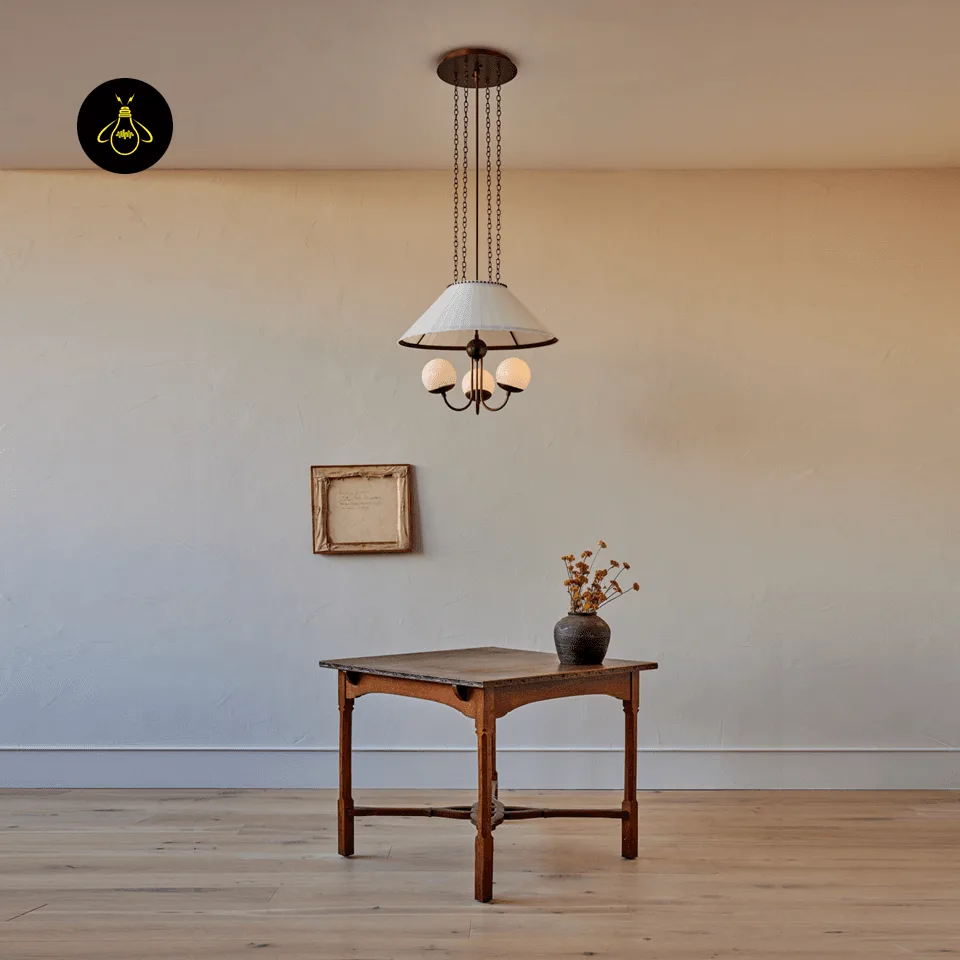
For the smallest rooms, the vintage glass chandelier is 24.4 cm across, with three opal borosilicate glass globes under a pleated fabric shade. Opal glass has white added while it is made, so the glow stays soft with no glare.
Every frame is 304-grade stainless steel, made in our own factory in India since 2015, with free shipping across India. Our certifications page lists the checks behind them. Pale walls and warm light also sit well with Vastu thinking, which values open, well-lit space.
FAQs
How to make a room look bigger without breaking walls?
Use pale paint, light the walls and keep the ceiling light high. A white paint with LRV 83 reflects about ten times more light than a navy with LRV 8.
Which colour makes a small room look bigger?
Pale colours with a high LRV, such as white or cream, make a small room look bigger. EN 12464-1 suggests a reflectance of 0.7–0.9 for ceilings and 0.5–0.8 for walls.
Does a chandelier make a small room look smaller?
A chandelier that is too wide or hangs too low can. Keep it near the length-plus-width size, about 56 cm in a 10 × 12 ft room, and keep 213 cm of headroom.
How to make a room feel bigger with lighting?
Light the walls and ceiling, not just the floor. Flynn’s studies found wall lighting gave people a stronger sense of space.
How to make a small room look bigger with a low ceiling?
Pick a semi-flush light and a pale ceiling. In a 2.75 m room, a light no deeper than about 62 cm keeps 213 cm of headroom, and lighter ceilings look taller in the Oberfeld study.
Nature gives the material.
Human hands give it meaning.
Vastu inspires harmony.
Light brings it to life.
That is JagMag.
See our small chandeliers, then read small bedroom ideas or how to size a chandelier for a small room. Not sure? Video-call us.
Sources
- Sherwin-Williams, Worthy of Reflection (LRV scale) (read 1 Nov 2026)
- Benjamin Moore, White Dove OC-17 (LRV 83.16) (read 1 Nov 2026)
- Benjamin Moore, Hale Navy HC-154 (LRV 8.36) (read 1 Nov 2026)
- Trilux, Luminance distribution and reflectance (EN 12464-1) (read 1 Nov 2026)
- Maxim Lighting, Chandelier size calculator (read 1 Nov 2026)
- Lighting Reimagined, How to size a chandelier (read 1 Nov 2026)
- US Access Board, Guide to the ADA Standards, Chapter 3: Protruding objects (read 1 Nov 2026)
- Model Building Bye-Laws 2016, general building requirements (read 1 Nov 2026)
- Labsphere, Integrating Sphere Theory and Applications (read 1 Nov 2026)
- Bará and Escofet, On lamps, walls, and eyes (arXiv) (read 1 Nov 2026)
- NIST, Evaluation of Subjective Response to Lighting Distributions (Collins, 1993) (read 1 Nov 2026)
- Oberfeld, Hecht and Gamer (2010), Surface lightness influences perceived room height (read 1 Nov 2026)
- NASA, The Inverse Square Law of Light (read 1 Nov 2026)