
You have picked a dining chandelier you love. Then a worry comes up. Will it hit someone’s head? Will it look squashed under a false ceiling? The answer starts with one number: the standard ceiling height in India, and how much of it your room really has.
Below you will find the legal minimum, the usual height in Indian flats, and a simple sum that tells you how low your chandelier can hang over the table.
The short answer
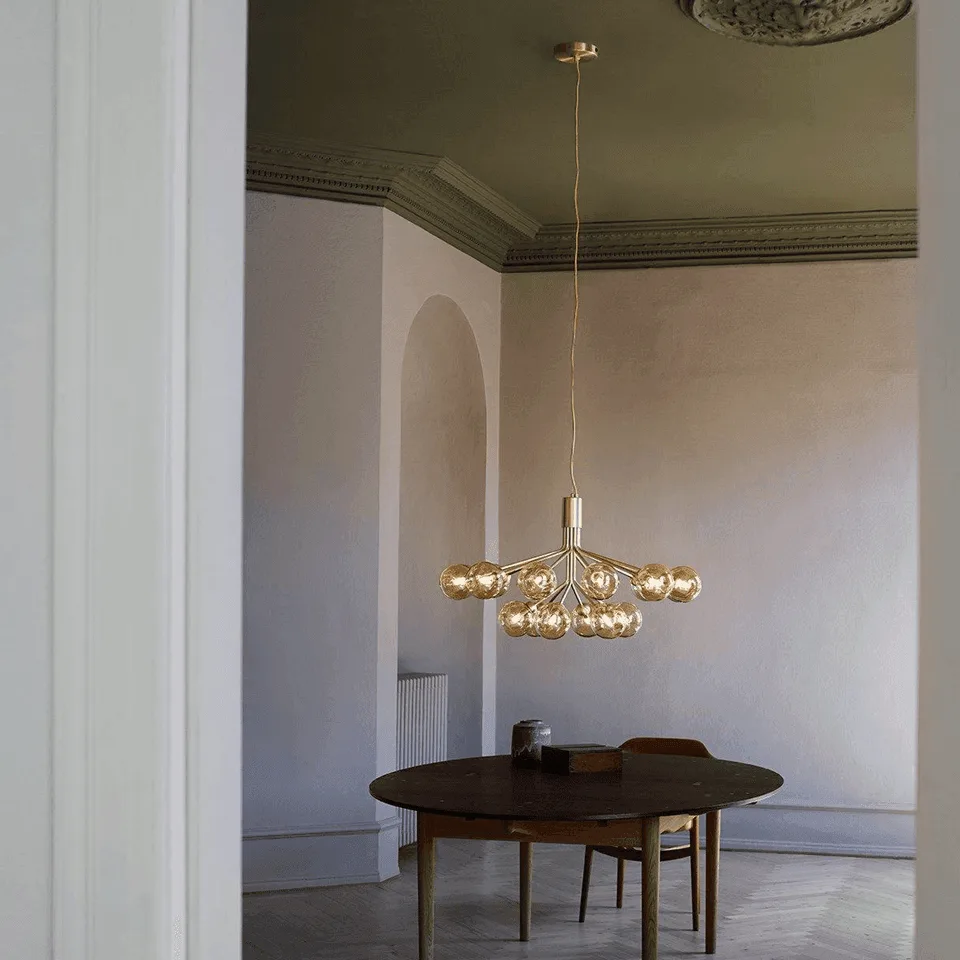
Building bye-laws in India set at least 2.75 m (about 9 ft) for living rooms and bedrooms. Many city flats have 9–10 ft ceilings, and a false ceiling takes 20–30 cm of that. Over a dining table, hang the bottom of the chandelier 76–91 cm above the tabletop.
Standard ceiling height in India: what the rules and builders say
The standard ceiling height in India comes from building bye-laws. The Jaipur Building Bye-Laws 2020 ask for 2.75 m in habitable rooms and kitchens. Bathrooms and toilets may drop to 2.2 m. The Model Building Bye-Laws table gives the same 2.75 m and 2.2 m.
A habitable room is any room you live in, such as a bedroom, living room or dining room. The height is measured from the finished floor to the lowest point of the ceiling.
Real homes often go a little higher. HomeLane notes that urban Indian flats often have 9 or 10 ft ceilings. Brick and Bolt calls 8–9 ft (2.44–2.74 m) conventional.
| Item | Number |
|---|---|
| Minimum height, living rooms and bedrooms | 2.75 m (about 9 ft) |
| Minimum height, bathrooms and toilets | 2.2 m |
| Usual city flat ceiling | 9–10 ft (2.74–3.05 m) |
| False ceiling height from floor: space it takes | 8–12 in (20–30 cm) below the slab |
| Dining table top | About 76 cm (30 in) |
| Chandelier bottom above the table | 30–36 in (76–91 cm) |
HouseYog adds a useful warning. A false ceiling needs 8–12 inches, so it suits rooms of 10 ft or more. Raymour and Flanigan, a US furniture store, gives the hanging rule. Keep the bottom 30–36 inches above the table, and at least 7 ft above the floor where people walk.
Our own dining room chandeliers page says the same in centimetres: about 75–85 cm above the tabletop.
How far should a chandelier hang from the ceiling?
Take a common flat. The slab is 2.75 m high, and the false ceiling sits 25 cm below it. Your table is 76 cm tall.
- Usable ceiling: 275 − 25 = 250 cm from the floor.
- Bottom of the light: 76 cm table + 80 cm gap = 156 cm from the floor.
- Space left for the light: 250 − 156 = 94 cm.
- A chandelier body 30 cm tall leaves 94 − 30 = 64 cm for the canopy and the wire or rod.
So in this room the chandelier hangs about 64 cm from the ceiling. Change any number and the sum changes. A 10 ft ceiling with no false ceiling (305 cm) leaves 149 cm of space.
Now check the size of the light itself. Lamps Plus, a lighting retailer, suggests 2.5–3 inches of chandelier height for each foot of ceiling. A 250 cm ceiling is 8.2 ft. So 8.2 × 2.5 = 20.5 in and 8.2 × 3 = 24.6 in, about 52–62 cm. A body taller than about 62 cm will look heavy in this room.
The standard height of a ceiling in metres converts simply. One foot is 0.3048 m, so 2.75 m ÷ 0.3048 = 9.02 ft.
We measured our own range on 31 October 2026. Our Dining Room Chandeliers hold 82 published lights. Of the 52 that list a body height, 20 are 30 cm or less, 22 are 31–50 cm, and 10 are taller than 50 cm. The middle value is 40 cm. Four more fix flush to the ceiling and two are semi-flush, for the lowest rooms.
Why the gap matters: eyes, glare and the slab above
The 76–91 cm gap is not a style choice. The logic runs step by step. When you sit, your eyes are well below the light. The bright part stays above your line of sight. So you see faces across the table, not a glaring bulb.
Glare is the harsh shine that makes you squint. A Perkins+Will research paper on glare explains that discomfort glare can come from anywhere in your field of view. Keeping the source above eye level is the easiest fix.
Distance also decides how bright the table looks. HyperPhysics at Georgia State University explains the inverse square law: light at 2 m is one quarter of the light at 1 m. Think of a torch beam spreading wider as you step back. Raise a chandelier from 80 cm to 160 cm above the table and the table gets 2 × 2 = 4 times less light.
The 7 ft rule is for walkways. Nobody walks across a dining table, so the light can hang lower there. Over the open floor beside the table, keep 213 cm (7 ft) clear.
The false ceiling adds one more rule. Gypsum board is thin and is not as strong as a concrete slab. Asian Paints advises fixing a sturdy hook in the slab before the false ceiling goes up. Do this before the board is closed, while your electrician can still reach the slab.
When guides differ, let the ceiling decide. Lamps Plus suggests 30–34 inches for 8 ft ceilings and 36–40 inches for 9 ft or more. A low room takes the lower number. A tall room takes the higher one.
The JagMag philosophy: shaped to fit your ceiling, not the other way round
Nature gives the material. Human hands shape it. Light connects the family at the table. A good dining light fits your room’s real height, so nobody ducks and nobody squints.
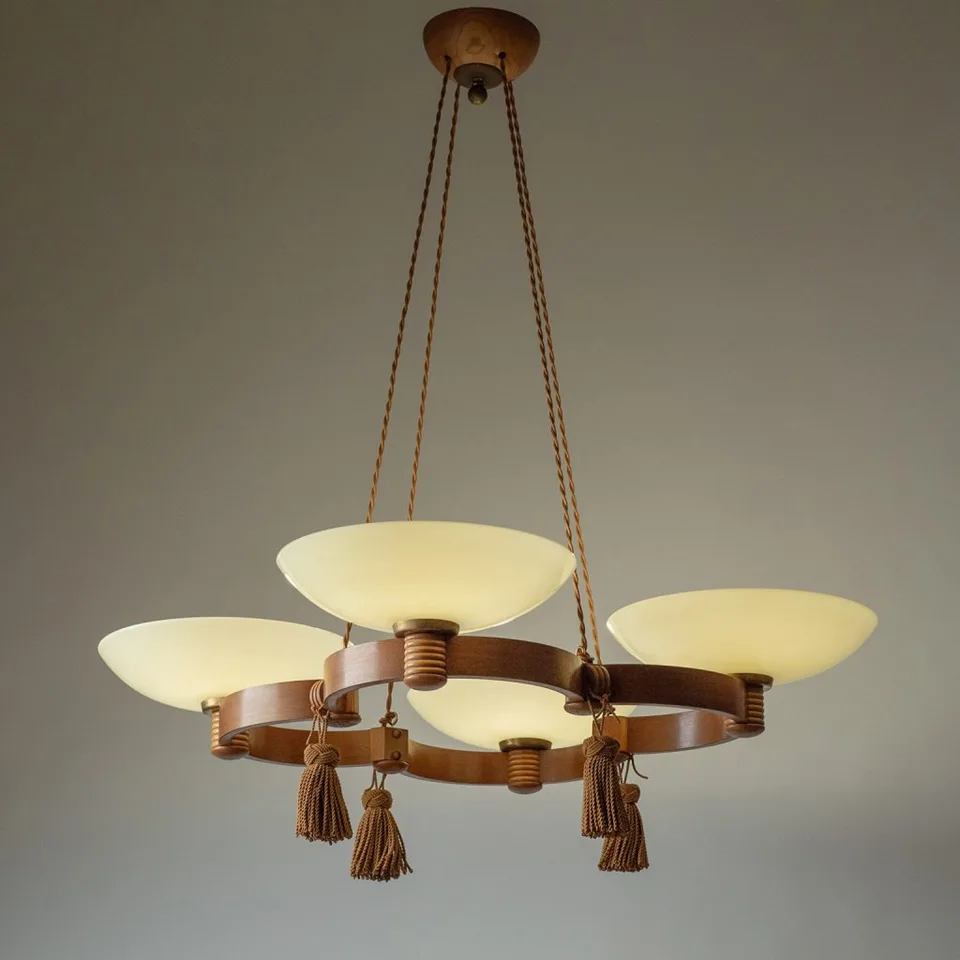
The Wood and Glass Chandelier is 86 cm wide with a body only 25 cm tall. Four opal borosilicate glass bowls face up on a shaped wooden ring. Its fabric cords drop up to 103 cm and are shortened at the rose. The four E27 holders come without bulbs; fit 3000K warm-white LEDs.
The Dining Table Chandelier with six glass globes has a 30 cm body on a 120 cm bar. The light hangs on 1.5 m of wire as standard, shortened at fitting to sit 75–90 cm above your table. Its built-in LED ring is 3000K warm white.
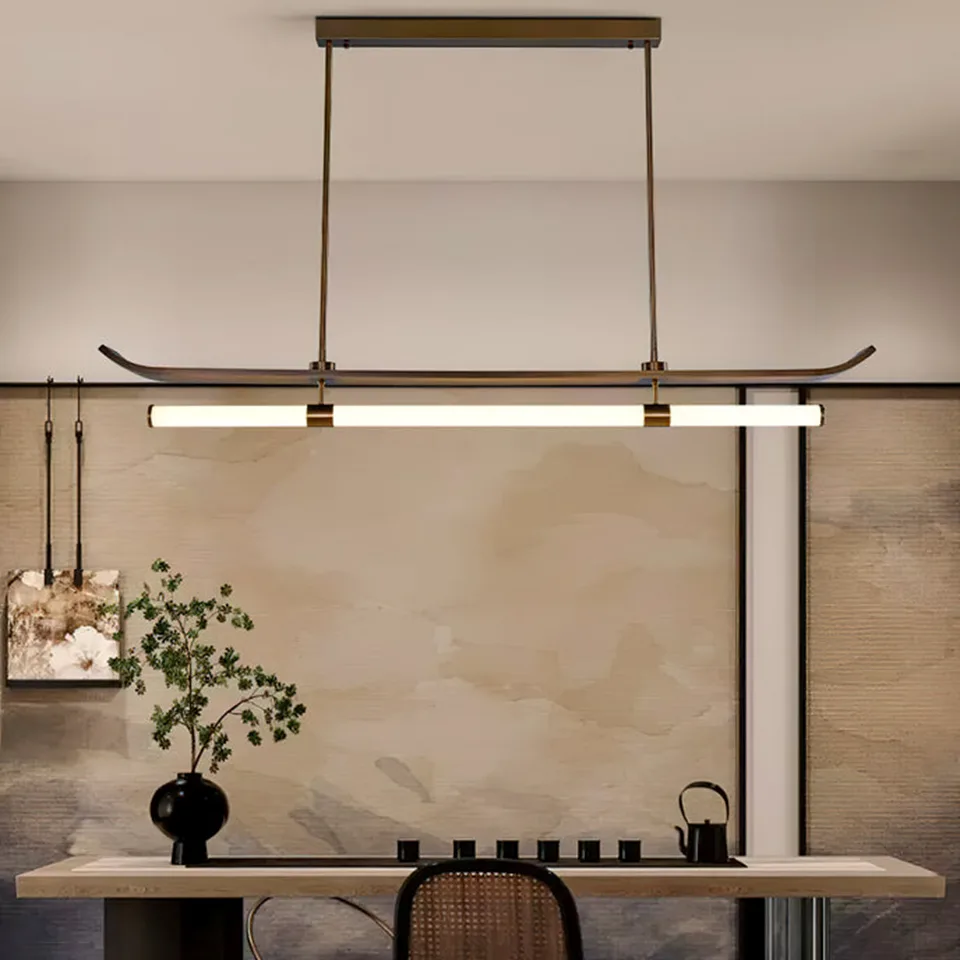
For long tables, the Wood Linear Chandelier runs 150 cm, with a wood blade over an acrylic diffuser tube that spreads the light evenly.
Our craftsmen make every part in our own factory in India, where we have built lights since 2015. Any licensed electrician can fit these lights, and we help on a free video call. The 304-grade stainless steel parts carry a lifetime rust warranty, as our Legal Policies state for orders from 4 October 2026.
A table with warm light over it is where a family slows down. Vastu thinking has long valued that kind of calm, well-lit gathering space. We do not promise luck, only a room that feels right.
FAQs
What is the standard ceiling height in India?
The minimum is 2.75 m (about 9 ft) for living rooms and bedrooms, and 2.2 m for bathrooms, under bye-laws such as Jaipur 2020. Many city flats are built at 9–10 ft.
What is the false ceiling height from the floor?
A false ceiling usually sits 8–12 inches (20–30 cm) below the slab. In a 10 ft room that leaves about 9 ft to 9 ft 4 in from the floor.
How far should a chandelier hang from the ceiling?
Work back from the table: ceiling height minus table height (about 76 cm), minus a 76–91 cm gap, minus the chandelier’s own height. In a 250 cm room with a 30 cm light, that leaves about 64 cm.
Can I hang a chandelier with a 9 ft ceiling?
Yes. Pick a body of about 30–50 cm and keep its bottom 76–91 cm above the table. Flush or semi-flush pieces suit rooms with a deep false ceiling.
Nature gives the material.
Human hands give it meaning.
Vastu inspires harmony.
Light brings it to life.
That is JagMag.
See our dining room chandeliers, then read 6 seater dining table size or chandelier and ceiling fan in the same room. Not sure? Video-call us.
Sources
- Jaipur Building Bye-Laws 2020, Regulation 11.0 (Frontdesk) (read 31 Oct 2026)
- Model Building Bye-Laws, general building requirements (read 31 Oct 2026)
- HomeLane, False Ceiling Installation Guide (read 31 Oct 2026)
- Brick and Bolt, High Ceiling House (read 31 Oct 2026)
- HouseYog, All About False Ceiling (read 31 Oct 2026)
- Raymour and Flanigan, How to Determine Chandelier Height (read 31 Oct 2026)
- Lamps Plus, What’s the Correct Chandelier Size? (read 31 Oct 2026)
- Wooden Street, 6 Seater Dining Table Size Guide (read 30 Oct 2026)
- HyperPhysics, Georgia State University, Inverse Square Law, Light (read 31 Oct 2026)
- Perkins+Will Research Journal, Understanding Glare (D. Mead) (page no longer online) (read 31 Oct 2026)
- Asian Paints Beautiful Homes, Do’s and Don’ts for Your False Ceiling (read 31 Oct 2026)