You find a glass pendant you like. One shop calls the shade reeded. Another calls the same look fluted. A third says ribbed. You start to wonder if you are buying three different things.
Our guide settles reeded glass vs fluted glass in plain words. The guide shows what the ribs do to light, with two small sums and the physics underneath. Then you can choose a ribbed shade with confidence.
The short answer
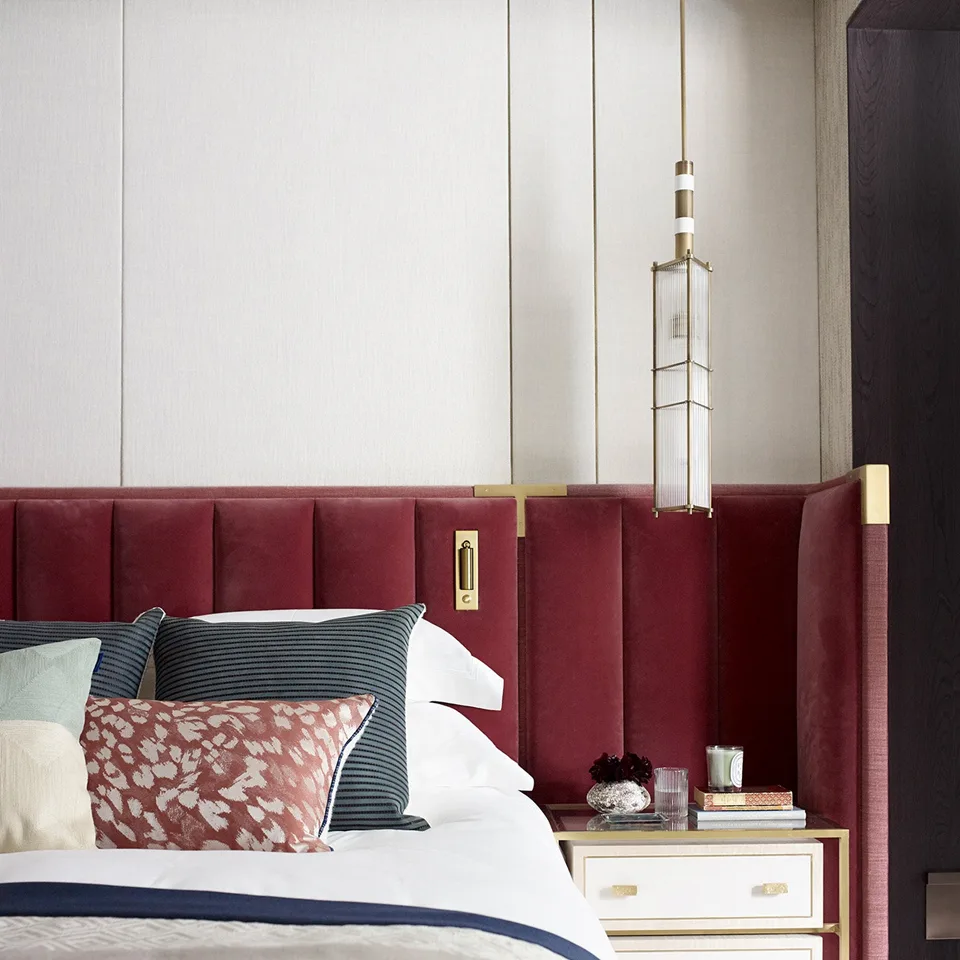
In the reeded glass vs fluted glass question, most makers use reeded, fluted and ribbed for the same thing: glass with long, straight ribs. A few makers split hairs: reeded ribs curve inward, and fluted ribs bulge outward. In pendant lamps, both hide the bulb and turn its glare into soft stripes of light.
Fluted reeded glass: what each word means
Ribbed glass has a surface of parallel ridges, like the lines on a corrugated sheet but smooth and rounded. Three names float around for it.
- Interchangeable names. The design site Indesignlive says fluted glass is the same as reeded glass, and also called ribbed glass. Two other design sites and a glass seller say the same.
- The fine split. Craftivity Designs says reeded glass is concave, curving in like a spoon. Fluted glass is convex, bulging out like the back of the spoon.
- How flat panels get their ribs. The same site says makers press semi-molten glass between metal rollers.
- Frosted is different. Frosted glass is usually sandblasted, so the whole surface turns cloudy. Ribbed glass stays clear between and along the ribs.
A shade is round, not flat, so it is not rolled. Our ribbed shades are blown or moulded by hand from borosilicate glass. On our pages, the lantern says “reeded (fluted)”, because buyers search both words.
So when two shops use different names, look at the glass, not the label. Ask three things: how wide are the ribs, is the glass clear or coloured, and does the bulb sit inside the ribbed part?
Reeded vs fluted glass: what do the sums say?
Start with our own range. On 31 October 2026, our glass pendant lights category had 29 designs. 9 of them use ribbed, fluted or reeded glass. 9 ÷ 29 = 31%, close to one in three.
Next, see how much a rib bends light. Light slows down in glass, and the bend depends on a number called the refractive index. The data sheet from the glass maker SCHOTT gives 1.471 for borosilicate glass.
- Take a ray of light that meets the glass at 30 degrees from straight on.
- Snell’s rule for bending light says: sin(angle inside) = sin(30°) ÷ 1.471.
- sin(30°) = 0.5, and 0.5 ÷ 1.471 = 0.340.
- The angle whose sine is 0.340 is about 19.9 degrees.
- So the ray turns about 10 degrees on its way in, and turns again on its way out.
On flat glass, the ray comes out parallel to where it started. On a curved rib, the two surfaces are not parallel, so the turns do not cancel. Every rib throws the light a little to one side.
A second sum shows why borosilicate suits a lamp. The same data sheet gives a heat growth of 3.25 millionths per degree Celsius.
- Our fluted shade is 25 cm wide, which is 250 mm.
- Say the glass warms by 40 °C when the light is on.
- Growth: 250 × 0.00000325 × 40 = 0.0325 mm.
The shade grows by about three hundredths of a millimetre. Small growth means low stress inside the glass when it warms and cools every evening.
Why ribs soften glare: the logic and the science
The logic runs in a short chain. A bare bulb is a tiny, very bright point. A bright point straight in the eye causes glare. Ribs stretch that point into many soft lines, so the eye never meets one hot spot.
The science is the cylindrical lens. A normal round lens, like a magnifying glass, focuses light into a point. A cylindrical lens, shaped like a glass rod, focuses light into a line instead. The rod bends light across its width and leaves it unchanged along its length.
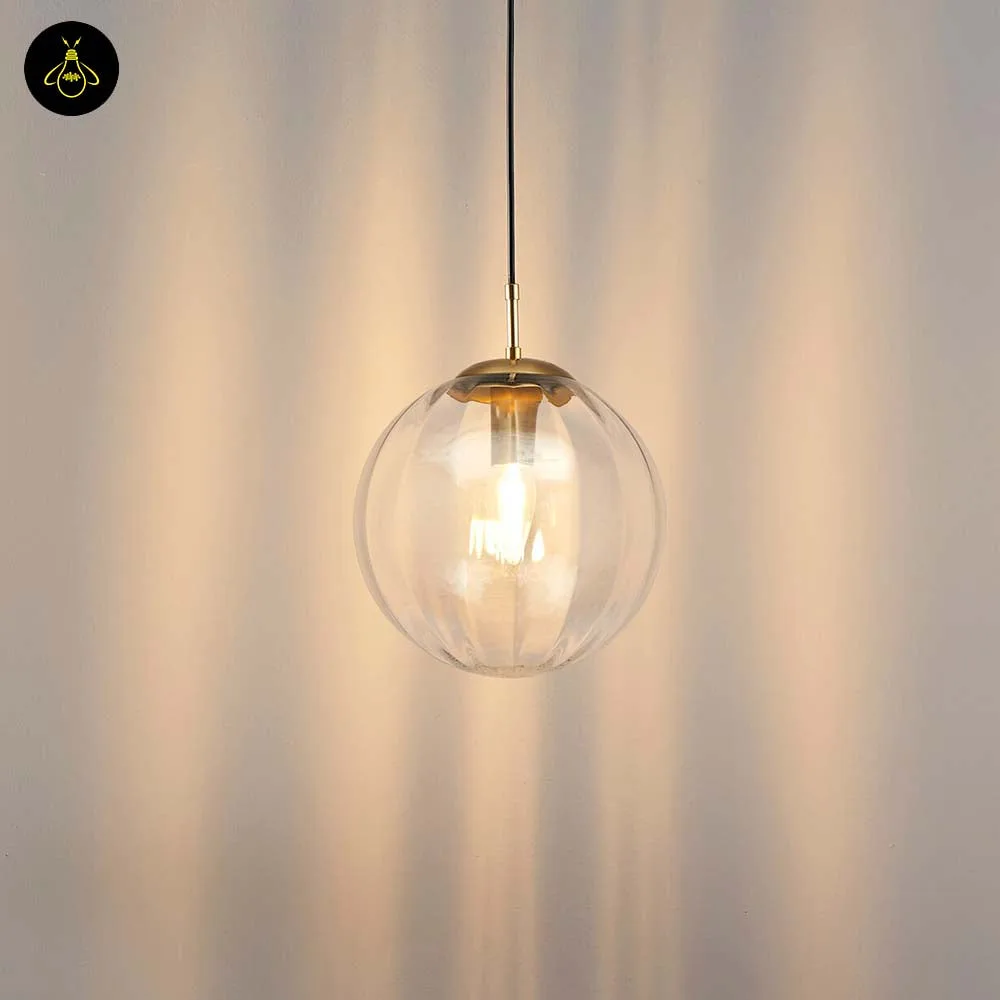
Each rib on a shade is a tiny glass rod. Vertical ribs stretch the bulb into vertical lines. A shade with dozens of ribs makes dozens of lines, and the eye sees a striped, gentle glow. You can see those stripes on the wall in the photo above.
Convex and concave ribs bend light in opposite directions. At the distance you sit from a pendant, both blur the bulb. The difference is mostly in how the glass feels under your finger and catches the light.
So choose by what you need. Pick tight, many ribs when the bulb sits at eye level, as over a bedside. Pick wider ribs or tinted glass when the shade hangs high and you want more sparkle. If you want no stripes at all, pick opal glass. Our guide to opal glass explains that glow.
Nature gives, hands shape, light draws the lines
Borosilicate glass starts as silica sand, boric oxide, soda ash and alumina, melted together. Then a craftsman blows or moulds it, rib by rib. Light does the last part and draws the lines on your wall.
The Glass Lantern Pendant Light holds clear reeded borosilicate glass in a slim cage of 304-grade stainless steel. The cage is 75 cm tall and 17 cm wide, so it hangs well beside a bed.
The Fluted Glass Pendant Light has a 25 cm by 36 cm ribbed barrel shade. The shade comes in clear, green or gold-lustre glass, with the colour added while the glass is made. The pendant hangs on 1.5 m of wire, shortened when it is fitted.
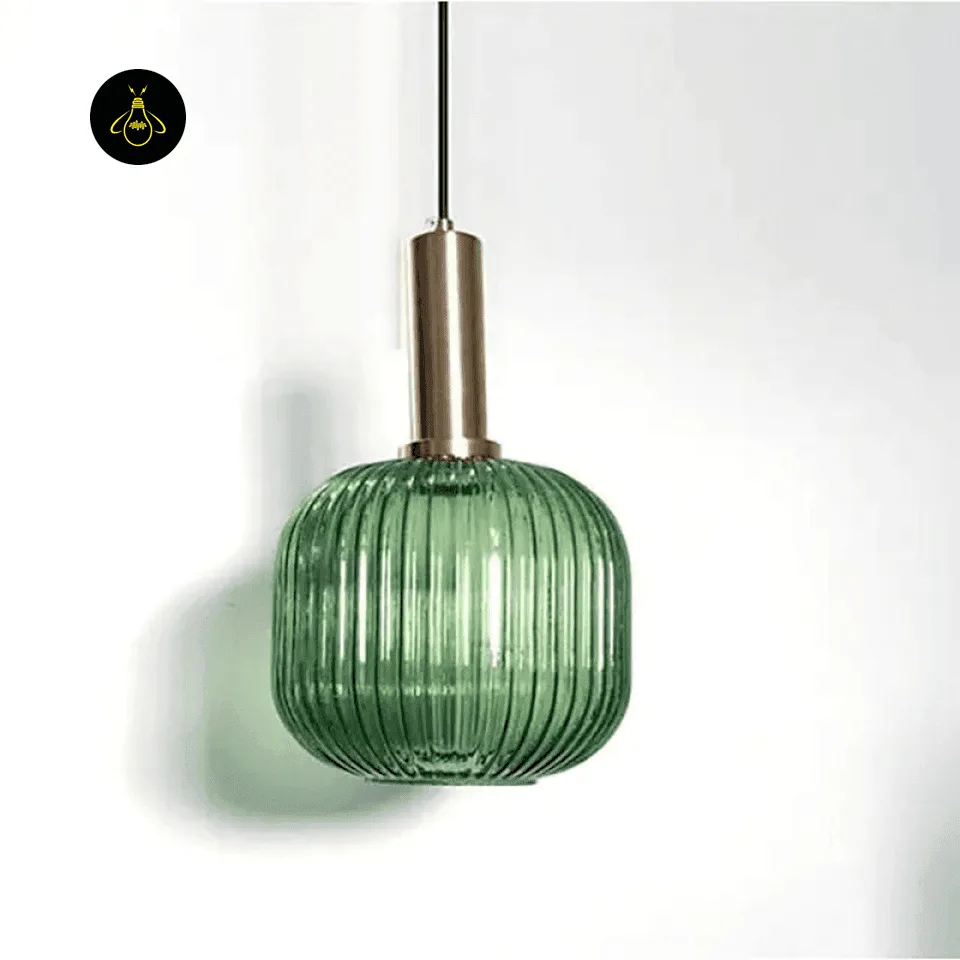
The Ribbed Glass Ball Pendant Light is a 20 cm globe of light smoked borosilicate glass. The holder takes up to 40 W; fit a 3000K warm-white LED, because the bulb is not included.
All three are made by our craftsmen in our own factory in India. We have made lights since 2015. The steel parts carry a lifetime warranty against rust on orders from 4 October 2026, as our legal policies set out.
Vastu thinking links light with fire, one of the five elements. A warm glow, spread soft by glass, keeps that fire gentle in the room. We do not promise luck, only a calmer evening.
FAQs
What is the difference between reeded glass vs fluted glass?
Most makers treat them as the same ribbed glass. A few say reeded ribs curve inward and fluted ribs bulge outward, but both soften a bulb in a pendant.
Is ribbed glass the same as fluted glass?
Yes, most sources use ribbed and fluted for the same glass. Even the site that splits reeded from fluted calls fluted and ribbed the same thing.
Does fluted glass make a pendant light less bright?
Clear fluted glass mainly changes the direction of light, because clear borosilicate glass is highly transparent. Smoked or amber fluted glass passes less light, so choose a brighter 3000K LED bulb for those.
Is fluted glass the same as frosted glass?
No. Frosted glass is usually sandblasted and looks cloudy all over, while fluted glass stays clear and bends light through its ribs.
Why does a ribbed pendant make stripes on the wall?
Each rib acts like a small glass rod, which focuses light into a line instead of a point. Many ribs make many lines.
Nature gives the material.
Human hands give it meaning.
Vastu inspires harmony.
Light brings it to life.
That is JagMag.
See every shape and colour in our glass pendant lights. To fit one, read how to hang a pendant light, or learn what borosilicate glass is. Not sure? Video-call us.
Sources
- Indesignlive: fluted glass design ideas (30 May 2022) (read 31 Oct 2026)
- Craftivity Designs: reeded glass (read 31 Oct 2026)
- Remodelista: fluted glass in kitchens and baths (23 June 2023) (read 31 Oct 2026)
- Stake Glass: reeded glass (read 31 Oct 2026)
- Houzz: 8 ways to use reeded glass (1 April 2019) (read 31 Oct 2026)
- SCHOTT BOROFLOAT 33 technical data sheet (read 31 Oct 2026)
- Wikipedia: cylindrical lens (read 31 Oct 2026)
- Sinoptix: cylindrical lens, a complete guide (read 31 Oct 2026)