You fit a new light over the dining table. Switch it on, and the dal looks grey. The rotis look pale. Faces look tired. The bulb is bright enough, so what went wrong?
The answer is usually CRI. Our guide explains what is CRI in lighting, how to read the number on a bulb box, and the simple sums that help you choose a bulb for the table.
The short answer
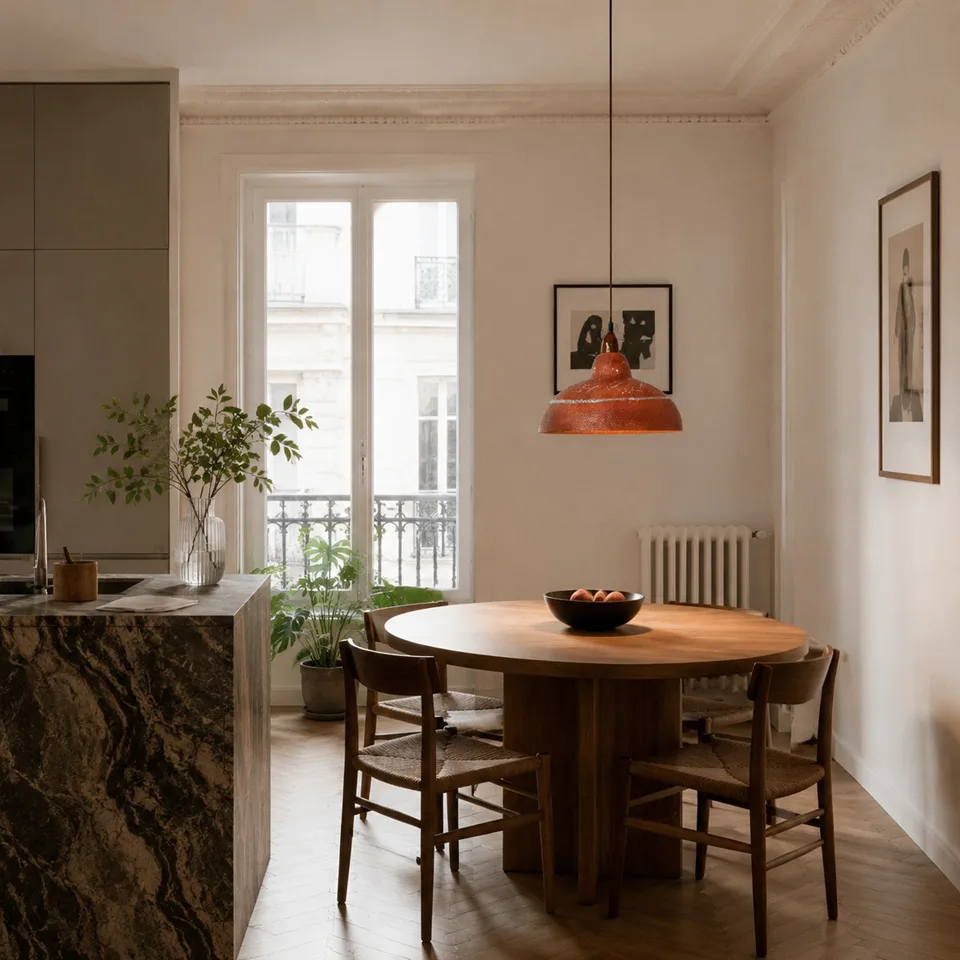
CRI full form is Colour Rendering Index. The colour rendering index meaning is simple: the index scores, out of 100, how true colours look under a light, compared with a reference light of the same colour. For a dining table, fit a 3000K warm-white bulb with a CRI of 90 or more in your pendant lights.
What is CRI in lighting? How the score is set
The rule book is CIE 13.3-1995, from the international lighting body CIE. Testers shine the bulb on 8 standard colour cards. Then they shine a reference light of the same colour on the same cards. The score shows how far each colour moves.
CRI, also written Ra, is the average of those first 8 cards. The standard adds 6 more cards for strong red, yellow, green, blue, skin and leaf. The strong red card is called R9. The US Department of Energy says R9 matters for skin tones.
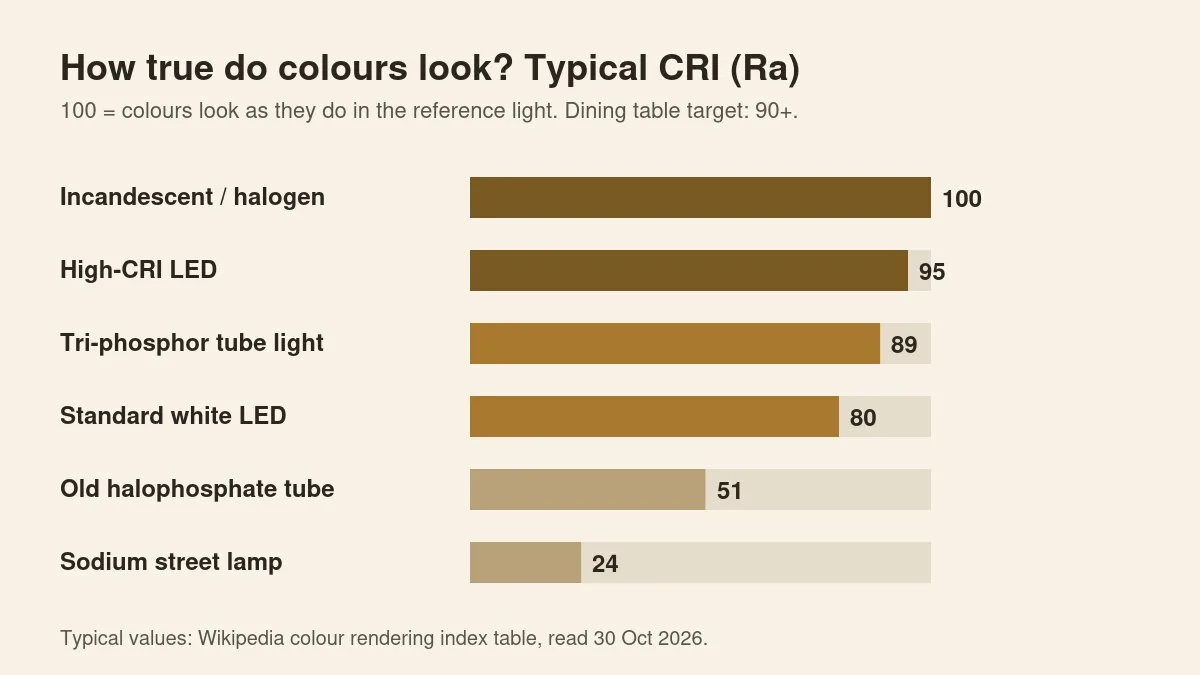
| Light source | Typical CRI (Ra) |
|---|---|
| Old filament or halogen bulb | 100 |
| High-CRI LED | 95 |
| Tri-phosphor tube light | 89 |
| Standard white LED | 80 or more |
| Old halophosphate tube light | 51 |
| Sodium street lamp | 24 |
Rules set the floor at 80. Europe’s ecodesign rule asks for CRI 80 or more. ENERGY STAR asks for 80, with R9 above 0. California’s JA8 rule asks for 90, with R9 of 50 or more. India’s BEE star-label schedule tests CRI under IS 16102 but does not print a minimum.
The Department of Energy grades the bands simply. A CRI in the 70s is acceptable indoors, the 80s are good, and the 90s are excellent.
What does a CRI of 80 or 90 mean? Two sums
Each colour card gets its own score. The formula is: score = 100 − 4.6 × colour shift. A shift of 0 means the colour did not move at all.
- For a score of 80: colour shift = (100 − 80) ÷ 4.6 = 4.35.
- For a score of 90: colour shift = (100 − 90) ÷ 4.6 = 2.17.
- Divide one by the other: 4.35 ÷ 2.17 = 2.
- So a CRI 90 bulb moves colours about half as much as a CRI 80 bulb.
Now the power cost. A California Energy Commission report assumed high-CRI bulbs lose about 15% of their efficiency. For an 800-lumen bulb, the report puts the extra at about 0.8 W. Lumens measure how much light a bulb gives out.
- Take three pendants over a table, each with an 800-lumen bulb.
- Extra power: 3 × 0.8 W = 2.4 W.
- Lit 4 hours a night: 2.4 W × 4 h × 365 days = 3,504 Wh.
- So the whole year costs about 3.5 extra units of power. One unit is one kWh on your bill.
We counted our own range on 30 October 2026. Of 103 dining room pendants, 83 take a bulb, or 80.6%. On those, you choose the CRI when you buy the bulb. The other 20 have a built-in 3000K LED.
Why colours go dull: logic and science
Your eye has three kinds of colour cells, called cones. One kind reacts most to blue light, near 420–440 nm. One reacts to green, near 534–545 nm. One reacts to red, near 564–580 nm. Your brain mixes the three signals into colour, like a cook mixing three spices.
An object only reflects the light that reaches it. A tomato looks red because it bounces back red light. If the bulb sends little red, the tomato has little red to bounce. So it looks brown.
Most white LEDs make their light from a blue chip and a yellow coating, says the Department of Energy. The blue-and-yellow mix can run short of deep red. So R9, the red card, often scores lowest. A California Energy Commission report says red matters most for food, skin and wood.
Colour temperature is a different number. Kelvin, written K, tells you the colour of the light itself: 3000K looks warm and yellow. CRI tells you how objects look under it. A bulb can be 3000K and still show colours badly. Our guide on warm white vs cool white covers the kelvin side.
Red costs energy. The Lumileds LED company explains that a higher CRI needs more red-orange light, where the eye is less sensitive. So a 90-CRI bulb gives fewer lumens per watt than an 80-CRI bulb.
No score is perfect. The Lighting Research Center says CRI alone does not fully predict how colours look. The newer TM-30 method uses 99 colour samples. When guides differ, use a simple rule. Pick CRI 90 and R9 of 50 where people eat. CRI 80 is fine for a passage or a store room.
The JagMag way: honest light for real materials
Nature gives every material its own colour. Human hands shape it. Good light lets that colour show at your table, the place where the family gathers.
Clay comes from the earth. Our terracotta pendant light is fired clay, painted by hand, with a 35 cm dome. Its earthy red needs red in the light. The pendant takes an E27 bulb, the common screw-in size. The bulb is not included, so fit a 3000K warm-white LED marked CRI 90.
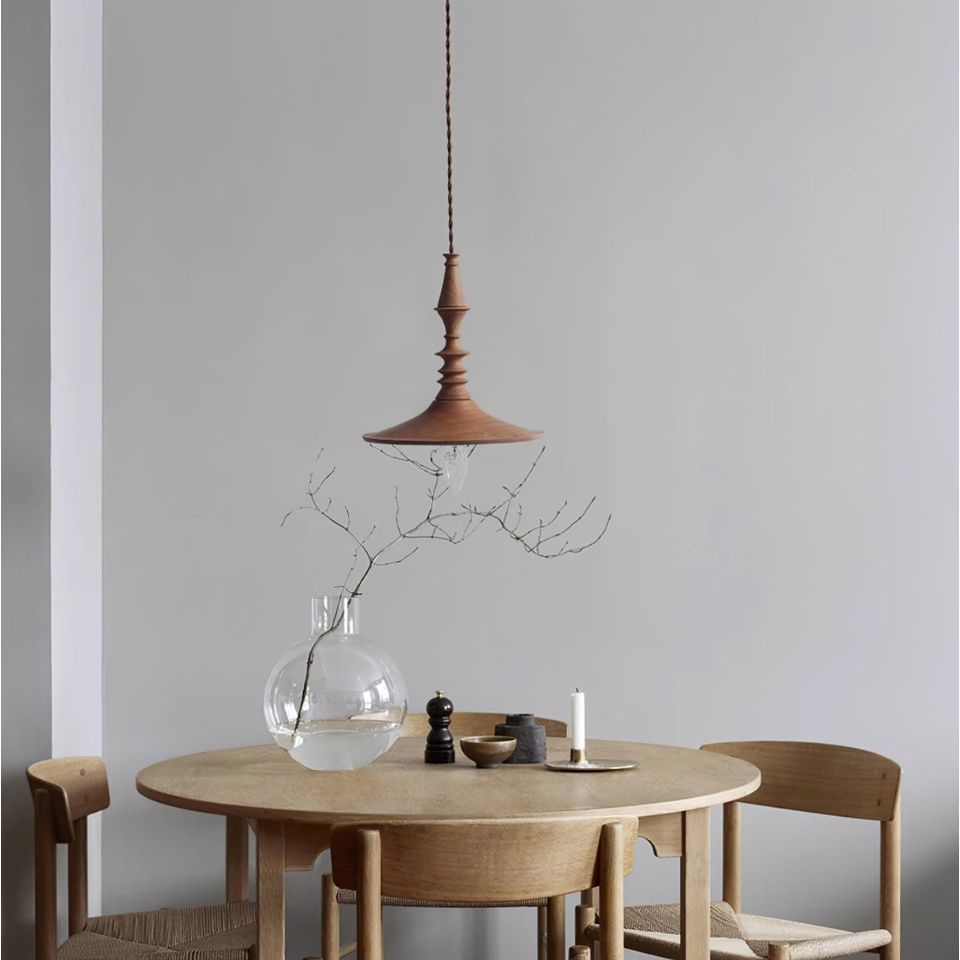
Wood grows for years before it reaches us. The turned wood pendant light is solid wood, turned by hand on a lathe into a 23 cm shade. Its bulb shows below the brim, so choose that bulb well.
Linen comes from the flax plant. The scalloped linen pendant is 45 cm wide and takes one E27 bulb of up to 60 W. Light passes through the weave, so a true-colour bulb keeps the beige warm, not grey.
Our craftsmen have made these in Greater Noida since 2015. Every metal part is 304-grade stainless steel, with a lifetime warranty against rust. Our lights carry CE, UL and ZED certification.
Vastu links warm light, the fire element, with a calm place to eat. A warm, true-colour bulb over the table fits that thinking.
FAQs
What is CRI full form?
CRI stands for Colour Rendering Index. The index scores from 0 to 100 how true colours look under a light, compared with a reference light.
What is CRI in lighting, and what number is good for a home?
CRI in lighting is a colour-truth score. Most rules set 80 as the minimum. For a dining table, kitchen or dressing mirror, choose 90 or more.
Is CRI the same as colour temperature?
No. Colour temperature, in kelvin, is the colour of the light, such as 3000K warm white. CRI is how true objects look under that light.
What is R9 on a bulb box?
R9 is the score for a strong red colour card. California’s JA8 rule asks for R9 of 50 or more, which helps food and skin look natural.
Does a high-CRI bulb use more power?
Slightly. Reports put the efficiency loss at about 15–20%, or about 0.8 W on an 800-lumen bulb. Three such bulbs, lit 4 hours a night, add about 3.5 units a year.
Nature gives the material.
Human hands give it meaning.
Vastu inspires harmony.
Light brings it to life.
That is JagMag.
Ready to light your table? See our dining room pendant lights. Then read how to hang a pendant light and our 6-seater dining table size guide. Not sure? Video-call us.
Sources
- CIE 13.3-1995: method of measuring and specifying colour rendering (read 30 Oct 2026)
- US Department of Energy: LED color characteristics factsheet (read 30 Oct 2026)
- Davis and Ohno, NIST: colour rendering of light sources (read 30 Oct 2026)
- EU Regulation 2019/2020, Annex II (ecodesign for light sources) (read 30 Oct 2026)
- ENERGY STAR Lamps V2.0 specification (draft 3) (read 30 Oct 2026)
- California Title 24 JA8 qualification requirements (read 30 Oct 2026)
- BEE star label schedule for LED lamps (read 30 Oct 2026)
- California Energy Commission docket report on colour quality (read 30 Oct 2026)
- Lumileds: high-CRI LED white paper (read 30 Oct 2026)
- Lighting Research Center (RPI): colour research (page no longer online) (read 30 Oct 2026)
- Wikipedia: Color rendering index (typical values) (read 30 Oct 2026)
- Wikipedia: Cone cell (read 30 Oct 2026)