Your child studies at the desk every evening. You bought a lamp, but the bulb box only says “450 lumens”, and you do not know if that is enough.
How many lumens for reading is a fair question, and the answer is a small sum. Lumens tell you what the bulb gives out. What your eyes need is the light that lands on the page.
Below, you will see the numbers standards use, the sum for your own desk, and the science of why distance changes everything.
The short answer
Aim for about 500 lux on the page, the level work-lighting rules set for desk tasks. A bulb of about 450 lumens, with the lamp head 30 to 40 cm above the book, leaves room to spare. Readers over 60 need 1000 lux or more.
Lux for reading: the levels the rules set
Lux measures how much light falls on a surface. One lux is one lumen spread over one square metre, by the standard definition.
Sweden’s Work Environment Authority follows the European standard EN 12464-1. For normal desk work, it asks for 300 lux in the room and 500 lux on the work area. Harder visual tasks get 750 lux on the work area.
The Lighting Research Center in New York studies light for older adults. The centre says less light reaches the retina of an older eye. Task areas for older people need about three times the light, and at least 1000 lux.
One lamp maker’s reading guide names 450 lumens as the sweet spot for reading a book. The 450 figure is for the bulb, not for the page.
| Who is reading | Light on the page |
|---|---|
| Room light around the desk | 300 lux |
| Student or office reader | 500 lux |
| Harder tasks, fine print | 750 lux |
| Reader over 60 | 1000 lux or more |
How many lumens does your own desk need?
Lumens for study room desks come from one simple rule: lux times area gives lumens. Take a book and notebook open in front of you, a patch 60 cm wide and 40 cm deep.
- Area of the patch: 0.6 m × 0.4 m = 0.24 square metres.
- For 500 lux: 0.24 × 500 = 120 lumens must land on that patch.
- For a reader over 60, at 1000 lux: 0.24 × 1000 = 240 lumens must land there.
- A lamp never puts all its light on the page. Some lights the wall, the arm and the room. With a 450-lumen bulb, about 27 percent must land on the patch for 500 lux, since 120 ÷ 450 = 0.27. A shaded desk lamp aimed down can do that.
Now check what happens when you move the lamp head. Say the lamp gives exactly 500 lux at 35 cm above the page.
- Raise it to 50 cm: 500 × (35 ÷ 50)² = about 245 lux. Half the light is gone.
- Lower it to 30 cm: 500 × (35 ÷ 30)² = about 681 lux.
- To get 500 lux back at 50 cm, you need about 2 times the lumens, because (50 ÷ 35)² = 2.04.
We counted our desk lamp range on 27 October 2026. Of 9 desk lamps, 6 take a bulb you choose (two E27, one GU10, three G9). So for two in three of our lamps, the lumen number on the bulb box is your decision. Three have a built-in 3000K LED, and two have an arm that moves the head closer to the page.
Why distance matters more than the bulb: the logic
The answer to how many lumens for reading depends on distance first. A brighter bulb far away can give less light on the page than a modest bulb close by.
So set the lamp head first, then pick the bulb. Bring the head to 30 to 40 cm above the page and to the side opposite your writing hand. Then your hand throws no shadow on the line you are writing.
When guides differ, read them by the reader. Use 500 lux for a student, and move toward 1000 lux for a parent or grandparent. Fit a stronger bulb, or bring the head closer, rather than buying a second lamp.
Keep the room light on too. The Swedish rules ask that the work area be no more than 20 times brighter than the darkest part of the room. A bright page in a dark room makes the eyes adjust again every time you look up.
The science of lumens, lux and your eyes
A lumen measures all the light a bulb sends out, like the water flowing out of a tap. Lux measures how much of it lands on each square metre, like how wet one patch of floor gets.
Light spreads out in every direction from the bulb. At twice the distance, the same light covers four times the area. So each spot gets a quarter as much, which physicists call the inverse square law.
The eye changes with age. Less light gets through to the retina, the screen at the back of the eye that senses light. So an older reader needs more light on the same page to see the same print.
Glare is the other half of eye comfort. Glare comes from a bright source or reflection that blurs what you see or tires the eyes. A shade or an opal glass diffuser, a milky glass that spreads light, hides the bright point and keeps the light on the book.
Colour plays a part in comfort too. Our built-in LEDs give warm 3000K light, the soft white of an evening sun, and we suggest 3000K bulbs for the rest. Our guide on warm white vs cool white explains that choice.
Nature gives the material, hands shape it, light connects
A desk lamp does one job well when its weight, its reach and its shade work together. Natural materials help with all three.
Our antique brass desk lamp with a marble base rests on real white marble, cut from stone formed beneath the earth. The heavy base holds a balance arm steady. The height moves from 41 to 66 cm and the arm reaches 56 cm. So you can set the head right at the 30 to 40 cm mark. A built-in 3000K LED lights it.
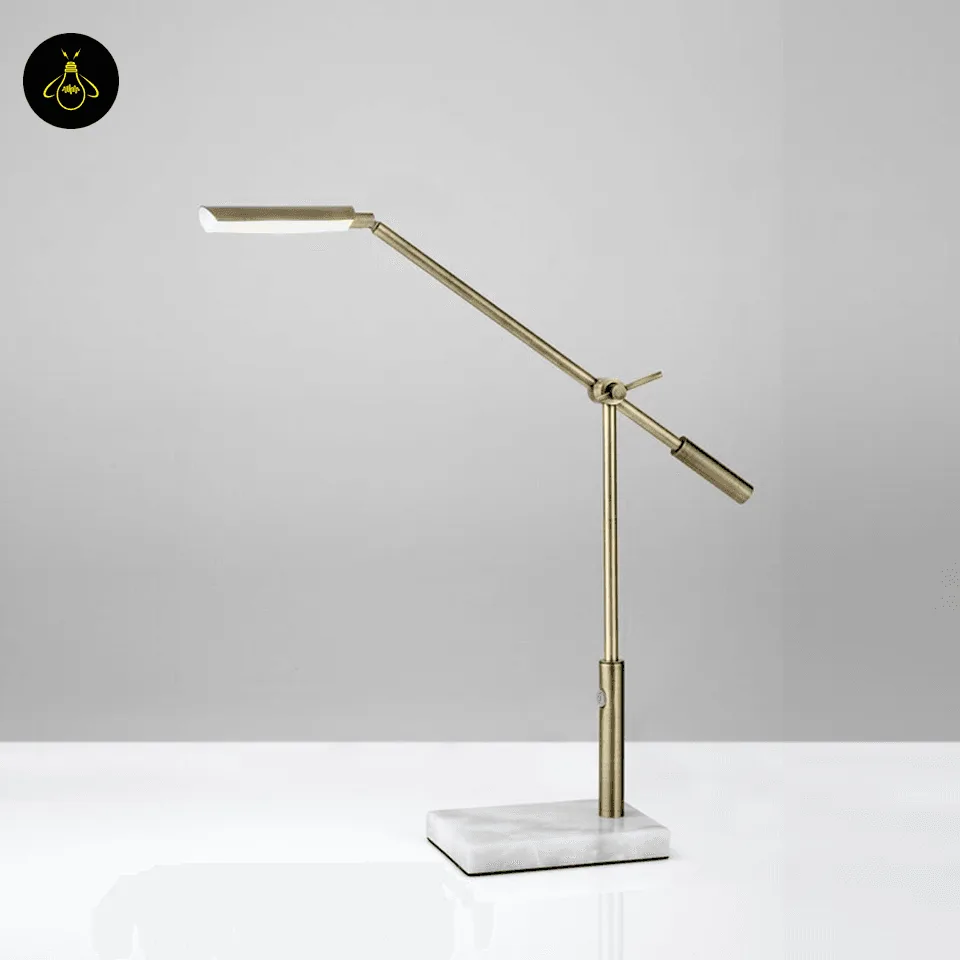
Our adjustable balance-arm desk lamp has an arm that reaches 60 cm and an opal borosilicate glass diffuser in its head. The lamp takes one GU10 bulb, not included; fit a 3000K warm-white LED, and choose its lumens with the sum above.

For a smaller desk, our travertine table lamp with a clear glass dome stands 34 cm tall on a base of real travertine. No two bases match, because the stone’s pits and cream shade change from piece to piece.
Our craftsmen make each lamp in our own Greater Noida factory, where we have worked since 2015. The metal parts are 304-grade stainless steel. You can read how we stand behind them on our legal policies page.
Vastu values a calm, well-lit corner for study. Warm light falling on the page, and a room that is not left dark, gives the mind that quiet place to focus.
FAQs
How many lumens for reading a book?
About 450 lumens from the bulb is enough for most readers when the lamp head sits 30 to 40 cm above the page. What matters is about 500 lux landing on the book.
Is 500 lux enough for reading?
Yes, 500 lux on the page suits students and office readers. Readers over 60 need about 1000 lux or more.
How do I turn lumens into lux?
Divide the lumens that land on the surface by its area in square metres. 120 lumens on a 0.24 square metre patch gives 500 lux.
How far should a desk lamp be from the book?
Keep the lamp head about 30 to 40 cm above the page. Raise it from 35 to 50 cm and the light on the page falls by about half.
Nature gives the material. Human hands give it meaning. Vastu inspires harmony. Light brings it to life. That is JagMag.
See all our desk lamp designs. For the desk itself, read study table direction as per Vastu and our best study lamp guide. Not sure? Video-call us.
Sources
- Swedish Work Environment Authority, Office lighting (refers to SS-EN 12464-1:2021) (read 27 Oct 2026)
- Lighting Research Center, Lighting principles for older adults (page no longer online) (read 27 Oct 2026)
- BenQ, How many lumens for reading (read 27 Oct 2026)
- IALA Dictionary, Lux (read 27 Oct 2026)
- University of Rochester, Intensity: the inverse square law (read 27 Oct 2026)