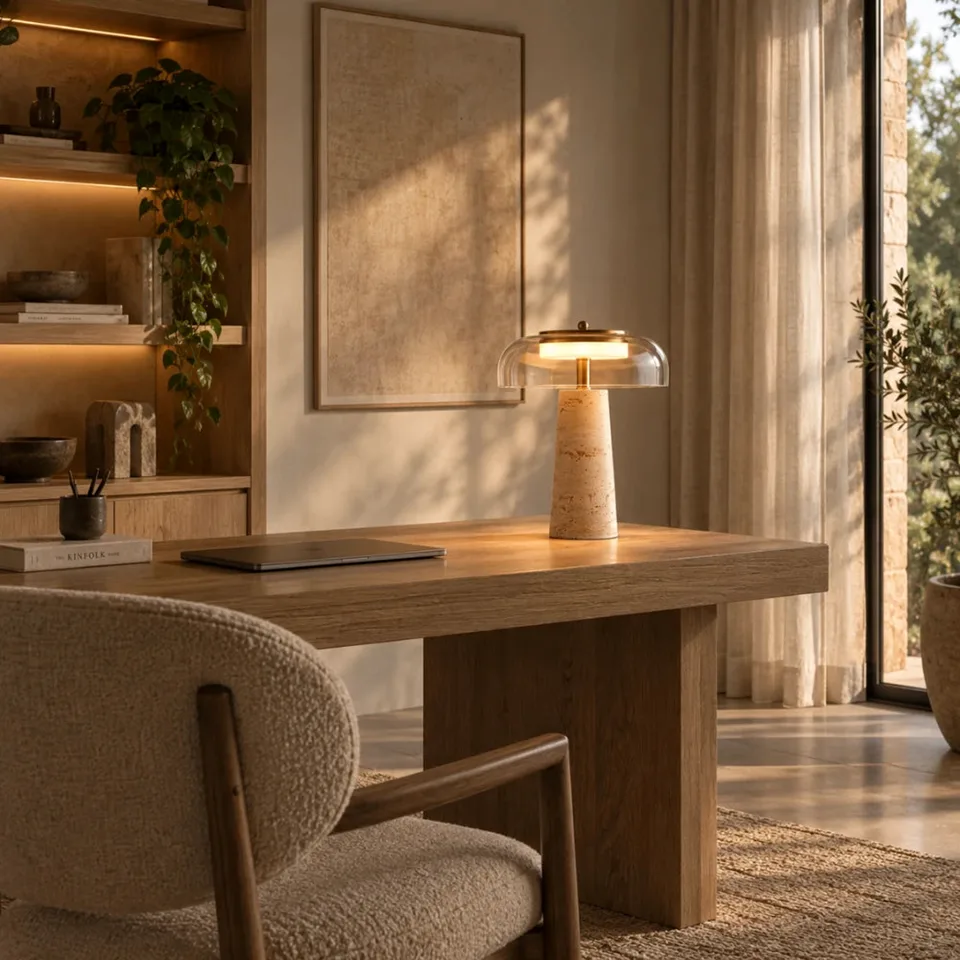
Study table direction as per Vastu comes down to one rule: sit facing east or north, and do not face south. Put the lamp on your left if you write with your right hand, so your hand does not shade the page.
Your child is getting a new study table. Grandmother says it must face east. The carpenter wants it against the only free wall, facing south. And nobody has thought about the lamp yet.
Below, you will see which way to face, and what to do when the only free wall is south. You will also see how a window helps, and how far from the page to keep one of our table lamps.
Study table direction as per Vastu: east or north
All three Vastu guides we read name the same two directions. You sit facing east or facing north. Some guides call north-east the best of all.
The guides link each direction with a quality. East is linked with focus, and north with memory. We share these as a tradition many Indian families follow, not as a promise of better marks. Our note on what we promise about Vastu says where we stand.
Two of the guides also list directions to avoid, and both name due south. They add in-between points too, such as east of south-east and south of south-west.
The best direction for study table as per Vastu also depends on the room. Use these steps to set it up.
- Stand where the chair will go and find east with a phone compass.
- Turn the table so you face east or north when you sit.
- Leave a gap of a few inches between the table and the wall.
- Check the ceiling. Move the table if a beam runs right above it.
- Keep a solid wall behind the chair, and a window close by for daylight.
What if the only free wall faces south?
None of the three Vastu guides we read gives a fix for this room. So the next lines are our own working, not a Vastu rule.
The rule talks about the way you face. The rule does not say the table must touch the wall in front of you. So turn the table, and the south wall stops being a problem.
The sizes below are examples, so use your own.
- Say the table is 120 cm long and 60 cm deep. The chair needs 75 cm behind it.
- Add the depth and the chair space: 60 + 75 = 135 cm.
- First layout: put your back to the south wall and face north. The table and chair reach 135 cm into the room, and you get a solid wall behind the chair.
- Second layout: rest the short end near the south wall and sit facing east. The table reaches 120 cm into the room, and the set takes 135 cm along the wall.
- Both layouts use the same floor: 1.35 m × 1.20 m = 1.62 square metres.
Leave the gap of a few inches at the wall in either layout.
Where the lamp goes, and how bright study room lighting should be
Daylight from the window does the work in the morning. After sunset, the lamp takes over, and its place on the table matters.
The Lighting Research Center, a lighting research team in New York, gives a clear rule. Place the lamp to the left for a right-handed person, and to the right for a left-handed one. The light then falls on the page, and your writing hand stays out of the way.
One Vastu guide we read gives the same advice: keep the lamp on the left side of the table. The tradition and the lighting rule agree here.
Now put the two rules together. Your compass direction tells you which end of the table takes the lamp.
| You face | Right-handed: lamp on | Left-handed: lamp on |
|---|---|---|
| East | North end | South end |
| North | West end | East end |
Height comes next. BenQ, a lamp maker, suggests a lamp head about 15 to 20 inches above the desk. 15 inches is 38 cm and 20 inches is 51 cm, so aim for a head between 38 and 51 cm above the desk.
Brightness comes last. Lux tells you how much light lands on your page, the way a rain gauge tells you how much rain fell. The 2016 National Building Code of India asks for 300 to 500 lux on office desks, the same kind of reading and writing a student does. Our guide to how many lumens for reading turns that into a bulb.
A lamp alone should not light the whole room. Keep a ceiling light on as well, so your eyes do not jump between a bright page and a dark wall. Choose a shade that hides the bulb from your eyes.
Why the direction, the window and the lamp fit together
A north window suits a desk well. Studio Matrx, an Indian architecture guide, says a north wall in India sees almost no direct sun, so its light stays soft, even and free of glare.
An east window is harder to sit in front of. Direct, low sun comes in until about 9 am, and the same guide warns against screen work opposite a large east window. So if you face an east window, keep a curtain for the morning.
The best layout follows from those facts. Face east with a north window on your left. You keep the Vastu direction, you get steady daylight, and the daylight comes from the same side as the lamp.
Side light works because of how a page reflects. Light leaves a surface at the same angle it arrives, the way a ball bounces off a clean floor. A lamp straight in front of you can bounce off a glossy page into your eyes, and the words wash out.
The Lighting Research Center says the best place is usually to the side and slightly behind you. On the writing side, your hand sits between the lamp and the words, so its shadow lands on them.
Distance changes brightness more than most people expect. Light from a small source spreads as it travels, so at double the distance only a quarter of it lands on each spot. Physics calls this the inverse square law, and our height band shows it well.
- Take the two ends of the band, 38 cm and 51 cm.
- Divide them: 51 ÷ 38 = 1.34.
- Square the answer: 1.34 × 1.34 = 1.8.
- So the same lamp gives the page about 1.8 times more light at 38 cm than at 51 cm.
Our lamps run at one brightness, so height is your control. If the page looks dim, lower the head first. If the page looks harsh, raise the head towards 51 cm.
Lamps from our range that fit both rules
We counted the lamps in our desk range on 4 Nov 2026. Of 11 lamps, 6 reach the 38 to 51 cm band by overall height, and 2 have arms you can move. 4 have a built-in LED, and 7 take a bulb you fit.
Our antique-brass-finish lamp with a marble base covers the height band. The lamp adjusts from 41 to 66 cm, and its arm reaches 56 cm across the desk. The base is real white marble, 18 by 13 cm, with its own grey veins.
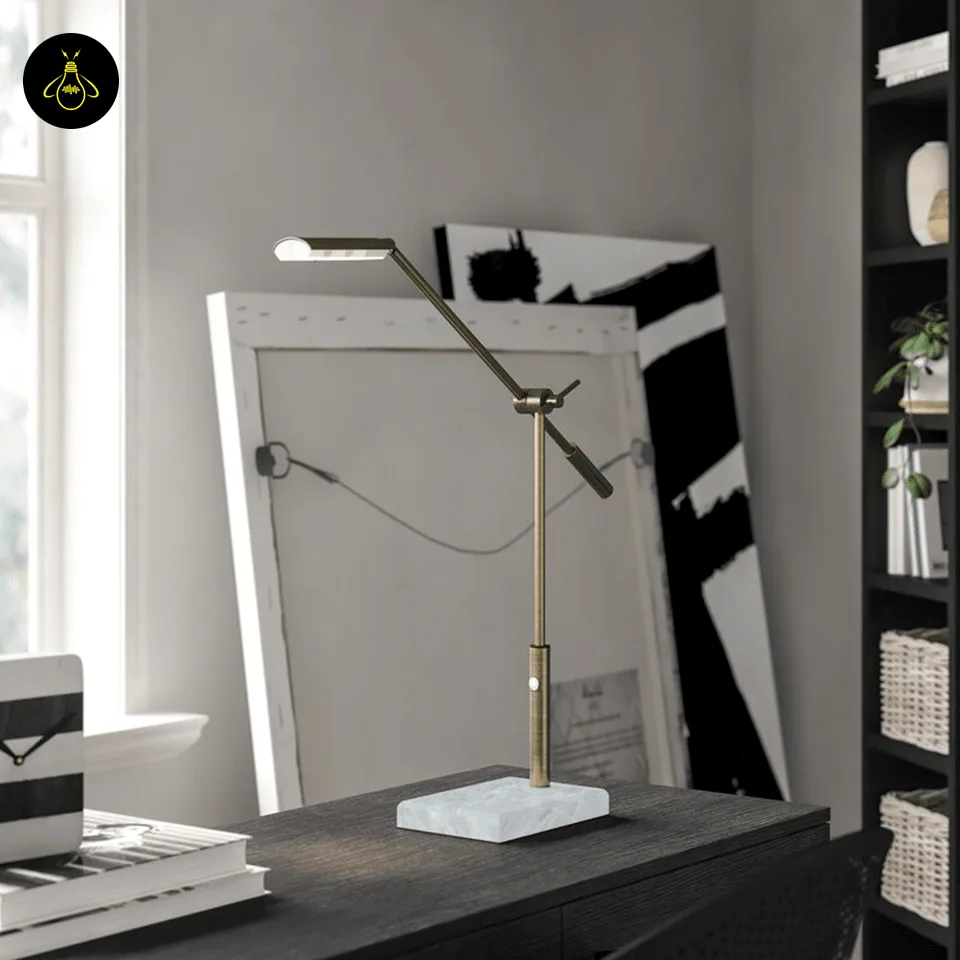
The head tilts to aim the light at your page. A built-in LED gives warm 3000K light, so you never buy a bulb for it.
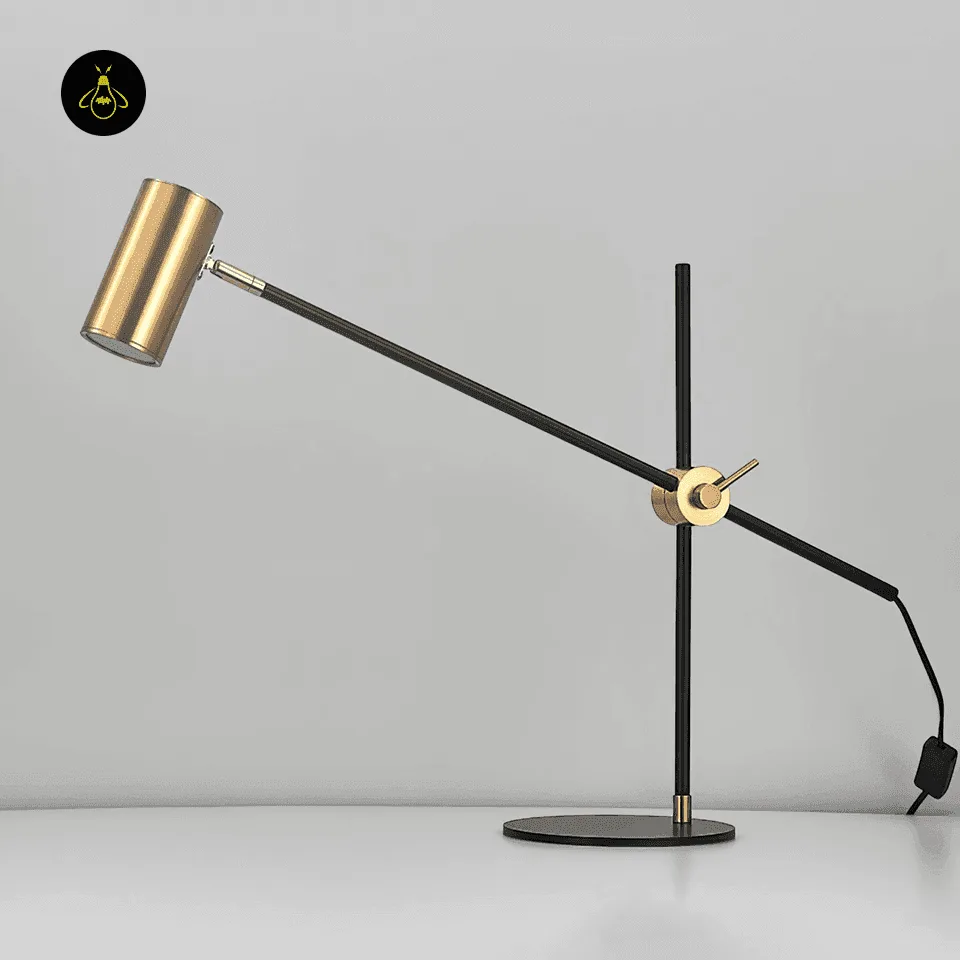
For a wider desk, the balance-arm lamp stands 48 cm tall, and its arm reaches up to 60 cm. You swing the arm and tilt the head. An opal borosilicate glass diffuser softens the light. The lamp takes one GU10 bulb, which is not included; fit a 3000K warm-white GU10 LED.
For a small table, the travertine LED lamp is 34 cm tall, with a clear borosilicate glass dome 23 cm across. Real travertine forms the base. The light is built in, at 3000K.
Nature gives the marble and the travertine, and no two pieces carry the same veins. Our craftsmen shape each lamp in our own factory in India, as they have since 2015. Every metal part is 304 stainless steel, with free shipping across India. Our certifications page shows our CE and UL marks.
Natural stone on the table and warm light on the page give a study corner the calm, grounded feel that Vastu values.
FAQs
What is the best study table direction as per Vastu?
The best study table direction as per Vastu is one where you face east or north while you sit. Some guides call north-east the best of all.
What if the study table can only face south?
Turn the table so you sit facing east or north, even if the table stands side-on to the wall. Vastu guides say to avoid facing south but give no fix, so this is our own working, and it needs about 1.6 square metres of floor.
Which side of the study table should the lamp go?
Put the lamp on the left if you write with your right hand, and on the right if you are left-handed. One Vastu guide also places the lamp on the left side.
How bright should study room lighting be?
Aim for 300 to 500 lux on the desk, the level set for office desks in India. Use a lamp and a ceiling light together.
Can a study table go near a window?
Yes, a study table near a window is good, because daylight lights the page. A north window on your left is the best case, since the light stays even. One Vastu guide suggests a window too, as long as you still face east or north.
Nature gives the material. Human hands give it meaning. Vastu inspires harmony. Light brings it to life. That is JagMag.
See every desk lamp we make, or read our guide to the best study lamp for long study hours. For light in the rest of the home, see Vastu for chandeliers. Not sure? Video-call us.
Sources
- Housing.com, Best direction for the study table as per Vastu (read 26 Oct 2026)
- Brick & Bolt, Vastu for study table: directions and tips (read 26 Oct 2026)
- Godrej Properties, Best direction to study according to Vastu (read 4 Nov 2026)
- Lighting Research Center, Lighting Patterns for Homes: plug-in lighting equipment (read 4 Nov 2026)
- Studio Matrx, North-facing window design in India (read 4 Nov 2026)
- Studio Matrx, East-facing window design in India (read 4 Nov 2026)
- HyperPhysics, Georgia State University, Inverse square law for light (read 4 Nov 2026)
- HyperPhysics, Georgia State University, Law of reflection (read 4 Nov 2026)
- Infralens, office lux levels citing NBC 2016 Part 8, Section 1, Table 1 (read 26 Oct 2026)
- BenQ, Desk lamp placement guide (read 26 Oct 2026)