
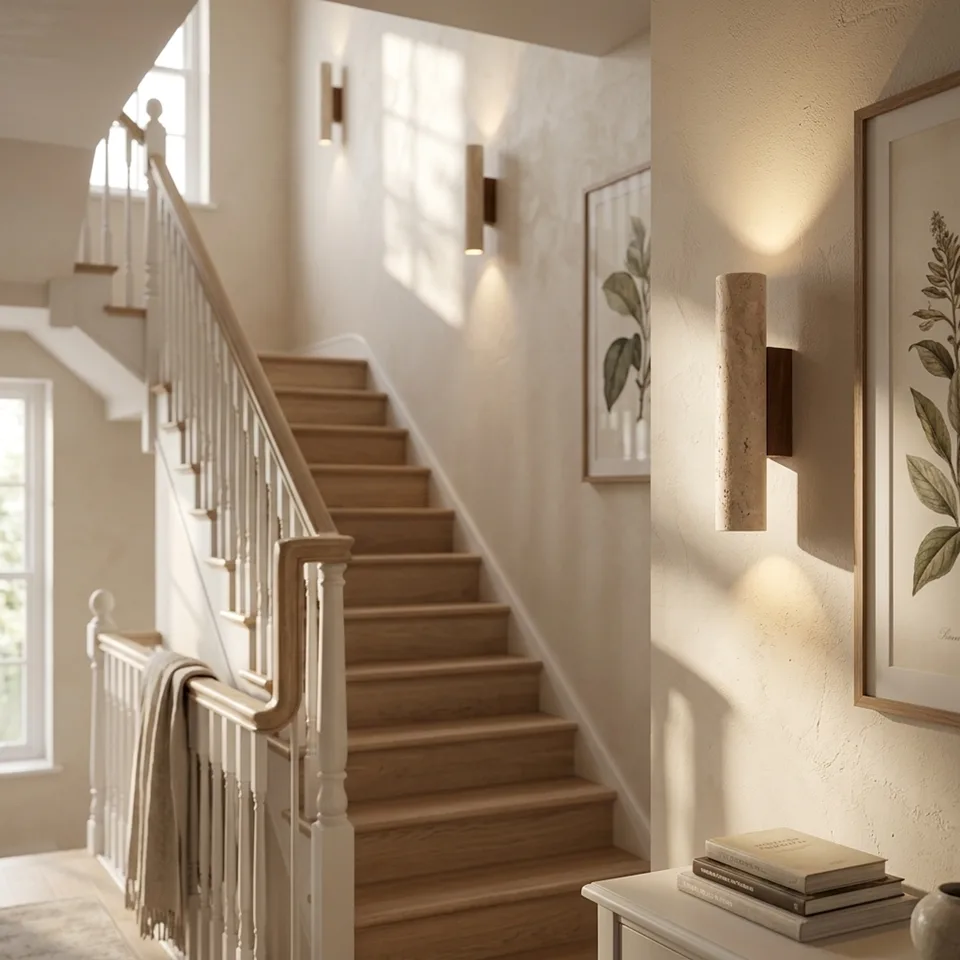
The passage lights are marked. Now the electrician turns to the stairs and stops. The steps keep rising under the wall, so “160 cm from the floor” no longer makes sense.
Stairs need their own rule. You measure from the step, not from the ground floor.
Below, you will find the staircase wall light height that lighting guides use. You will also see how far apart to place the lights, and how to light the landing.
The short answer
Set each light 152 to 180 cm above the step right below it. Every light then sits the same height above its own step, so the row runs parallel to the handrail. Space the lights 2 to 3 m apart along the climb, and add one at each landing.
Staircase wall light height: measure from the step
On flat floors, you measure from the floor. On stairs, guides measure from the step below each light.
One guide gives 60 to 66 inches above each step, which is 152 to 168 cm. A second guide gives 1.6 to 1.8 m above the step. Put together, the band runs from 152 to 180 cm. Our staircase page uses about 180 cm, at the top of that band.
Pick one number in the band and use the same number for every light. The lights then climb with the stairs, in a line that follows the handrail.
The wall sconce height in a stairwell still needs a mark from the ground floor, because the electrician starts there. The sum is short.
- Find the riser, the height of one step. India’s National Building Code allows up to 19 cm in homes.
- Count the steps up to the light. Say the light sits above the 4th step.
- Multiply. 4 × 19 cm = 76 cm, so the 4th step is 76 cm above the ground floor.
- Add your chosen height. 76 cm + 165 cm = 241 cm. Mark the wall at 241 cm from the ground floor.
Measure your own risers first. Your steps may be lower than 19 cm, and the mark changes with them.
How far apart should staircase lights be?
Height puts each light in the right place. The gap decides whether every step gets light.
Lighting guides give 2 to 3 m between lights, measured along the slope. One guide goes closer, with one light every 3 to 4 steps. Pick the closer gap for small lights that give less light.
A simple test tells you the gap works. Stand at the top of the stairs at night with the lights on. You should see the edge of every step, right down to the bottom.
IS 3646, India’s code for indoor lighting, lists 100 to 150 lux for corridors and stairs. Lux tells you how much light lands on a surface, the way a rain gauge tells you how much rain fell.
Glare matters on stairs, because you walk down facing the lights, so a bare bulb at eye level dazzles you. Shaded lights, or lights that throw their glow up and down the wall, cut that glare.
Stair landing lighting ideas
A landing is the flat part where the stairs turn. People slow down there, and the line of lights should carry on without a gap.
Mark the landing light at the same height you used on the stairs, measured from the landing floor. A landing often has more wall space, so a wider light fits there.
We counted the 28 lights in our staircase range on 26 Oct 2026. 13 of the 28 have a built-in LED, so you never stand on a ladder over the steps to change a bulb. 8 of the 28 throw light both up and down the wall.
Staircase lights from our range
Our travertine up and down light stands out just 5 cm, so the block sits close to the wall. The block is 22 cm wide and 8 cm tall, cut and honed by hand from real travertine. Three beams go up and three go down, from a built-in 3000K warm-white LED.
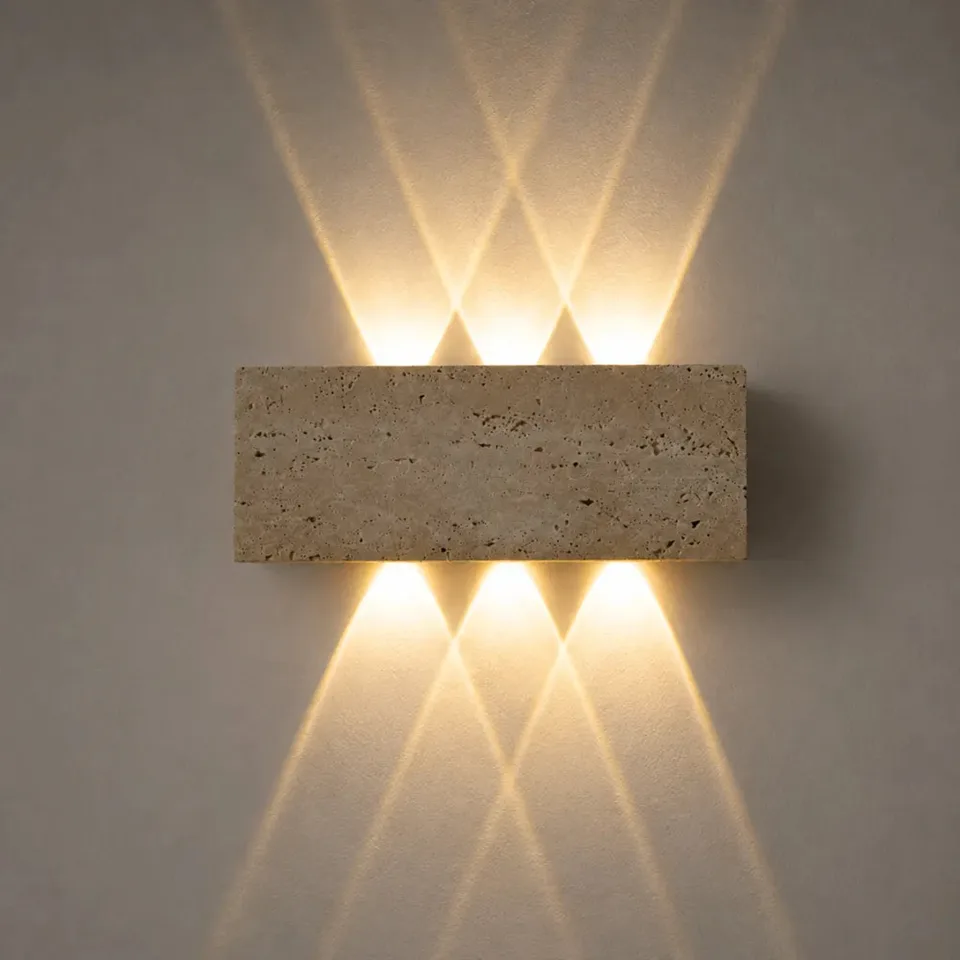
The travertine light is rated IP65, so it also works on an outdoor staircase. IP65 means sealed against dust and against jets of water.
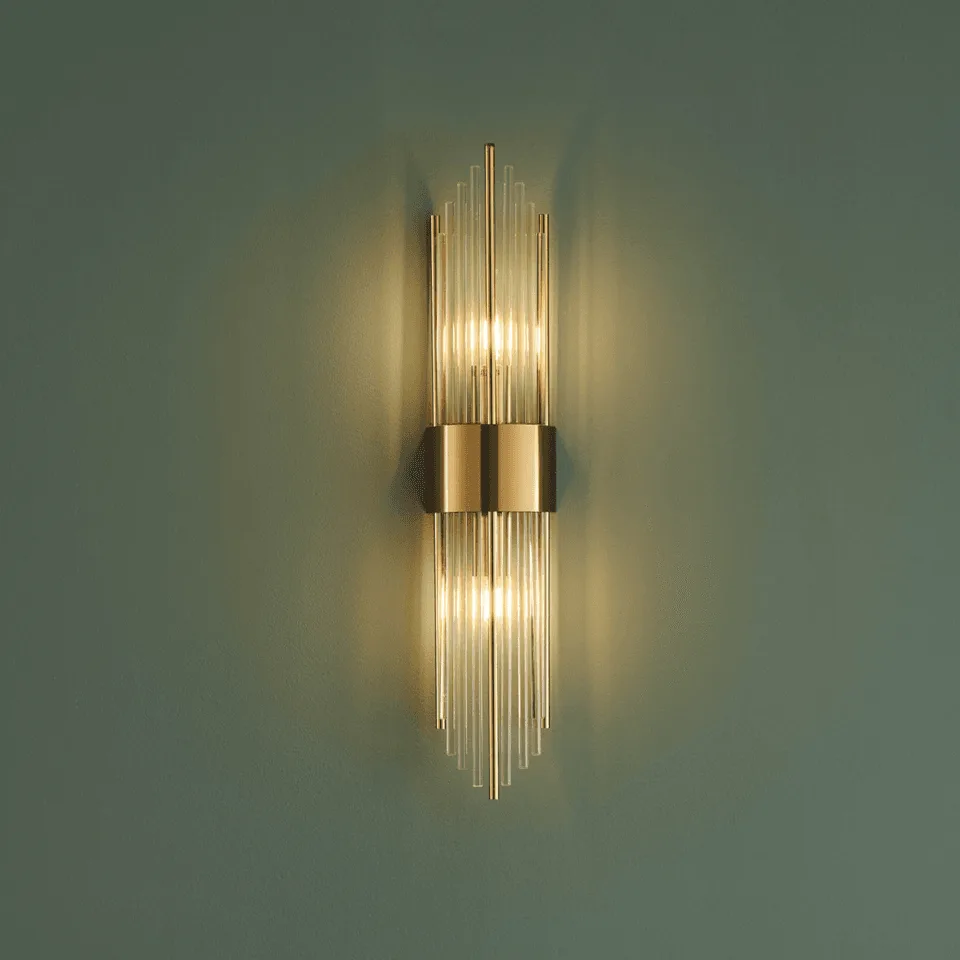
For a glass look, the art deco glass rod wall light is 60 cm tall and stands out 6 cm. Crystal-clear borosilicate glass rods wrap a gold-finish band of 304 stainless steel. One light goes up and one goes down. The light takes two E14 bulbs, a small screw base; bulbs are not included, so fit 3000K warm-white LEDs.
For wood, the walnut and brass up and down light sets an antique brass-finish steel column on a walnut wood plate. The column is 26.7 cm tall and stands out 8.9 cm. The light takes one G9 bulb, a small two-pin base, not included.
Our craftsmen make each one in our own Greater Noida factory, where we have worked since 2015. Our certifications page lists our CE, UL and ZED marks.
Natural stone and wood with warm light on the stairs give the climb the calm, grounded feel that Vastu values.
FAQs
What is the right staircase wall light height?
Set each light 152 to 180 cm above the step right below it. Use one height for every light, so the row follows the handrail.
How do you work out the wall sconce height in a stairwell?
Multiply the riser by the number of steps below the light, then add your chosen height. Above the 4th of 19 cm steps, 76 cm + 165 cm gives a mark at 241 cm.
How many wall lights does a staircase need?
Place one light every 2 to 3 m along the slope, plus one at each landing. A straight stair 5 m long along the slope takes 2 or 3 lights.
How bright should stair lighting be?
IS 3646, India’s code for indoor lighting, lists 100 to 150 lux for stairs and corridors. From the top step, you should see the edge of every step.
Can an outdoor wall light go on an indoor staircase?
Yes, an IP65 outdoor light works indoors too. Our travertine up and down light is made for both, with a built-in 3000K LED.
Nature gives the material. Human hands give it meaning. Vastu inspires harmony. Light brings it to life. That is JagMag.
See every one of our staircase wall lights. For more, read our full guide to staircase lighting and our guide to staircase chandeliers. For the passage at the top of the stairs, see wall light height from floor. Not sure? Video-call us.
Sources
- Lumitop, How to position wall lights in a staircase (read 26 Oct 2026)
- Montreal Lighting, Staircase wall lighting (read 26 Oct 2026)
- Mod Lighting, How to install and position wall lights (read 26 Oct 2026)
- Infralens, maximum riser for residential stairs, NBC 2016 Part 4, Clause 4.4.2 (read 26 Oct 2026)
- Infralens, IS 3646:2009 Code of Practice for Interior Illumination, quick reference (read 26 Oct 2026)