You switch on the one tube light in the hall. The middle goes bright and flat, and the corners stay grey. The room has light, but it does not feel lit.
Good ambient room lighting fixes that. Ambient light is the soft, even base light of a room, the light you walk around in. Below are the numbers for a real Indian hall, the sums, and the science of why light bounced off a wall feels calm.
The short answer
Aim for about 108 to 215 lux across a living room. In a 12 × 16 ft hall, that means roughly 1,900 to 3,800 lumens must land on the room. The softest way is to bounce warm 3000K light off pale walls and the ceiling with wall lights that throw light up and down.
What is ambient lighting, and how much does a room need?
Philips India calls ambient lighting general lighting, because it fills the entire room. Houzz puts it simply: ambient light stops you tripping over things.
Task light sits close to your work, like a reading lamp. Accent light picks out one thing, like a painting. Studio Matrx says accent light should feel a few times brighter than the ambient light around it.
A lumen counts the light a bulb gives out, like litres of water from a tap. Lux counts the light that lands on each square metre, like how wet the floor gets. ENERGY STAR, the US government label, measures bulb brightness in lumens, not watts.
| Room or layer | Guide figure | Source |
|---|---|---|
| Living room, ambient | 10–20 foot-candles (about 108–215 lux) | Penn State, from IES guidance |
| Reading at home | about 50 foot-candles | Penn State |
| Old 40 W bulb | at least 450 lumens | ENERGY STAR |
| Old 60 W bulb | at least 800 lumens | ENERGY STAR |
A foot-candle is the American unit: one lumen spread over one square foot. One foot-candle equals about 10.76 lux. So the living room band of 10 to 20 foot-candles becomes about 108 to 215 lux.
How many lumens and lights does a 12 × 16 ft hall need?
Take a common Indian hall of 12 × 16 ft with white walls.
- Convert the size: 12 ft is 3.66 m and 16 ft is 4.88 m.
- Find the floor area: 3.66 × 4.88 = 17.8 square metres.
- Low end of the band: 108 lux × 17.8 m² = about 1,920 lumens landing on the room.
- High end of the band: 215 lux × 17.8 m² = about 3,840 lumens.
- Count bulbs: an LED sold as a 40 W equal gives at least 450 lumens. Four up-and-down sconces with two bulbs each hold 8 bulbs, so 8 × 450 = 3,600 lumens leave the lamps.
Some light is lost to walls and furniture, so the room lands inside the band. Check the lumens on your bulb box.
Next, the wall colour decides how much bounced light comes back.
- Send 450 lumens from one bulb onto a white painted wall. White paint returns 75 to 85 per cent: 450 × 0.75 = 338 lumens and 450 × 0.85 = 383 lumens.
- Send the same 450 lumens onto a dark blue or dark green wall. Dark paint returns 15 to 20 per cent, so only 68 to 90 lumens come back.
- Compare them: 338 ÷ 90 = 3.75 and 383 ÷ 68 = 5.6. A white wall gives back about 4 to 6 times more light.
Our own count, 11 November 2026: of our 110 wall light designs, 7 (6.4 per cent) throw light up and down. Another 24 (21.8 per cent) use opal borosilicate glass, which spreads light all round.
Why bounced light feels softer: the logic
A bare bulb is a small, very bright spot, so it looks harsh to the eye. A lit wall is a big, gentle surface. The same light now comes from a wide area, so no single point stings the eye.
Bounced light also reaches the corners. The wall sends light back in many directions, so it fills the shadows one ceiling tube leaves behind.
Guides give a band, not one number. Start at the low end, about 108 lux, for an evening hall where you watch TV. Move toward 215 lux for a hall where children study or elders read. Add a reading lamp for close work, because reading needs about 50 foot-candles.
Height matters too. Our wall light page advises about 165 to 180 cm from the floor, just above eye level. Houzz keeps a wall sconce under about 6.5 ft, which is 198 cm. Both heights keep the bulb out of your line of sight.
The science behind ambient room lighting
HyperPhysics, from Georgia State University, explains the inverse square law. At 2 metres, light is one fourth of what it was at 1 metre. At 3 metres the share drops to one ninth. So one bright ceiling light floods the floor below it and leaves the far walls dim.
Ambient light for a room works around that law. Several sources spread along the walls keep every corner close to a light, so the light stays even.
A matte wall scatters light. A rough paint surface sends light out in all directions, the way a cotton sheet spreads sunlight. Engineering ToolBox lists white paint at 75 to 85 per cent reflection and dark paint at 15 to 20 per cent.
Colour temperature, measured in kelvin, tells you how yellow or blue a light looks. Penn State lists an old bulb at about 2,800 K and a halogen at about 3,000 K, the same homely glow as a 3000K warm white LED.
Nature gives the material, hands shape it, light connects the room
Ambient wall lighting works best when the lamp itself is gentle, and the material decides that. Our craftsmen shape glass, stone and wood by hand in our own factory in India, since 2015.
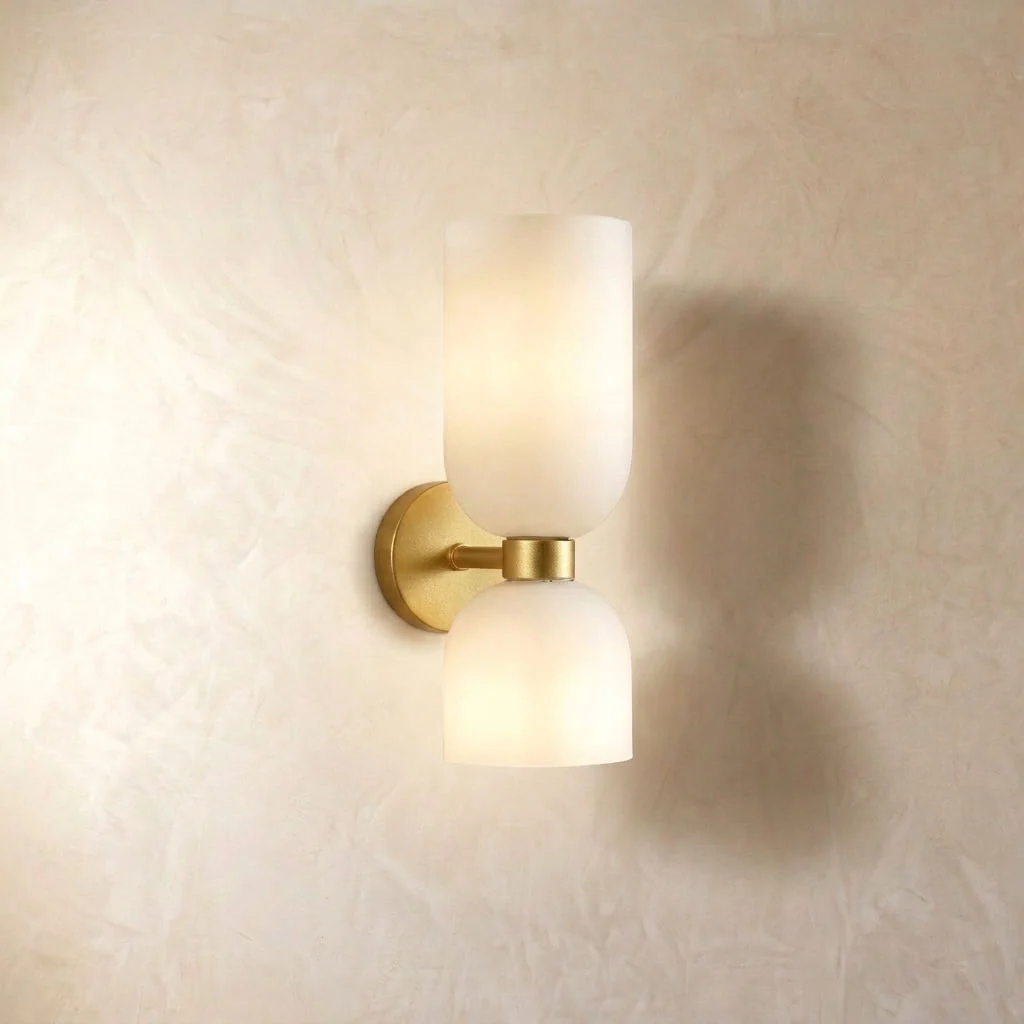
The Up Down Wall Light in opal glass is 35 cm tall with two G9 holders, one up and one down. Our glassblower shapes each opal borosilicate glass shade by breath and by hand, so the glow comes through soft and even. Bulbs are not included; fit a 3000K warm-white LED in each.
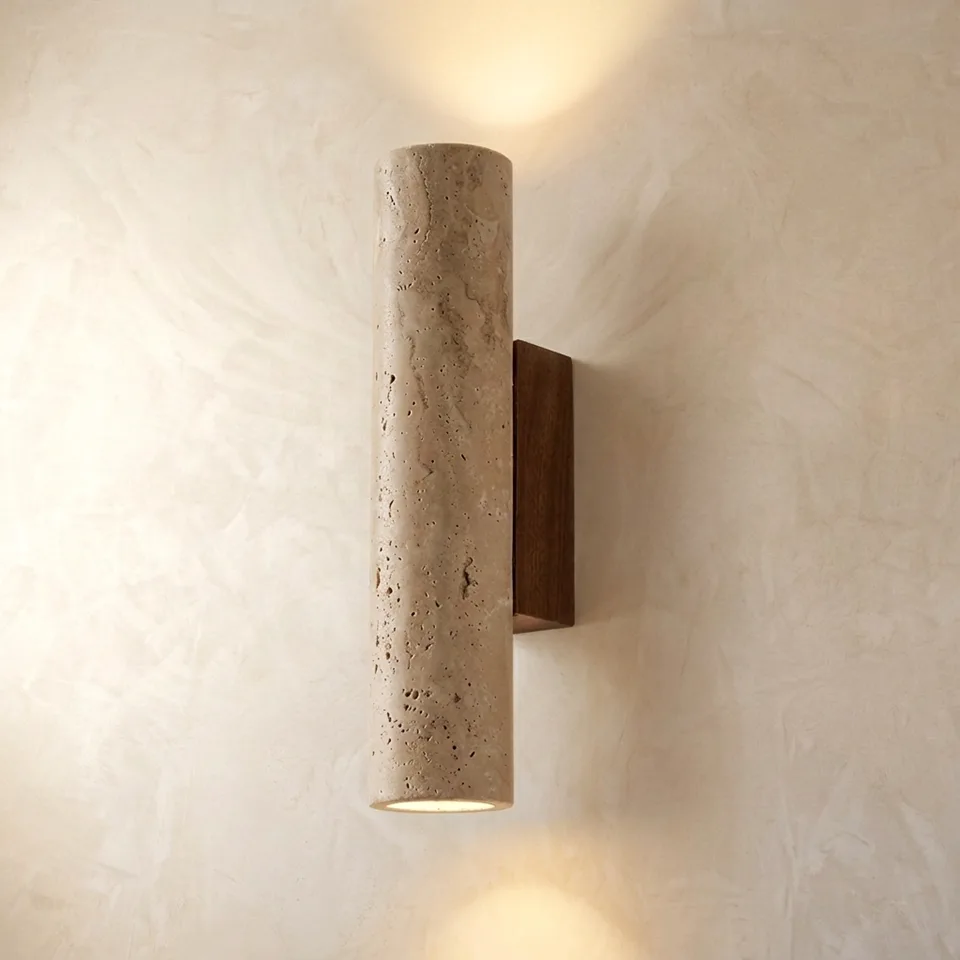
The Travertine Cylinder Wall Light is real travertine, cut and honed by hand, 28 cm tall and 6.5 cm across. Built-in 3000K LEDs wash 3 W up and 3 W down. The LED carries a 1-year warranty for orders from 4 October 2026.
The Up and Down Wall Light on walnut wood is a 26.7 cm column of 304-grade stainless steel on a real walnut backplate. The steel carries a lifetime rust warranty for orders from 4 October 2026. All three are IP20 for indoor rooms. None of our lights dim, so plan the brightness with the number of lights.
Each piece is CE, UL and ZED certified; see our certifications. Many families plan a room with Vastu in mind. Natural stone, wood and warm, even light fit that wish for a calm and balanced home.
FAQs
What is ambient room lighting?
Ambient room lighting is the soft, even base light that fills the whole room. For a living room, aim for about 108 to 215 lux, which is 10 to 20 foot-candles.
What is ambient lighting, compared with task and accent light?
Ambient lighting is the general light of the whole room. Task light is a bright light near your work, and accent light picks out one object.
How many lumens does a living room need?
A 12 × 16 ft living room needs about 1,900 to 3,800 lumens landing on the room: 17.8 square metres times 108 to 215 lux.
Which wall light gives the best ambient wall lighting?
An up-and-down wall light or an opal glass sconce gives the softest ambient wall lighting. The light falls on the wall, not in your eyes. Fit it about 165 to 180 cm from the floor with a 3000K warm white LED.
Does wall colour change ambient light for a room?
Yes, wall colour changes ambient light a lot. White paint reflects 75 to 85 per cent and dark paint only 15 to 20 per cent. A white wall returns about 4 to 6 times more light.
Nature gives the material.
Human hands give it meaning.
Vastu inspires harmony.
Light brings it to life.
That is JagMag.
Ready to light your hall? See our living room wall lights. For the bedroom, read our ambient lighting bedroom guide, and for passages, our guide to wall light height from floor. Not sure? Video-call us.
Sources
- Penn State EGEE 102, 8.3 How Much Lighting is Needed (read 11 Nov 2026)
- ENERGY STAR, Learn About Brightness (read 11 Nov 2026)
- HyperPhysics, Georgia State University: Inverse Square Law, Light (read 11 Nov 2026)
- Engineering ToolBox, Materials: Light Reflecting Factors (read 11 Nov 2026)
- Archtoolbox, Recommended Lighting Levels in Buildings (read 11 Nov 2026)
- Studio Matrx, Layered Lighting Explained for Indian Homes (read 11 Nov 2026)
- Philips India, Ambient, Task and Accent Guide (read 11 Nov 2026)
- Houzz, A Guide to Ambient Lighting, and How to Get It Right (read 11 Nov 2026)