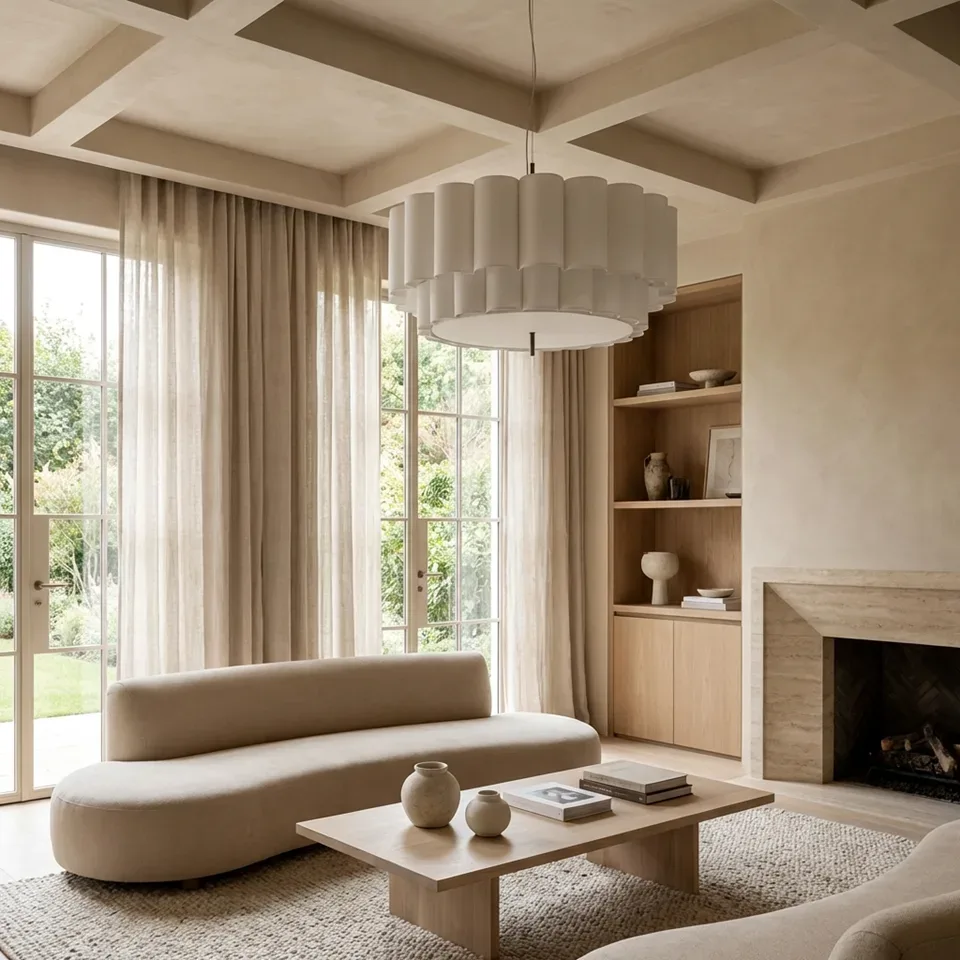
White walls, light wood, a soft rug and one warm lamp. You have seen these rooms on Instagram and saved them. Scandinavian interior design looks calm because every object has a job and the light is soft.
Below you will learn where the style came from, the few rules it follows, and why light sits at its heart. You will also see how to bring it into an Indian home, where the sun behaves very differently.
The short answer
Scandinavian interior design is a style from Denmark, Norway and Sweden built on light colours, natural materials and useful furniture. Nordic winter days last only about 6–7 hours, so the style uses white walls to bounce daylight and warm lamps, near candlelight, for the long evenings.
Scandinavian interior design: where it came from and its rules
MasterClass traces the style to Norway, Denmark and Sweden in the 1930s. The style went global in the 1950s. The Brooklyn Museum’s “Design in Scandinavia” show opened in April 1954 with more than 700 home objects. The show then toured the United States and Canada for three and a half years.
The rules are few. Keep the palette light and neutral. Use natural materials such as wood, wool and linen. Choose furniture for its use first. Let in as much daylight as you can; Homes & Gardens calls lots of natural light “crucial”.
Light fittings carry the style. Soft fabric pendant lights hang low over tables, and lamps fill the corners. A bare, bright bulb breaks the mood.
Hygge is the feeling behind it all. VisitDenmark says the word began in old Norwegian, where it meant something like well-being. Merriam-Webster dates its first use in English to 1960. Oxford shortlisted hygge for its 2016 Word of the Year.
Candles are part of hygge. A Statista chart, citing the European Candle Association, shows Danes burned 4.3 kg of candles per person in 2016.
Nordic interior design is the same idea under another name. Finland and Iceland add their own touches, but the rules match.
How much light does a Scandinavian living room need?
Follow the sums below. The first shows why the style was born. The second sizes the light for your own room.
- Winter daylight in Copenhagen: timeanddate.com lists 7 hours 1 minute on 21 December 2025.
- Winter daylight in Oslo: about 5 hours 55 minutes on the same date.
- Winter daylight in Mumbai: about 11 hours 0 minutes.
- Mumbai minus Oslo: 660 − 355 = 305 minutes, or about 5 hours more light. Mumbai gets 660 ÷ 355 = 1.86 times the winter daylight.
- Candles: 4.3 kg in Denmark ÷ 1.45 kg EU average = about 3 times the candles.
- Your living room: 3.5 m × 4.5 m = 15.75 m². IS 3646 sets 150 lux for a lounge. 15.75 × 150 = 2,363 lumens.
- Per bulb: our 65 cm linen drum has 4 holders. 2,363 ÷ 4 = about 590 lumens from each bulb.
A lux is the light that lands on one square metre. A lumen is the total light a bulb gives out, like the water flowing from a tap.
Our own count, taken on 1 November 2026: we make 21 fabric pendant lights. Twenty take a standard E27 bulb, and one has a built-in LED. At least 6 use real silk and 5 use linen.
Why soft, warm light is the heart of the style
The logic is simple. Long, dark winters meant people spent most hours under lamps. Harsh light felt cold, so they chose soft, warm light. White walls then spread every bit of light around the room.
Colour temperature explains the warmth. Kelvin, written K, measures how yellow or blue a light looks. Philips puts candlelight at about 2000K and bright sunlight at about 6000K. A 3000K warm-white LED sits close to the candle end, so it feels like evening, not office.
Fabric explains the softness. A bare bulb is a tiny, bright point, and a tiny point causes glare. A linen shade lets light pass but scatters it in every direction. The whole shade then glows, so your eye sees a large, soft source.
White walls do the rest. A University of North Carolina lighting table gives white paint a reflectance of 75–90%. Most of the lamp’s light comes back into the room instead of being swallowed.
India needs one change. Our winter days are longer, and summer sun brings heat, so shade matters more than extra brightness. Keep the white walls and warm lamps. Use sheer cotton curtains to soften strong daylight. A Scandinavian bedroom here works best with one fabric pendant and a reading lamp, not many bright lights.
The JagMag way: nature, hands, light
Nature gives the material. Human hands shape it. Light connects it to your evening. Scandinavian design asks for the same three things: real materials, honest work and warm light.
The Scalloped Linen Drum Pendant Light is 65 cm wide and 40.5 cm tall, with 4 E27 holders. Real woven linen sits on a 304-grade stainless steel frame.
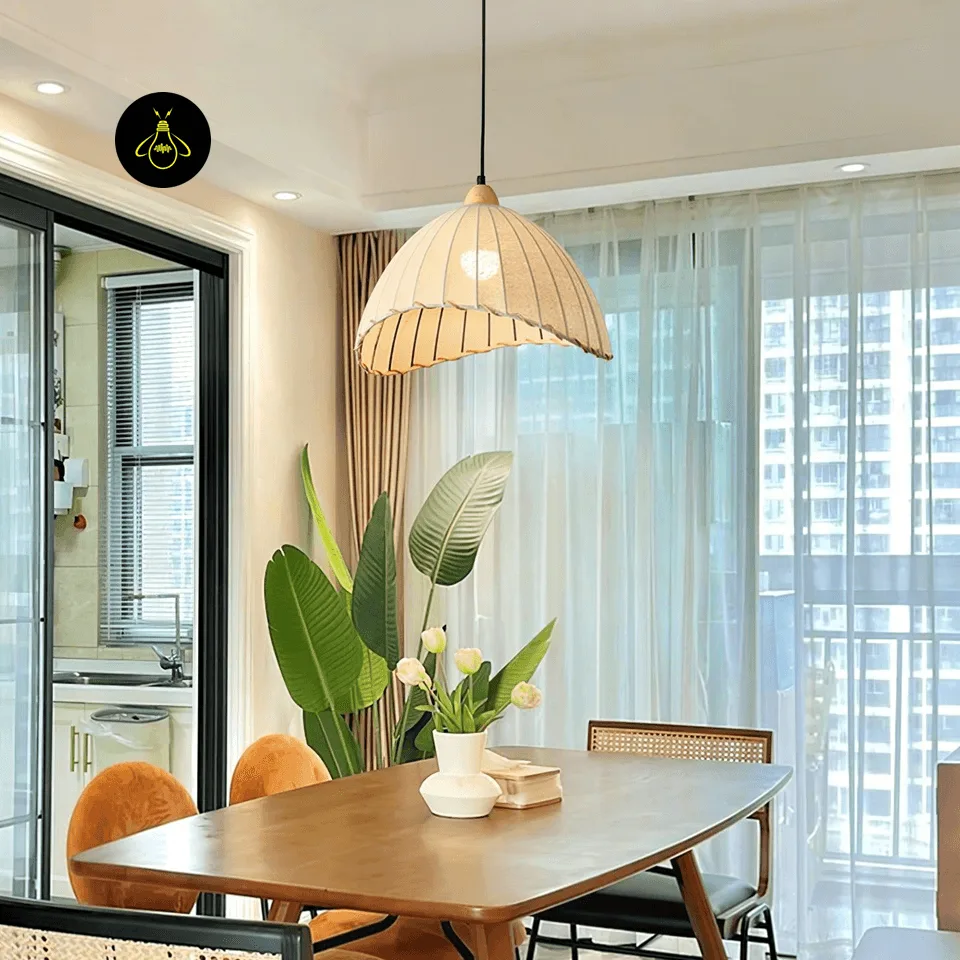
The Linen Cloth Pendant Light is a 35 cm dome with a wavy, cord-bound hem and a turned wood cap. The dome suits a small dining table or a reading corner.
The Japanese Pendant Light pairs a 40 cm raw silk dome with a walnut cap. Silk and walnut give the warm, quiet mix the style loves.
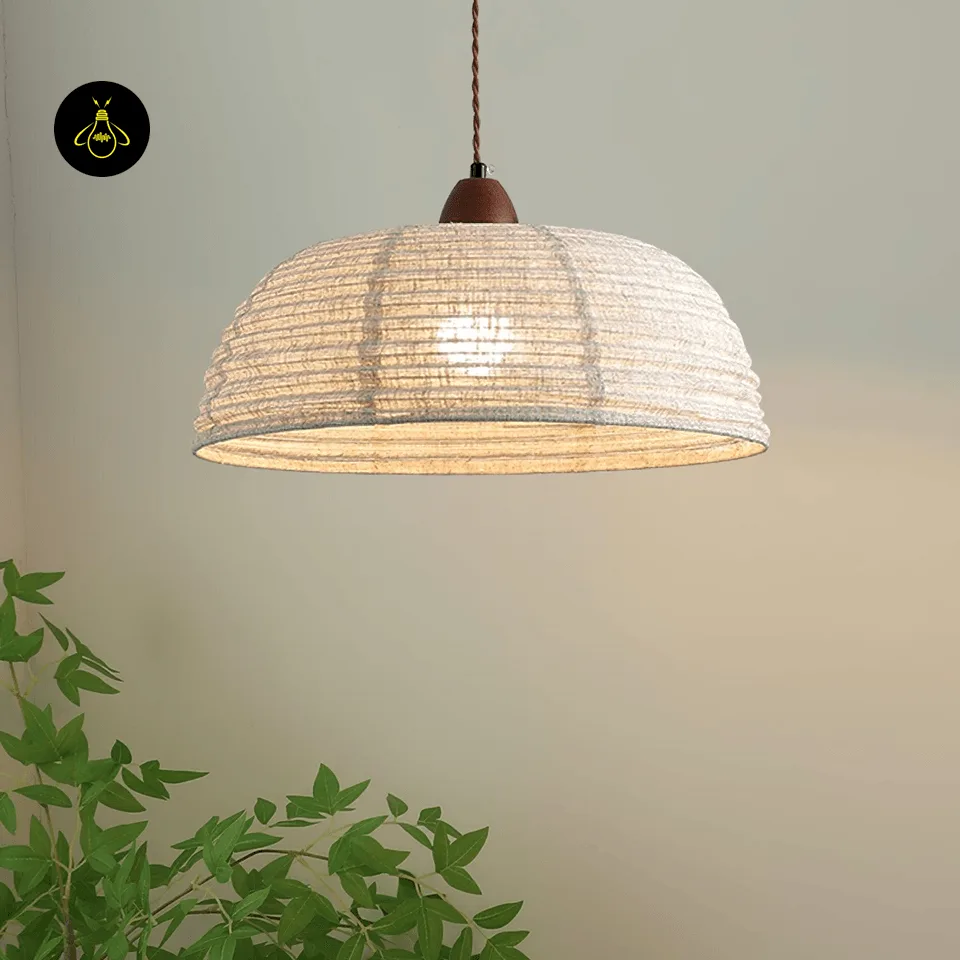
The two domes hang on 1.5 m as standard, and the drum takes a cord up to 200 cm. Bulbs are not included; fit a 3000K warm-white LED. Our craftsmen stitch the linen and pleat the silk by hand in our own factory in India, as we have since 2015. Read more about our company. In Vastu thinking, warm light and natural fibre bring calm to a room. We see that as harmony, not luck.
FAQs
What is Scandinavian interior design in simple words?
Scandinavian interior design is a calm style with light colours, natural materials and useful furniture. The style grew in Denmark, Norway and Sweden from the 1930s.
What does hygge mean?
Hygge means a cosy feeling of comfort and well-being. VisitDenmark says the word began in old Norwegian, and English has used it since 1960.
Is Nordic interior design the same as Scandinavian?
Yes, mostly. Nordic interior design adds Finland and Iceland, but it follows the same rules of light colours, wood and soft light.
What light colour suits a Scandinavian bedroom?
Use 3000K warm-white light. Candlelight is about 2000K and daylight about 6000K, so 3000K keeps the warm evening feel.
How is Scandinavian different from Japandi?
Scandinavian design warms a room with layers and soft objects. Japandi mixes it with Japanese calm and more empty space, says the Danish Architecture Centre.
Nature gives the material.
Human hands give it meaning.
Vastu inspires harmony.
Light brings it to life.
That is JagMag.
See our fabric pendant lights, then read our Japandi lighting guide or why linen, silk and cotton glow. Not sure? Video-call us.
Sources
- MasterClass, Scandinavian interior design guide (read 1 Nov 2026)
- Homes & Gardens, What is Scandinavian interior design (read 1 Nov 2026)
- Brooklyn Museum, Design in Scandinavia (1954) (read 1 Nov 2026)
- VisitDenmark, Hygge (read 1 Nov 2026)
- Merriam-Webster, Hygge (read 1 Nov 2026)
- Oxford Languages, Word of the Year 2016 shortlist (read 1 Nov 2026)
- Statista, Candles in the tailwind (European Candle Association data) (read 1 Nov 2026)
- timeanddate.com, Copenhagen sunrise and sunset, December (read 1 Nov 2026)
- timeanddate.com, Oslo day length (read 1 Nov 2026)
- timeanddate.com, Mumbai day length (read 1 Nov 2026)
- Philips Lighting, Colour temperature (read 1 Nov 2026)
- UNC Greensboro, Lighting material properties (read 1 Nov 2026)
- BIS, IS 3646 (Part II) 1966, Code of practice for interior illumination (read 1 Nov 2026)
- Danish Architecture Centre, Japan and Scandinavia (read 1 Nov 2026)