In the last post we wrote about terracotta. Fire turns soft clay into a hard shade. Cloth asks for something else: a loom first, and then a pair of patient hands.
Today we turn to natural fabrics. We use three of them in our shades: linen, silk and cotton. All three begin in nature, and all three soften light.
In this post we follow each cloth from its source to our bench. Then we follow it to the glow in your room. The line stays the same as in our story: nature gives the material, and human hands shape it.
Natural fabrics begin as a plant or a silkworm
Linen comes from the flax plant. Long, strong fibres grow inside its stem. Makers soak the stems, pull out the fibres, spin them into thread and weave the thread into cloth.
Cotton grows on the cotton plant. Soft white hairs cover its seeds inside a round pod called a boll. Spinners twist those hairs into thread.
Silk comes from the silkworm. The worm spins one long thread around itself to build its cocoon. A single cocoon can give a thread hundreds of metres long.
India has spun and woven cotton and silk for thousands of years. We bring the same cloths into light.
We use the real cloth. When our product page says linen, silk or cotton, the shade is made of that cloth.
Each cloth looks different because each one starts differently. Our craftsmen work with that difference, not against it.
Our craftsmen pleat, stretch and fit every shade by hand
Cloth reaches our own factory in Greater Noida as flat lengths. A shade needs a shape. Our craftsmen give it that shape by hand.
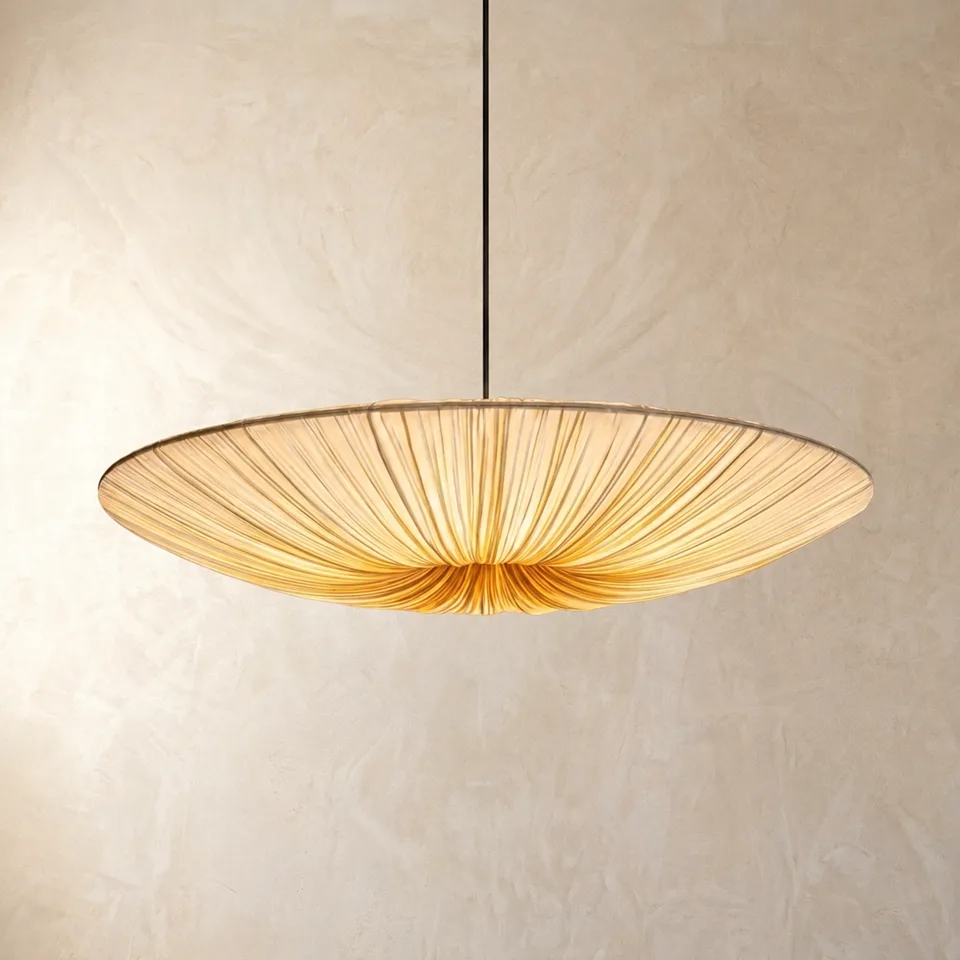
Take our pleated silk saucer pendant light. A craftsman folds real cream silk into fine pleats, one fold at a time. He sets each fold over a slim stainless steel frame, 60 cm across. Then he gathers the silk into a soft centre.
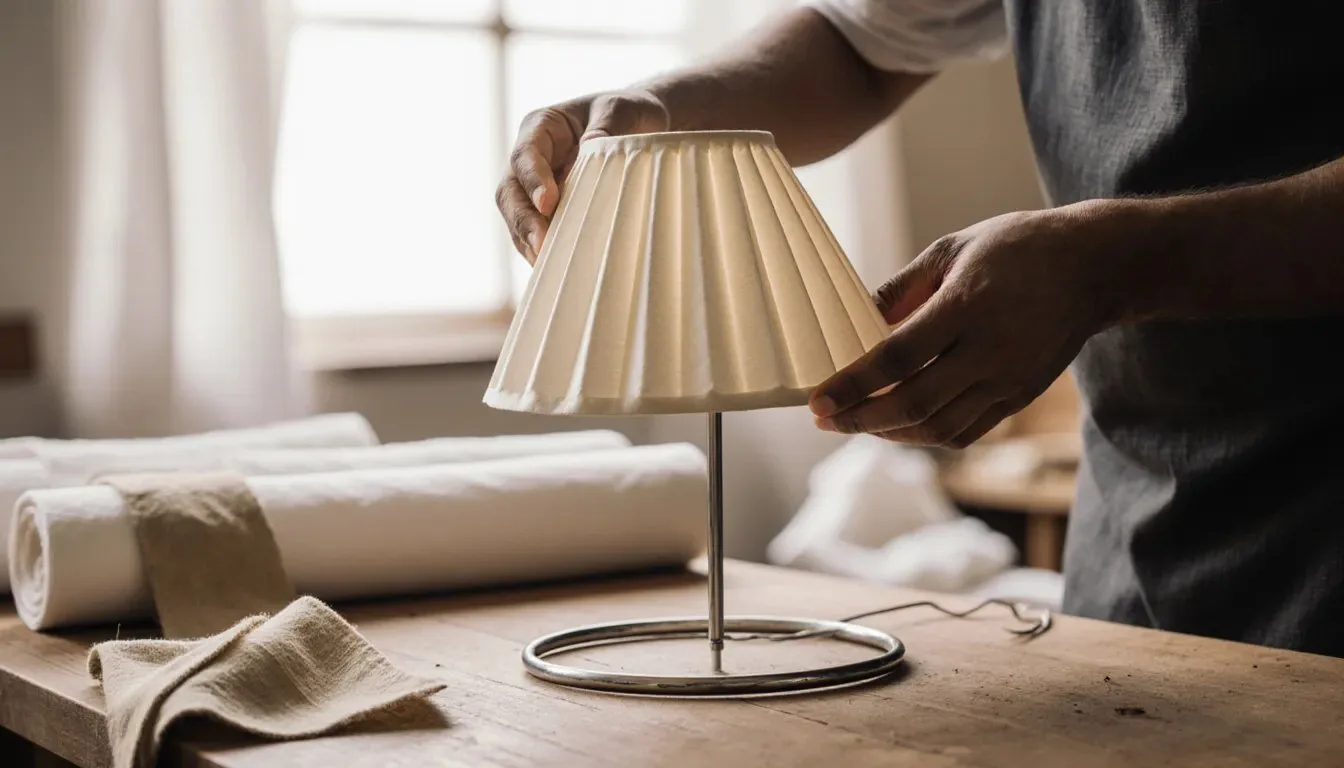
For our linen table lamp, he cuts the linen to size. He stretches it around a slim cylinder and binds both rims neatly. The lamp stands 50 cm tall.
For our cloth chandelier, he fits eight pleated cotton shades to their arms, one at a time. He checks each one, so all eight sit level.
For our white chandelier, he stretches raw silk over five tapered shade frames. He finishes every edge by hand and keeps each seam straight.
Raw silk carries small thick spots in its thread, called slubs. We leave them in. They show that the cloth is real.
A crooked seam shows the moment a light comes on. So every fold and every seam gets the patient effort of one pair of hands. All that care has one aim: an even glow.
Cloth softens light and hides the bulb
A bare bulb is one bright point. A bright point causes glare. Glare is the harsh light that makes you squint.
Cloth stops the glare. Light enters the weave, spreads through thousands of fine threads and comes out soft and even. You see a glowing shade, not a bulb.
Each cloth glows in its own way. Linen shows its weave, with thick and thin threads catching the light. Silk warms to a honey glow with a soft sheen. Pleated cotton shows every fold as a thin line of light.

Many fabric shades stay open at the top and the bottom. Light falls down onto your table and rises gently up the wall. The room fills with warmth instead of bright spots.
A fabric light suits the places where you slow down. Think of a bedside table, a sofa corner, or a dining table late in the evening. Many of our bedside lamps carry a linen shade for this soft glow.
We suggest a 3000K warm-white LED for every fabric light. Warm light suits the natural colours of linen, silk and cotton. Natural fabrics and warm light together give a room the calm, grounded feeling that Vastu thinking values.
Cloth hides the bulb and spreads the light. Clear glass does the opposite and lets light pass straight through. In the next post we turn to hand-blown borosilicate glass.
FAQs
What are natural fabrics?
Natural fabrics are cloths woven from fibres that grow in nature. Linen comes from flax, cotton from the cotton plant and silk from the silkworm. We use all three in our lamp shades.
What is linen?
Linen is cloth woven from the fibres inside the stem of the flax plant. Its weave is slightly uneven, and warm light shows every thread.
Does a fabric shade make a room darker?
A fabric shade softens the light more than it blocks it. Light spreads through the weave, so the room gets an even glow without glare.
Nature gives the material.
Human hands give it meaning.
Vastu inspires harmony.
Light brings it to life.
That is JagMag.
With you.
Read next: What is borosilicate glass? Hand-blown glass in our lights
Bring soft cloth light into your room: see our fabric pendant lights →