You have a measuring tape in one hand and a photo of a fabric pendant on your phone. The listing says 65 cm. Your dining room feels small, and you are not sure 65 cm is right.
Learning how to measure lamp shade size settles the doubt in five minutes. Below are the three numbers on every shade, two sums for your room and table, and the reason the right size glows softly.
The short answer
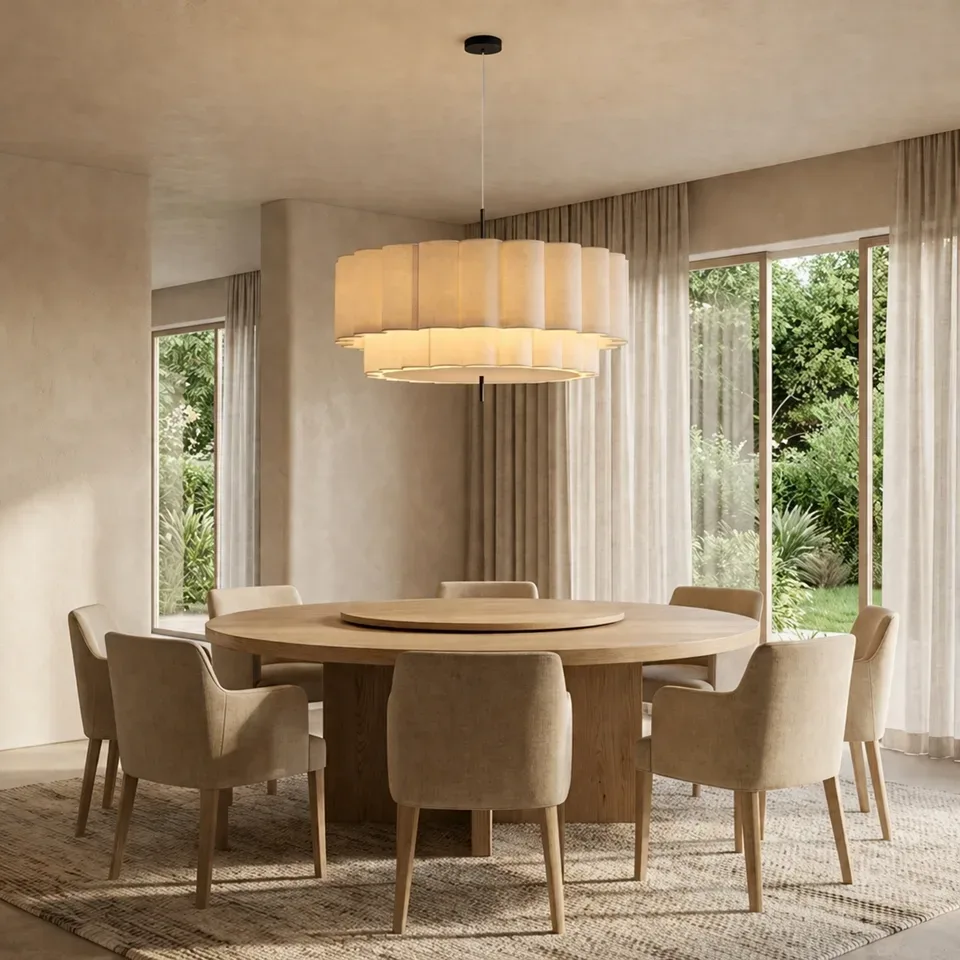
Measure three things: the width across the bottom, the height of the shade, and the drop from the ceiling. For the width, add your room’s length and width in feet and read the total as inches. A 3.6 × 4.2 m room points to a shade about 65 cm wide.
Over a table, keep the shade between half and two-thirds of the table’s width. Hang its bottom 75 to 90 cm above the table top.
How to measure lamp shade size: the three numbers on every shade
Every size on our product pages, and on most pendant lights you will see anywhere, comes from the same three numbers. Home Depot’s guide asks you to measure “from edge to edge, and as close to center as possible.”
- Diameter. Hold the tape across the widest opening, through the centre. Shades are named by the bottom width, so a 30 cm shade is 30 cm across the bottom.
- Height. Measure straight up, from the bottom rim to the top rim. A drum shade has the same top and bottom width, so its height and side length match.
- Slant. On a tapered shade, run the tape down the sloping side. Shade makers write the size as top × bottom × slant, for example 10 × 16 × 12 inches.
A pendant needs one more number: the drop, the cord between the ceiling plate and the top of the shade. Our pendants hang on 1.5 m of cord as standard, and your electrician shortens it at fitting.
Use this lamp shade sizes chart as a starting point.
| Your room or table | Shade width to start with |
|---|---|
| Room 3 × 3 m (about 10 × 10 ft) | About 50 cm |
| Room 3.6 × 4.2 m (about 12 × 14 ft) | About 65 cm |
| Room 4.2 × 5.4 m (about 14 × 18 ft) | About 80 cm |
| Table 90 cm wide | 45 to 60 cm |
| Table 120 cm wide | 60 to 80 cm |
Pendant light size: how wide and how low for your room?
Take one real room: a 3.6 × 4.2 m dining room with a 90 cm wide table, a 75 cm high table top and a 285 cm ceiling. Measure your own room and swap in your numbers.
- Change metres to feet: 3.6 ÷ 0.3048 = 11.8 ft, and 4.2 ÷ 0.3048 = 13.8 ft.
- Add them: 11.8 + 13.8 = 25.6. Read the answer as inches: 25.6 inches.
- Change inches to cm: 25.6 × 2.54 = 65 cm. The room asks for a shade about 65 cm wide.
- Now check the table. Half of 90 cm is 45 cm, and two-thirds is 60 cm. The rule quoted from the American Lighting Association keeps a light at least 12 inches (30 cm) narrower than the table: 90 − 30 = 60 cm. The table allows 45 to 60 cm.
- Set the height. A shade bottom 75 to 90 cm above a 75 cm table sits 150 to 165 cm from the floor.
- Find the cord length for a 40.5 cm tall shade: 285 − 165 − 40.5 = 79.5 cm, and 285 − 150 − 40.5 = 94.5 cm. Both fit inside the 1.5 m standard cord.
A second sum helps with tapered shades. Take a shade 30 cm across the top, 50 cm across the bottom and 30 cm tall. Each side steps out (50 − 30) ÷ 2 = 10 cm. The slant is √(30² + 10²) = 31.6 cm, so the slant reads 1.6 cm more than the height.
On 30 October 2026 we counted the 21 fabric pendants in our own catalogue. Their 26 size options run from 25 cm to 90 cm across. The middle size is 45 cm, and 16 of the 26 options sit between 35 and 50 cm.
Why the size rules work: the logic and the science of a fabric shade
In our sum the room asked for 65 cm and the table allowed only 60 cm. Over a table, the table rule wins. A shade wider than two-thirds of the table reaches over the chairs, so heads come close to the rim and the table feels crowded.
Where no table sits below, use the room answer and think about heads. The US Access Board asks for at least 80 inches (2030 mm) of headroom along walking paths. Most lighting guides round that to 7 ft, about 213 cm, from the floor to the bottom of the shade.
Height matters more than width for brightness. The inverse square law says light from a small source spreads over a bigger area as it travels. At 2 m a page gets one-fourth of the light it gets at 1 m. Raise a shade from 75 cm to 90 cm above the table, and the plates get roughly (75 ÷ 90)² = 69% of the light.
The fabric itself is a filter. Light from the bulb passes between the threads and scatters, so the whole shade glows like one soft surface instead of one sharp point. A 2026 textile study found that a tighter weave lets less light through, and darker colours reflect less light. Cream linen and pale silk therefore give a brighter glow than a dark, dense cloth.
The depth of the shade controls glare. Lighting engineers call the angle at which a shade hides its bulb the shielding angle, the way a cap’s brim hides the sun from your eyes. A deeper shade hides the bulb from more seats in the room.
The JagMag way: real fibre, careful hands, the right size
Linen comes from the flax plant. Silk comes from the cocoon, and hemp from a tall plant stem. Nature gives the fibre. In our Greater Noida factory, hands pleat the silk, stitch the linen over its frame and wind the rope fold by fold. Our craftsmen have worked this way since 2015. Light then passes through the weave, and the size you measured decides how that glow fills your room.
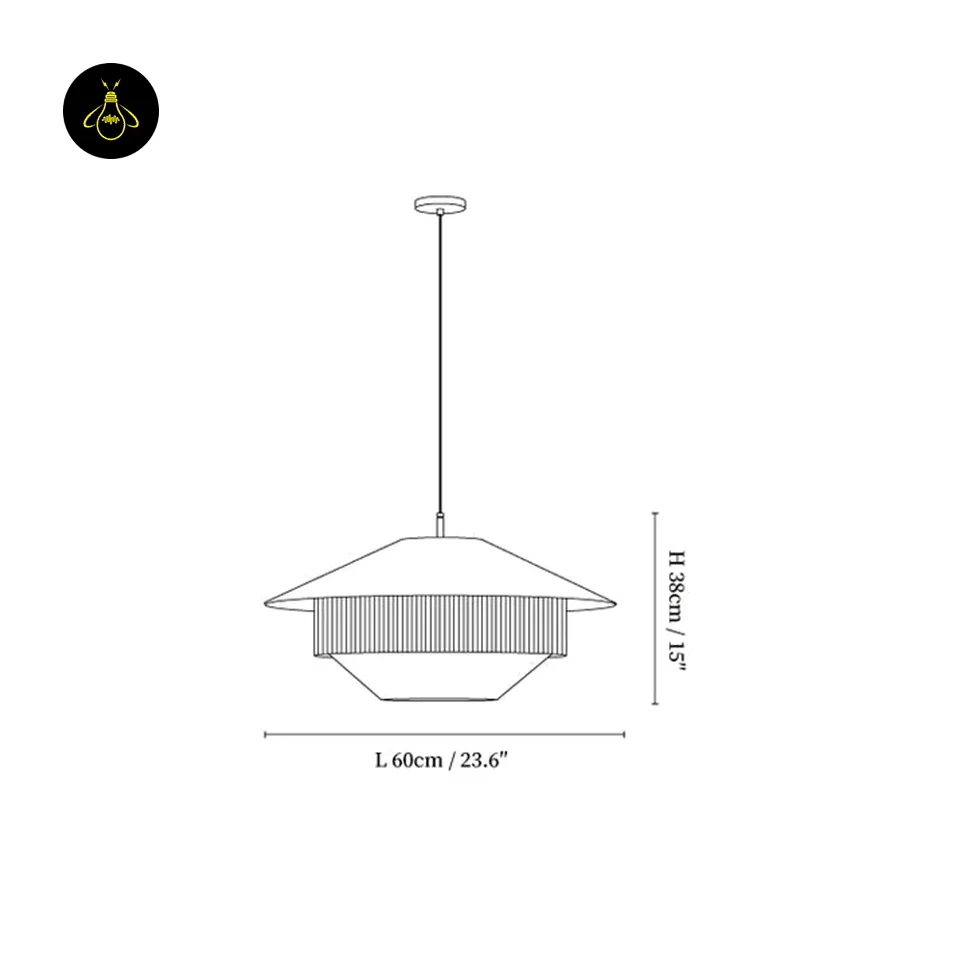
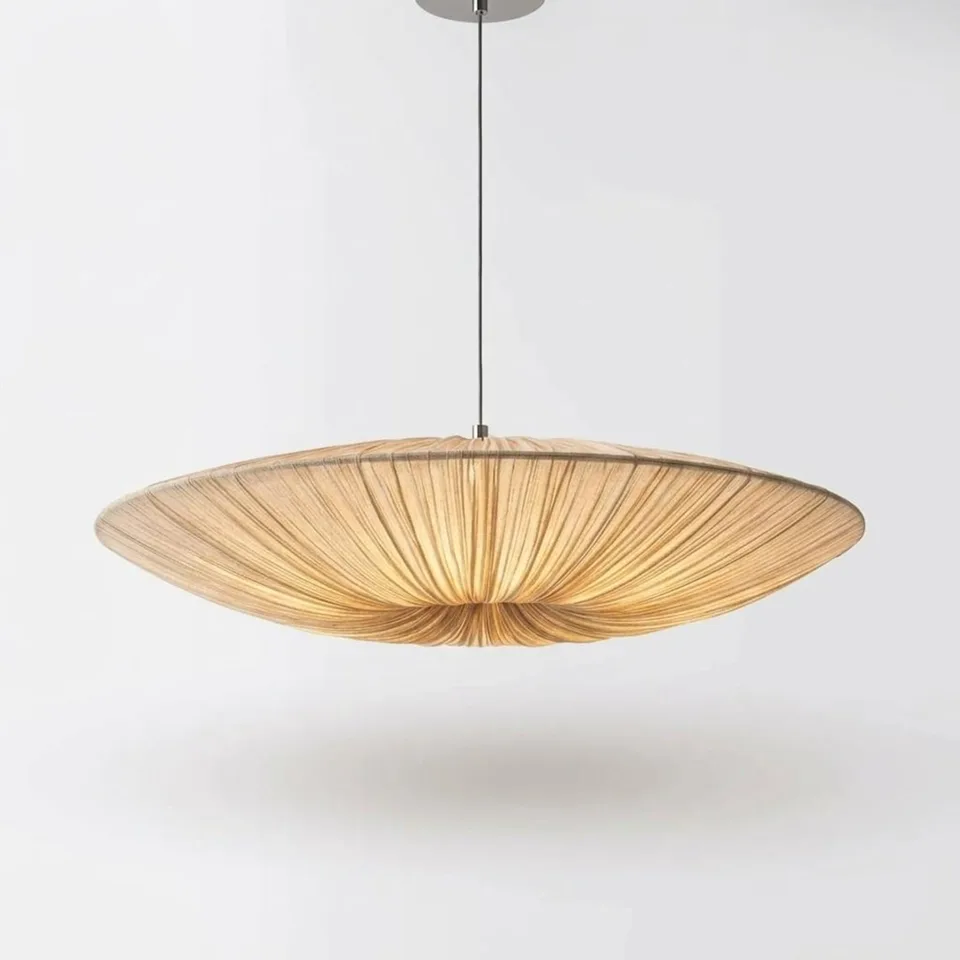
The scalloped linen drum pendant is 65 cm across and 40.5 cm tall, with cord up to 200 cm. The width matches the 3.6 × 4.2 m room in our sum. The pleated silk saucer pendant is 60 cm wide but only 12 cm tall, so it sits at the top of the range for a 90 cm table. The Japanese linen and hemp rope pendant is 60 × 38 cm.
All three take an E27 bulb, the common screw-in base found in most Indian homes. The bulb is not included; fit a 3000K warm-white LED. Each shade hangs from 304-grade stainless steel, with a lifetime warranty against rust on the stainless parts for orders from 4 October 2026. You can check our certifications before you choose.
Natural fibre and warm light also sit well with Vastu thinking: a material from the earth, the warmth of fire, and open space under the shade. We see that as harmony in the room, not a promise of luck.
FAQs
How to measure lamp shade size for a pendant light?
Measure the width across the bottom opening, the straight height from rim to rim, and the drop from the ceiling to the top of the shade. Write the size as width × height, for example 65 × 40.5 cm.
What size lamp shade suits a 10 × 12 ft room?
A shade about 22 inches, or 56 cm, wide suits a 10 × 12 ft room. Add 10 + 12 = 22 and read the answer in inches.
How high should a fabric pendant hang above a dining table?
Hang the bottom of the shade 75 to 90 cm (30 to 36 inches) above the table top. Over a walking path, keep at least 213 cm (7 ft) from the floor.
Does a bigger shade give more light?
No, the bulb sets the amount of light, and a bigger shade only spreads that light over a larger glowing surface. Hanging height changes the light on the table more: double the distance and the table gets one-fourth of the light.
Nature gives the material.
Human hands give it meaning.
Vastu inspires harmony.
Light brings it to life.
That is JagMag.
Ready to choose a size? See our fabric pendant lights. For care and fitting, read how to clean lamp shades and how to hang a pendant light over a dining table. Not sure? Video-call us with your room size.
Sources
- Home Depot – How to Measure a Lamp Shade (read 30 Oct 2026)
- Wayfair UK – How to measure lamp shades (read 30 Oct 2026)
- Fenchel Shades – How to measure lamp shade dimensions (read 30 Oct 2026)
- Schoolhouse – Choose the right size chandelier or pendant (read 30 Oct 2026)
- Tala – What size pendant light do I need? (read 30 Oct 2026)
- Hammerton – Selecting lights that fit your dining table (read 30 Oct 2026)
- US Access Board – Protruding objects, 80-inch headroom (read 30 Oct 2026)
- HyperPhysics – Inverse square law for light (read 30 Oct 2026)
- Bayar et al., Journal of Innovative Engineering and Natural Science, 2026 – light transmittance of woven fabrics (read 30 Oct 2026)
- CIE International Lighting Vocabulary – shielding angle (read 30 Oct 2026)