You lie down at night, and the ceiling light is still burning white above you. Your eyes feel wide awake, even though your body is tired.
The best light colour for bedroom use is a warm one. Light colour is not only about looks. The colour and the brightness of the light both tell your body what time of day it is.
Below are the guide numbers, a simple sum for an Indian bedroom, and the science of warm light at night.
The short answer
Pick warm white light of about 3000K for the bedroom. ENERGY STAR puts warm white between 2200K and 3000K. Daylight bulbs sit at 5000K to 6500K, and they suit reading or work, not the last hour before sleep. In the evening, keep only a lamp or a wall light on, and switch the bright ceiling light off.
Which colour light is good for sleep?
Light colour is measured in kelvin, written K. A low number means yellow, candle-like light. A high number means bluish light, like the sky at noon. ENERGY STAR groups bulbs in three bands.
| Light colour | Kelvin | Good for |
|---|---|---|
| Warm white | 2200K to 3000K | Most rooms, bedroom at night |
| Neutral or cool white | 3500K to 4100K | Kitchen, work area |
| Daylight | 5000K to 6500K | Reading, close work |
Harvard Health Publishing describes an experiment with 6.5 hours of light. Blue light held back melatonin, the body’s sleep hormone, for about twice as long as green light. Blue light also moved the body clock by 3 hours, against 1.5 hours for green.
The same Harvard advice says to avoid bright screens for 2 to 3 hours before bed. For a night light, it suggests a dim red one, because red light is less likely to disturb melatonin.
Brightness matters too. Indian Standard IS 3646 lists 30, 50 and 100 lux for hotel bedrooms. Lux is the light falling on one square metre, like rain falling on one tile. So a bedroom needs far less light than an office or a kitchen.
All our bedroom lights follow the warm side of this table. The next step is to turn these numbers into a plan for your own room.
How bright should your bedroom be? The simple sum
Take a bedroom 3.6 m long and 3.3 m wide. Lux tells you how much light lands on each square metre, so the sum is easy.
- Floor area: 3.6 × 3.3 = 11.88 square metres, about 128 square feet.
- At 30 lux: 30 × 11.88 = about 356 lumens must land on the floor. A lumen is the total light a bulb gives out, like litres of water from a tap.
- At 50 lux: 50 × 11.88 = about 594 lumens.
- At 100 lux: 100 × 11.88 = about 1,188 lumens.
- Shades, walls and ceilings soak up part of every bulb’s light. So the lumens on the bulb boxes run higher. The Home Depot’s guide gives 1,000 to 2,000 lumens in all for a bedroom.
Now plan the evening. Say you sleep at 11 pm.
- The 2 to 3 hour screen gap puts the switch-down time at 8 pm to 9 pm.
- From then, use one lamp. BLT Direct suggests a warm bulb of about 230 to 270 lumens for bedrooms.
- A 250-lumen lamp against 1,500 lumens of full room light: 250 ÷ 1,500 = about 0.17. Your room now runs on about one sixth of its daytime light.
We also counted our own range on 29 October 2026. Our bedroom collection holds 255 lights. 71 have a built-in LED, and every one of those is 3000K warm white. 179 take a bulb in a holder, sold without a bulb, and we ask you to fit a 3000K warm-white LED. Not one light in the 255 is set to a cool or daylight colour.
Best light colour for bedroom nights: why warm, low light works
The reason follows a simple chain. Your eye sees blue-rich light. Your brain reads blue-rich light as daytime. Your body then holds back melatonin. Less melatonin means you feel awake when you want to sleep.
Warm light has less blue in it. So the same lamp at 3000K sends a weaker “daytime” message than a 6500K tube light. Low light sends a weaker message again. So a warm lamp, kept low, gives the body its night signal on time.
Guides differ a little on the exact number. Some sleep writers like 1800K to 2700K for the very last hour. The warm white band runs from 2200K to 3000K. We stay at 3000K, because 3000K still shows true skin and wood colours when you dress or read. Then we keep the light low and to the side.
The science of light and sleep
Light is energy in waves. Each colour has its own wave size. Blue light has short waves. Red and amber light have longer waves.
Your eye has special cells that answer most strongly to blue light. These cells talk to the body clock, a small part of the brain that sets your day and night. Blue light in the evening tells the clock that the sun is still up.
Normal room light is enough to do it. A 2011 study in the Journal of Clinical Endocrinology and Metabolism tested 116 healthy adults. Room light under 200 lux, compared with dim light under 3 lux, cut melatonin by more than half in 85% of the trials. The room light also shortened the melatonin night by about 90 minutes.
Distance helps too. Light spreads out as it travels, like spray from a hose. A wall light beside the bed sends less light into your eyes than a bright tube light straight above your pillow.
Warm light in natural materials: the JagMag way
Nature gives the material. Stone, wood and silk already soften light before it reaches you. We have made lights in our own Greater Noida factory since 2015. Our craftsmen shape each piece by hand, so its glow stays low and warm.
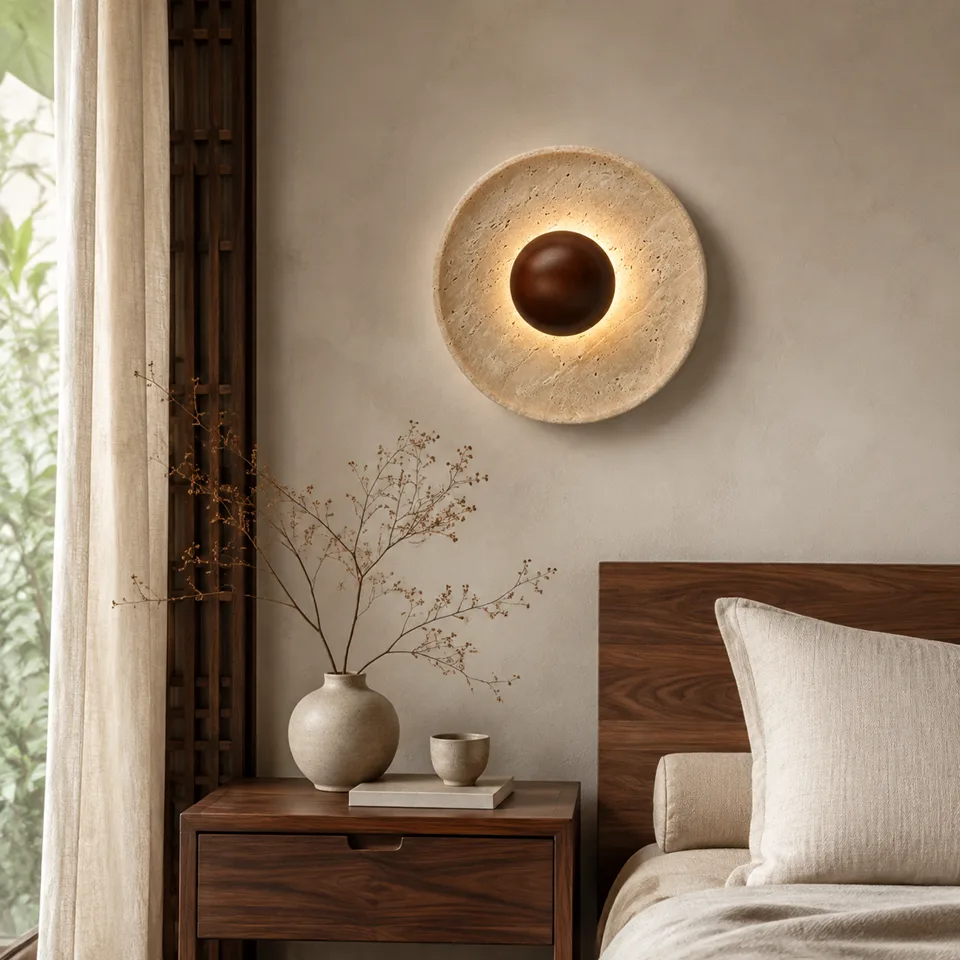
The Travertine Dish Wall Light is a 25 cm disc of real travertine, cut and honed by hand. Its built-in 3000K LED washes the wall, not your eyes. The light is rated IP20, for indoor rooms.
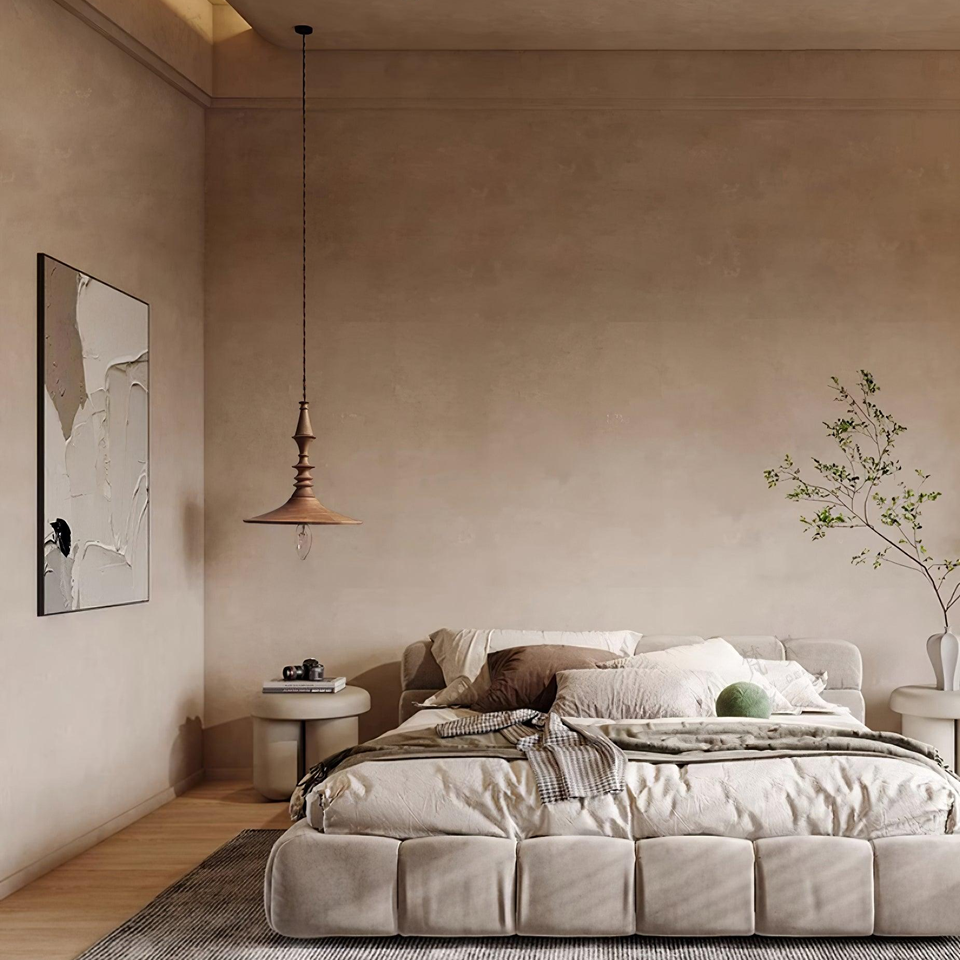
The Turned Wood Pendant is solid wood, turned on a lathe, 23 cm wide and 24 cm tall. Hung beside the bed on its 1.5 m cord, it works as a bedside lamp. The bulb is not included; fit a 3000K warm-white LED.
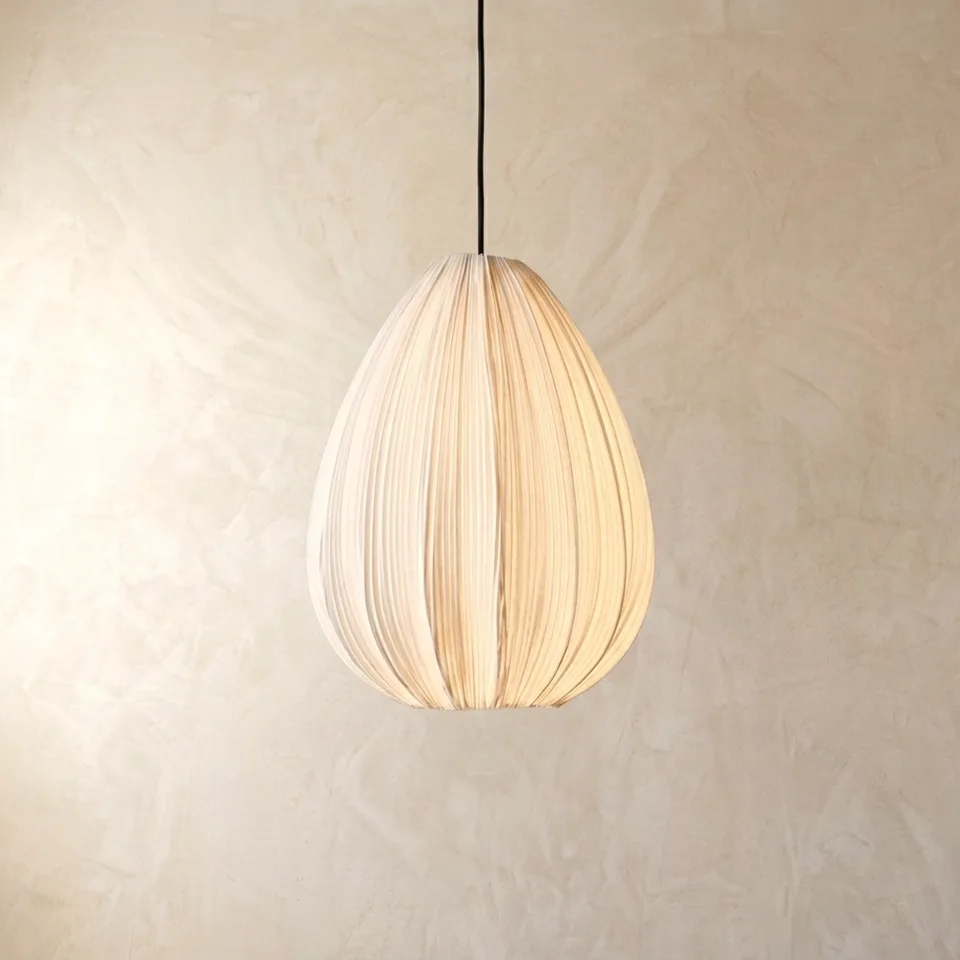
The Silk Teardrop Pendant wraps the bulb in real silk, pleated by hand. The shade is 28 cm wide and 40 cm tall, and the silk turns a bright bulb into a soft glow. Its steel frame is 304-grade stainless steel, covered by our lifetime warranty against rust.
Vastu guidance often asks for soft lamps or wall lights in the bedroom, not harsh direct light from overhead. Warm stone, wood and silk light follows that same calm idea.
FAQs
What is the best light colour for bedroom use?
Warm white of about 3000K is the best everyday choice. ENERGY STAR places warm white at 2200K to 3000K. In the last 2 to 3 hours before sleep, keep the light warm and low.
Which colour night bulb is good for bedroom sleep?
A dim red or amber night light is the gentlest choice. Harvard Health Publishing says red light is less likely to shift the body clock or hold back melatonin. Keep it low, near the floor.
Is cool white or daylight light bad in a bedroom?
Cool white (3500K to 4100K) and daylight (5000K to 6500K) are not bad by day. At night they carry more blue light, which tells the body it is still daytime. Use them for a study desk, not the bedside.
How many lumens does a bedroom need?
About 1,000 to 2,000 lumens in all, from every light in the room. Bedside lamps of about 230 to 270 lumens are enough for the hour before sleep.
Nature gives the material. Human hands give it meaning. Vastu inspires harmony. Light brings it to life. That is JagMag.
Find warm lights for your bedroom. Read our warm white vs cool white guide and our bedroom lighting ideas. Not sure? Video-call us.
Sources
- Harvard Health Publishing, Blue light has a dark side (updated 24 Jul 2024) (read 29 Oct 2026)
- Gooley JJ et al., Exposure to room light before bedtime suppresses melatonin onset and shortens melatonin duration in humans, J Clin Endocrinol Metab, 2011 (read 29 Oct 2026)
- ENERGY STAR, Light Bulb Purchasing Guide (read 29 Oct 2026)
- Bureau of Indian Standards, IS 3646 (Part 1): 1992, Code of practice for interior illumination (read 29 Oct 2026)
- The Home Depot, How to estimate lumens for your space (read 29 Oct 2026)
- BLT Direct, How many lumens do I need for a room (read 29 Oct 2026)
- JK Cement, Colours and lighting in Vastu for interior spaces (read 29 Oct 2026)
- Theatrecrafts, Lighting terms, definitions and conversions (lux and the inverse square law) (read 29 Oct 2026)
- Livingetc, Best color light for sleep (read 29 Oct 2026)