
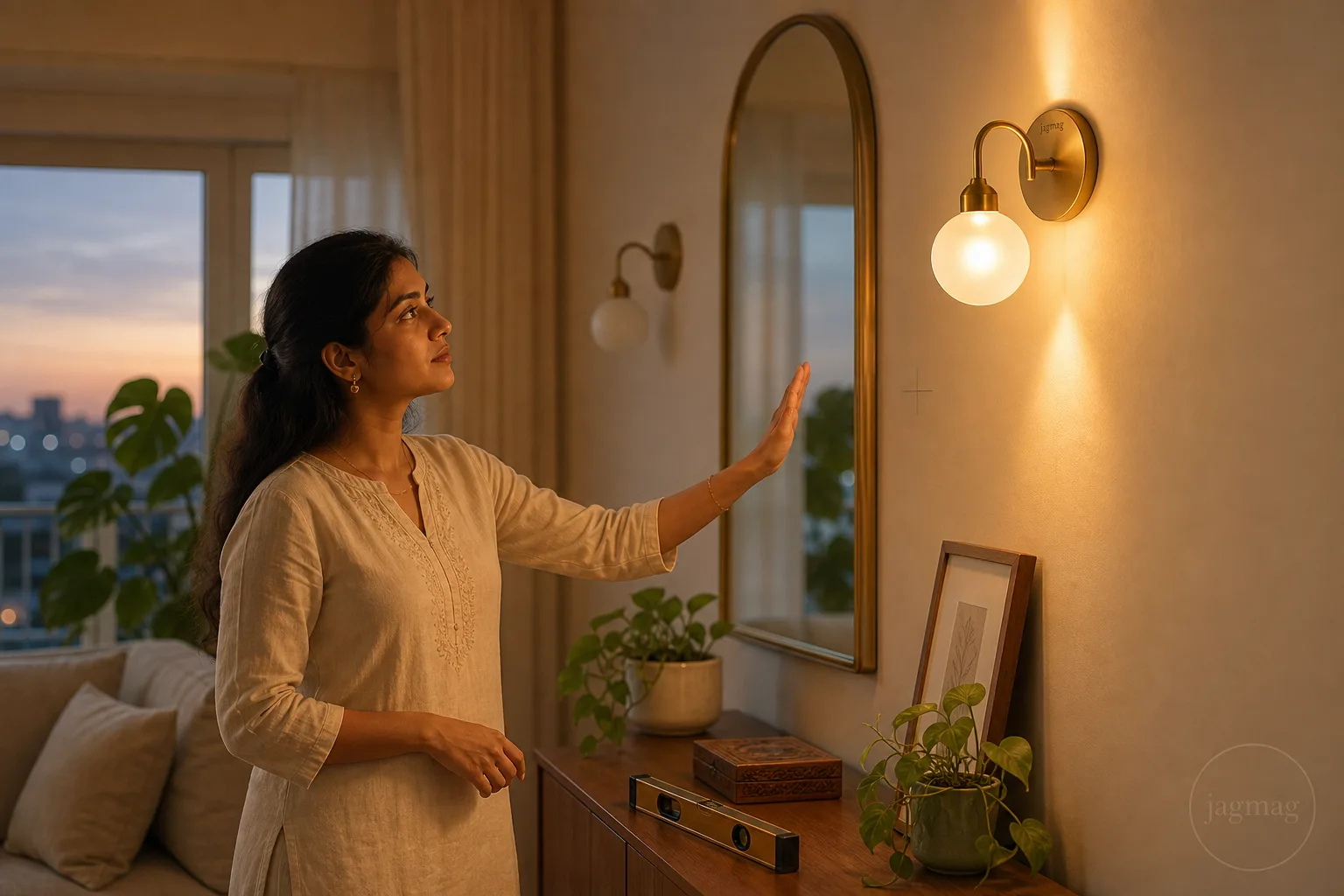
It’s a quiet evening. You switch off the big ceiling light, turn on a soft wall light beside the sofa, and the whole room changes. The harsh white glare is gone. What’s left is a warm, golden pool of light that makes your home feel calm and a little bit special.
That’s the magic of a good wall light.
But walk into any lighting shop and you’ll see a hundred options. Up-lights, down-lights, sconces, reading lights, outdoor lights. So how to choose wall lights that actually suit your home, your wall, and your budget?
Here’s the thing. It’s simpler than it looks. Let me walk you through it, step by step.
In this guide
- Quick answer: how to choose wall lights
- Why wall lights make a room feel finished
- How to choose wall lights in 6 simple steps
- Wall light height: the easy cheat sheet
- Best wall lights, room by room
- Warm light or white light?
- Which wall light should you buy?
- 3 mistakes to avoid
- Your questions, answered
Quick answer: how to choose wall lights
To choose wall lights, match three things: the job (soft mood light, reading light, or task light), the spot (most wall lights sit around 150–180 cm from the floor, bedside ones lower), and the look (warm 3000K light in every room, placed close to where you need to see). Pick the size to suit your wall, choose warm white LED bulbs for cosy rooms, and you’re done. See all our bedroom wall lights.
Now let me explain each part so you feel sure before you buy.
Why wall lights make a room feel finished
Big ceiling lights flatten a room. They throw light straight down, so everything looks flat and a bit like an office.
Wall lights do the opposite.
They throw light sideways and upward. That bounces off your walls and ceiling and fills the room with a soft, even glow. Designers call this “layered lighting” — just a fancy way of saying you use a few smaller lights instead of one big one.
Wall lights also save space. No floor lamp eating into your living room. No table lamp crowding your bedside. They free up the floor and still give you that warm corner glow.
And they look beautiful even when switched off. A brass sconce or an alabaster disc is a piece of decor on your wall, day or night.
How to choose wall lights in 6 simple steps
You might be thinking this is going to get technical. It won’t. Just answer these six questions.
1. What’s the job? Do you want soft mood light, a reading light by the bed, or bright light over a mirror? The job decides everything else.
2. Up, down, or both? An up-down light throws light to the ceiling and floor — great for hallways and feature walls. A downward sconce is better for reading. A soft glow shade spreads light all .
3. How big is the wall? A tiny sconce on a huge wall looks lost. A big light on a narrow wall feels heavy. As a rule, a single wall light works on a wall up to about 1.5 metres wide. For wider walls, use a pair.
4. Where will it go? Beside the bed? Next to a mirror? On the staircase? The spot decides the height (more on that below).
5. Wet area or dry? Bathrooms and outdoor walls need a sealed, moisture-safe light. Look for an “IP44” rating for bathrooms and balconies, and “IP65” for fully open outdoor walls. That number just tells you how well the light keeps water out.
6. What’s the finish? Brass and warm gold suit traditional and cosy Indian homes. Matte black and chrome suit modern spaces. Alabaster and frosted glass give a soft, premium glow.
Shopping now? See how real stone glows in our 70 cm alabaster wall light, made by hand in Greater Noida.
Answer those six and you’ve basically figured out how to choose wall lights for any room. See? Not scary at all.
Wall light height: the easy cheat sheet
This is where most people get stuck. So here’s a simple table you can save.
| Where | Height from floor | Quick tip |
|---|---|---|
| Living room / general | 150–180 cm | Around eye level, so it glows without glare |
| Beside the bed | 90–110 cm | About 30 cm above the mattress, easy to reach while sitting up |
| Beside a bathroom mirror | 150–165 cm | At face level, one on each side kills shadows |
| Hallway / staircase | 150–180 cm | Space lights about 2.5–3 metres apart |
| Outdoor / entrance | 165–180 cm | Above head height, near the door |
One golden rule: always measure to the centre of the light. And if your ceilings are tall (common in newer Indian flats), move the light up a little so it still looks balanced on the wall. These placement ranges line up with guidance from lighting specialists like Visual Comfort and Seus Lighting.
Best wall lights, room by room
Let me make this real. Knowing how to choose wall lights room by room is half the job — here’s what works where.
Living room. Go for a warm, glowing sconce that lifts the whole room. The Gold Oriol Globe Sconce is a lovely starting point — a soft gold globe that looks like a tiny moon on your wall. Put a pair on either side of your TV or sofa.
Bedroom. You want a reading light that’s also gentle on the eyes. The Akner Alabaster Dome Sconce throws a warm, milky glow — perfect for late-night reading without waking your partner. Short on space? The compact Verde Duo Green Marble light is small, classy and easy to fit beside any bed.
Hallway and staircase. Here you want light that travels up and down the wall. The Slim Black Linear LED Bar is clean, modern and makes a dark passage feel safe and stylish. Want a statement piece instead? A decorative wall light like our 44 cm tiered torch sconce sends warm light up, out and down the wall from one fitting.
Bathroom. Stick to moisture-safe lights beside the mirror, at face level, one on each side. That kills the ugly shadows you get from a single overhead light.
Shopping now? For one light over the whole mirror, our 88 cm three-globe vanity wall light spreads warm light across it. Fit it on a dry wall, outside the shower splash zone. For a pair beside the mirror, our 45 cm fluted glass vanity light in satin brass gives a soft column of warm light on each side. Prefer stone? Our 40.6 cm alabaster vanity light glows through a real alabaster dome, fitted on a dry wall beside the mirror. Want two lights in one piece? Our 68 cm double wall light holds two opal borosilicate glass balls in reeded wood bowls, on a dry wall at the side of the mirror.
Outdoor and entrance. The Outdoor Stripe Sconce is built to handle rain, dust and our Indian summers — a warm welcome by your front door, even during the monsoon.
Want to see the full range in one place? Browse the JagMag wall lights collection.
Warm light or white light?
This one question changes how your whole room feels. So don’t skip it — it’s the part of how to choose wall lights that people forget most.
For living rooms, bedrooms and dining areas, choose warm white bulbs (around 3000K). That’s the soft, golden, sunset-like light that helps you relax. It makes wood, brass and skin tones look beautiful.
For bathrooms, study tables and outdoor walls, you need more light where you work, not a colder colour. Put the light at face level or right beside the task. Warm 3000K light then shows skin and make-up true while you shave or get ready.
Simple rule: warm light everywhere, placed close to the task. Our lights are not dimmable, so choose brightness by size and placement. A pair beside a mirror gives more light on your face than one above it.
Which wall light should you buy?
Still feeling unsure? Here’s what I’d tell a friend.
If this is your first wall light, start with one warm-glow sconce for the living room, like the Gold Oriol Globe Sconce. It’s affordable, easy to love, and you’ll instantly see the difference.
For the bedroom, get a pair of bedside sconces so both sides of the bed get a reading light. A wall reading lamp with a head you can aim keeps the light on your page, not on your partner. For a hallway or stairs, one or two slim LED bars do the trick.
And here’s why buying from a real manufacturer matters. JagMag makes its lights in India, in-house. So if a part ever needs replacing — even years later — you can still get it. Importers often can’t, because the stock is long gone. Custom sizes and finishes take just 15–20 working days, not the 60–120 days importers quote. For a homegrown, government-recognised (DPIIT) Make-in-India brand, that’s real peace of mind.
Need help matching your wall lights to a chandelier? Read our guide on matching wall lights with chandeliers, and our quick list of common lighting mistakes so you don’t repeat them.
3 mistakes to avoid
1. Mounting them too high. A wall light at the ceiling lights up nothing but the ceiling. Keep to the heights in the cheat sheet above.
2. Picking cool white for the bedroom. That blue-white “tubelight” glow kills the cosy feeling. Go warm.
3. Buying just one when you need a pair. Single lights look lonely beside a bed or mirror. Pairs look balanced and spread light better.
Avoid these three and your wall lights will look like a designer placed them.
Once you have chosen the right fixture, it helps to see it in real rooms. Here are nine wall light design ideas Indian homes love.
Your questions, answered
How high should a wall light be?
For most rooms, around 150–180 cm from the floor (roughly eye level). Beside the bed, drop it to 90–110 cm so it’s easy to reach. Always measure to the centre of the light.
How many wall lights do I need in a room?
For a small room, one or two. For a long living room or hallway, space them about 2.5–3 metres apart so the light spreads evenly.
Can I use wall lights in the bathroom?
Yes — just use a moisture-safe light rated IP44 or higher. Mount one on each side of the mirror at face level for shadow-free light.
Warm or cool light for wall lights?
Warm white (3000K) everywhere, bathrooms and study areas included. Where you need more light, place it closer to the task instead of choosing a colder colour.
Do I need an electrician to install them?
For a hard-wired wall light, yes — it’s quick and safe to have an electrician fix the wall box. Some plug-in styles, like our plug in wall lamp, you can mount yourself.
So, now you know how to choose wall lights without second-guessing yourself. Pick the job, pick the spot, pick a warm glow — and watch your room come alive. Which room are you lighting up first?
Shopping now? See our living room wall lights, made by hand in our Greater Noida factory and shipped free across India.