Hold two cream cloths side by side. They can look the same. Then you crease them, wash them or hang them in front of a bulb, and they behave differently. The linen vs cotton question comes up with shirts, bed sheets, curtains and lamp shades.
We work with cloth every day, because cloth is a lamp shade. Below you will find where each fibre comes from and what the numbers say. Three small sums and some plain science then show how a shade spreads light.
The short answer
Linen comes from the stem of the flax plant, and cotton comes from the seed boll of the cotton plant. Linen is stronger, feels cooler and creases more. Cotton holds a little less moisture from the air. On hanging lamps, both spread light well, and the tightness of the weave matters more than the fibre.
Linen vs cotton: what is linen fabric, and how do they differ?
Linen is a fabric woven from bast fibres, which are the long strands inside a plant stem. CAMEO, the materials database of the Museum of Fine Arts Boston, gives that definition. Cotton is the fluffy fibre around the seeds of the cotton plant.
| Point | Linen | Cotton |
|---|---|---|
| Source | Flax stem | Cotton seed boll |
| Moisture regain | 12% | 7 to 8.5% |
| Cellulose in the fibre | 70 to 80% | 88 to 96% |
| Water it can hold | Up to 20% of its weight | Over 25% of its weight |
| Creasing | Very easy | Medium |
Moisture regain means the water a dry fibre takes back from normal air. Cellulose is the plant material that gives a fibre its body, the same stuff that makes up paper.
Flax takes real time to become cloth. Farmers can harvest it about 100 days after sowing. Then comes retting, which means soaking or leaving the stems so bacteria eat the glue between the fibres. Retting in water can take 10 to 90 days. Cotton needs no retting, which is one plain difference between linen and cotton.
Britannica says linen is stronger than cotton and dries faster. Wikipedia goes further and says linen can be up to three times stronger. Fibre length is less clear. CAMEO gives 6 to 65 mm for flax and 16 to 60 mm for cotton, while Wikipedia gives flax 25 to 150 mm. So treat length as a rough guide only.
How much moisture does each fabric hold?
Three small sums turn those numbers into something you can picture.
Sum 1: water from the air.
- Take 500 g of dry cloth, our example.
- Linen at 12%: 500 x 0.12 = 60 g of water.
- Cotton at 8.5%: 500 x 0.085 = 42.5 g of water.
- Linen takes up 17.5 g more, or about 1.4 times as much.
Sum 2: why a shade softens a bulb.
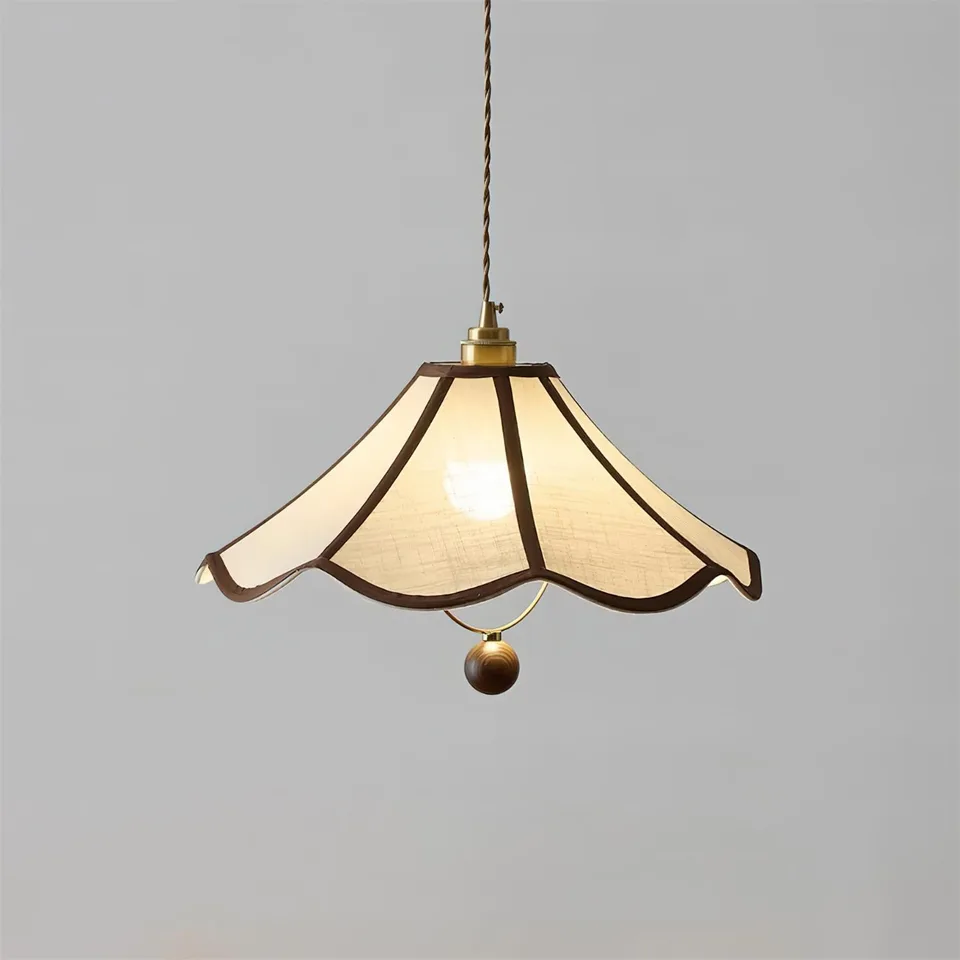
- Take a shade 45 cm wide and 20 cm tall, the size of our scalloped linen shade.
- The side area is 3.14 x 45 x 20 = 2,827 square cm.
- A round bulb 6 cm wide has a surface of 3.14 x 6 x 6 = 113 square cm. The 6 cm is our example.
- Divide: 2,827 ÷ 113 = 25. The shade glows over about 25 times more area than the bulb.
Sum 3: how much of the cloth is open.
- Blind makers rate cloth by openness factor, the share of space between the threads. Draper says most run from 1 to about 13%.
- At 3%, the same shade has 2,827 x 0.03 = 85 square cm of gaps.
- At 10%, the gaps reach 283 square cm, over three times as much.
Those openness numbers come from window fabrics, and we have not rated our shades that way. The lesson still holds, because thread spacing changes how much light gets through.
We counted our own range on 3 Nov 2026. Of our 21 cloth pendants, 6 name linen, 6 name silk and only 1 names cotton. Nine use the word fabric, and some of those overlap.
Is linen better than cotton? The logic and the science
Neither fibre wins every job, so start from the job. Linen is better when you want strength and a cool feel. Wikipedia links the cool touch to better heat flow, and MasterClass says the flax fibres are hollow. So linen suits hot Indian summers.
Cotton is better when you want fewer creases and an easy daily fabric. Linen’s stiffness causes its creases, says MasterClass. A stiff fibre bends and stays bent. Cotton bends and recovers more.
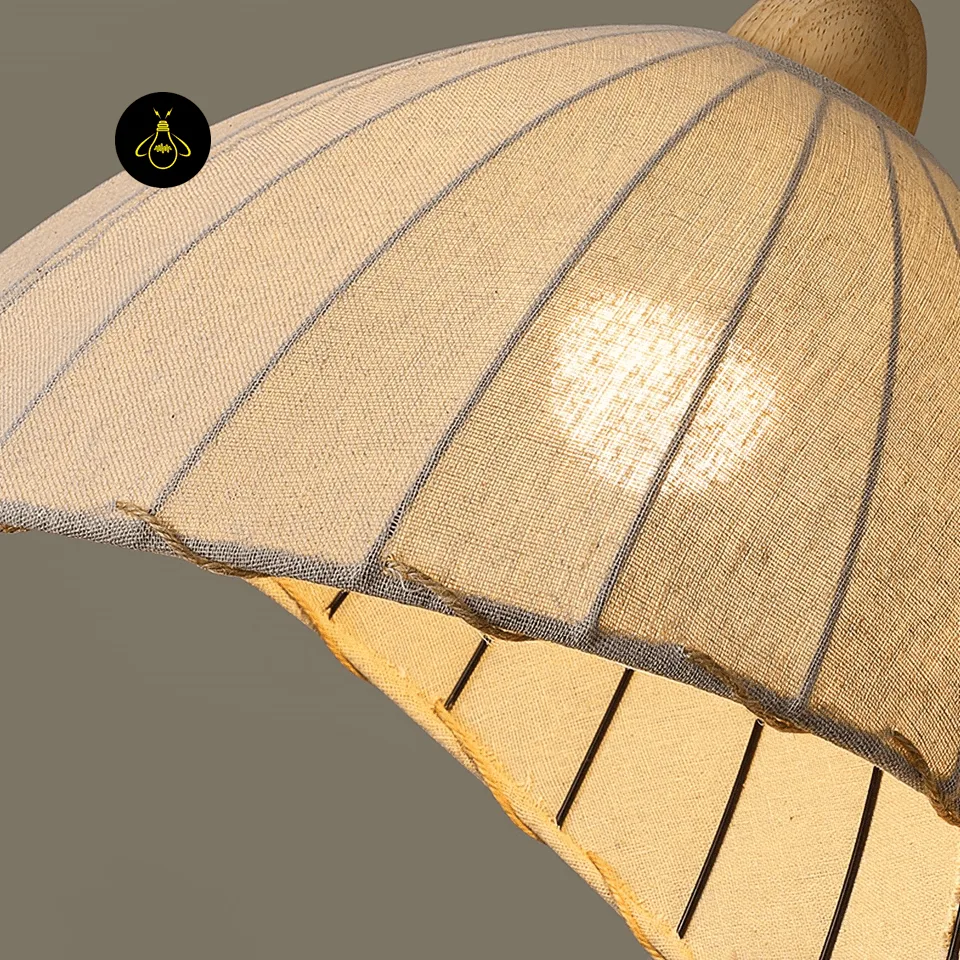
A lamp shade changes the logic. Nobody folds a shade or wears it, so creasing hardly counts. A stiff cloth also holds its shape on a frame, and a shade needs shape. Strength and body count for more here, and softness counts for less.
Clear glass lets light travel straight. Cloth does not. Light meets a thread, bends, bounces and leaves in a new direction. Each fibre sends it somewhere else, so the rays mix. An IIT Kanpur physics note calls this scattering, where light goes in all directions and objects behind look hazy.
Think of headlights in fog. The fog does not add light, but the bright point turns into a soft patch. A shade does the same thing to a bulb.
Your eye likes that. Glare means light so strong in your view that seeing gets harder. A CIE research note says glare falls when the same light spreads over a larger area. Sum 2 shows a shade spreading the glow 25 times wider, so your eye rests.
Colour matters as well. Draper notes that darker cloth absorbs more light. So cream linen gives a brighter room than brown linen, with the same bulb.
Heat matters last. CAMEO says linen degrades slowly in sunlight and above 120 °C. Old filament bulbs turn 90% of their energy into heat, says the US Department of Energy. An LED bulb is the kinder partner for any cloth shade.
Nature gives the fibre, hands stitch it, light shows the weave
Flax grew in a field. Cotton grew around a seed. Our craftsmen stretch and stitch the cloth over the frame by hand, and a shade only looks right when each panel sits even. Switch it on, and the weave you could barely see comes alive.
- Our Linen Cloth Pendant Light has a natural linen dome 35 cm wide with a turned wood cap.
- Our Umbrella Fabric Pendant Light has a cream linen shade, 40 cm wide and 28 cm tall.
- Our Cane and Fabric Layered Drum pairs cotton fabric with hand-woven cane, 45 cm wide and 38 cm tall.

All three use an E27 holder, the common screw fitting. The bulb is not included, so fit a 3000K warm-white LED. Each one carries a 304 stainless steel frame. We have made them in our own factory in India since 2015, with free shipping across India. Our certifications are open to read.
Plant fibre and warm light both sit well with Vastu thinking, which looks for harmony in a room. We take that as inspiration, not as a promise.
FAQs
Is linen better than cotton?
Linen is better for strength and a cool feel, while cotton is better for fewer creases. Wikipedia says linen can be up to three times stronger. So the job decides.
What is linen fabric?
Linen fabric is cloth woven from fibres in the stem of the flax plant. Flax can be harvested about 100 days after sowing, then the stems are retted to free the fibres.
What is the difference between linen and cotton?
Linen comes from a flax stem and cotton comes from a seed boll. Linen takes back 12% moisture from air, against 7 to 8.5% for cotton, and linen creases more.
Which is better for summer, linen vs cotton?
Linen usually feels cooler, because heat moves through it more easily and the fibres are hollow. Cotton can hold more water, over 25% of its weight, against up to 20% for linen.
Does linen shrink?
Linen has only moderate first-wash shrinkage, says Wikipedia. Do not dry it too much in a tumble dryer, and press it while damp.
Nature gives the material.
Human hands give it meaning.
Vastu inspires harmony.
Light brings it to life.
That is JagMag.
See our fabric pendant lights, then read how to clean a cloth shade and how linen and silk shades differ. Not sure? Video-call us.
Sources
- CAMEO, Museum of Fine Arts Boston, linen, read 3 Nov 2026.
- CAMEO, Museum of Fine Arts Boston, cotton, read 3 Nov 2026.
- Britannica, linen, read 3 Nov 2026.
- Wikipedia, linen, read 3 Nov 2026.
- MasterClass, cotton and linen, read 3 Nov 2026.
- Sew Guide, how linen is made, read 3 Nov 2026.
- A-level Design and Technology, linen, read 3 Nov 2026.
- Draper, openness factor, read 3 Nov 2026.
- IIT Kanpur SATHEE, translucent materials, read 3 Nov 2026.
- LED professional, CIE research roadmap on glare, read 27 Oct 2026.
- US Department of Energy, LED lighting, read 2 Nov 2026.