
Almost every Indian room has a ceiling fan in the middle. Now you want a small chandelier too, maybe over the bed or the dining table. The worry is simple: will the two fight for the same ceiling?
A chandelier and ceiling fan in same room work well when two numbers are right: the gap between them and the height of each. Below we give the gaps most guides use, work the sum for two real rooms, and explain the flicker and the swaying you want to avoid.

The short answer
Yes, both fit. Keep the chandelier’s edge 2 to 3 ft (61 to 91 cm) from the fan’s blade tips, and keep the fan blades at least 7 ft (213 cm) above the floor. In a 2.85 m room, a chandelier over a walking path should hang no more than 72 cm from the ceiling.
Chandelier and ceiling fan in same room: the gaps most guides use
Fan makers and lighting guides agree on a short list of gaps. Read them before you fix the hook for a chandelier.
| Gap | Number | Who says so |
|---|---|---|
| Fan blades above the floor | At least 7 ft (213 cm); 8 to 9 ft is best for airflow | ENERGY STAR, Crompton |
| Fan blades below the ceiling | At least 8 to 10 inches (20 to 25 cm) | This Old House, Crompton |
| Fan from the nearest wall | 18 inches (45 cm) | ENERGY STAR |
| Blade tip to the nearest ceiling fixture | 2 to 3 ft (61 to 91 cm) | Atomberg |
| Chandelier bottom above a walking path | 7 ft (213 cm) | Perigold guide |
Indian fans come in standard sweeps of 900, 1050, 1200, 1400 and 1500 mm under BIS standard IS 374. The sweep is the full circle the blade tips draw, so a 1200 mm fan reaches 60 cm out from its centre. The National Building Code sets 2.75 m as the lowest height for a living room, and most flats built since 2010 have 2.7 to 2.9 m.
How far apart should a fan and chandelier be?
Take a 1200 mm fan and a typical small chandelier, 50 cm wide. Then work the gap step by step.
- Fan reach: 1200 ÷ 2 = 60 cm from the fan’s centre to a blade tip.
- Chandelier reach: a 50 cm chandelier reaches 50 ÷ 2 = 25 cm from its centre.
- Centre to centre: 60 + 61 + 25 = 146 cm with a 2 ft gap, or 60 + 91 + 25 = 176 cm with a 3 ft gap.
- A 3.6 m bedroom with the fan in the middle: the chandelier’s centre lands at 180 + 146 = 326 cm, and its edge at 351 cm. The gap to the wall is only 9 cm, which is too tight.
- A 5.4 m living and dining room: put the fan over the sofa at 135 cm and the chandelier over the table at 405 cm. The centres sit 270 cm apart, and the clear gap is 270 − 60 − 25 = 185 cm.
- Height in a 285 cm room: fan blades 25 cm below the ceiling sit at 260 cm, about 8.5 ft, inside the best band. A chandelier over a walkway may drop at most 285 − 213 = 72 cm.
The sum shows a pattern. A small room with a central fan rarely has space for a chandelier on the same ceiling. A long room with two zones has plenty.
On 30 October 2026 we counted the 9 small chandeliers in our own catalogue. Eight list a width, from 36 cm to 85 cm, and the middle width is 60 cm. Six of the eight are 62 cm or narrower.
Why the gap matters: flicker, moving air and a swinging chain
The first reason is flicker. If a chandelier hangs near the fan and below its blades, the light shines up through the spinning blades. Each blade cuts the light and throws a moving shadow on the ceiling, the same shadow flicker wind turbines cause on a sunny day.
The eye sees light that changes less than about 80 times a second as flicker. A three-blade fan cuts the light three times each turn, so it would need 80 × 60 ÷ 3 = 1,600 turns a minute to hide the flicker. Fan makers therefore ask for at least 1 ft (30 cm) between blades and any light, and more is better.
The second reason is moving air. Research in the REHVA Journal found that a ceiling fan pushes a strong jet of air straight down under its blades, which then spreads along the floor. The BEE star label asks a 1200 mm fan to move at least 210 cubic metres of air every minute.
Air pushes harder than you might expect. NASA’s drag equation shows the push grows with the square of the air speed, so air moving twice as fast pushes 2 × 2 = 4 times harder. A chandelier near that jet starts to sway.
A hanging chandelier swings like a pendulum, and its swing time depends on chain length, not weight: T = 2π√(L ÷ g). A 0.5 m chain swings back and forth in about 1.4 seconds, and a 1 m chain in about 2.0 seconds. A short drop near a fan keeps the swing small and slow.
The third reason is support. A fan shakes as it spins, so it needs its own fan-rated hook. The US electrical code even asks for separate support for fans over 70 lb (about 32 kg). Never hang a chandelier from the fan’s hook or the fan’s box.
The JagMag way: light made for a ceiling you share
Glass begins as silica sand, and silk as a cocoon. Nature gives the material. In our Greater Noida factory, our craftsmen have shaped, stitched and assembled these by hand since 2015, keeping each piece compact enough to share a ceiling with a fan.
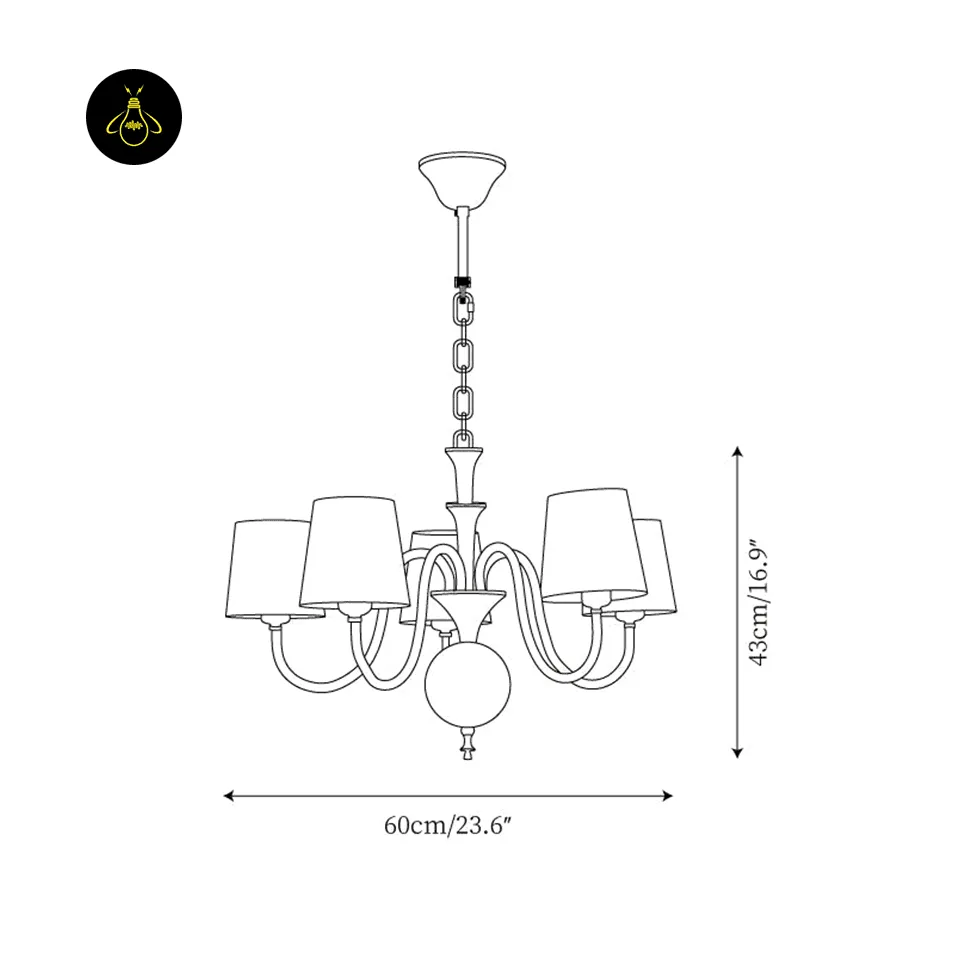
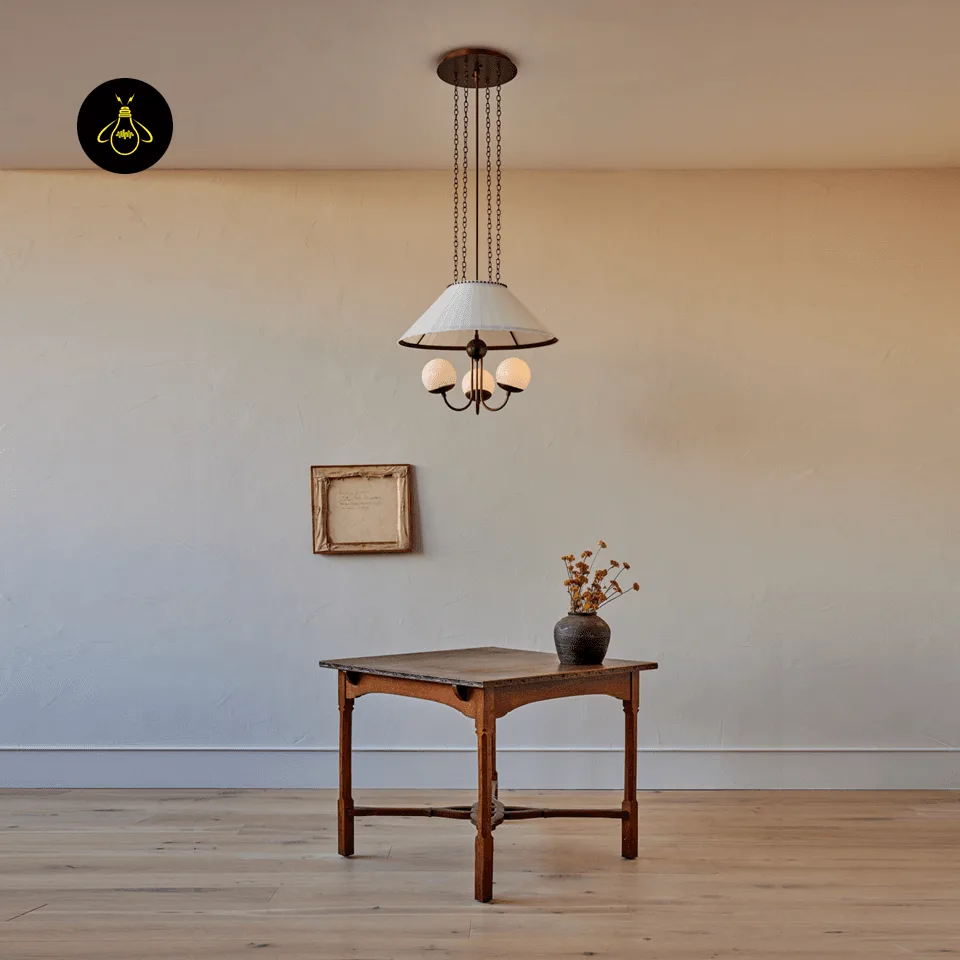
The vintage glass chandelier holds three opal borosilicate glass globes under a pleated cream shade, 24.4 cm across and 36.15 cm tall overall, well inside a 72 cm drop. The white chandelier with raw silk shades is 60 cm wide and 43 cm tall without its chain, with five E27 holders. The spiral ring chandelier is a 62 cm ring of 304-grade stainless steel with a built-in 3000K LED.
Holder lights come without a bulb; fit a 3000K warm-white LED. Your own electrician fits the light, and we give free installation support on a video call, as our FAQ explains. A fan for air and a warm light for evening also keep a room in balance, which is how Vastu thinking sees harmony between elements. We see that as comfort, not a promise of luck.
FAQs
Can you put a chandelier and ceiling fan in same room?
Yes, keep 61 to 91 cm (2 to 3 ft) between the fan’s blade tips and the chandelier’s edge. In a small room with a central fan, wall lights may suit better.
What is the right ceiling fan height from floor?
Fan blades should sit at least 7 ft (213 cm) above the floor. For the best airflow, 8 to 9 ft (244 to 274 cm) works best.
What is the minimum ceiling height for a ceiling fan?
About 239 cm plus the fan’s own depth: 213 cm for the blades and at least 25 cm of air above them. For ceilings under 8 ft, ENERGY STAR points to low-profile hugger fans.
Why does my light flicker when the fan is on?
The fan blades are cutting across the light. Each blade throws a moving shadow, so move the light at least 30 cm clear of the blades, or keep it above the blade level.
Can a chandelier hang from the fan hook?
No, a chandelier needs its own hook and box. A fan shakes as it spins, and that shake would pass straight into the chandelier.
Nature gives the material.
Human hands give it meaning.
Vastu inspires harmony.
Light brings it to life.
That is JagMag.
Planning a light for a room with a fan? See our small chandeliers. For size and height, read chandelier for small room and how high a chandelier over a bed should hang. Not sure? Video-call us and show us the ceiling.
Sources
- ENERGY STAR – Ceiling fan basics (read 30 Oct 2026)
- Crompton – Ceiling fan height from floor (read 30 Oct 2026)
- This Old House – How to size up a ceiling fan (read 30 Oct 2026)
- Atomberg – Ceiling fan size chart (read 30 Oct 2026)
- BIS IS 374 – Electric ceiling type fans (read 30 Oct 2026)
- Bijli Bachao – BEE star rating for ceiling fans (read 30 Oct 2026)
- NBC 2016 minimum room height summary (read 30 Oct 2026)
- Studio Matrx – Apartment interior planning in India (read 30 Oct 2026)
- Perigold – Chandelier size and placement (read 30 Oct 2026)
- Crestar – Causes of ceiling fan shadows (read 30 Oct 2026)
- Wikipedia – Stroboscopic effect (read 30 Oct 2026)
- REHVA Journal – Desks as airflow diffusers for ceiling fans (read 30 Oct 2026)
- NASA Glenn – The drag equation (read 30 Oct 2026)
- University of Tennessee physics – The pendulum (read 30 Oct 2026)
- EC&M – NEC 314.27 boxes for ceiling fans (read 30 Oct 2026)