

A chandelier over bed space should keep its bottom at least 213 cm (7 ft) above the floor. Over a bed, that is about 152 cm (5 ft) above the mattress. In a 2.75 m room, the whole light can hang only about 62 cm below the ceiling, body and rod together.
You have chosen the light. The bed is in place. Now the electrician asks two questions: where does the ceiling point go, and how low should the light hang?
A jhumar over a bed follows its own rule. People sit up in bed, stretch and change bedsheets under it. A light that looks fine from the door can sit too close to your head.
Below, you will see the heights guides give, where the ceiling point belongs, and what a ceiling fan changes. You will also see why a shaded light suits a bed best.
Chandelier over bed height: what the guides say
Most lighting guides start with the floor. One guide asks for at least 7 ft, or 213 cm, from the floor to the bottom of the chandelier. Some people leave 8 ft, or 244 cm. A second guide gives about 215 cm.
A third guide measures from the bed instead. The same guide asks for about 5 ft, or 152 cm, above the mattress. The same guide says a bed usually sits about 2 ft, or 61 cm, off the floor.
One more guide allows only 30 to 36 inches, or 76 to 91 cm, above the mattress. We think that is too low, and the logic section below shows why.
Your ceiling sets the limit for any chandelier over bed space. India’s National Building Code 2016 asks for at least 2.75 m of clear height in a bedroom. Many flats are built close to that number.
| Guide | Measured from | Number |
|---|---|---|
| Floor rule | Floor | 213 to 244 cm |
| Bed rule | Mattress top | About 152 cm |
| Low bed rule | Mattress top | 76 to 91 cm |
| Bedroom ceiling (NBC) | Floor | 2.75 m or more |
How low can a chandelier hang in a 2.75 m bedroom?
Take a 12 ft by 14 ft bedroom with a 2.75 m ceiling. The sum takes four steps.
- Start with the ceiling: 275 cm.
- Take away the floor rule: 275 cm − 213 cm = 62 cm. The whole light, from ceiling plate to lowest point, must fit in 62 cm.
- Check the bed rule. A 61 cm bed plus 152 cm of space gives 61 + 152 = 213 cm. Both rules land on the same mark.
- Now the width. Add the room’s length and width in feet: 12 + 14 = 26. Read the answer in inches. 26 inches is about 66 cm across.
A second check uses the bed itself. One guide suggests a chandelier half to two-thirds as wide as the mattress. For a 180 cm mattress, that gives 90 to 120 cm. Take the smaller of your two answers, so here 66 cm wins.
We measured our own range on 5 Nov 2026. Of the 20 bedroom chandeliers that come in one fixed width, 15 are between 50 and 70 cm across. Those 15 fit the 66 cm answer for a 12 by 14 ft room.
Chandelier over bed or room centre: where does the ceiling point go?
The electrician’s first question has two good answers. Pooky, a UK lighting brand, says the centre of the bedroom ceiling and the middle of the bed both work. Shades of Light, a US lighting shop, adds that the room centre most often lands over the foot of the bed.
Our own sum agrees. Take the same 12 by 14 ft room, with a king bed 198 cm long and its head against the 12 ft wall.
- The room is 14 ft, or 427 cm, long. Its centre sits 213 cm from the head wall.
- The bed ends 198 cm from that wall. So the room centre is 213 − 198 = 15 cm past the foot of the bed.
- The middle of the bed sits 198 ÷ 2 = 99 cm from the wall. To hang the light there, the wire must move 213 − 99 = 114 cm.
So a room-centre point is the simple choice. The light hangs just past your feet, and nothing sits right above your face.
A ceiling fan changes the sum. Many Indian bedrooms already use the centre point for the fan. A chandelier needs its own hook, and our guide to a chandelier and ceiling fan in one room asks for at least 61 cm between the light’s edge and the blade tips.
- A 1200 mm fan reaches 60 cm from its centre.
- Add the 61 cm gap and half of a 66 cm light: 60 + 61 + 33 = 154 cm from fan centre to light centre.
- With the fan at the centre of a 427 cm room, the light lands 213 − 154 = 59 cm from the head wall. The spot sits over your pillow.
- For the light to reach the middle of the bed, the fan must sit 99 + 154 = 253 cm from the head wall. With a centre fan, the room must be 253 × 2 = 506 cm long, about 16.6 ft.
So in a 12 by 14 ft room with a centre fan, leave the ceiling to the fan. Light the bed from the side with bedroom wall lights or bedside lamps. A long room of 17 ft or more can take both.
Why a bed changes the rule
A dining chandelier hangs low because people sit beside the table, not under it. A bed is different. You sit up, stretch your arms and shake out a quilt right under the light. So the light must stay above your reach, not just above your head.
Both height rules agree on 213 cm for a simple reason. A standing person walks under 213 cm without ducking. A person sitting on a 61 cm bed gets about the same space above them. A lower bed only helps: a 50 cm bed leaves 163 cm above the mattress at the same mark. The low 76 to 91 cm rule leaves your raised hand touching the shades. Try it yourself: sit up in bed, lift one arm, and keep the light above your fingertips.
Light also behaves differently when you lie under it. Light spreads out as it travels, so its strength falls with the square of the distance. Twice as far away means one quarter as bright on your face.
A light 152 cm above the mattress against one 91 cm above it makes a big gap. (152 ÷ 91)² is about 2.8. So the low light hits your eyes nearly three times as hard.
Lying on your back, you look straight up, right at the light. Glare is the dazzle from a bright point in your view, like a car’s headlight at night. Lighting researchers find glare drops when the same light spreads over a bigger surface. A fabric shade or an opal glass globe does exactly that, so the bulb never stares back at you.
Colour matters too. A guide on bedroom chandeliers suggests about 3,000 kelvin. Kelvin is the scale for the colour of light. 3,000K looks warm and yellow, like an evening lamp, not blue like daylight.
Nature, hands, and the light above your bed
Nature gives the material. Silk, cotton and sand-made glass each soften light in their own way. Our craftsmen shape them by hand, and the light then connects the room.
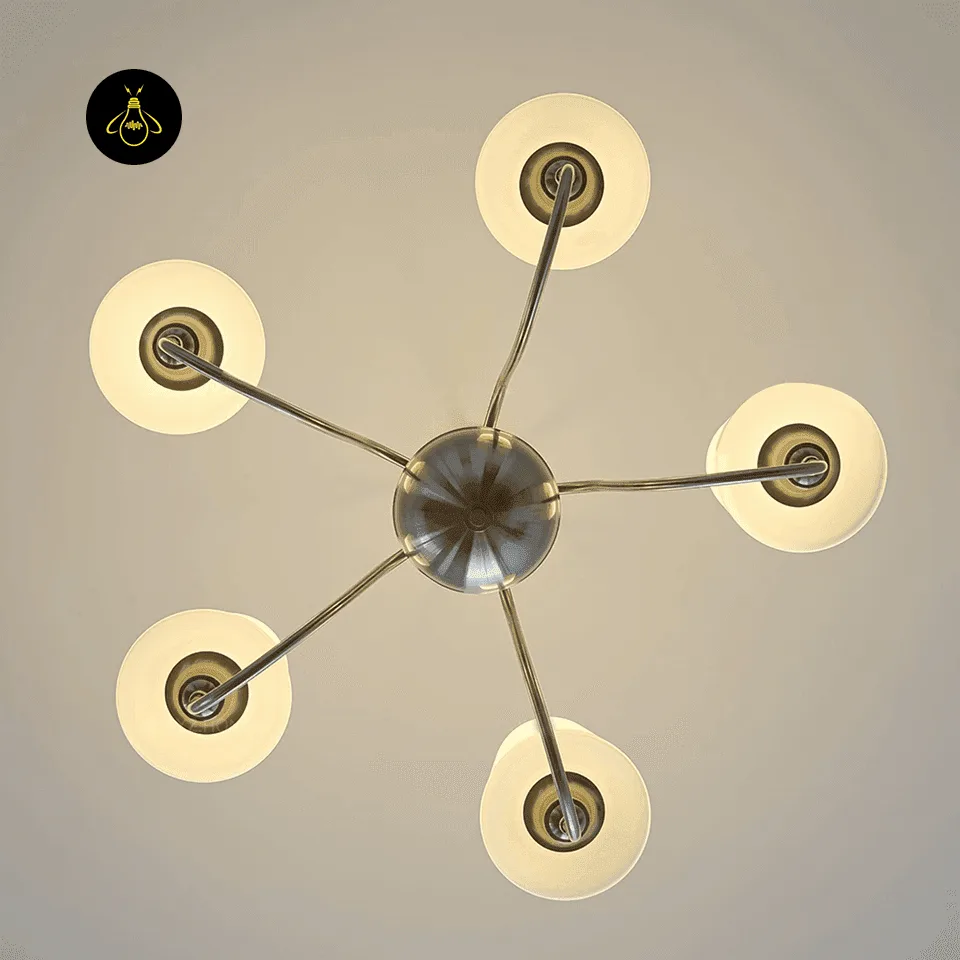
Our white chandelier with raw silk shades is 60 cm wide and 43 cm tall. In a 2.75 m room, that leaves 62 − 43 = 19 cm for the chain and canopy. Raw silk is a natural fibre, so the small slubs in the weave stay as part of its character. Five E27 holders, a standard screw base; bulbs not included, so fit 3000K warm-white LEDs.
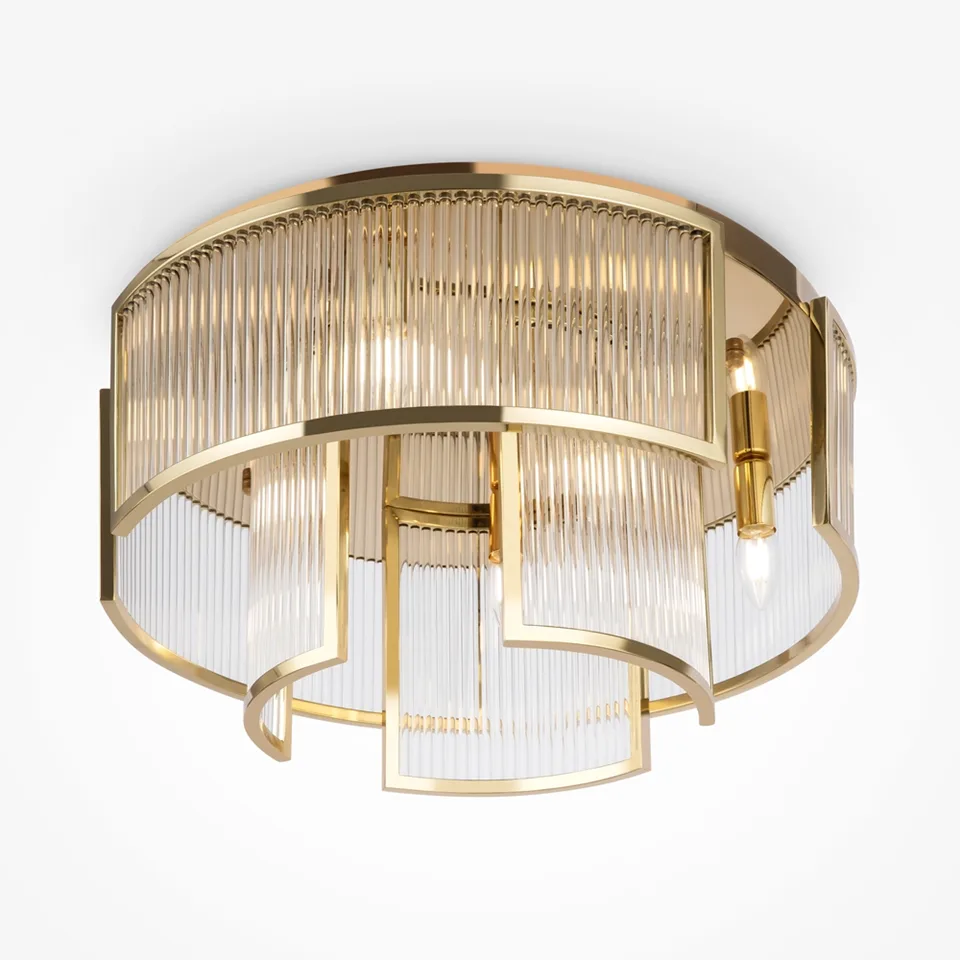
For a lower ceiling, our fluted glass chandelier sits only 33 cm below the ceiling, with no rod or chain. In a 2.75 m room, its bottom stays at 242 cm, 29 cm above the 213 cm mark. Each clear borosilicate glass panel is set by hand in two tiers, on a 65 cm frame of 304-grade stainless steel. The light takes nine E14 candle bulbs, a small screw base, not included.
For a soft cotton glow, our cloth chandelier with pleated shades is 80 cm wide and 50 cm tall. Its steel rod comes 1.5 m long and is cut at installation. In a 2.75 m room, keep only 12 cm of rod. Choose it for a bigger bedroom, where 80 cm fits the room sum.
Every frame is 304-grade stainless steel, made in our own factory in India since 2015. Our certifications page lists our CE, UL and ZED marks.
Vastu guides ask for care here, and we would rather say so. Brick&Bolt, an Indian home builder, advises against ceiling lights directly above the bed. A room-centre point past the foot of the bed respects that advice, and warm side lights do the reading work. We treat Vastu as a way to think about calm in a room, not as a promise.
FAQs
How high should a chandelier over bed space hang?
Keep the bottom at least 213 cm (7 ft) above the floor, or about 152 cm (5 ft) above the mattress. Both rules give the same mark for a bed about 61 cm high.
Is it safe to hang a chandelier over a bed?
Yes, if the bottom stays above your reach when you sit up and raise an arm, and the hook grips the concrete slab. Our chandelier hook guide rates the fixing at about 5 times the weight, so a 12 kg light needs 60 kg.
What size chandelier suits a bedroom?
Add the room’s length and width in feet and read the answer in inches. A 12 by 14 ft room takes about 26 inches, or 66 cm.
Should a chandelier go over the bed or in the centre of the room?
The room centre is the simpler choice, and in a 12 by 14 ft room it lands about 15 cm past the foot of the bed. Over the middle of the bed works only if a fan does not share the ceiling.
Can I use a ceiling light above the bed instead?
Yes, a flush ceiling light above the bed works well in rooms close to 2.75 m high. A shaded or stone-diffused one keeps glare off your eyes when you lie down.
Nature gives the material. Human hands give it meaning. Vastu inspires harmony. Light brings it to life. That is JagMag.
See all our bedroom chandeliers. Beside the bed, add one of our bed side lights. For the rest of the room, read our bedroom lighting ideas, and for the attached bath, chandelier in bathroom. Not sure? Video-call us.
Sources
- Visual Comfort, How high above the floor should a bedroom chandelier hang? (read 27 Oct 2026)
- Arteriors, Bedroom chandelier ideas (read 27 Oct 2026)
- SA Decor, The art of hanging a chandelier above your bed (read 27 Oct 2026)
- Residence Supply, How to choose a chandelier for a bedroom (read 27 Oct 2026)
- Infralens, minimum ceiling height for habitable rooms, NBC 2016 Part 4, Clause 5.4.1 (read 27 Oct 2026)
- HyperPhysics, Georgia State University, Inverse square law for light (read 27 Oct 2026)
- LED Professional, CIE research roadmap on glare (read 27 Oct 2026)
- Lighting New York, Chandelier height in bedroom (read 5 Nov 2026)
- Pooky, Where to place a chandelier (read 5 Nov 2026)
- Shades of Light, Bedroom chandelier design ideas (read 5 Nov 2026)
- Brick&Bolt, Master bedroom layout as per Vastu (read 5 Nov 2026)
- Bureau of Indian Standards, National Building Code (SP 7:2016) (read 5 Nov 2026)