The tiles are up and the mirror is chosen. Now the electrician stands at the wall with a pencil and asks how high the light points should go.
Mirror light height decides how your face looks every morning. Fit the light too high and you see dark rings under your eyes. Fit it too low and the light shines straight into them.
Below are the heights guides use, the sum for a normal Indian bathroom, and the science of shadows on a face.
The short answer
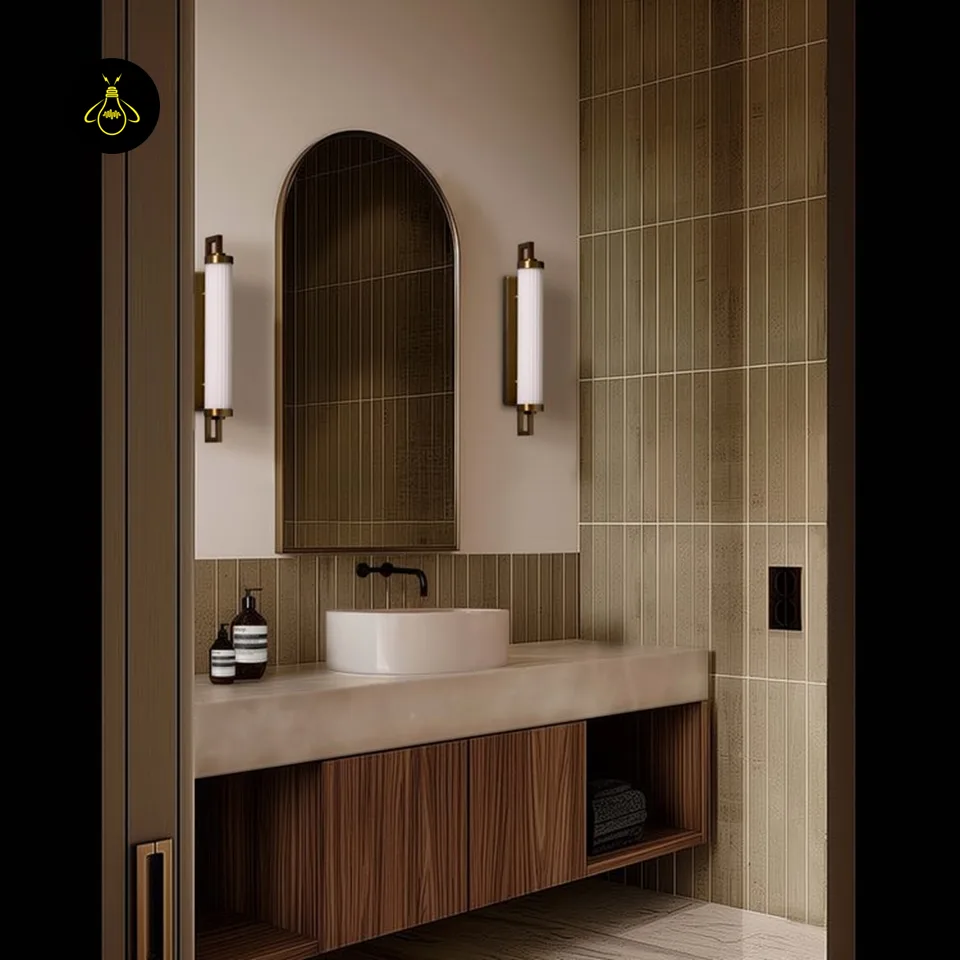
Lights beside the mirror go with their centre 152 to 168 cm from the floor, close to your eye level. A single light above the mirror goes with its centre about 198 to 213 cm from the floor. Side lights are better, because they leave no shadows on your face.
Bathroom mirror light height: the numbers guides use
One US home store guide puts side lights 60 to 70 inches, or 152 to 178 cm, from the floor. A light above the mirror goes 75 to 80 inches up, or 190 to 203 cm, about 8 cm above the mirror’s top edge.
A lighting maker’s guide gives a tighter band. Side lights sit with their centre 60 to 66 inches up, or 152 to 168 cm. Each light sits 2 to 6 inches (5 to 15 cm) from the mirror’s edge. A light above the mirror has its centre 198 to 213 cm up. At least 15 cm stays free below the ceiling.
| Where the light goes | Centre height from floor |
|---|---|
| Beside the mirror (pair) | 152 to 168 cm |
| Above the mirror | 198 to 213 cm |
| For a seated dressing table | 132 to 168 cm |
Wash basin light height follows the same numbers, because the basin is where you stand at the mirror. So the band above works for a powder room too.
How high should a vanity light go over your own mirror?
Take a mirror 60 cm wide and 75 cm tall, its bottom edge 105 cm from the floor. Your ceiling is 2.75 m.
- Find the mirror’s top: 105 + 75 = 180 cm.
- Add the 8 cm gap the home store guide asks for: 180 + 8 = 188 cm. The light’s bottom edge sits here.
- Our 3-globe vanity light is 26.5 cm tall. Half of that is 13.25 cm. So its centre lands at 188 + 13.25 = about 201 cm. The centre sits inside both guide bands.
- Check the ceiling. The light’s top reaches 188 + 26.5 = about 214 cm. The ceiling is at 275 cm, so 61 cm stays free. The guide asks for only 15 cm.
Now a pair of slim side tubes, each 6.5 cm across, for the same mirror.
- Leave 5 cm between each tube and the mirror’s edge.
- Centre to centre: 60 + 5 + 5 + 6.5 = 76.5 cm, or about 30 inches. The maker’s guide gives 28 to 34 inches, so 30 fits.
- Our fluted vanity light has a lit tube 30 cm long. Centre it at 160 cm and it glows from 145 cm to 175 cm. One tube covers the eye level of most people in a family.
We counted our own range on 27 October 2026. Of the 15 lights in our bathroom range, 9 are 40 cm or longer. A light that long covers the face from chin to brow. Only 2 of the 15 are IP65, sealed against water. Most of the rest are IP20, made for a dry wall.
Why side lights beat a light above: the logic
The rule comes from the shape of a face. The brow sticks out over the eyes. A light from above hits the brow first, so the eye socket below falls into shade.
A side light sits at the height of your eyes. Its light reaches the face almost level. The brow cannot block it, so the eye sockets stay lit. Two side lights work together, one filling the shade the other leaves. Lighting designers call this cross-lighting.
The US kitchen and bath body, the NKBA, agrees: light from above alone casts shadows under the eyes.
Vanity light height guides differ because people differ in height. So stand at the basin, mark your eye level on the wall, and centre the side lights on that mark. A family of shorter people picks the low end, near 152 cm.
Mirror light height and the science of shadows
Light travels in straight lines, so any bump between lamp and skin throws a shadow, the way a hand blocks a torch.
Take a light above the mirror, 45 cm higher than your eyes. You stand about 50 cm from the wall. The light then reaches your eyes at an angle of about 42 degrees from above. At that slope, the brow shades the upper eye. A side light at eye level reaches you at close to 0 degrees, so nothing on the face is in its way.
Distance matters too. Light gets weaker with the square of the distance, the inverse square law. Move a lamp twice as far away and only a quarter of the light reaches you.
Warm 3000K light, the soft white of a sunset, keeps skin tones natural at the mirror.
Water matters last. Some UK guides treat the 60 cm around a basin as a splash zone. They ask for IP44 there, a score for dust and water. Our IP20 lights belong on a dry wall. Read our guide to IP65 meaning before you choose a light for a wet spot.
Nature gives the material, hands shape it, light connects
A mirror light sits close to your face every day, so its material matters.
Our fluted glass vanity light is a tube of opal borosilicate glass, made from silica sand, boric oxide, soda ash and alumina. The ribs in the glass spread the light, so you see a soft glow, not a hot dot. The light stands 45 cm tall, with a 30 cm lit tube and a built-in 3000K LED.
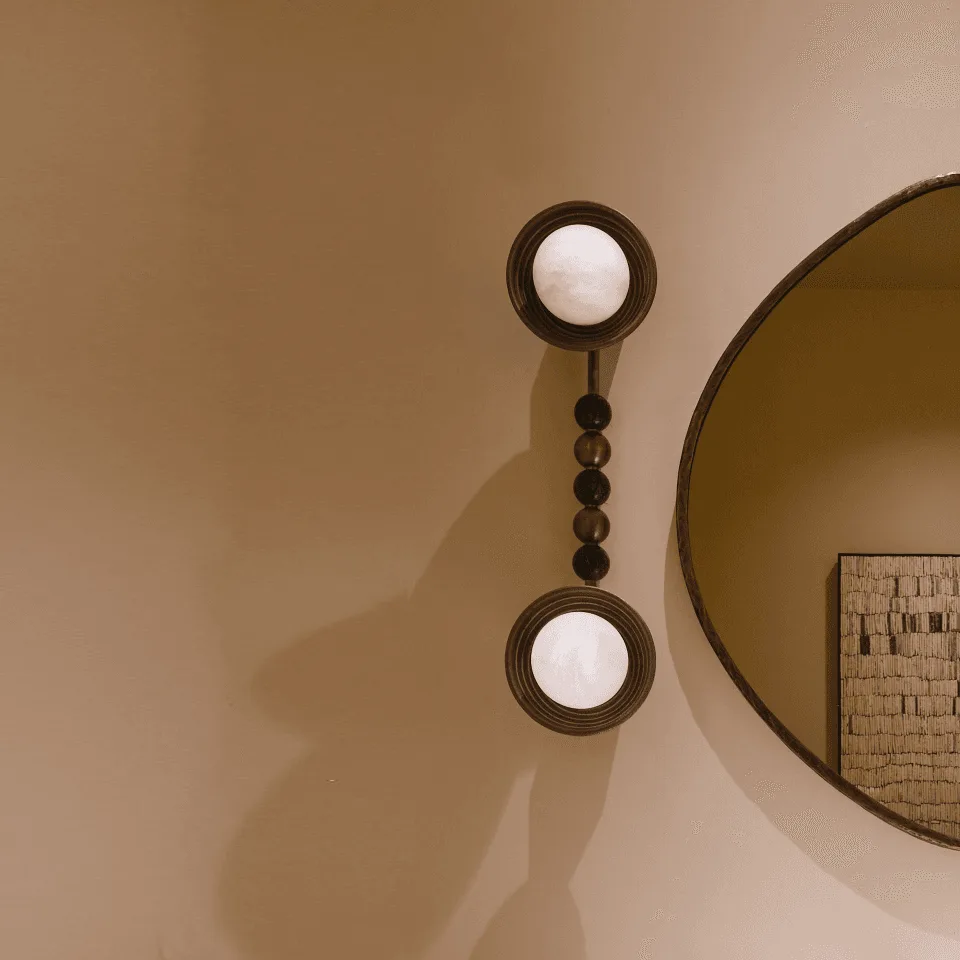
Our mirror wall light with reeded wood bowls brings wood and stone to the wall. Two opal glass balls sit in reeded wood bowls on a stem of natural green stone beads. The light is 67.7 cm tall and takes two G9 bulbs, not included; fit 3000K warm-white LEDs.
For a light above the mirror, our 3-globe vanity wall light joins walnut wood to three opal glass globes. The bar is 88 cm wide and 26.5 cm tall, so it suits a mirror of about 90 cm. The globes take three E27 bulbs, not included; fit 3000K warm-white LEDs.

Our craftsmen build every one of these in our own Greater Noida factory, where we have made lights since 2015. Every metal part is 304-grade stainless steel, with a lifetime warranty against rust on orders from 4 October 2026. You can check our certifications any time.
Vastu values a calm, well-lit place to begin the day. A mirror lit evenly from both sides, in warm light, gives you that small calm every morning.
FAQs
What is the right mirror light height?
Fit side lights with their centre 152 to 168 cm from the floor, near your eye level. A light above the mirror goes with its centre about 198 to 213 cm up, around 8 cm above the mirror’s top edge.
Should bathroom mirror lights go on the sides or on top?
Sides are better if your wall allows them. Side lights reach your face level and leave no shadows under the eyes. A light on top works when the mirror is wide or the wall is narrow.
How far apart should lights beside a mirror be?
Place each light 5 to 15 cm from the mirror’s edge. For a 60 cm mirror that gives about 71 to 86 cm from centre to centre.
Is wash basin light height the same as mirror light height?
Yes, in most homes the basin sits under the mirror, so use the same band. Centre side lights 152 to 168 cm from the floor and keep IP20 lights on a dry wall.
Nature gives the material. Human hands give it meaning. Vastu inspires harmony. Light brings it to life. That is JagMag.
See all our bathroom wall lights. For the rest of the house, read wall light height from floor and bathroom light and steam. Not sure? Video-call us.
Sources
- The Home Depot, Vanity light height (read 27 Oct 2026)
- Golden Lighting, Bathroom sconce placement (read 27 Oct 2026)
- NKBA Knowledge Base, Trends in bathroom lighting (read 27 Oct 2026)
- Simple Lighting, Bathroom lighting zones explained (read 27 Oct 2026)
- University of Rochester, Intensity: the inverse square law (read 27 Oct 2026)