
You lie in bed and look up. The new chandelier is lovely, but the room feels like a shop at night. Or the opposite happens: the room looks dim, and you still switch on the tube light to find your phone charger.
Both problems come down to one number: the lux level for bedroom light. Our guide gives that number, shows the sum for your own room, and explains the science behind it. Then you can pick a chandelier that fits.

The short answer
A summary of India’s National Building Code 2016 gives 75 to 150 lux for a bedroom. Lux is the light that lands on one square metre. For reading in bed, the same summary gives 300 to 500 lux, but only on the page.
So the ceiling chandelier should give the soft 75 to 150 lux. A lamp beside the bed should give the strong reading light.
Lux level for bedroom: the numbers most guides use
Two words first. A lumen is the light a bulb sends out, like water coming out of a tap. A lux is how much of that light lands on one square metre, like water collecting in a bucket. One lux equals one lumen per square metre.
| Place in the bedroom | Lux |
|---|---|
| Whole bedroom, general light | 75 to 150 |
| Reading in bed, on the page | 300 to 500 |
| Rooms with only occasional visual tasks | 100 to 150 |
| Homes in general | 150 |
The first two rows come from the NBC summary. The last two come from an engineering table of room light levels.
The Indian band and the world tables agree well. The bedroom lux level sits at the low end because the room is for rest, not for work. The code measures bedroom light about 0.85 m above the floor, near the height of a mattress top.
How many lumens for a bedroom ceiling light? Your sum
Take a common Indian bedroom of 10 by 12 feet, which is about 3.0 m by 3.6 m. Work it out step by step.
- Floor area: 3.0 × 3.6 = 10.8 square metres.
- Low end: 75 lux × 10.8 = 810 lumens must land on that level.
- High end: 150 lux × 10.8 = 1,620 lumens.
- Bulb light: our lamp pages say an 8 W warm-white LED gives about 700 lumens. 700 ÷ 8 = 87.5 lumens per watt.
- Our opal globe chandelier takes 6 bulbs of the E14 type, the small screw base. With a 4 W LED in each, at the same rate: 6 × 4 × 87.5 = 2,100 lumens leave the bulbs.
- If every lumen reached the bed level: 2,100 ÷ 10.8 = about 194 lux.
Glass, walls and the ceiling soak up part of the light. So the real figure lands lower, close to the 75 to 150 band. Six small bulbs suit this room.
A bigger fitting needs a bigger room. Our walnut chandelier has 8 holders of the E27 type, the standard screw base. With 6 W bulbs it sends out 8 × 6 × 87.5 = 4,200 lumens. In a 10.8 m² room that is up to 389 lux, too bright for rest. In a master bedroom of 4.2 m by 4.8 m, the area is 20.16 m² and the top figure falls to about 208 lux. Smaller bulbs bring it down again.
We also counted our own range. On 31 October 2026, our bedroom chandeliers category had 29 designs. 16 take bulbs (7 on E14, 5 on E27, 4 on G9), and 12 have a built-in 3000K LED. One page did not state its light source. With bulb designs, you choose the brightness when you choose the bulb.
Why low light for sleep and strong light for reading
The logic runs in a short chain. A bedroom is for rest, so the eye needs only enough light to move around safely. Too much overhead light keeps the room feeling awake. The page of a book needs much more, so that light should come from close by.
Distance explains the rest. Light spreads out as it travels, so it covers a bigger area and gets weaker. HyperPhysics at Georgia State University puts it simply: at 2 metres you get one fourth of the light you get at 1 metre. Doubling the distance cuts the light to a quarter.
Try it on your bed. A chandelier hangs about 1.5 m above your pillow. A bedside lamp shade sits about 0.5 m from your book. The ratio is (1.5 ÷ 0.5)² = 9. The same bulb gives 9 times more light on the page from the side table. So the chandelier can stay soft, and the reading lamp does the hard work.
Guides give a range, 75 to 150 lux, because rooms differ. Pick the low end for dark walls you want to keep cosy. Pick the high end for white walls, older eyes, or a room you also dress in. The range is a band, not one exact number.
Colour matters too. Warm 3000K light looks soft yellow-white, like the evening sun. Our guide to the best light colour for bedroom explains why warm suits sleep.
Nature gives, hands shape, light settles the room
A lux number only tells you how much light. The material decides how that light feels. Each of these three pieces from our range turns a bright bulb into a calm glow.
The Modern Opal Glass Globe Chandelier is 70 cm across and 65 cm tall. The 6 globes are opal borosilicate glass, melted from silica sand, boric oxide, soda ash and alumina. White is added while the glass is made, so each bulb becomes one round glow with no glare.
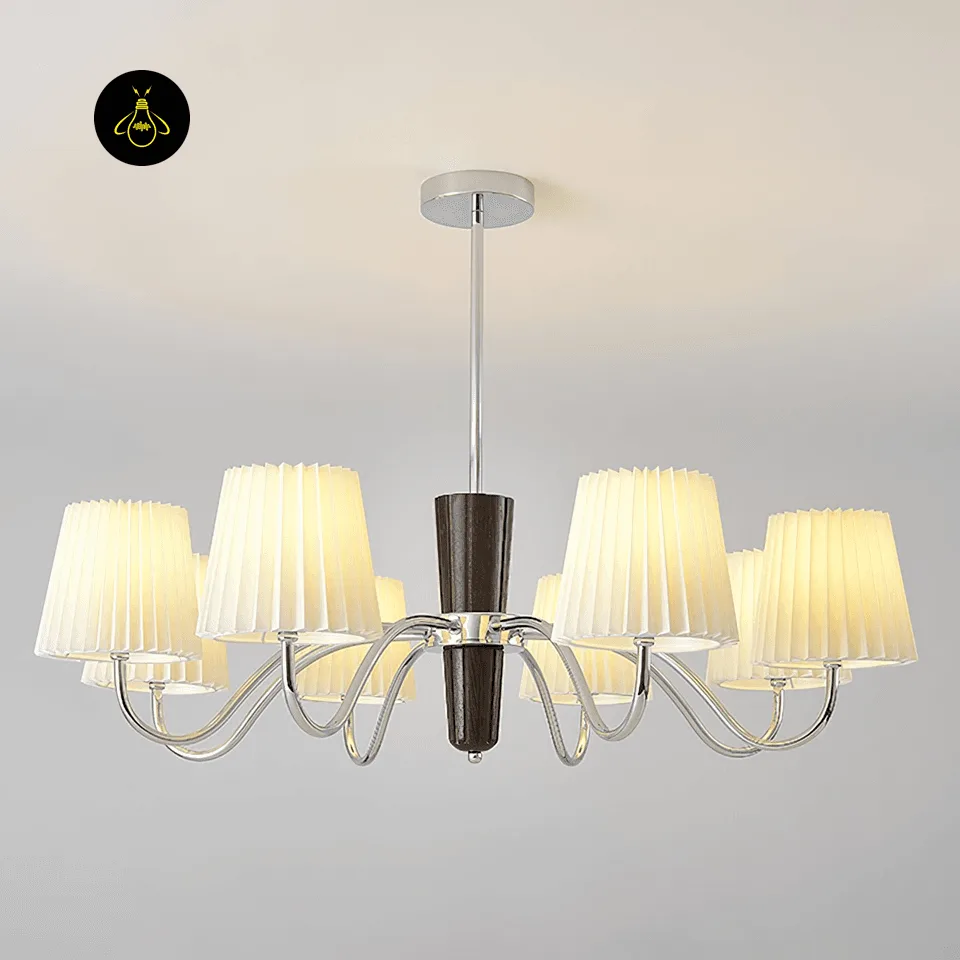
The Walnut Chandelier is 87 cm wide. The column is solid walnut, a wood that grows for many years, and our craftsman shapes it by hand. The pleated raw silk shades soften 8 bulbs. The product page says a 6 to 8 W warm LED in each is plenty.
The Ceramic Ginkgo Leaf Chandelier is 85 cm across. Each porcelain leaf is shaped, glazed and fired by hand, so no two curl the same. Light falls between the leaves and throws soft shadows on the ceiling.

All three are made by our craftsmen in our own factory in India. We have made lights since 2015. Bulbs are not included; fit a 3000K warm-white LED. The frames are 304-grade stainless steel, with a lifetime warranty against rust on orders from 4 October 2026. Our certifications page lists the CE, UL and ZED marks.
Vastu thinking asks for a bedroom that feels calm and grounded. Natural materials and soft warm light help a room feel that way. We do not promise luck. We only promise a room that is easier to rest in.
FAQs
What is the lux level for bedroom light?
A summary of India’s National Building Code 2016 gives 75 to 150 lux for general bedroom light. For reading in bed, aim for 300 to 500 lux on the page from a bedside lamp. See our bedside lamps.
How many lumens do I need for a bedroom?
Multiply the floor area in square metres by 75 to 150. A 3.0 m by 3.6 m bedroom needs about 810 to 1,620 lumens landing at bed level.
How many lumens for a bedroom ceiling light?
Start with the same 810 to 1,620 lumens for a 10.8 m² room. Then add some extra, because glass, shades and walls absorb part of it. Six 4 W LED bulbs give about 2,100 lumens, which suits that size.
Is 300 lux too bright for a bedroom?
Yes, 300 lux is too bright for the whole bedroom at night. The code summary keeps 300 to 500 lux for the reading spot only.
Can I make a bright chandelier softer?
Yes, fit lower-watt LED bulbs in it to bring the lux level for bedroom rest down. Our lights are not dimmable, so the bulb you choose sets the brightness.
Nature gives the material.
Human hands give it meaning.
Vastu inspires harmony.
Light brings it to life.
That is JagMag.
Ready to choose? See our bedroom chandeliers. For the reading lamp, read how many lumens for reading, or our bedroom Vastu tips. Not sure? Video-call us.
Sources
- InfraLens: bedroom lux levels (NBC 2016 Part 8, Section 1, Table 1) (read 31 Oct 2026)
- Engineering ToolBox: illuminance, recommended light levels (read 31 Oct 2026)
- Engineering ToolBox: optical distance law (read 31 Oct 2026)
- HyperPhysics, Georgia State University: inverse square law for light (read 31 Oct 2026)
- Engineering ToolBox: luminous efficacy of lamps (read 31 Oct 2026)
- US Department of Energy: LED lighting (page no longer online) (read 31 Oct 2026)