
Walk down a hallway at night under one bright tube light. Everything looks flat. Now picture two soft beams on each wall, one climbing up, one falling down. The same wall suddenly has depth. That is what up and down wall lights do.
Quick answer: Up and down wall lights are wall sconces that send light both upward and downward, so the wall glows above and below the fitting and the light does not hit your eyes. Choose the material first (stone, glass or steel), then indoor or outdoor (IP20 or IP65), then the height. At JagMag we make them in alabaster, travertine, borosilicate glass and 304-grade stainless steel, in our own Greater Noida factory.
- They light the wall, not your eyes. The beam goes up and down, so there is almost no glare.
- Material changes the mood. Alabaster and travertine glow from inside. Opal glass gives a soft halo. Steel gives two crisp beams.
- Outdoor needs IP65. For a gate pillar or boundary wall, pick an IP65 light with a 304-grade stainless steel body.
- Height matters. Around 165–180 cm from the floor works for most Indian rooms.
What are up and down wall lights?
An up and down wall light is a sconce that is open at the top and at the bottom. Light leaves from both ends. One beam climbs the wall toward the ceiling. The other falls toward the floor.
You may also hear them called up down lights, wall uplighters or up and down sconces. It is the same idea. A plain uplighter only throws light up. An up and down light does both, so the wall gets two soft fans of light with a darker band in the middle.
Here’s the thing. Most of the light lands on the wall, not in your eyes. That is why these lights feel calm. They are accent lights. They make a room feel finished, but they do not replace your main ceiling light.
Where do up and down wall lights look best?
Anywhere you have a plain wall that deserves a little drama.
- Hallways and passages. A row of them turns a dull corridor into a walk you notice. Space them about 2 to 2.5 metres apart.
- Staircases. Fix one at each landing, or stagger them along the climb, so every step gets light. See our staircase wall lights.
- Living room. One on each side of the TV unit or a large painting frames it without glare on the screen.
- Bedroom. A pair on either side of the bed gives a soft glow for the evening. See our bedroom wall lights.
- Gate pillars and boundary walls. Outside, the two beams mark your entrance and show off the wall texture. This needs an outdoor-rated light.
Stone, glass or steel: which up and down wall light should you choose?
The material decides how the light looks on your wall. A craftsman looks at the material before deciding how to work with it. You can choose the same way.
Natural stone: alabaster and travertine
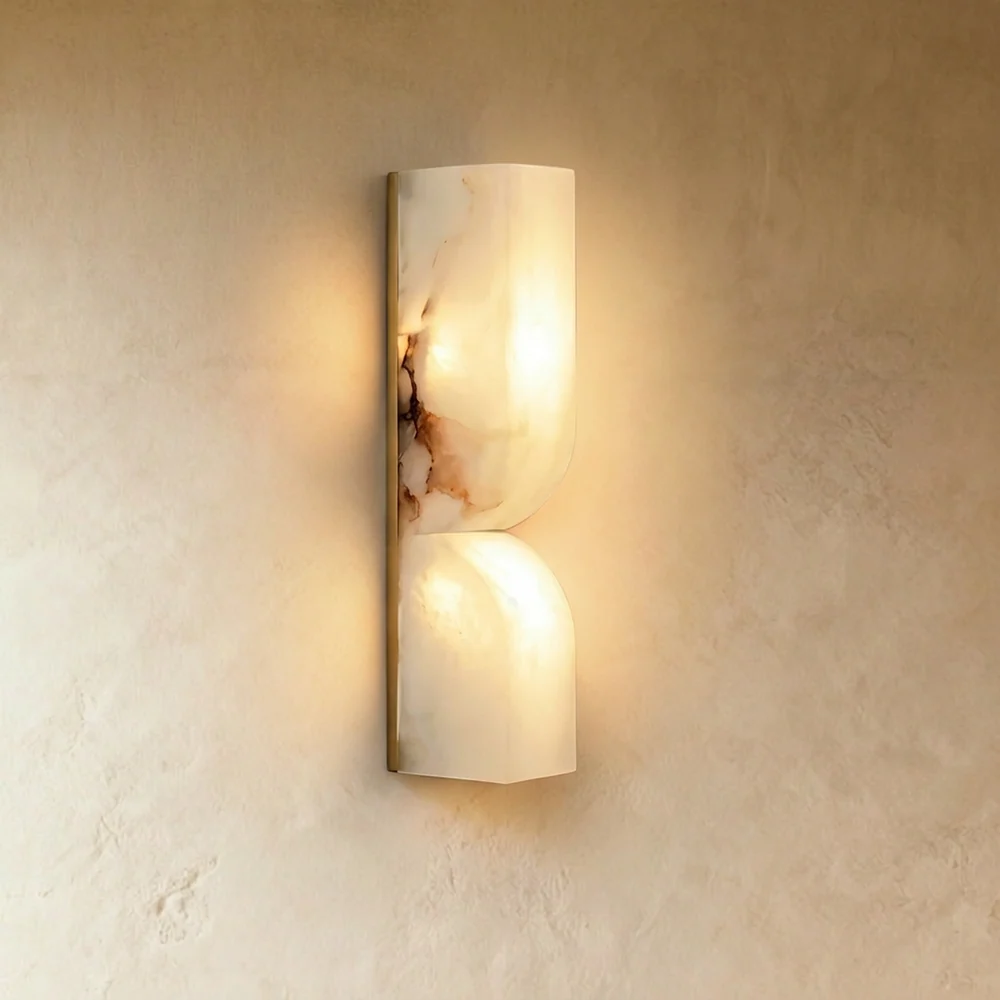
Alabaster is stone formed beneath the earth. Our craftsman reads the veins before he carves. Switch it on and the stone glows from inside, while the beams wash the wall above and below. The Alabaster Up and Down Wall Light is 35 cm tall and only 8 cm wide, with a built-in 3000K warm-white LED. For a longer piece, the Linear Alabaster Wall Light runs 70 cm, with two veined alabaster cylinders and a brushed gold finish.
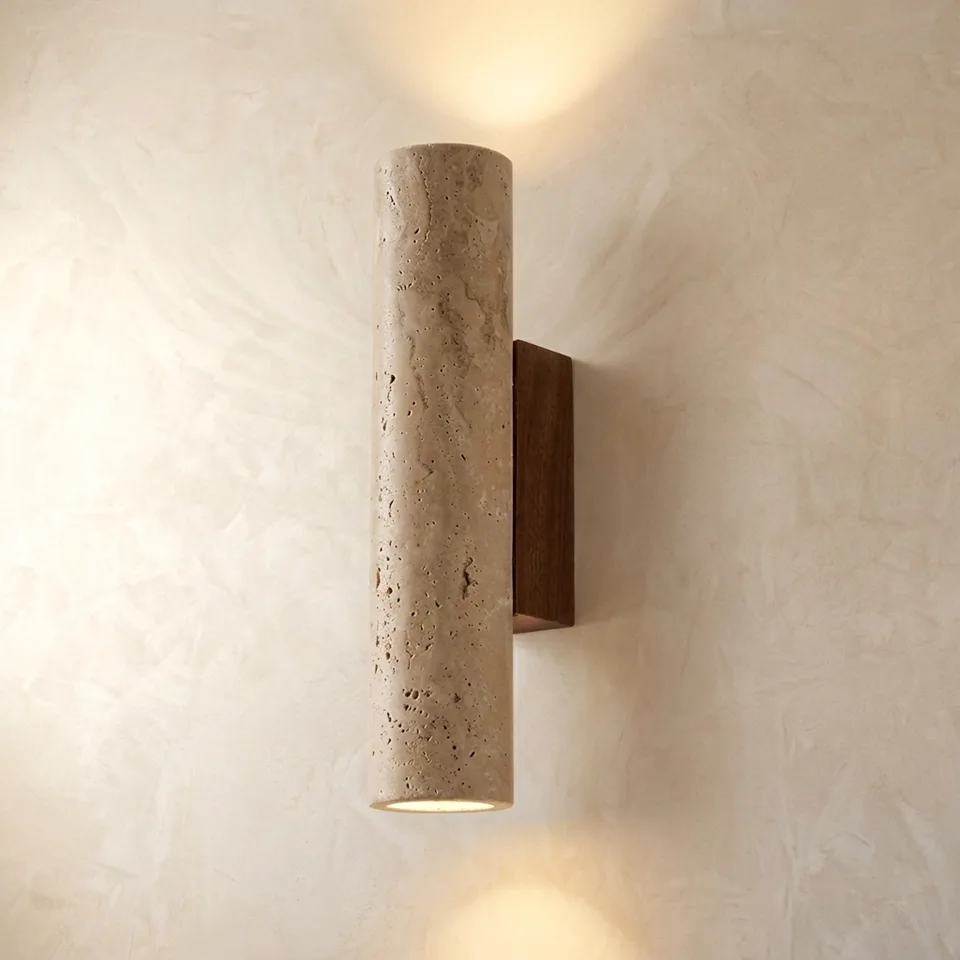
Travertine is warmer and more textured. Its small natural pores show when light grazes across it. No two pieces look the same. The Travertine Cylinder Wall Light is 28 cm tall, with built-in 3000K LEDs shining up and down. The Travertine Half-Cylinder Wall Light is 22 cm tall and takes two G9 bulbs (not included).
Opal and fluted borosilicate glass
Glass gives a softer, rounder glow. Our up down wall light has two hand-blown opal borosilicate glass shades on a 304-grade stainless steel frame in a satin brass finish. It is 35 cm tall and takes two G9 bulbs. The Fluted Glass Wall Light pairs two clear fluted borosilicate glass cylinders with a band of natural wood. It is 59 cm tall, with two E14 holders, and the flutes break the light into fine lines on the wall.
304-grade stainless steel
A metal body gives the crispest beams, because light leaves only from the two open ends. Every metal part we make is 304-grade stainless steel, with a lifetime warranty against rust on the stainless parts (orders from 4 October 2026).
Indoor or outdoor: why the IP rating matters
An IP rating tells you how well a light keeps out dust and water. It matters most outside.
- IP20 is for dry indoor rooms. Our glass and travertine up and down lights are IP20.
- IP65 keeps out dust and jets of water. Our outdoor lights are IP65, and so are our alabaster lights with a built-in LED, even indoors.
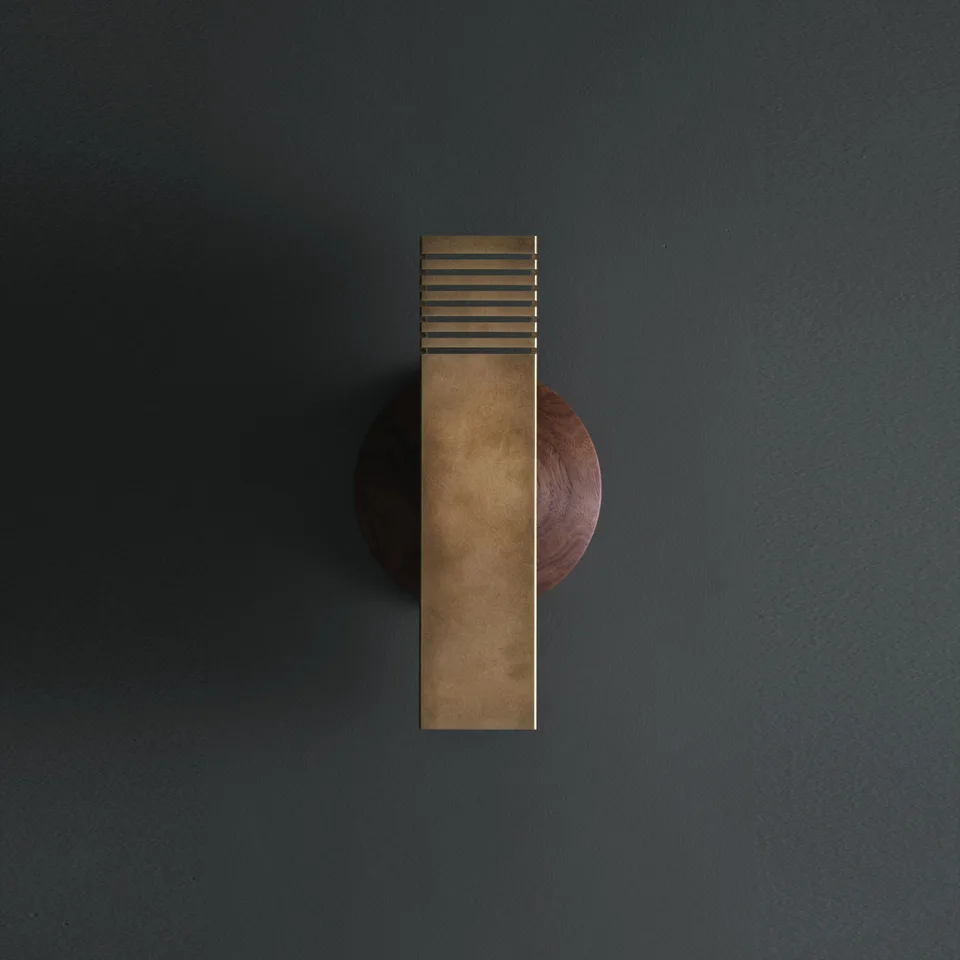
For a gate or compound wall, look at our boundary wall light. It is a 26.7 cm column of 304-grade stainless steel in an antique brass finish, on a real walnut wood backplate. It is IP65 and takes one G9 bulb (not included). Browse all our outdoor wall lights for more.
A monsoon tip: keeping water out is only half the story. A painted metal body can still rust under the paint. Stainless steel does not need paint to stay rust-free. We explain the simple checks in our guide to a waterproof wall light.
How high should you fix up and down wall lights?
Most Indian rooms look right with the centre of the light about 165 to 180 cm from the floor. That is just above eye level, so you see the glow, not the source.
- Hallway or living room: 165–180 cm.
- Beside a bed: 150–165 cm, so the lower beam lands near the bedside table.
- Staircase: about 180 cm above the step line, following the slope.
- Gate pillar: 180–200 cm, or close to the top of the pillar.
Leave at least 30 cm of wall above the light. The upward beam needs room to spread before it meets the ceiling.
Built-in LED or a bulb holder?
Some up and down lights have a built-in LED. Others have a holder for a bulb. Both work well. Here is the difference.
- Built-in LED: nothing to buy and a very slim body. Ours are 3000K warm white only, with a 1-year warranty on the LED module (orders from 4 October 2026).
- Bulb holder (G9, E14 or E27): the bulb is not included. Fit a 3000K warm-white LED, and change it yourself whenever you need to.
One honest note: none of our lights are dimmable. Warm 3000K light is already soft and easy on the eyes.
Why buy up and down wall lights from JagMag?
- Made in our own factory in Greater Noida since 2015. Not imported, not traded.
- Real materials. Real alabaster, real travertine, real walnut and borosilicate glass.
- Custom size or finish in 15–20 working days. Importers take 60–120.
- Spares for 10+ years, free shipping across India, and EMI on eligible cards.
Want to see every style in one place? Browse our wall lights.
FAQs
What is the difference between an uplighter and an up and down wall light?
An uplighter sends light only toward the ceiling. An up and down wall light sends light both up and down, so the wall glows above and below the fitting.
Are up and down wall lights bright enough to light a room?
They are accent lights, not your main light. Use them with a ceiling light or a chandelier, and let them add warmth and depth to the walls.
Can I use up and down wall lights outside?
Yes, if the light is rated IP65. Our boundary wall light is IP65, with a 304-grade stainless steel body made for gates, pillars and compound walls.
How many up and down wall lights do I need for a hallway?
Plan one every 2 to 2.5 metres along the wall. A 5-metre passage usually needs two or three.
Which light colour is best for up and down wall lights?
Warm white at 3000K. It makes stone, wood and plaster look rich. Our built-in LEDs are 3000K, and we suggest a 3000K bulb for every holder light.
Do up and down wall lights need special wiring?
No. They connect to a normal wall point. Any licensed electrician fits one in 20 to 30 minutes, and we give free video-call installation support.
Nature gives the material. Human hands give it meaning. Light brings it to life. Pick your stone, glass or steel, and let your walls glow. Shop wall lights online →