
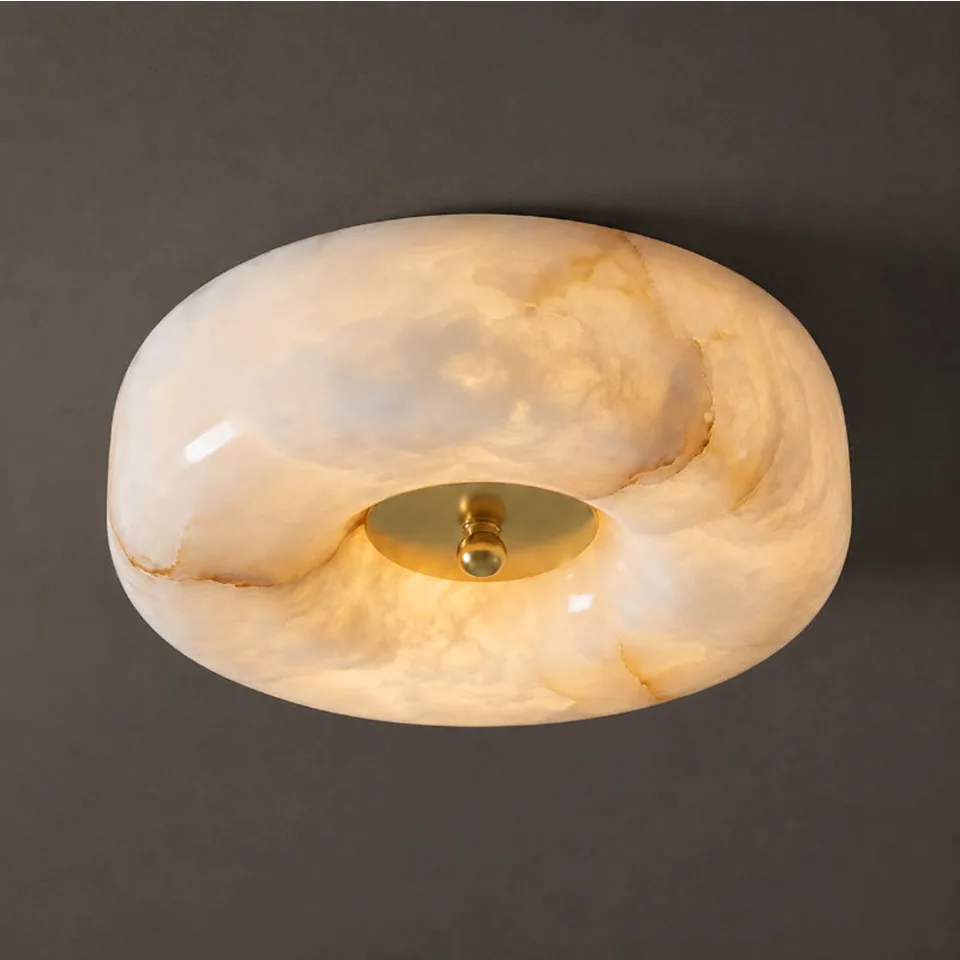
To clean alabaster, switch the light off, let it cool and dust the stone with a soft dry brush or microfibre cloth. For a mark, use a cloth that is only slightly damp, then dry the stone at once. Never use acid, spray cleaner, dishwashing liquid, oil or wax, and never soak it.
Your alabaster ceiling light has been up for a few months. One evening you switch it on and see a thin film of dust across the stone. The veins look less clear than on the first day. Of all the decorative lights in a home, stone asks for the gentlest hand.
The first idea is a wet cloth and a spray cleaner. Stop there. The stone is soft and dissolves a little in water.
Below, you will see the care steps from a stone-lighting maker and a museum conservator. Small sums show what water does to the stone. You will also see why travertine needs a different warning.
How to clean alabaster: the care steps
A stone-lighting maker and a conservator writing for the US National Park Service agree on most of these steps.
- Switch off. The stone-lighting maker says to always make sure the light is off before you touch it.
- Dust first. The maker uses a soft, dry microfibre cloth. The conservator prefers a soft bristle brush, because wiping can build static that draws dust back. A brush also reaches into carved grooves.
- Go gentle. Do not rub hard. Alabaster can be scratched with a fingernail, so firm rubbing can scratch or dull it.
- Use very little water. A cloth that is only slightly damp is the limit. Dry the stone with a soft cloth right away.
- Skip chemicals. Harsh or abrasive cleaners, solvents and acidic products can harm the stone and the brass-finish parts.
- Keep it out of long, direct sun. The maker warns of colour change. The conservator says light does not generally change alabaster itself, but it can harm old coatings.
Dishwashing liquid gets its own warning. Polished alabaster washed with it turns rough, dull and whiter, and loses much of its glow.
A stain needs a different plan. The conservator says not to rub it with detergent, because even blotting a fresh spill can drive it in. Let it dry, then show it to us on a video call before you try anything.
Yellowing comes from dirty air, or from old coatings and cleaners. So skip oil and wax as well. Oils darken with age, and wax traps dust in the stone.
Alabaster care in numbers: what water really does
Gypsum, the mineral in gypsum alabaster, dissolves at about 2.0 to 2.5 grams per litre at 25°C. The sum shows what a “quick wash” in a half-litre bowl could take away.
- Half a litre of water can hold 0.5 × 2.0 = 1.0 g to 0.5 × 2.5 = 1.25 g of gypsum.
- Take the face of our 30 cm alabaster disc light. Its area is π × 15 × 15 = about 707 square cm.
- Gypsum weighs about 2.32 g per cubic cm. So 1 g spread over that face is 1 ÷ (2.32 × 707) cm thick, about 6 micrometres. 1.25 g is about 8 micrometres.
- 6 to 8 micrometres is far thinner than a hair. Even so, the shine of polished stone sits on its very surface, so a thin loss shows as a dull patch.
Water needs time to dissolve stone, so a quick wash will not take all of that. Read the sum as the upper limit. A second sum shows why a damp cloth is so much safer.
- Say a damp cloth leaves 2 ml of water on the stone. The 2 ml is our own round figure, less than half a teaspoon.
- 2 ml is 0.002 litres. The water can hold 0.002 × 2.0 = 0.004 g to 0.002 × 2.5 = 0.005 g of gypsum.
- 1.0 g ÷ 0.004 g = 250. The damp cloth can carry away 250 times less than the bowl.
Every wet clean still takes a little, so dry methods come first.
We counted our own stone ceiling lights on 5 Nov 2026. Of the 16 lights, 10 are travertine and 6 are alabaster. 15 of the 16 have a built-in LED, so you only switch off and wait, with no bulb to remove. All 6 alabaster lights are IP65, and all 10 travertine lights are IP20.
IP65 means dust-tight and protected against jets of water. The rating protects the wiring inside. The stone itself still wants a dry cloth, and the maker says to keep alabaster away from direct moisture and steam.
Why stone needs gentle care
Alabaster comes in two kinds. Gypsum alabaster scores 1.5 to 2 on the Mohs scale. The Mohs scale rates scratch hardness from 1 to 10, where talc is 1 and diamond is 10. Calcite alabaster is 3. Both dissolve slightly in water. Conservators add that polished faces are the most at risk, because moisture turns them dull and opaque. So the same dry-first care keeps either kind safe.
Softness explains the gentle hand. A fingernail scratches gypsum alabaster. A gritty sponge or hard rub leaves fine scratches, and each scratch scatters light at the surface. The stone then looks cloudy instead of glowing.
Light explains why it matters so much. Alabaster lets light pass through and scatters it evenly. Dust on the face blocks some of that light, and the veins fade. A clean, polished face lets the full glow through.
Travertine follows a different rule. Travertine forms from calcium carbonate laid down by fresh water, often at springs. Calcite, a form of calcium carbonate, fizzes when it meets acid. So vinegar and lemon, two common home cleaners, are a poor match for travertine.
Travertine also has natural holes. Fresh travertine can be 10% to 70% open space. Those pits trap dust, so a soft brush works better than a cloth.
When guides differ, choose the gentler step. One home guide rubs dirty stone with borax. No conservation source we read mentions it. The park service guide says anything past dry brushing needs a conservator, and it even suggests accepting light ageing as patina. On a light you will live with for years, start dry, and go damp only for a mark you cannot lift.
The JagMag way: stone, hands and the glow you keep
Nature gives the material. Alabaster formed beneath the earth. Travertine grew where spring water left its minerals behind. Our craftsmen carve, hone and polish each piece by hand in our own factory in India, where we have worked since 2015. Light then passes through the stone and connects the room.
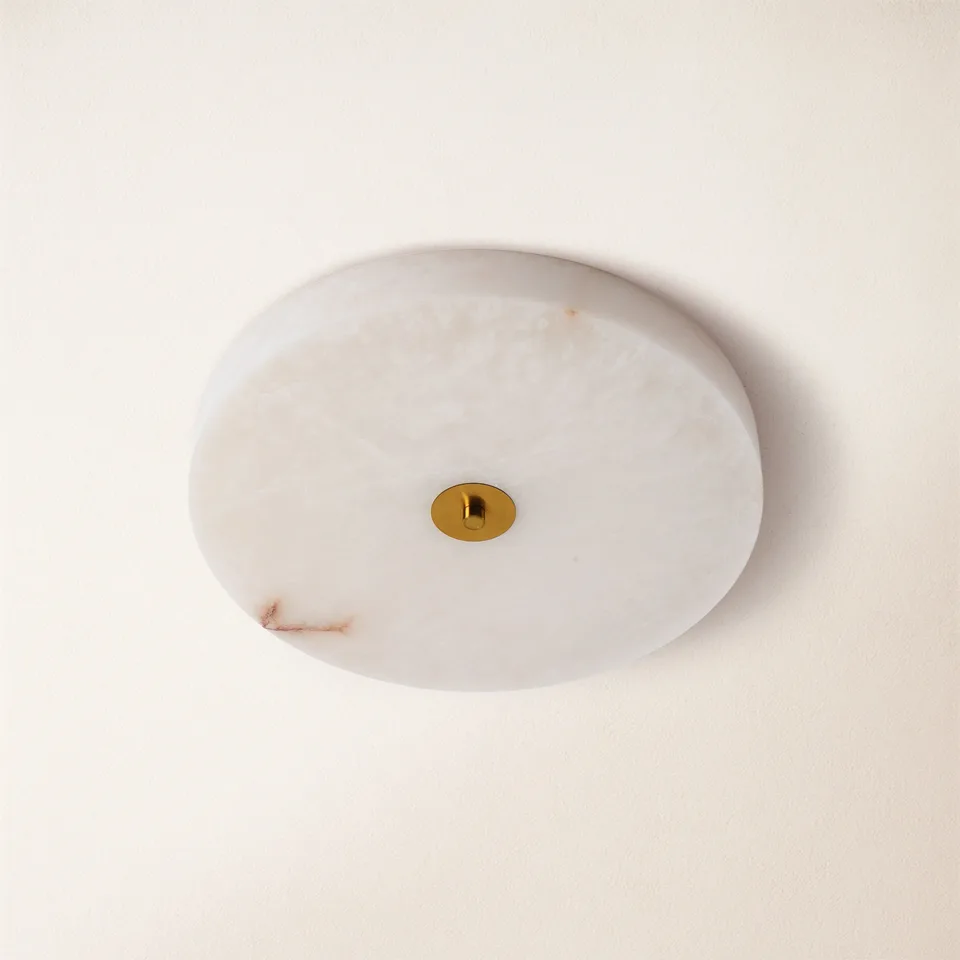
Our alabaster disc ceiling light is 30 cm across and 5 cm deep, carved and polished by hand. The light has a built-in 12W LED at 3000K warm white, and it is rated IP65. A dry microfibre cloth over the flat face takes a minute.
Our alabaster pebble ceiling light is a 40 cm rounded dome, 10 cm deep, white with honey veining. Its curves catch dust on the top edge first, so dust along the rim.
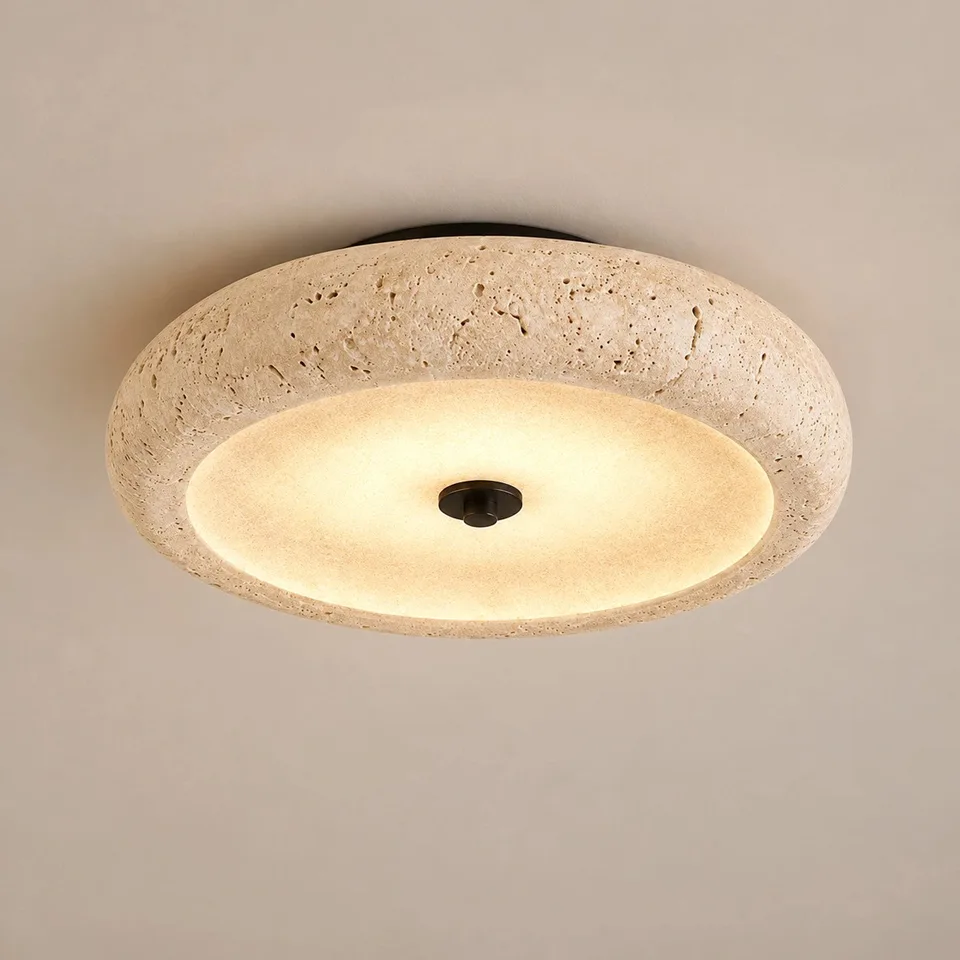
Our travertine ceiling lamp is 30 cm across with a hand-honed rim and a soft cream diffuser inside. A soft brush clears the stone’s pits. Keep vinegar and lemon away from it.
Natural stone shows small marks and colour shifts from piece to piece, and that is part of it. Our certifications page lists our CE, UL and ZED marks.
Stone and warm light bring the earth element into a room, the kind of grounding Vastu thinking has always valued. A little care keeps that calm glow for years.
FAQs
How to clean alabaster without damaging it?
Dust it with a soft dry brush or microfibre cloth, and use a barely damp cloth only for marks. Dry it at once, and never use acids, spray cleaners, dishwashing liquid, oil or wax.
Can alabaster get wet?
A little moisture is fine if you dry it straight away. Gypsum dissolves at about 2 grams per litre, so soaking or frequent washing slowly dulls the polish.
How to clean travertine on a light?
Brush the pits with a soft brush and wipe with a dry or slightly damp cloth. Avoid vinegar and lemon, because travertine is calcium carbonate and reacts with acid.
How do I remove a stain from alabaster?
Do not rub it, and do not use detergent. Let the mark dry, then ask us on a video call. A museum conservator warns that even blotting can drive a spill into the stone.
Can I use oil or wax on alabaster?
No. Oils darken and can turn the stone yellow or brown, and wax traps dust over time. A soft dry brush is all the stone needs.
Nature gives the material. Human hands give it meaning. Vastu inspires harmony. Light brings it to life. That is JagMag.
See all our stone ceiling lights. To learn more about the stone, read what is alabaster and faux alabaster vs real alabaster. Not sure? Video-call us.
Sources
- Lusso, Lighting cleaning and care guide (PDF) (read 27 Oct 2026)
- John Griswold, Care of Alabaster, Conserve O Gram 15/1, US National Park Service (PDF) (read 5 Nov 2026)
- AIC Conservation Wiki, Alabaster (read 5 Nov 2026)
- Hunker, How to clean alabaster (read 5 Nov 2026)
- Wikipedia, Alabaster: gypsum and calcite types, hardness, care (read 27 Oct 2026)
- Wikipedia, Gypsum: solubility and specific gravity (read 27 Oct 2026)
- Wikipedia, Travertine: formation and porosity (read 27 Oct 2026)
- EEP, IP protection degrees under IEC 60529 (read 27 Oct 2026)