
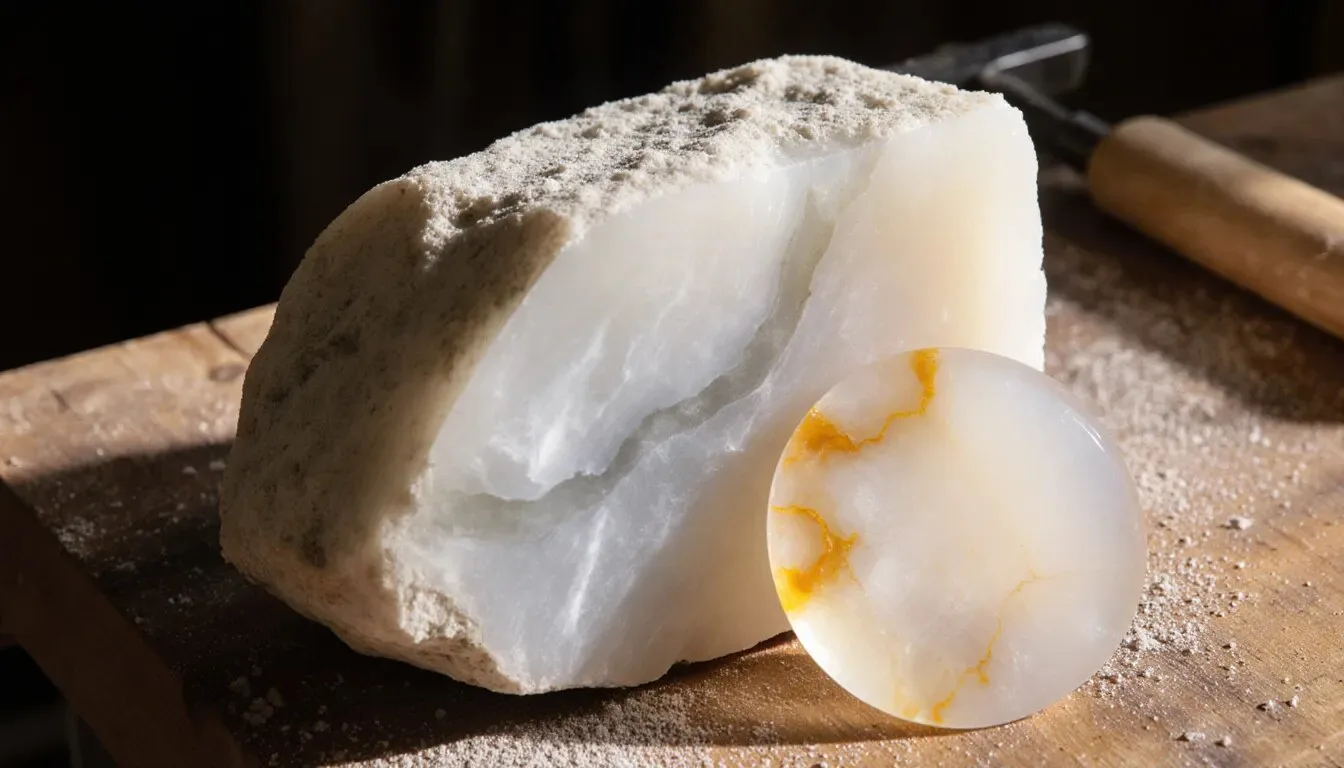
Alabaster is a soft natural stone made of the mineral gypsum. Light passes through it, so an alabaster lamp glows from inside.
We use alabaster in 86 of our 453 lights, more than any other stone. You will find it most in our wall lights and chandeliers.
Shopping now? Our pendant wall light hangs a ball and a cylinder of alabaster from your wall.
In the last post we shared our way of thinking about mood lighting. Good mood lighting begins with the material.
Alabaster taught us more about this than any other material. A shade of alabaster does not hide the light. The stone itself glows.
Below we look at what alabaster is, why the stone glows and how our craftsmen work with it.
Alabaster is a soft stone made by nature from water
Alabaster is a fine-grained form of gypsum, a natural mineral. Fine-grained means its tiny crystals sit close together, so the stone looks smooth and even.
Gypsum forms when water rich in minerals dries up very slowly. The water goes, and the mineral stays behind in layers. Over a very long time, these layers become stone.
Because alabaster is soft and smooth, people have carved it into vases, lamps and statues for centuries.
Pure alabaster is milky white. Small amounts of other minerals leave soft lines in the stone. We call these lines veins. In our pieces, the veins are grey, beige or soft gold.
Alabaster has one more special quality. Light can pass through it.
Light passes through the stone
Alabaster is a translucent stone. Translucent means light passes through, but you cannot see clearly through it, like light through frosted paper.
Thin alabaster lets a lot of light through. Thick alabaster lets less through. So when a bulb sits inside an alabaster shade, the whole shade glows. The light looks brighter where the stone is thinner and warmer where the stone is thicker.
An opal borosilicate glass shade lights up evenly. Alabaster lights up in its own pattern, because no piece of stone has the same thickness and density all through.
The veins show up too. Switched off, our alabaster drum pendant looks like calm white stone. Switched on, its 16.5 cm drum glows, and soft, cloud-like veins appear from inside.
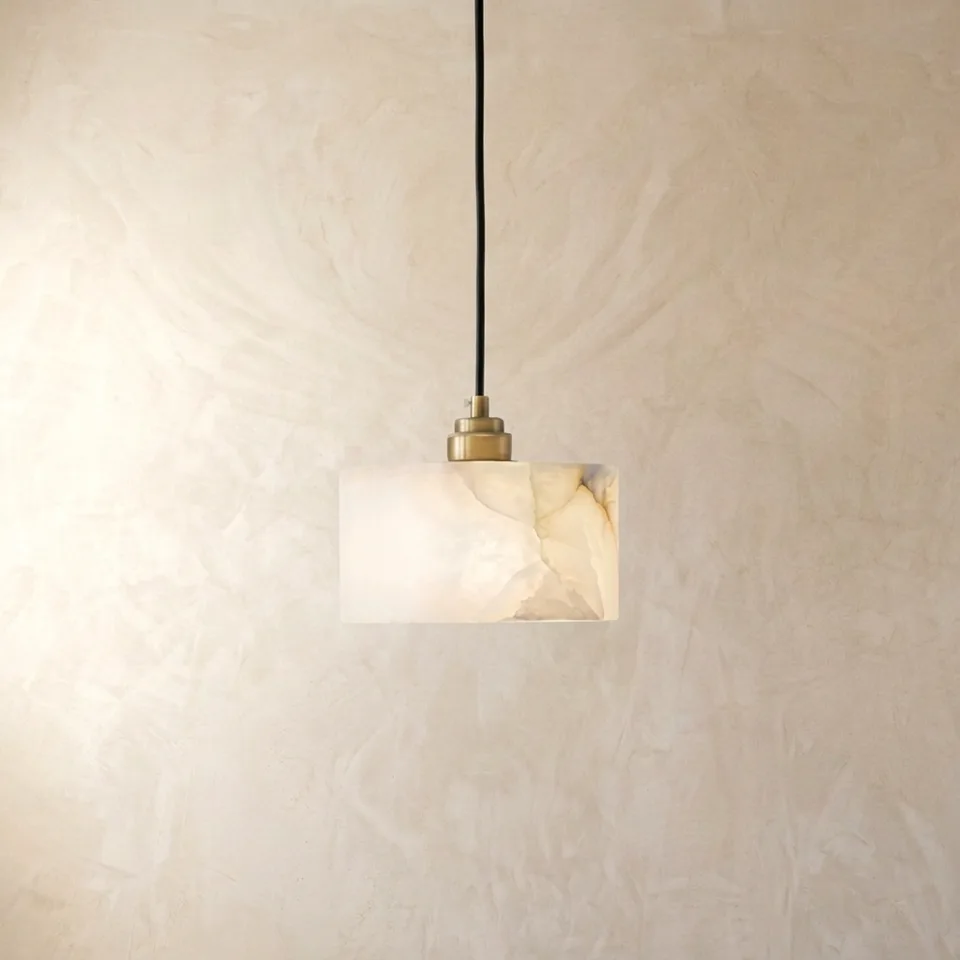
A glow like this depends on one thing: the thickness of the stone. A person has to decide that thickness, piece by piece.
Our craftsmen read the stone before they cut
Alabaster is soft for a stone. On the Mohs scale, a 1 to 10 scale of mineral hardness, alabaster sits at about 2. A soft stone is easy to shape, but a careless cut can crack it.
So a craftsman in our own factory in India reads each block before he cuts it. He looks at the veins. He decides where the shade must be thin enough for light to pass. He decides which vein to leave alone.
Then he cuts, hollows, shapes and polishes the stone by hand, one careful pass at a time. Behind every alabaster shade are hours of patient human effort.
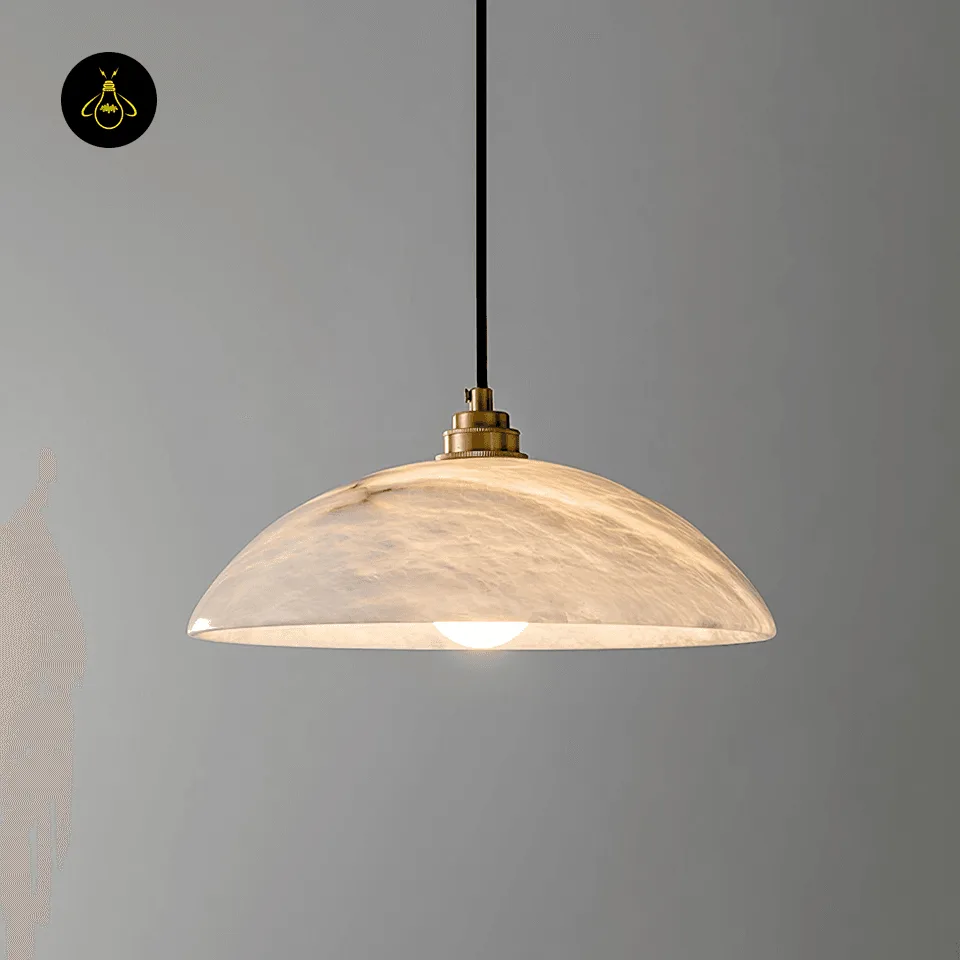
Our alabaster dome pendant shows the result. The shallow 30 cm dome is cut from natural stone. Its colour shifts from cream to soft grey, and the edges look darker where the stone is denser.
The softness that lets our craftsmen shape alabaster also asks for a little care at home.
A soft stone asks for gentle care
Gypsum slowly dissolves in water. So we clean alabaster dry, and we never use chemical cleaners on it.
Wipe your alabaster light with a dry, soft cloth. Skip rough cloths, and never let water sit on the stone. With this small care, the stone keeps its smooth surface for years.
For alabaster, the rule is simple: dry and gentle. Our care guide for natural materials covers every other material we use.
We value alabaster for what it truly is: a natural stone that holds light. Our job is not to change its character. Our job is to reveal it.
Natural stone also brings the earth element into a room. We see this as the kind of harmony Vastu has long valued, not a promise of luck.
Want alabaster glowing in your living room? See our table lamps for living room.
FAQs
What is alabaster, and is it a real stone?
Yes. Alabaster is a natural stone, a fine-grained form of the mineral gypsum. Every JagMag alabaster light uses real alabaster, never plastic or resin made to look like stone.
Why does alabaster glow when it is lit?
Alabaster glows because it is translucent, so light passes through the stone. Our craftsmen thin the walls of each shade by hand, so the light can come through.
Will two alabaster lights look exactly the same?
No. Each shade comes from its own piece of stone, so the veins and colour differ a little. For a group of lights, we can cut a matched set from the same stone batch.
Nature gives the material.
Human hands give it meaning.
Vastu inspires harmony.
Light brings it to life.
That is JagMag.
With you.
Read next: Natural stone: why no two marble or travertine lights match
Shopping now? Twelve eggs of this stone glow on three levels in our alabaster egg chandelier.
See the stone glow for yourself: explore our alabaster lighting →