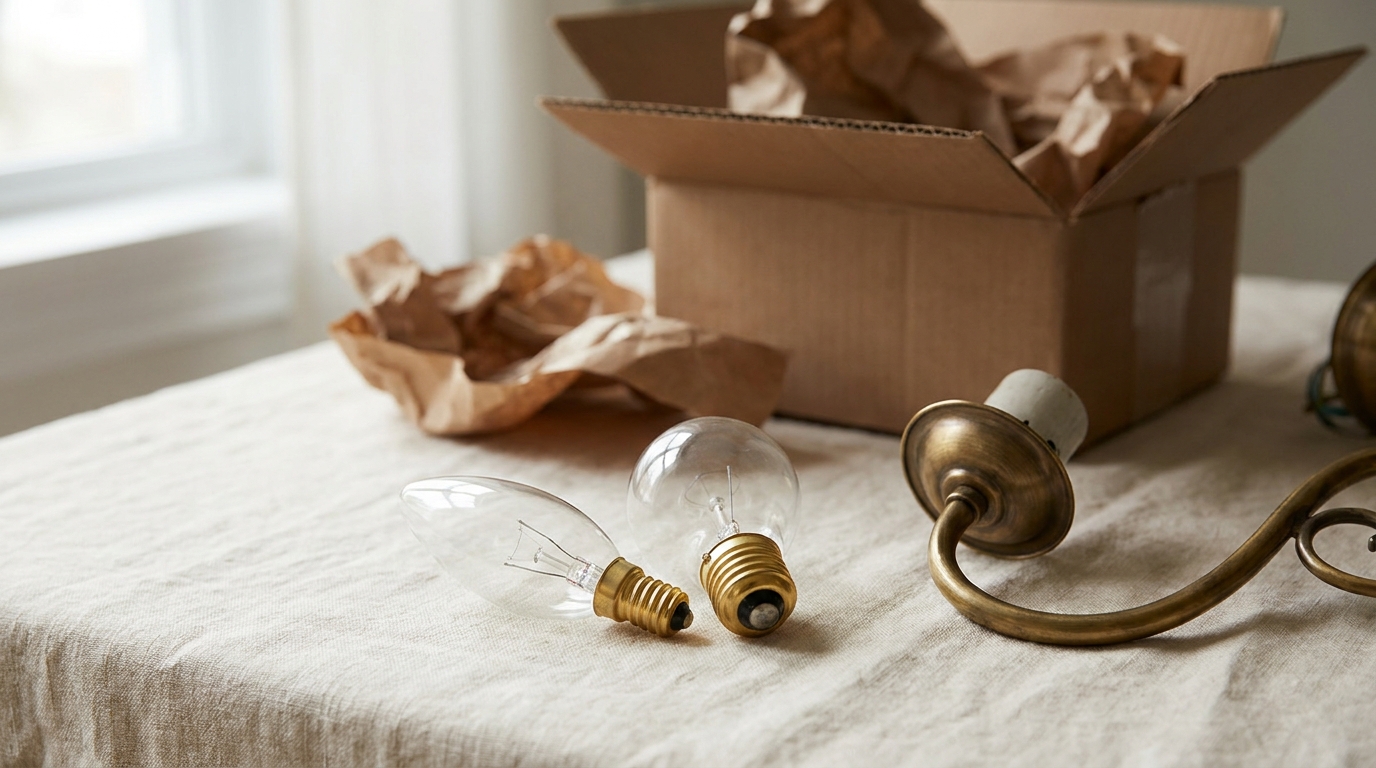
You found the perfect chandelier on a US website. You paid, and you waited six weeks for the box.
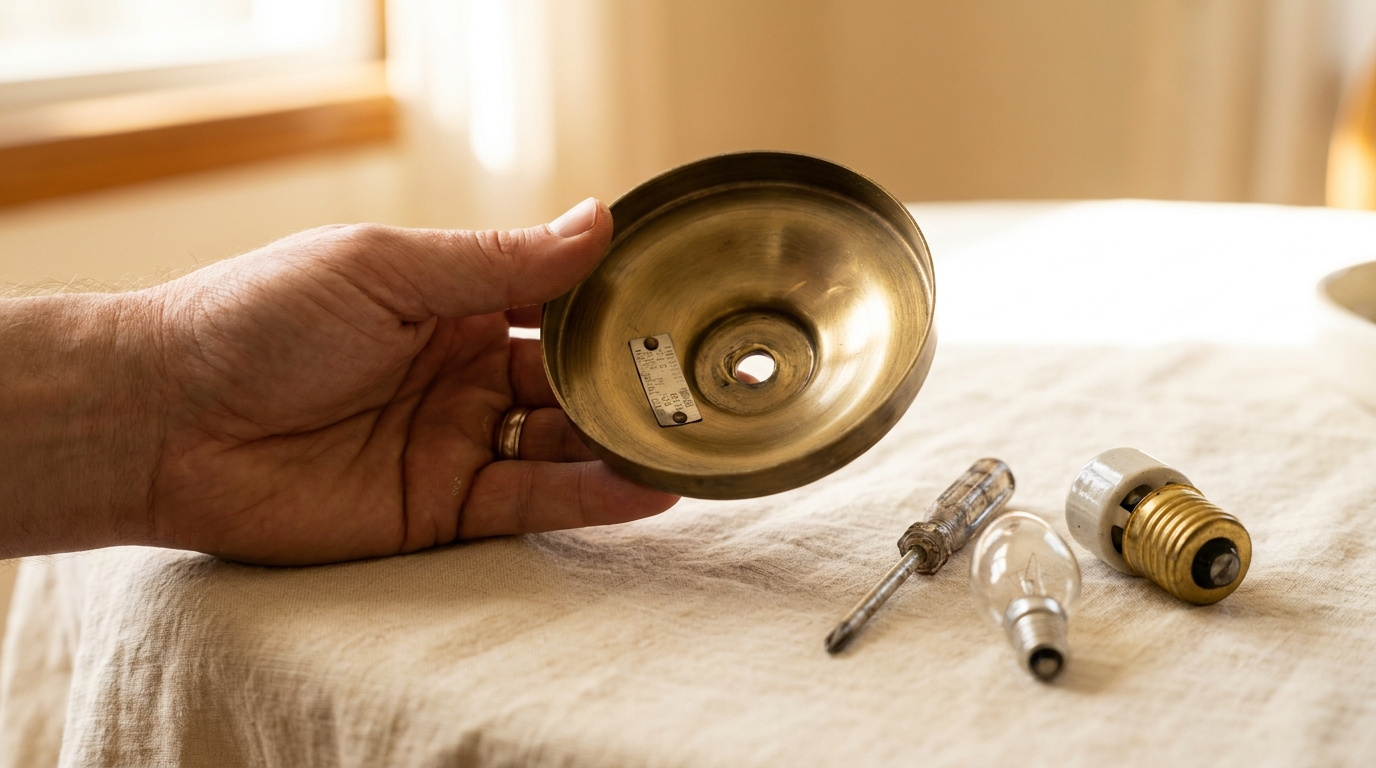
The box finally arrives. You open it, and the bulbs you bought in India do not fit. A small label inside the canopy says 120V.
Your electrician turns the canopy over, looks at the label, and shakes his head. He will not switch it on until he checks every wire.
The trouble has two parts: the bulb size and the power. The E26 vs E27 question covers both, and below you will see how to check any light before you pay.
The short answer
E26 is the screw size of bulbs in the USA, and E27 is the size used in India and Europe. The two look almost the same. But US lights and bulbs are made for 120 volts, and Indian homes run on 230 volts. Buy a light made for 220–240 volts with an E27 or E14 holder, and bulbs sold in Indian shops will fit it.
What is really going on
A volt is the push of electricity in your wires. Homes in the USA get 120 volts. Homes in India get 230 volts, almost double the push.
A bulb made for 120 volts gets that double push in an Indian socket. The bulb can burn out at once. LEDY, a lighting maker, warns that the swap can also cause a spark or a fire.
In the E26 vs E27 story, the screw is the smaller problem, but it adds to the confusion. The number in E26 or E27 is the width of the screw in millimetres. One millimetre is very hard to see, so a 120-volt bulb can screw into a 230-volt holder without a fight.
Small candle bulbs have the same story. US chandeliers often use E12, a narrow screw. Indian and European candle bulbs use E14, a little wider.
The voltage question goes deeper than the bulb. A light with a built-in LED has a small power box inside, called a driver. The driver carries its own voltage rating, and you cannot swap a driver as easily as a bulb.
How to check E26 vs E27 before you buy
Five checks take a few minutes, on a listing or in a shop.
- Find the voltage line on the listing; you want 220–240 V, not 120 V.
- Read the bulb holder size; E27 and E14 suit Indian bulbs, E26 and E12 come from the US.
- Turn the canopy over and read the rating label before any wire goes in.
- For a light with a built-in LED, ask if the driver is made for 220–240 V.
- Ask who keeps a spare holder in India if one ever breaks.
We opened one US chandelier page on 12 October 2026 as an example. The page lists 120 volts and E12 candle bulbs, and says the light ships in 4–6 weeks.
When a listing hides the voltage, ask before you pay. Do not guess. A good seller answers that question in one line, and the answer decides whether the light can work in your home.
Side by side
| What you care about | JagMag light | Light bought from a US website |
|---|---|---|
| Made for Indian power? | Yes, 220–240 volts | Often made for 120 volts |
| Bulb fits from a shop near you? | Yes, E27 or E14 | Not always, E26 or E12 |
| Wait for your light | 15–20 working days for custom | Weeks of shipping, then customs |
| Spare part if one breaks | Kept for 10+ years in India | Ordered again from abroad |
| Help to fit it | Free video call | Your electrician works it out |
Where the other side is better
US websites show designs and brands that no Indian maker sells. If you love one exact piece, that range is hard to beat.
Some US lights can also work here with care. Super Bright LEDs notes that an E27 bulb can usually go in an E26 holder if the bulb suits the voltage. A licensed electrician must still check the wires, the holder and any driver first.
What we do at JagMag
JagMag Lights is a decorative lighting manufacturer in Greater Noida, making lights since 2015. We make our lights for Indian power, 220–240 volts, with holders for bulbs sold in Indian shops.
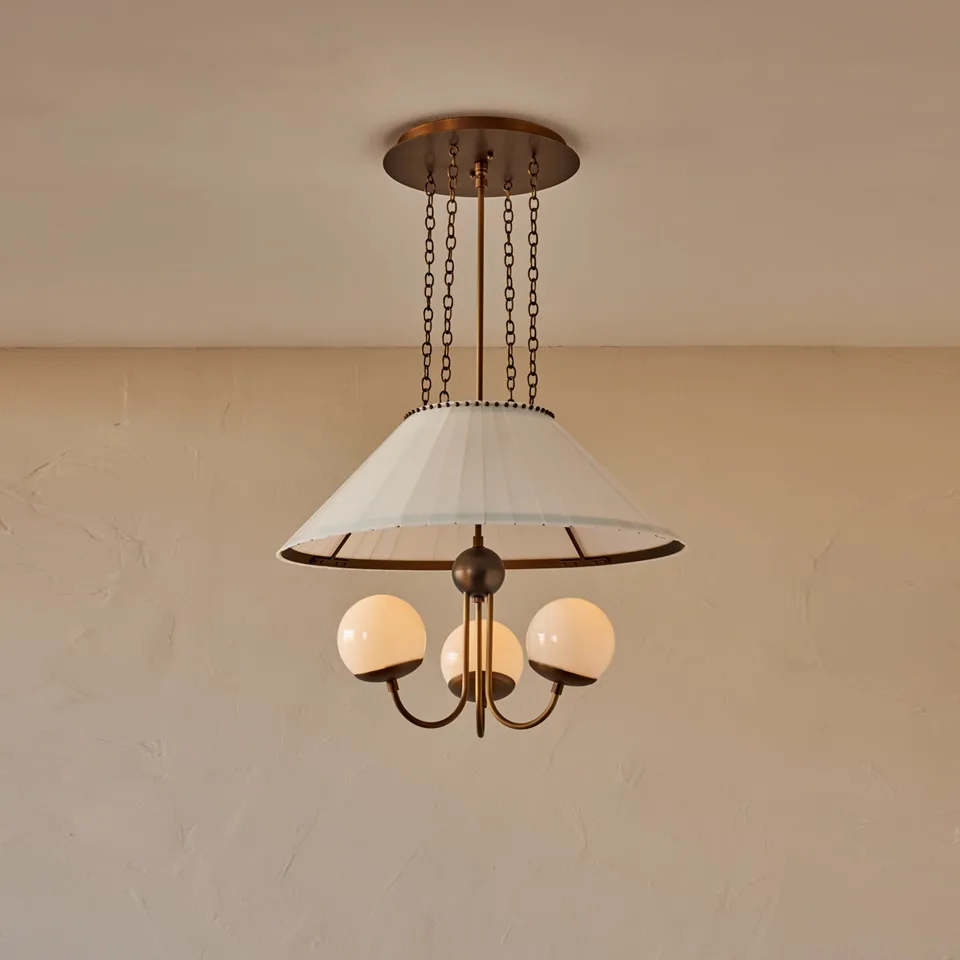
Our milk glass chandelier shows how. Three opal glass globes sit on antique-brass-finish arms of 304 stainless steel, the same grade as a good kitchen sink. The light takes three E14 bulbs, and the product page lists 220–240 V and India as the country of origin.
Hands in our own factory shape and finish each frame, so we know what sits inside it. When a holder or a globe breaks, we have the part. We keep spares for 10+ years, and you can see them in our lighting components range.
Every stainless steel part carries a lifetime warranty against rust, for orders from 4 October 2026. The terms sit in our Legal Policies.
Loved a shape on a US page? Send us the photo and your ceiling height. We can make a custom size or finish for your room, built for Indian power, in 15–20 working days.
Warm 3000K light from the right holder also suits Vastu thinking, which values a calm, steady glow in the home.
Thinking of an import for its look? Read imported lights vs made in India and how long an Italian chandelier makes you wait.
FAQs
What is the difference between E26 and E27?
E26 is a 26 mm bulb screw used in the USA. E27 is a 27 mm screw used in India and Europe. The bigger difference is power: E26 bulbs are made for about 120 volts, E27 bulbs for 220–240 volts.
Can I use an E26 bulb in India?
Not a 120-volt E26 bulb. On Indian power the bulb gets almost double its rated push, so it can burn out or spark.
Will a chandelier from the USA work in India?
Only after a licensed electrician checks it. The bulbs, holders and any built-in LED driver must suit 230 volts before you switch it on.
Which bulb holder is used in India?
E27 is the common screw holder across Asia, including India, and E14 is the small candle size. Our chandeliers use E27 or E14 holders, made for 220–240 volts.
Do JagMag lights work on Indian voltage?
Yes. We make our lights for 220–240 volts in our own Greater Noida factory, and we give free video-call help with fitting.
Nature gives the material. Human hands give it meaning. Light brings it to life.
Ready to choose? Browse our chandeliers or the glass chandeliers range. Not sure? Video-call us before you buy anything.
Sources
- Wikipedia: Mains electricity by country (India 230 V 50 Hz; USA 120 V 60 Hz)
- Super Bright LEDs: Light bulb base types, E26, E27, E12 and E14
- LEDY Lighting: E26 vs E27 bulbs
- Example US chandelier listing: 120V, E12 candelabra, ships in 4–6 weeks (checked 12 October 2026)
- JagMag Lights: Milk glass chandelier specification
- JagMag Lights: Customized lights (lead time, spares, own factory)
- JagMag Lights: Legal Policies, section 4.1A