You like a lamp with a wooden base and a woven shade. Then a worry comes. The bulb sits inside wood, linen or rattan every night. Will it get hot enough to burn?
The worry is fair, and the answer starts with one question: does LED bulb produce heat? Our guide answers it with numbers, two short sums and the science of why bulbs warm up. Then you can choose a natural-material lamp without fear.
The short answer
An LED bulb does make some heat, but far less than an old bulb. The US Department of Energy says old filament bulbs release 90% of their energy as heat, while LEDs emit very little. With a warm-white LED inside, wooden and woven table lamps stay safely warm, not hot.
Do LED bulbs get hot? What the guides say
A watt is the electricity a bulb uses, like petrol in a scooter. A lumen is the light it gives back. Every bulb turns part of its watts into light and the rest into heat.
| Fact | Number |
|---|---|
| Energy an old filament bulb releases as heat | 90% |
| Energy a CFL releases as heat | about 80% |
| Energy a home LED uses, compared with a filament bulb | at least 75% less |
| Light per watt, filament bulb | 12 to 18 lumens |
| Light per watt, LED lamp | 30 to 90 lumens |
| LED heat sink temperature, typical home bulb | 30 to 60 °C |
The first three rows come from the US Department of Energy. The light-per-watt rows come from an engineering reference table. The last row is Philips’ own figure for the heat sink, the metal part at the base of the bulb that carries heat away. The same page adds that the outer glass or plastic is often cool or only slightly warm.
How much less heat? The sums for one lamp
Our lamp pages suggest an 8 W warm-white LED of about 700 lumens. Work out the heat for that light, step by step.
- LED light per watt: 700 ÷ 8 = 87.5 lumens per watt.
- An old bulb gives 12 to 18 lumens per watt. For 700 lumens it needs 700 ÷ 18 = 39 W up to 700 ÷ 12 = 58 W.
- Heat from the old bulb: 90% of 39 to 58 W = about 35 to 52 W.
- Heat from the LED, worst case: the same bulb maker says up to about 70% of input can turn to heat in high-power LEDs. 70% of 8 W = 5.6 W.
- Compare: 35 ÷ 5.6 = 6.3 and 52 ÷ 5.6 = 9.4. The LED makes about 6 to 9 times less heat for the same light.
Now check the holder label. Every bulb holder carries a maximum wattage, the most heat it is built to handle. On 31 October 2026 we checked all 13 lamps in our wooden and rattan table lamps range. All 13 use one E27 holder, the standard screw base, sold without a bulb. 5 are rated 40 W, 5 are rated 60 W and 3 are rated 100 W.
- Lowest rating: 40 W.
- Suggested LED: 8 W.
- 8 ÷ 40 = 0.2, so the LED uses only 20% of the lowest rating. The holder has five times the margin it needs.
5 of the 13 product pages name the same 8 W, roughly 700-lumen LED. An 8 W LED gives plenty of light for a bedside or a console.
Why bulbs get hot, and why wood stays safe
An old filament bulb makes light by heating a thin wire until it glows, like the red coil of a heater. Most of its power leaves as heat and invisible infrared light. The glass gets hot because the wire inside is very hot.
An LED makes light a different way. Electricity passes through a tiny chip, and the chip gives off light directly. The chip still warms a little, so the bulb has a metal heat sink to carry that heat into the air.
Now compare temperatures. An engineering table gives an ignition temperature of about 300 °C for wood. Ignition temperature is the heat at which a material catches fire on its own. Paper sits lower, at 218 to 246 °C. A typical LED heat sink runs at 30 to 60 °C. So wood would need about 240 °C more heat than a warm LED base gives.
The logic runs in a short chain. Less heat means a cooler shade. A cooler shade means wood, linen and rattan keep their colour and shape. Cooler parts also mean a longer life for the LED, because heat speeds up ageing inside the bulb, as the bulb maker notes.
Three simple habits keep the margin wide. Use an LED, never a bulb above the holder’s rating. Keep the shade from touching the bulb. Switch off a lamp before you clean it.
Wood is flammable, like any natural material. The point is the distance from that limit. A warm LED stays far below it.
Nature gives, hands shape, light stays gentle
Wood grows for years. Hemp and rattan come from plants. Our craftsmen shape these materials by hand, and a cool LED lets them stay close to the light without harm.
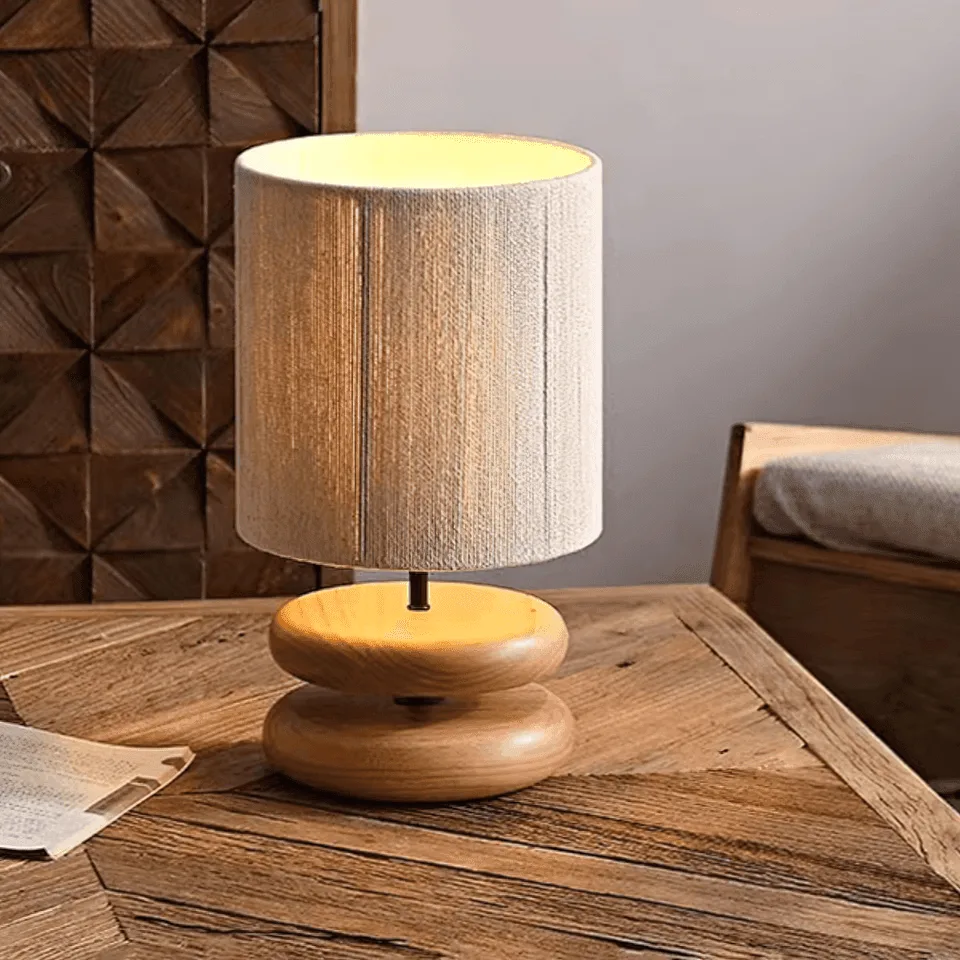
The Wood Base Table Lamp with Hemp Rope Shade is 40 cm tall. Two rounded discs of natural wood sit under a 22 cm shade of hemp rope, wound by hand. The holder is rated 60 W.
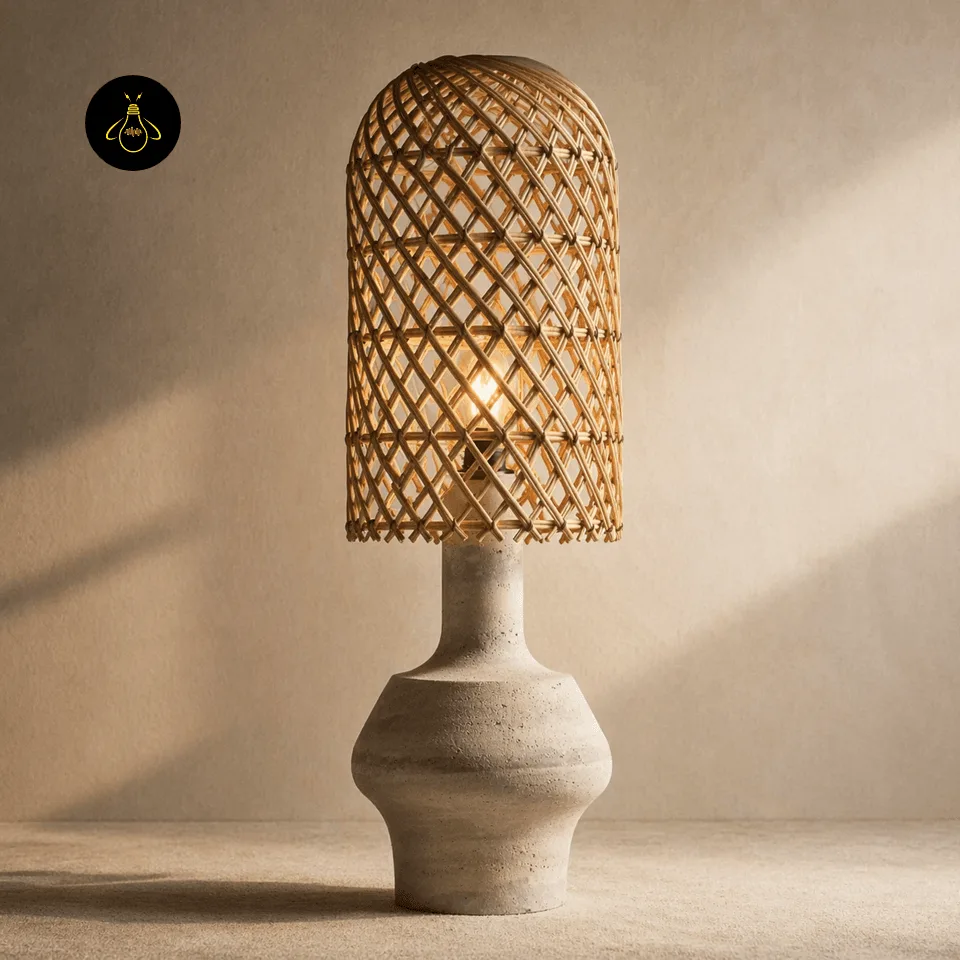
The Tall Table Lamp with Rattan Shade stands 105 cm high. An open-weave shade, 38 cm wide, sits on a sculpted travertine base. The holder is rated 40 W, so an 8 W LED fits well.
The Tripod Table Lamp has a teak body, turned and distressed by hand, under a 50.8 cm raw silk shade. Teak grows over decades, so no two bodies match.

All three are made in our own factory in India, where we have made lights since 2015. Bulbs are not included; fit a 3000K warm-white LED. Read more about our makers on our about page.
Vastu thinking pairs earth materials, like wood and stone, with the warm fire of light. A cool LED inside a wooden lamp brings both together gently. We do not promise luck, only a calm and safe corner.
FAQs
Does LED bulb produce heat?
Yes, but very little compared with old bulbs. Filament bulbs release 90% of their energy as heat, while a home LED’s heat sink stays around 30 to 60 °C.
Is it safe to use an LED bulb in a wooden lamp?
Yes, an LED within the holder’s rating is the right choice for a wooden lamp. Wood ignites at about 300 °C, far above a warm LED.
Why do light bulbs get hot?
Filament bulbs heat a wire until it glows, so most power becomes heat. LEDs make light from a chip, so far less power turns to heat.
What wattage LED should I use in a rattan or linen lamp?
An 8 W warm-white LED of about 700 lumens suits most bedside and console lamps. The 8 W uses only 20% of a 40 W holder rating.
Nature gives the material.
Human hands give it meaning.
Vastu inspires harmony.
Light brings it to life.
That is JagMag.
Find your wooden table lamp in our range. Before you buy, check the right height of a table lamp, or learn how to clean lamp shades. Not sure? Video-call us.
Sources
- US Department of Energy: LED lighting (page no longer online) (read 31 Oct 2026)
- Philips Hue: do LED bulbs get hot? (read 31 Oct 2026)
- Engineering ToolBox: luminous efficacy of lamps (read 31 Oct 2026)
- Engineering ToolBox: autoignition temperatures of fuels (read 31 Oct 2026)
- Nelson-Miller: do LEDs produce heat? (11 Dec 2018) (read 31 Oct 2026)