
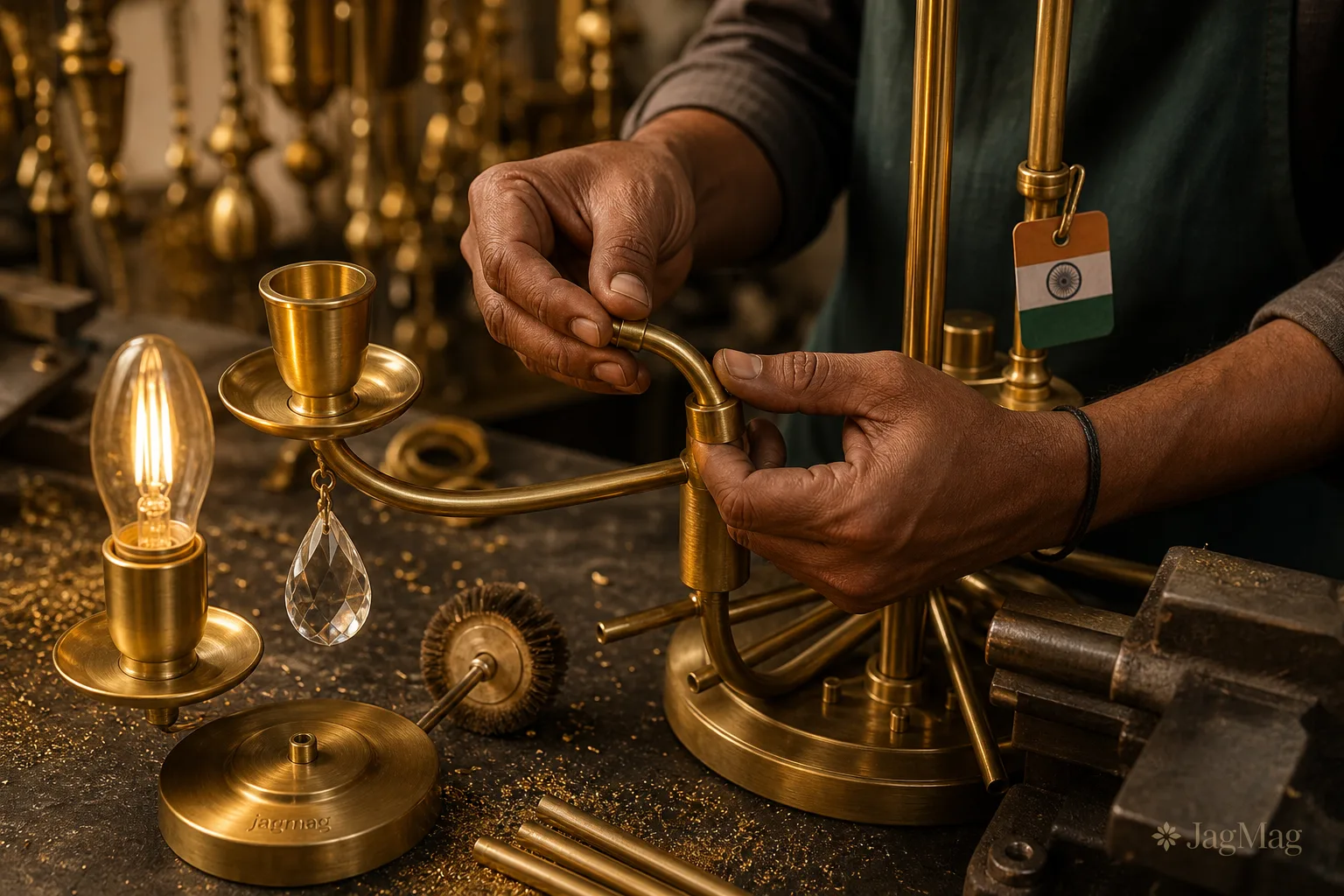
You found the perfect chandelier. You’re about to tap “add to cart.” Then a headline flashes past: “US puts 50% tariff on copper.” And you pause — is the light in your cart about to get more expensive?
It’s a fair worry. A light fixture is mostly metal, and copper sits at the heart of it: in the wiring, in the brass arms, in the warm gold and bronze finishes you love. So when the world’s largest economy brings in new copper tariffs, it’s worth knowing what actually changes for you, here in India.
Here’s the honest, no-spin version — and what it means for the price you pay.
Do copper tariffs raise lighting prices in India?
Short answer: The new US copper tariffs raise costs inside the United States — a 50% duty on semi-finished copper since August 2025, with a refined-copper tariff of 15% in 2027 and 30% in 2028 still under review (a US Commerce report is due 30 June 2026). For Indian buyers, the direct impact is small, because these are American import duties, not Indian ones. The real risk is indirect: brands that import finished lights from China ride global metal-price swings, while India-made fixtures from a local manufacturer stay far steadier.
Key takeaways
- The tariffs are American, not Indian. They tax copper entering the US — they don’t add a duty to a chandelier you buy in Delhi or Mumbai.
- Copper hides in every light. Wiring, brass arms (brass is roughly two-thirds copper), screws and canopies all use it.
- Importers feel it most. Sellers who ship finished lights from China are exposed to world metal prices, the dollar and freight.
- Make-in-India means price stability. A local manufacturer buys raw metal and labour in rupees, so global shocks reach it slowly, if at all.
- Buying now is sensible. Lock today’s price online instead of waiting for the next imported container.
What’s in this guide
- What the new US copper tariffs actually are
- Why your price in India isn’t hit directly
- Why importers feel it more than makers
- Importer vs maker: who feels the price shock?
- How to buy lighting that won’t get hit
- India-made metal lights to buy now
- FAQs
What the new US copper tariffs actually are
In 2025 the US opened a national-security review of copper and started taxing it. In plain terms, here’s the timeline:
- From 1 August 2025: a 50% tariff on semi-finished copper — pipes, wires, rods, sheets and tubes — plus copper-heavy parts like cables and connectors.
- Refined copper (the raw cathode metal): a phased tariff of 15% in 2027 and 30% in 2028 has been recommended, but it isn’t final yet.
- 30 June 2026: the US Commerce Secretary is due to report on the copper market, after which the President decides whether the refined-copper copper tariffs go ahead.
You can read the official US proclamation in the US Federal Register.
Why does any of this touch your lighting? Because a fixture is a metal object. The frame, the arms, the screws, the canopy and the wiring inside are largely copper or brass — and brass is roughly two-thirds copper. When copper gets taxed somewhere big, copper-based products can get pricier everywhere the ripple reaches.
Why your price in India isn’t hit directly
A tariff is a tax a country charges on goods coming into it. These copper tariffs are charged by the US on imports landing in America. If you’re buying a chandelier in Bengaluru or Jaipur, you’re not paying a US import duty.
So the copper tariffs don’t add a line to your Indian invoice. What they can do is nudge the global price of copper as supply chains rearrange — and that ripple can reach anyone, anywhere, who buys metal on the world market.
That’s the part worth watching. And it’s where who you buy from matters far more than where you live.
Why importers feel it more than makers
Picture two kinds of lighting sellers in India.
The importer or stockist. They buy finished lights — often from China — in bulk, ship them in, and sell from a showroom or website. Their cost is tied to overseas factory prices, world metal rates, the dollar and freight. When copper tariffs scramble global metal flows or the rupee wobbles, their landed cost moves. The next container can cost more, and that gets passed on to you.
The Indian manufacturer. They buy raw metal and make the light here. Their costs are mostly local — labour, power, Indian-sourced material — so global shocks reach them slowly and softly, if at all.
JagMag is the second kind. Every light is made in our own India factory in Greater Noida — not imported. That isn’t just a feel-good line; it’s the reason a global copper-tariff headline doesn’t force a sudden jump on our chandeliers. Because we own the manufacturing, we also keep spare parts for 10+ years and don’t wait on any overseas supplier to fix a project — our own team handles it.
Importer vs maker: who feels the price shock?
| What you care about | Importer / stockist | JagMag (Indian manufacturer) |
|---|---|---|
| Where the light is made | Overseas, often China | In-house in India (Greater Noida) |
| Exposure to global copper tariffs | High — tied to world metal + freight + dollar | Low — costs are mostly local, in rupees |
| Sudden price jumps | Possible with the next container | Far steadier |
| Spare parts later | Often gone once stock sells out | Available 10+ years (we still make the part) |
| Custom lead time | 60–120 days | 15–20 working days |
| Reorder the exact design | Hit or miss | Reliable — we can make it again any time |
How to buy lighting that won’t get hit by metal-price shocks
- Buy from a manufacturer, not a reseller. A maker controls its own metal and labour costs, so it absorbs world swings better than a seller reselling imported stock.
- Check where it’s made. “Made in India” isn’t only patriotic — it usually means a shorter, rupee-priced supply chain that’s less tariff-sensitive.
- Ask about spare parts. If the seller can’t supply a replacement arm or crystal in three years, you’ll repurchase the whole fixture later — the real hidden cost.
- Lock your price by buying online now. Today’s listed ₹ price is today’s price. Waiting only exposes you to the next cost cycle.
- For projects, confirm reorder and lead times. Hotels and builders installing in phases need the same design months later — only a manufacturer can guarantee that.
India-made metal lights to buy now
Want metal fixtures whose price isn’t riding a global tariff wave? These are made in our own factory, in stock, with live ₹ prices:
- Gold Glass Dome Wall Light — ₹2,773. A warm, curved sconce for a living room or bedroom; an easy first upgrade.
- Art Deco Brass Wall Light (3-Light) — ₹4,890. Brushed brass and alabaster-effect glass; pairs beautifully on either side of a bed or mirror.
- Art Deco Brass Pendant Light, 30 cm — ₹5,680. A jewel-like mini chandelier for a nook, island corner or entryway.
- Round Art Deco Brass Chandelier, 50 cm (4-Light) — ₹32,600. The centrepiece for a living, dining or foyer ceiling.
- Linear Dining Chandelier, 150 cm — ₹98,500. A long brass island light for big dining tables, banquets and project spaces.
Browse the full ranges of chandeliers and customized lights, or — if you’re an interior designer, architect or builder — see our trade and projects page for reorder-friendly, made-to-order manufacturing.
Why JagMag stays steady when metal prices don’t
We’re a 100% Make-in-India lighting manufacturer — DPIIT-recognised and government-funded under the Uttar Pradesh Startup Policy — building here so the country relies less on imported lights. Because we own the factory end to end, we offer spare parts for 10+ years, overnight project support with no overseas dependency, and 15–20 working-day custom builds where importers quote 60–120 days. That control is exactly why a copper-tariff headline abroad doesn’t shake your price here.
Planning room by room? Start with our lighting for every room guide, and if you’re hanging pendants, get the heights right with our pendant light height guide.
Frequently asked questions
Will copper tariffs increase lighting prices in India?
Not directly. The copper tariffs are charged by the US on copper entering America, so they do not add a duty to a light you buy in India. They can nudge global copper prices indirectly, which affects sellers who import finished lights from China more than Indian manufacturers who buy metal and make fixtures locally in rupees.
What exactly did the US tariff on copper?
From 1 August 2025 the US placed a 50% tariff on semi-finished copper such as pipes, wires, rods, sheets and tubes, plus copper-heavy parts like cables and connectors. A phased tariff on refined copper of 15% in 2027 and 30% in 2028 has been recommended but is not yet final, pending a US Commerce report due 30 June 2026.
Are JagMag’s prices affected by copper tariffs?
JagMag is a 100% Make-in-India manufacturer in Greater Noida, so its costs are mostly local labour and Indian-sourced material priced in rupees. That keeps prices far steadier than importers who are exposed to global metal rates, freight and the dollar, so a copper-tariff headline abroad does not force a sudden price jump.
Is brass affected, since lights use brass not pure copper?
Brass is a copper alloy, roughly two-thirds copper mixed with zinc, so brass costs do move with copper. That is one more reason buying brass fixtures from an Indian manufacturer is safer than from an importer, because the maker buys and works the metal locally rather than shipping finished brass lights across tariff-affected supply chains.
Should I buy lighting now or wait?
If you like a fixture, buying now lets you lock today’s listed rupee price. Waiting mainly exposes you to the next cost cycle. Choosing an India-made light from a manufacturer with long spare-parts support is the most price-stable option either way.
The bottom line: copper tariffs are a real global story, but they hit importers far harder than they hit you. Buy India-made, buy from the maker, and your price stays in your control. Shop JagMag chandeliers online →