
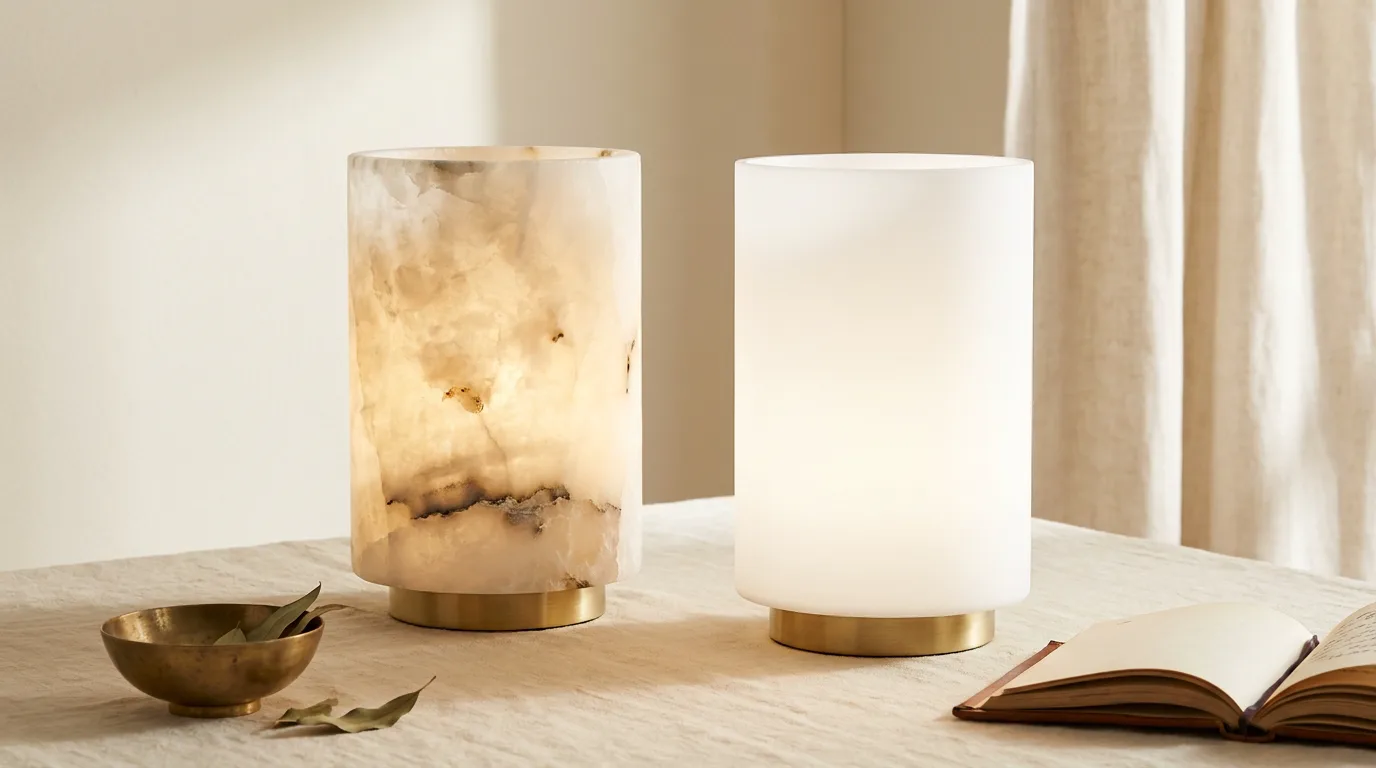
You see a lamp online. The listing says “alabaster”. The photo shows a soft white glow.
You see a second lamp. The second listing also says “alabaster”. The two lamps look almost the same.
But one lamp may be real stone, and the other may be plastic. The name on the listing is the same. The material is not.
This guide shows you what faux alabaster is, how to check a lamp yourself, and what real stone does that plastic cannot.
The short answer
Faux alabaster is not stone. Most look-alike alabaster is resin, acrylic or PVC, all kinds of plastic, shaped to look like alabaster. Real alabaster is a soft natural stone that glows unevenly, with veins, when you switch it on.
At JagMag, every light we sell as alabaster is real stone. We keep spare stone pieces for 10+ years.
So why do two very different materials carry the same name? The answer starts with the stone itself.
What is really going on
Alabaster is a stone formed beneath the earth. Alabaster is smooth, soft and a little see-through, like thick candle wax. People have carved alabaster into lamp shades for a very long time, because light passes into the stone.
Real stone is never the same all the way through. Alabaster has veins, cloudy patches and darker bands. When light shines through the stone, those marks come up from inside.
Many sellers now use the word “alabaster” for a look, not for a stone. On IndiaMART, two listings show the gap. One sheet is called “Faux Alabaster Stone”, and its material line says acrylic and PVC. Another panel is called “Backlit Alabaster Stone”, and its material line says polyester resin, a hard plastic poured into a mould.
The resin listing even calls its panel an alternative to natural stone. The title says stone. The material line says plastic.
Glass uses the same word too. The Museum of Fine Arts, Boston describes alabaster glass as a decorative white glass. Alabaster glass is glass, not stone.
Resin, acrylic and white glass are real materials, and sellers may sell them. The trouble starts when you read only the word “alabaster”.
So how do you know which one is in front of you? You can check it yourself in under a minute.
How to check it yourself
- Read the material line on the listing, not only the title.
- Put your palm flat on the shade, because real stone stays cool for a few seconds while plastic warms almost at once.
- Switch the light on, because real alabaster shows uneven veins while plastic glows flat and even.
- Look at two pieces side by side, because two shades with the same exact pattern came from one mould.
- Ask the seller to write “natural alabaster stone” on your bill.
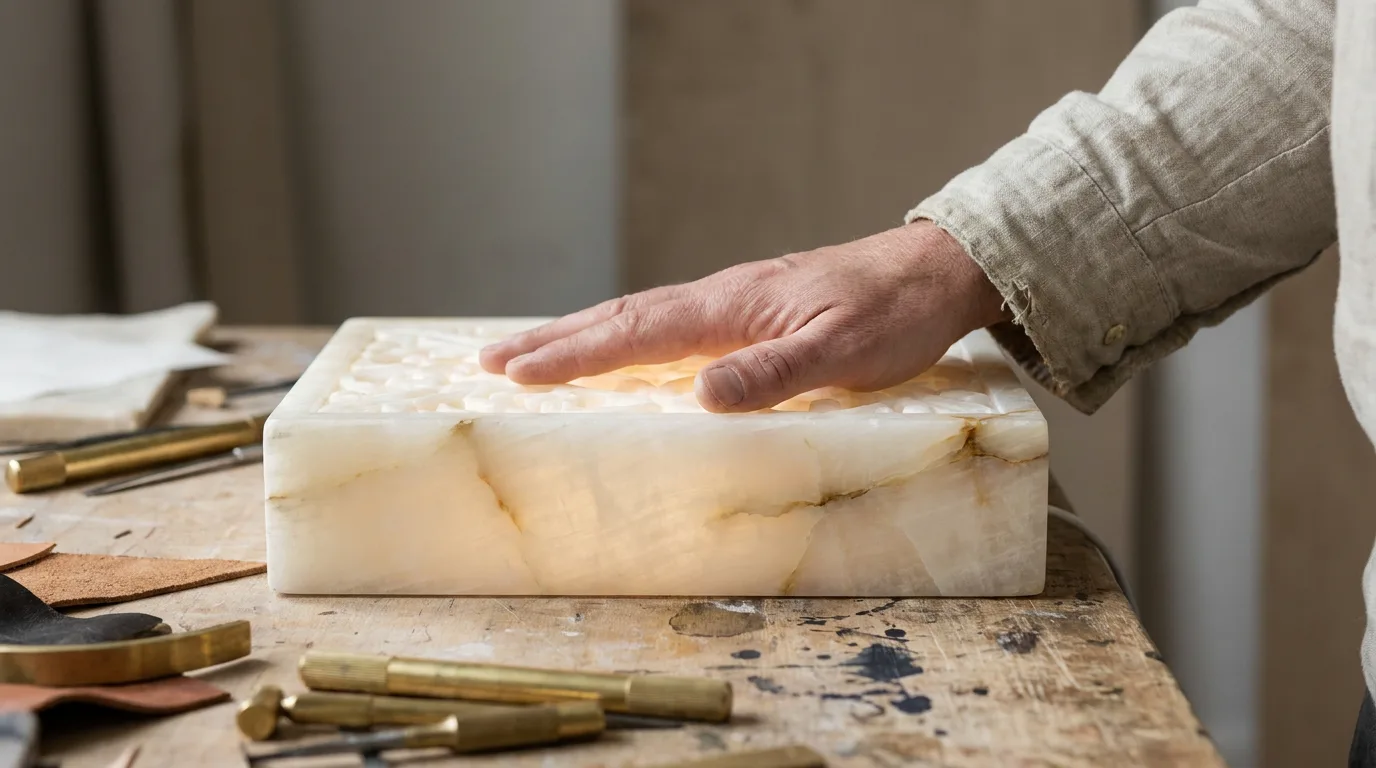
Lift the light too, if you can. A real stone light feels much heavier than a plastic one of the same size.
Skip one test: never scratch the shade. Real alabaster is soft enough to mark with a fingernail, so a scratch test hurts the stone you want to keep.
Once you know the checks, the two materials are easy to compare.
Faux alabaster vs real alabaster, side by side
| What you care about | JagMag real alabaster | Faux alabaster |
|---|---|---|
| What it is | Natural stone from the earth | Plastic (resin, acrylic or PVC), or white glass |
| When you switch it on | Glows unevenly, veins show | Glows flat and even |
| Two pieces side by side | Never the same | Can match exactly |
| How it feels | Cool for a few seconds | Warms up quickly |
| Weight | Heavy | Light |
Real stone wins on glow and character. But plastic does some jobs better, and you should know them.
Where the other side is better
Plastic is tougher. Real alabaster is soft and can get a scratch, so real stone needs a soft, dry cloth and gentle care.
Plastic can bend. A resin panel can curve around a wall or a long bar counter in one smooth sheet.
Plastic is lighter, and every panel matches. If you want ten panels that look exactly alike, real stone will not give you that.
If you want the real stone and its glow, here is how we work with it.
What we do at JagMag
JagMag Lights is a decorative lighting maker in Greater Noida, Uttar Pradesh. Every light we sell as alabaster is real stone, shaped in our own factory.
Our craftsman reads each block before he cuts it. He decides where to cut, how thin to make the wall so light can pass, and which vein to leave alone. The work is slow, one careful movement at a time.
Our alabaster pendant light shows the result. The pendant is a 400 mm cylinder of real stone, lit from inside by a warm LED. Switch it on and the veins come up from inside the stone.
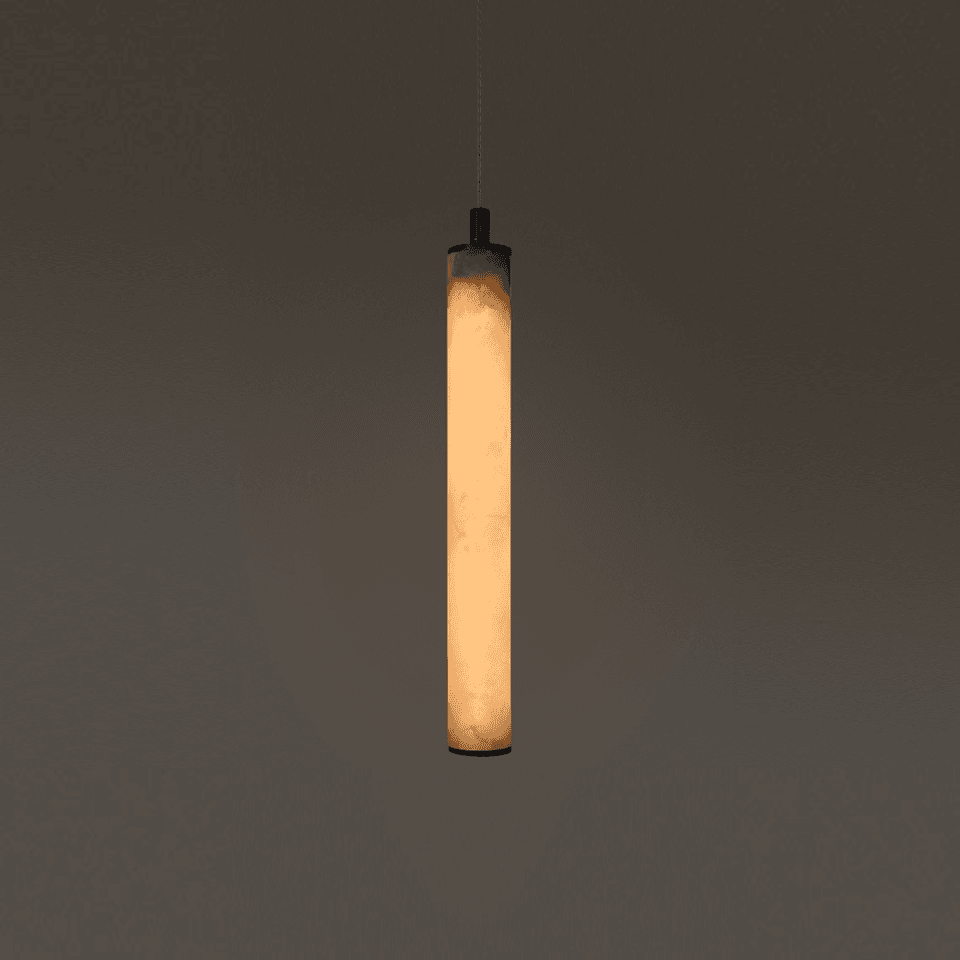
No two of our cylinders look the same, because no two pieces of stone are the same. For a wall, see our alabaster wall light, a thin disc of real stone that shows every vein when lit.
The stone hangs on 304 stainless steel, the same kind of steel used in a good kitchen sink. Our legal policies give a lifetime warranty against rust on those steel parts, for orders from 4 October 2026.
We keep spare stone pieces for 10+ years, because we cut them ourselves. If a piece arrives damaged and you tell us within 24 hours, we replace that part after we check your photos.
Natural stone and warm light give a room a calm, grounded feel. Vastu thinking has always valued that kind of harmony.
FAQs
What is faux alabaster made of?
Faux alabaster is usually plastic: resin, acrylic or PVC shaped to look like alabaster stone. Some listings also use the word “alabaster” for white glass.
How can you tell if alabaster is real?
Switch it on and touch it. Real alabaster shows uneven veins when lit and stays cool for a few seconds. Plastic glows evenly and warms up quickly.
Is alabaster glass real alabaster?
No, alabaster glass is a white decorative glass, not stone. Alabaster glass can look similar, but it has no veins running through it.
Is faux alabaster better than real alabaster?
Plastic look-alikes are better for big, curved, matching panels, because plastic is tough, light and can bend. Real alabaster is better for a lamp you want to feel natural, because its glow and veins never repeat.
Are JagMag alabaster lights real stone?
Yes. Every JagMag light sold as alabaster is real alabaster stone, shaped by hand in our Greater Noida factory. Each piece has its own veins.
Nature gives the material. Human hands give it meaning. Vastu inspires harmony. Light brings it to life. That is JagMag.
Ready to see real stone glow? Browse our alabaster lighting, or see all our pendant lights. Curious about the metal inside a light? Read mild steel vs stainless steel lights. Wondering who made a light? Read Bhagirath Palace light market vs buying from a maker.
Not sure? Video-call us and we will show you the stone.
Sources
- CAMEO, Museum of Fine Arts Boston: Alabaster (soft, can be scratched with a fingernail)
- Wikipedia: Alabaster (a translucent stone, used for lampshades)
- CAMEO, Museum of Fine Arts Boston: Alabaster glass (a decorative white glass)
- IndiaMART listing: “Designer Acrylic/pvc Faux Alabaster Stone”, material acrylic/PVC (checked 6 Oct 2026)
- IndiaMART listing: “Backlit Alabaster Stone”, material polyester resin, bendable (checked 6 Oct 2026)
- Modern Chandelier: How to tell real alabaster from resin (touch, lit, mould and weight tests)
- JagMag Lights: Legal Policies, 4.1A lifetime rust warranty and 4.2 transit damage
- JagMag Lights: FAQ (spare parts for 10+ years, own factory in Greater Noida)