
You have chosen a long linear light for the dining table. The bulb box in your hand says “450 lumens”. Are eight of them too much or too little?
How many lumens for dining room lighting is a simple sum. You need two numbers: the size of your room and the light you want on the table. A lumen is the total light a bulb gives out, like litres of water from a tap.
Below are the guide figures, the sums for an Indian dining room, and the physics of a long bar of light.
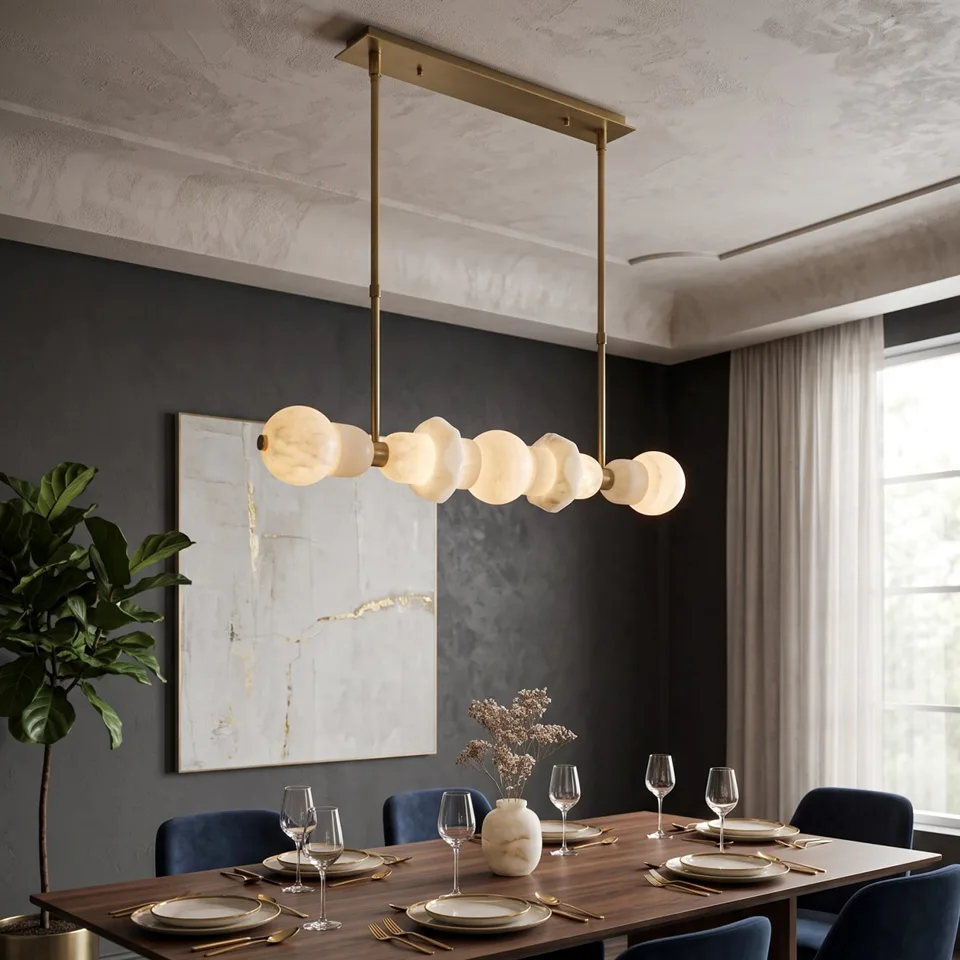
The short answer
A dining room needs about 3,000 to 4,000 lumens in all, from every light in the room. On the table itself, aim for about 108 lux for everyday meals and about 216 lux when the table doubles as a desk. A linear chandelier over the table carries part of that load, and wall lights or ceiling lights carry the rest.
Dining room lux level: the numbers guides use
Lux is the light that lands on one square metre, like rain falling on one tile. Lumens are what the bulb sends out. The two are linked by area: lux = lumens ÷ square metres.
| What it measures | Guide figure |
|---|---|
| Whole dining room, all lights | 3,000 to 4,000 lumens |
| Whole room, per square foot | 30 to 40 lumens |
| Table, formal dinner | 5 foot-candles, about 54 lux |
| Table, everyday meals | 10 foot-candles, about 108 lux |
| Table, homework or work | 20 foot-candles, about 216 lux |
The room totals come from The Home Depot and Engineerfix guides. The table figures come from the US residential lighting practice ANSI/IES RP-11, as summed up by a lighting maker. A foot-candle is the old unit for lux, and 1 foot-candle is about 10.8 lux.
For bulbs, ENERGY STAR gives an easy check. 450 lumens matches an old 40 W bulb, and 800 lumens matches an old 60 W bulb.
These figures turn into a plan with two short sums.
How many lumens for dining table light? Your own sum
Take a dining room 12 ft by 10 ft, about 3.66 m by 3.05 m, with a 180 cm six-seater table.
- Room area: 12 × 10 = 120 square feet, or about 11.15 square metres.
- Room total at 30 lumens per square foot: 120 × 30 = 3,600 lumens. At 40: 120 × 40 = 4,800 lumens.
- The Home Depot range is 3,000 to 4,000. Both ranges meet at 3,600 to 4,000, so plan about 4,000 lumens from all lights together.
Now the table itself.
- Table top: 1.8 m × 0.9 m = 1.62 square metres.
- Everyday meals at 108 lux: 108 × 1.62 = about 175 lumens must land on the table.
- Homework at 216 lux: 216 × 1.62 = about 350 lumens on the table.
- Part of a light’s lumens always falls outside the table. So give the linear light more than the 350 it must land. Say it carries 1,000 lumens, one quarter of the room’s 4,000.
- Our 120 cm wave chandelier has 8 bulb holders: 1,000 ÷ 8 = 125 lumens per bulb. Our 120 cm ceramic petal chandelier has 10 holders: 1,000 ÷ 10 = 100 lumens per bulb. Read the lumens on the bulb box, not the watts.
We counted our own range on 29 October 2026. Of 31 linear and rectangular chandeliers, 15 take bulbs in holders, and one of those also has a built-in LED ring. 14 have only a built-in 3000K LED, and 2 do not state the light source on the page. For the 14 built-in pieces, the lumen sum is already done for you in the factory.
How many lumens for dining room use: the logic behind the sum
Every guide splits the job in two. The room needs enough light to walk, serve and see faces. The table needs more, because food, plates and homework sit there. So the room total and the table figure answer two different questions.
The guides differ, so choose by use. A table used only for dinners can sit near 54 to 108 lux. A table where children study each evening needs the 216 lux figure. In that case, add a second light. One very bright bar shines into the eyes of everyone seated.
Height is part of the sum. Our linear and rectangular page asks for a light about two thirds the table’s length. Its bottom hangs 75 to 90 cm above the top. A 180 cm table suits a 120 cm bar.
The science: a long bar of light spreads differently
A single small bulb follows the inverse square law. Double the distance, and the light on the table falls to one quarter, like butter spread over a bigger slice of bread.
A long bar is different. A 2025 physics paper tested light and distance. Light from a linear source, such as an LED strip, falls off with distance itself, not with distance squared. Many small lights in a row keep topping up the table.
The difference shows in numbers. Raise a single pendant from 75 cm to 90 cm above the table. (75 ÷ 90)² = 0.69, so about 69% of the light reaches the plates. Raise a long bar the same way: 75 ÷ 90 = 0.83, so about 83% still reaches them. A linear light forgives a small height mistake.
Colour still matters. ENERGY STAR calls 2200K to 3000K warm white. At 3000K, food and skin look natural and warm, the way an evening meal should.
Light carried by natural materials: the JagMag way
Nature gives the material, and human hands shape it. We have made lights in our own Greater Noida factory since 2015. Our craftsmen set every globe, petal and stone along the bar by hand. Each one spreads part of the light, so the table glows evenly from end to end.
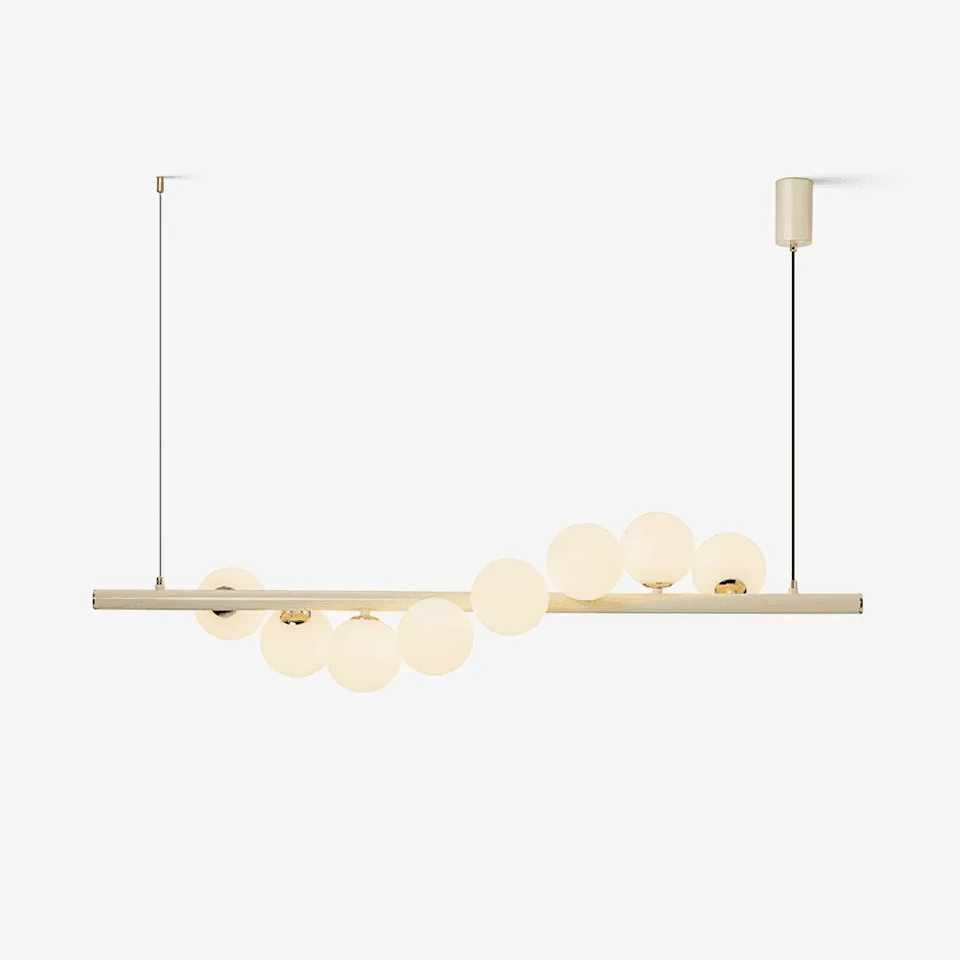
The Modern Linear Chandelier, Wave Design is 120 cm long, with 8 opal borosilicate glass globes on a 304-grade stainless steel bar. The bar takes 8 G9 bulbs, not included; fit 3000K warm-white LEDs, and a 3 to 4 W G9 LED works best.
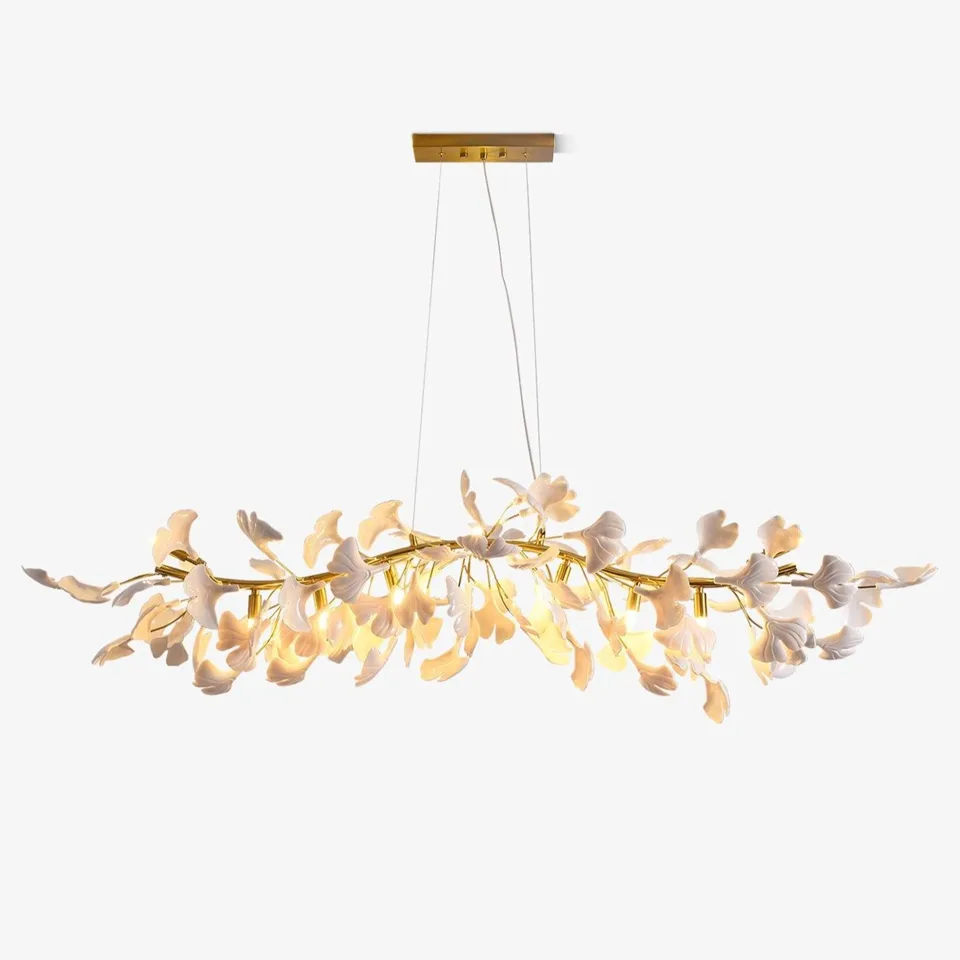
The Ceramic Petal Chandelier carries real porcelain leaves on a 120 cm branch, 40 cm high, with 10 G9 holders. The branch hangs on 1.5 m of steel cable, shortened at installation.
The Alabaster Orb Linear Chandelier in the first photo is 145 cm long, with a built-in 3000K LED. Its steel is covered by our lifetime warranty against rust, and its built-in LED by a 1-year warranty.
A warm, even light over the table keeps the family around it a little longer. Vastu thinking values a calm, well-lit place where people gather to eat.
FAQs
How many lumens for dining room lighting in total?
About 3,000 to 4,000 lumens from all the lights in the room. A simple check is 30 to 40 lumens per square foot, so a 120 square foot room needs about 3,600 to 4,800.
What is the right dining room lux level on the table?
About 108 lux for everyday meals, about 54 lux for a formal dinner, and about 216 lux for homework. These figures come from the US residential lighting practice ANSI/IES RP-11.
How many lumens should each bulb in a linear chandelier give?
Divide the lumens you want from the light by the number of bulbs. For 1,000 lumens from 8 bulbs, pick bulbs of about 125 lumens each.
Watts or lumens: which should I check?
Check lumens. Watts tell you the power a bulb uses; lumens tell you the light it gives. ENERGY STAR matches 450 lumens to an old 40 W bulb and 800 lumens to an old 60 W bulb.
Nature gives the material. Human hands give it meaning. Vastu inspires harmony. Light brings it to life. That is JagMag.
See all our linear chandeliers. For size and height, read chandelier size for a rectangular table and chandelier brightness. Not sure? Video-call us.
Sources
- The Home Depot, How to estimate lumens for your space (read 29 Oct 2026)
- Engineerfix, How many lumens do you need for a dining room? (read 29 Oct 2026)
- Golden Lighting, How bright should your dining room be? Numbers from ANSI/IES RP-11 (read 29 Oct 2026)
- ENERGY STAR, Light Bulb Purchasing Guide (read 29 Oct 2026)
- Stari C, Abreu M, Monteiro M, Martí AC, Light illuminance does not always decay with the inverse of the square of the distance (arXiv, 2025) (read 29 Oct 2026)
- Theatrecrafts, Lighting terms, definitions and conversions (lux and the inverse square law) (read 29 Oct 2026)