You hold a pendant light in a shop. The light looks warm and well made. You ask, “Who made this?” The shopkeeper shrugs. He says it came in a big box.
Turn the box over. A small line names a country far away. The light was made in a factory you will never see. Nobody can tell you which hand shaped which part.
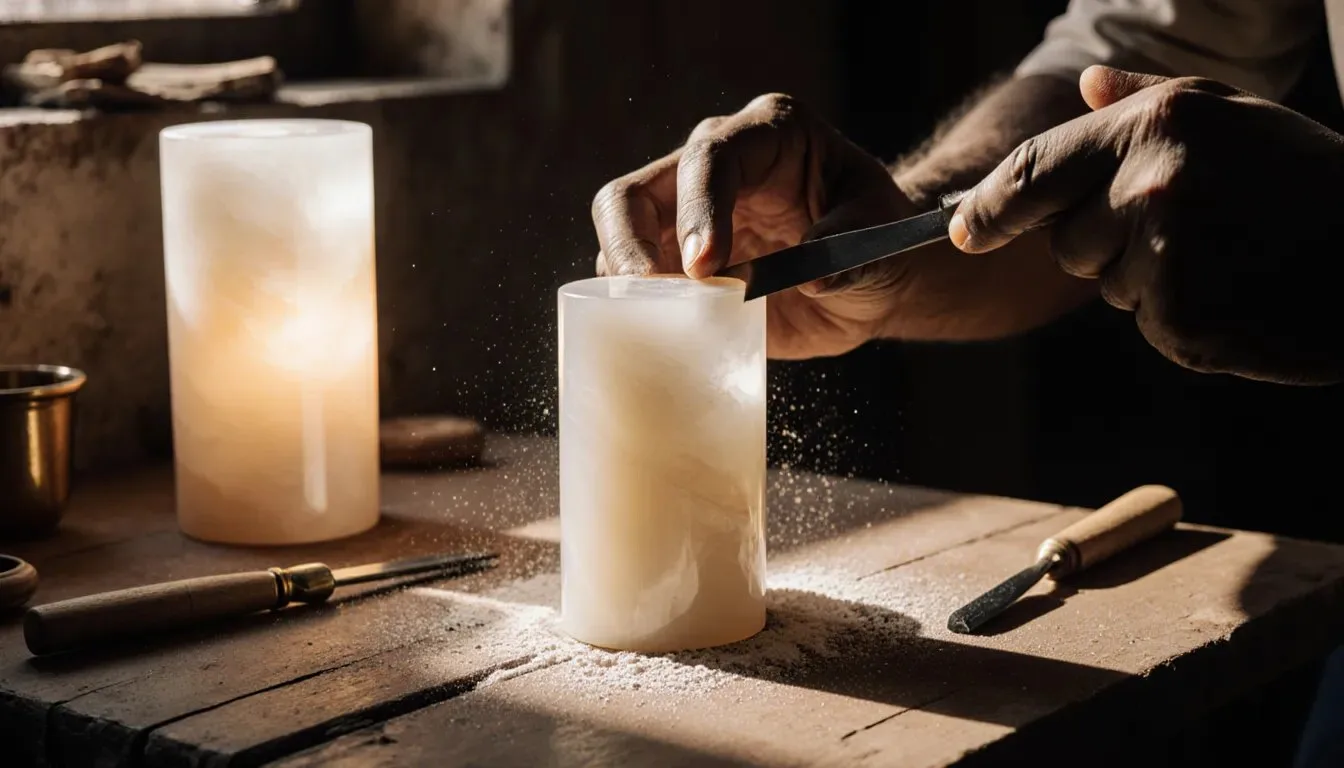
Now think of a light shaped by Indian artisans. A craftsman in Greater Noida held this stone first. He looked at its veins before he cut. You can call the same factory ten years later and ask for one part.
Below, you will see with real numbers who India’s craft workers are and how much work they do. You will also see how much of the light we buy still comes from abroad. Last, you will learn how to check who made the light in your hand.
The short answer
Indian artisans are the craft workers who shape stone, wood, cane, metal and glass by hand. India has an estimated 64.66 lakh handloom and handicraft artisans, and 64% of them are women. Buy from JagMag and you get a maker you can find. You also get spares for 10+ years and custom sizes in 15–20 days, not 60–120.
What is really going on: Indian artisans in numbers
The numbers tell two stories at once. Indian craft is growing. But most lamps India buys from abroad still come from one country.
- 64.66 lakh handloom and handicraft artisans work in India, says the government’s PIB explainer of December 2025.
- Over 32 lakh artisans had a Pehchan ID card by 2024. Pehchan is the government’s ID card for craft workers.
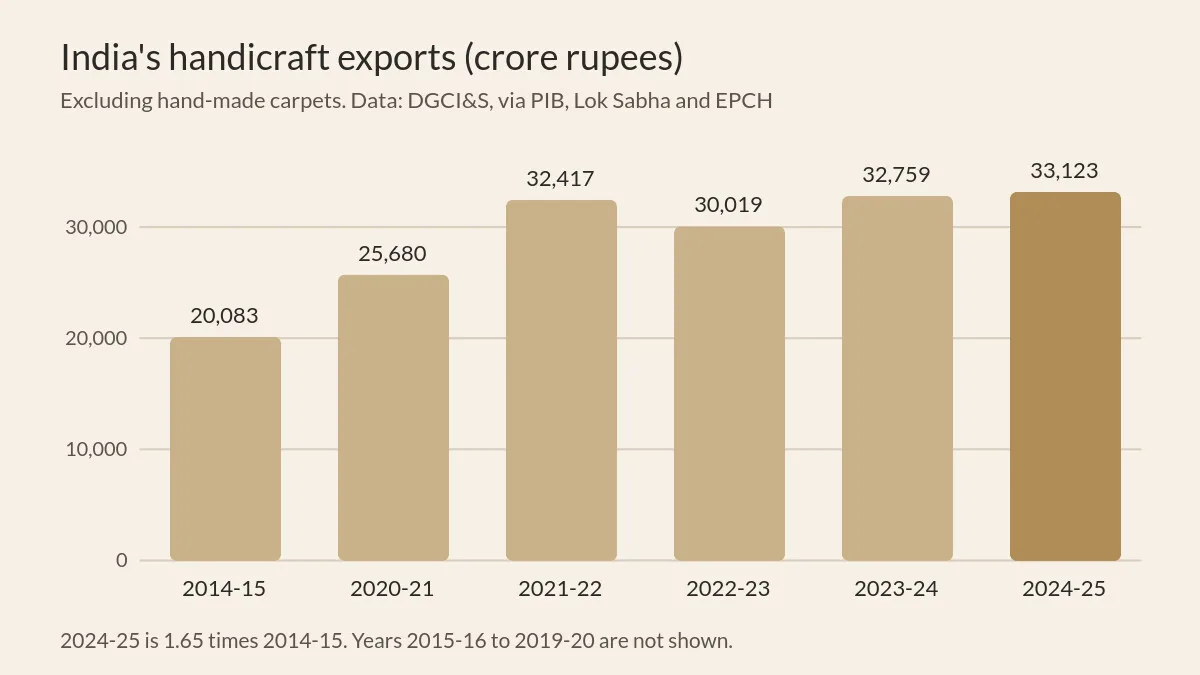
- ₹33,122.79 crore of Indian handicrafts were exported in 2024-25, up from ₹20,082.53 crore in 2014-15.
- US$195.40 million of electric lamps and light fittings came into India in 2024 under one trade line. US$149.92 million of that came from China.
- 139 of our 254 material-tagged lights use a natural material, by our own count on 22 October 2026.
Start with the good news. Indian craft exports grew from ₹20,082.53 crore to ₹33,122.79 crore in 10 years. Divide the new figure by the old one. The answer is 1.65. So buyers abroad now spend 1.65 times as much on Indian handmade work.
The growth is real in recent years too. Exports were ₹25,679.98 crore in 2020-21, according to a Lok Sabha answer from the Ministry of Textiles. By 2024-25, that grew by 29%.
Metal craft grew as well. Art metal ware is the craft family that includes lamps and metal decor. Its exports went from ₹3,344.01 crore in 2020-21 to ₹4,179.83 crore in 2021-22. Metal craft exports jumped 25% in one year.
Now the other side. The World Bank’s trade database shows India imported US$195.40 million of electric lamps and light fittings in 2024. China sent US$149.92 million of that. Divide 149.92 by 195.40 and you get 76.7%. So about 3 of every 4 import dollars on these lamps went to China.
The year before was even higher. In 2023, China’s share of the same trade line was 81%. Weight shows the scale too. China sent 4,537,780 kg of these lamps in 2024. Divide by 365 days. About 12,432 kg of Chinese lamps arrived every single day.
Each of those kilograms was shaped somewhere else. The factory work behind them was done abroad, not here.
How to check it yourself
You do not need a lab to find out who made a light. Use these five checks in a shop or on a website.
- Read the “Country of Origin” line on the box or the listing. If it does not say India, the light was made abroad.
- Look for the maker’s name and full address. A real address has a plot number, a city and a PIN code.
- Read the material line. “Alabaster”, “teak” or “cane” names a real material. “Metal” or “stone look” names nothing.
- Ask, “Can I buy one part in 10 years?” A maker who keeps spares will say yes. Ask a reseller the same question and note the answer.
- Ask how long a custom size takes. An Indian maker can quote about 15–20 days. An import order often takes 60–120 days.
We ran check 3 on our own catalogue on 22 October 2026. Of our 408 published products, 254 carry a material tag. 139 of those 254 use a natural material: 50 alabaster, 46 wood, 26 travertine, 12 rattan and 7 cane, among others. So 54.7% of our tagged lights are made from stone, wood or fibre.
Side by side
| What you care about | Light made by Indian artisans at JagMag | Imported mass-made light |
|---|---|---|
| Who made it | Our factory, Greater Noida, since 2015 | A factory abroad; often only a brand name on the box |
| Where the money goes | Indian craftsmen and Indian suppliers | Abroad; 76.7% of India’s 2024 lamp imports came from China |
| Material | Named: alabaster, wood, cane, 304 stainless steel | Check the label; it may only say “metal” |
| Custom size | 15–20 days | Ask first; import orders take 60–120 days |
| One broken part later | Spares for 10+ years | Ask first; often not stated |
| Rust on metal parts | Lifetime rust warranty on stainless steel | Depends on the seller |
Where the other side is better
Imports bring volume. India took in 5,942,280 kg of these lamps in 2024, so shops can show many designs on one shelf.
A shop can also hand you an in-stock light today. Our in-stock lights leave the factory in 4 working days, and custom pieces take 15–20 days. If you need a light tonight, the shop wins.
What we do at JagMag
JagMag Lights is a decorative lighting manufacturer in Greater Noida, Uttar Pradesh. We have made lights in our own factory since 2015. Eleven years means the same hands, the same benches and the same spare parts.
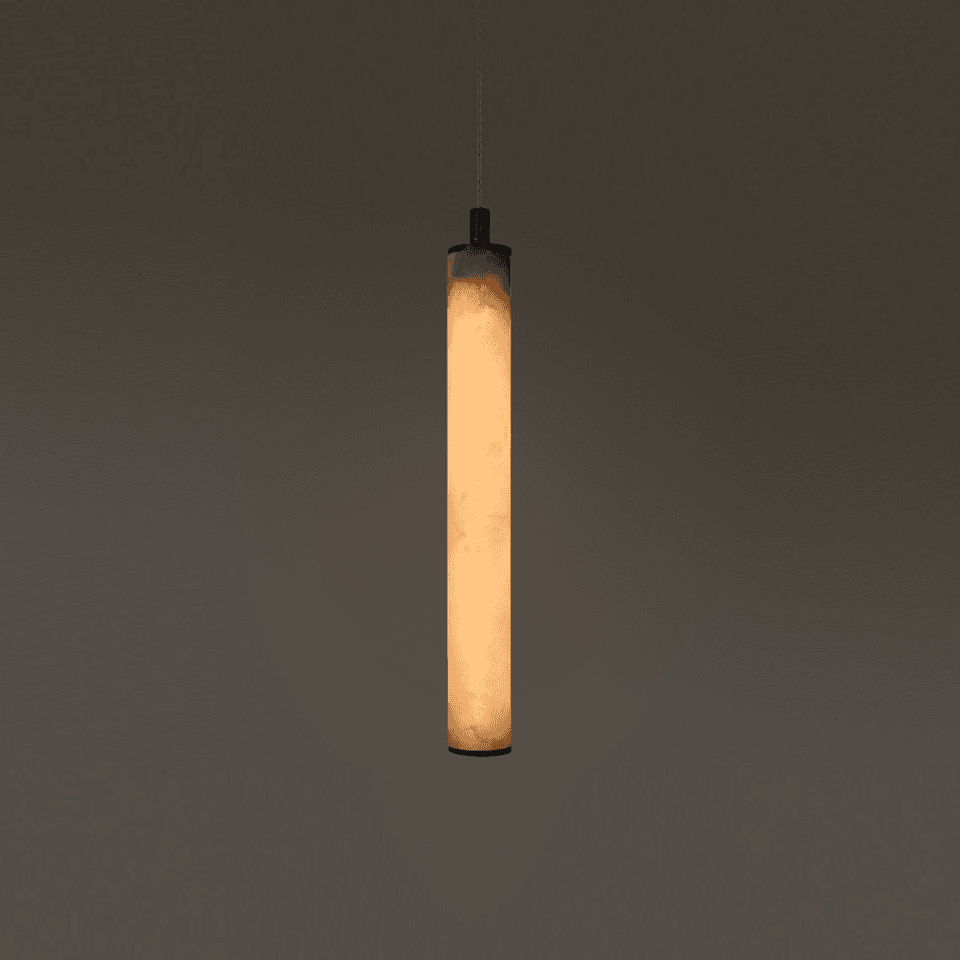
Take our alabaster pendant light. The pendant is a 400 mm cylinder of real alabaster, 50 mm across, and weighs 2 kg. Alabaster is soft stone formed beneath the earth. A craftsman reads the block before he cuts it. He smooths the wall thin enough for light to pass, and he leaves the veins where nature put them.
Switch it on and the stone glows warm from inside, with a 3000K warm-white LED. The cap and canopy are 304 stainless steel, the same grade as a good kitchen sink. They carry a lifetime warranty against rust under our Legal Policies, clause 4.1A.
Stone is only one of our materials. You can see more hand-shaped stone in our alabaster lighting. Woven fibre lives in our cane and rattan pendant lights. If a part ever breaks, we sell spare parts for chandeliers and lamps one piece at a time.
Natural stone and warm light are the kind of harmony Vastu has always valued. We do not promise luck. We promise a light whose maker you can call. You can check our CE, UL and ZED marks and our DPIIT recognition on our certifications page.
Want the bigger picture on imports? Read our guide to Chinese chandeliers vs made in India. To spot real handwork, see handmade lamps vs mass-made imports. For a quick shopping list, try our five vocal for local questions.
FAQs
How many Indian artisans are there?
India has an estimated 64.66 lakh handloom and handicraft artisans, according to a PIB explainer from December 2025. Women make up 64% of them.
Do Indian artisans make lights?
Yes. Craft workers in India shape stone, wood, cane, glass and metal into lamps and chandeliers. At JagMag, 139 of our 254 material-tagged lights use a natural material, by our count on 22 October 2026.
How much of India’s lamp imports come from China?
About 76.7% did in 2024, under one main trade line for lamps and fittings. China sent US$149.92 million of the US$195.40 million India imported, per World Bank trade data.
How can I tell if a light is made in India?
Read the “Country of Origin” line and the maker’s full address on the box or listing. Then ask if spares will exist in 10 years, and get the answer in writing.
Are handicraft exports from India growing?
Yes. Handicraft exports reached ₹33,122.79 crore in 2024-25, up from ₹20,082.53 crore in 2014-15. The new figure is 1.65 times the old one.
Nature gives the material. Human hands give it meaning. Vastu inspires harmony. Light brings it to life. That is JagMag.
See hand-shaped stone lights in our alabaster lighting range. Not sure which one fits your room? Video-call us and we will help you choose.
Sources
- PIB, “Handicrafts at the Heart of India’s Rural Economy”, 9 December 2025 (64.66 lakh artisans, 64% women, 32 lakh Pehchan IDs, exports 2014-15 and 2024-25). Read 22 October 2026.
- Lok Sabha Unstarred Question 1380, Ministry of Textiles, 14 December 2022 (page no longer online) (handicraft exports 2020-21; art metal ware 2020-21 and 2021-22). Read 22 October 2026.
- EPCH, handicraft export data (source: DGCI&S, Kolkata) (2024-25 exports). Read 22 October 2026.
- EPCH press release, 28 June 2023 (handicraft exports 2022-23: Rs. 30,019.24 crore). Read 26 October 2026.
- EPCH 38th Annual Report 2023-24 (handicraft exports 2023-24, used in the chart). Read 22 October 2026; the report has since been removed from the EPCH website.
- World Bank WITS, India imports of HS 940540 (electric lamps and lighting fittings, nes), 2024. Read 22 October 2026.
- World Bank WITS, India imports of HS 940540, 2023. Read 22 October 2026.