
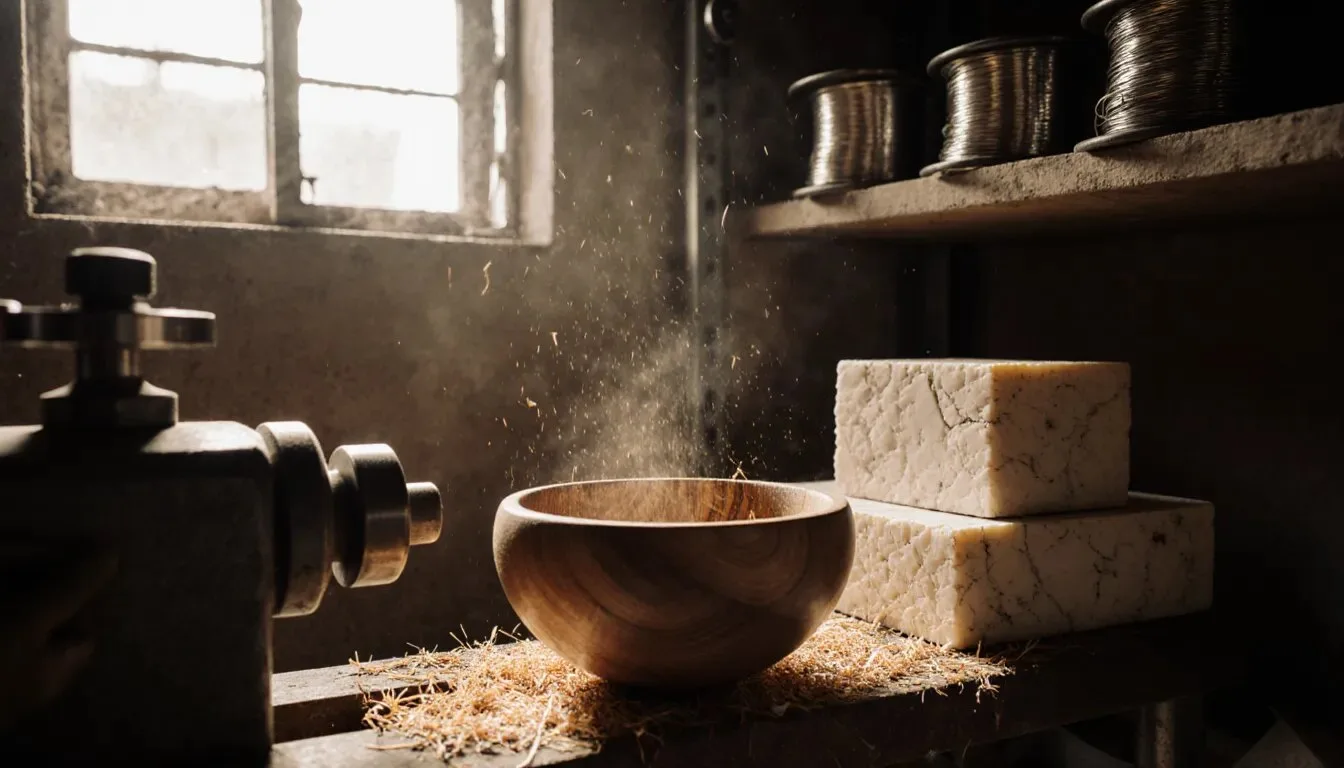
In the last post we shared how to clean light fixtures made from stone, wood, fibre and glass. We ended at the place where every one of those lights begins: our lighting factory in Greater Noida.
Today we walk you through that factory. We follow one light from start to finish: our teak wood wall light. Its path shows how a raw material becomes a light under one roof.
We chose this light because it brings four parts together: teak, steel, glass and wire. Each part meets a different pair of hands on the way.
Every light starts as raw material on our floor
Our factory floor holds the raw materials of our lights. Blocks of stone. Pieces of solid wood. Bundles of cane and rope. Sheets, tubes and rods of 304 stainless steel.
The teak wall light starts as a block of solid teak. Teak is a hardwood that grows slowly over many years. The wood is dense and strong, so a bowl turned from it lasts.
A craftsman picks up the block and reads the grain before the first cut. The grain decides how the bowl will look, so he looks first and works second. We wrote about this first look in our post on handmade lights.
Then he takes the block to the lathe.
The teak takes its shape on the lathe
A lathe is a machine that spins the wood fast. The craftsman holds a sharp tool against the spinning block and cuts it slowly into shape.
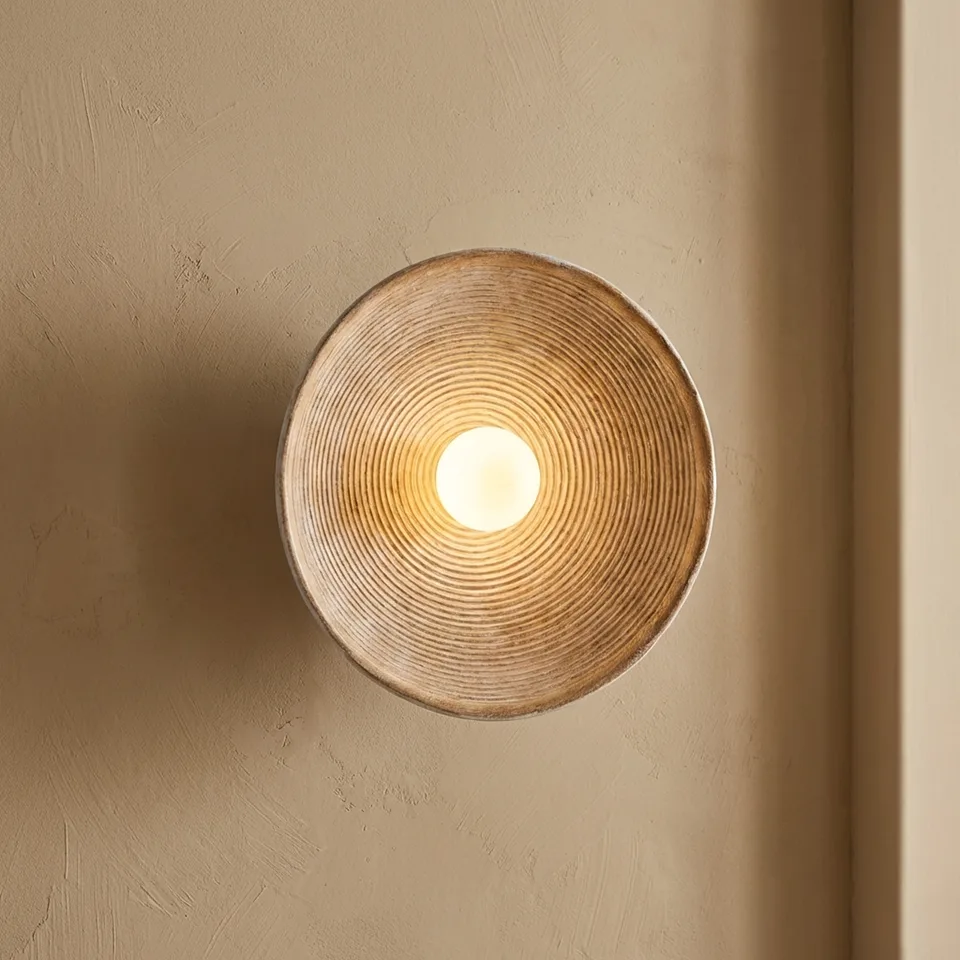
The machine only spins. The craftsman’s hands decide every curve. He turns the teak one ring at a time, until fine rings run from the rim to the centre. The finished bowl is 27 cm across and stands 11 cm off the wall.
Next comes the finish. We give the teak a soft, washed tone. The outside looks pale, and the inside stays warm and honey-coloured.
Because the bowl is real teak, no two bowls match. The grain and the tone shift a little from piece to piece. We see that as the mark of the wood, not a defect.
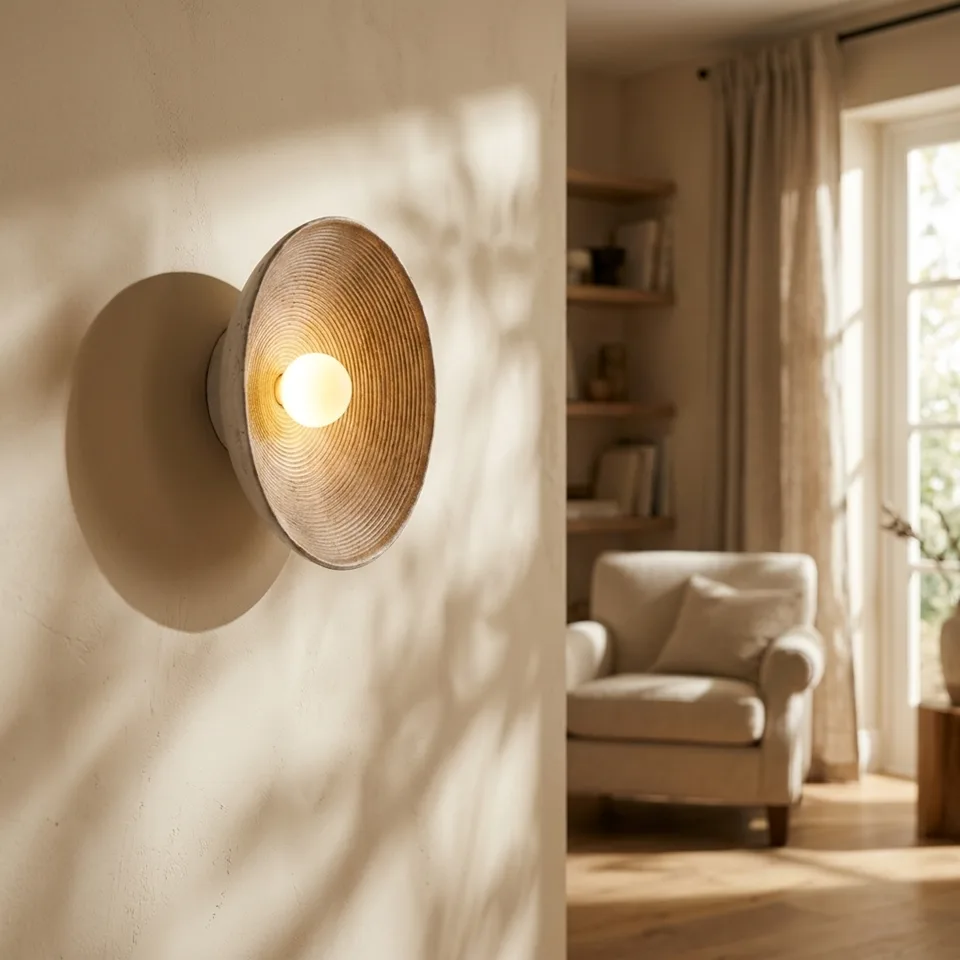
A wooden bowl is still not a light. Three more materials have to join it.
Steel, glass and wire join the wood
The first material is steel. Our craftsmen cut the wall bracket and fixings from 304 stainless steel, then finish them. The bracket sits behind the bowl and carries its weight on your wall. You will never see it, but it has to hold the bowl straight for years.
The second material is glass. An opal borosilicate glass ball sits at the heart of the bowl. Opal glass is clear glass with white colour added, so the ball softens the bulb into a glow.
The third is the wiring. Our team fits a G9 bulb holder inside the bowl, runs the wire and joins every part to the bracket. A G9 holder takes a small bulb with two pins.
Wood, steel, glass and wire all come together in the same building. The people who shape, finish and wire the light work under one roof.
Our own years of work taught us why that matters. Quality has to be built into each step, not added at the end. With every step under our roof, we see each piece at every stage.
A final look before the box
Before the light leaves our factory, we check its finish up close. We look at the rings, the glass and the bracket. Only then does the light go into its box.
We pack each light to travel across India, to homes far from Greater Noida. A light turned with care has to arrive with the same care.
On your wall, the light starts its real life. Switch it on, and the whole bowl glows amber. The turned rings catch the light and turn gold around the glass ball.
The teak wall light passes through many hands on its way to you. One person turns the wood. Another finishes the steel. Another wires and checks the light. Behind one wall light are hours of patient human effort.
We have worked this way since 2015. Our factory grew from a small rented space, as we shared in our journey. The rule stayed the same: we make every light ourselves.
FAQs
Where is the JagMag lighting factory?
Our lighting factory is in Greater Noida, India. We have made our lights there, in our own factory, since 2015.
Does JagMag make its own lights or import them?
We make every JagMag light ourselves. Nothing we sell is imported or bought from another maker.
What is a lathe?
A lathe is a machine that spins a block of wood or stone. The craftsman holds a sharp tool against it and shapes the piece by hand.
Nature gives the material.
Human hands give it meaning.
Vastu inspires harmony.
Light brings it to life.
That is JagMag.
With you.
Read next: Craftsmanship: why things made with care feel different
See turned teak up close: explore the teak wood wall light →