

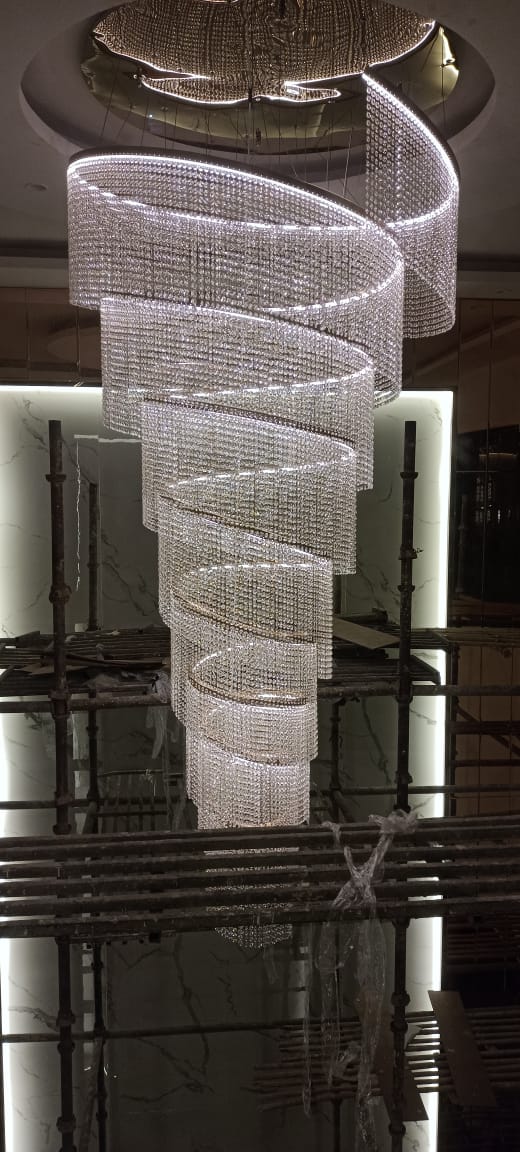
It is the same chandelier at 7 in the evening and at 7 in the morning, and yet it feels like two different rooms. In the morning it is just a fixture on the ceiling. But when the sun drops and you reach for the switch, something either happens or it doesn’t. The room either softens into gold and pulls everyone toward the sofa, or it flattens into a cold, slightly clinical white that makes the tea look grey. The chandelier didn’t change. The bulbs did.
This is the part most people skip when they buy a beautiful light. They fall in love with the crystal, the brass, the curve of the arms, and then they screw in whatever bulbs the local shop hands over. A few weeks later the room feels off and nobody can say why. The truth is that the bulb is the actual light. The chandelier is only the jewellery around it.
Why the glow matters more than the fixture
Think about the rooms you remember loving. A friend’s living room where the evening just felt warm. A restaurant where everyone looked a little more beautiful than usual. A hotel lobby that made you slow down the moment you walked in. None of that was the shape of the chandelier. It was the colour and softness of the light pouring out of it.
Warm light does something quietly generous. It makes skin look healthy, wood look richer, and a long day feel like it is finally ending. Cool, bluish light does the opposite. It is honest and alert, the kind of light you want over a kitchen counter when you are chopping onions, and exactly the kind you do not want over the dining table when family has come over. So before any talk of watts and bases, decide what you want the room to feel like at night. Everything else follows from that.
Choosing the best bulbs for a chandelier: warmth first
If you remember only one thing, remember this: for a chandelier in a living room, bedroom, dining room or entryway, choose warm white. On the box it will be written as a number with a K after it, and the magic range is roughly 2700K to 3000K. You don’t need to memorise it. Just picture sunset light versus daylight. 2700K is candle-and-sunset, the cosy golden glow people describe as “homely.” 3000K is a touch crisper and cleaner while still feeling warm, which suits more modern rooms with greys and whites. Both are lovely. Anything labelled “cool white” or “daylight” belongs in your study or kitchen, not over your sofa.
The second thing that separates a rich glow from a flat one is something called colour rendering, often printed as CRI. A high number here (look for 90 or above) simply means colours look true under the light, so your red cushions stay red and a wooden floor glows instead of going muddy. Cheap bulbs cut this corner, and it is the hidden reason a room can feel “cheap” even under an expensive chandelier.
Brightness is the easy part. Most decorative chandelier bulbs give a gentle 400 to 600 lumens each, and a chandelier with several of them adds up to a warm wash rather than a spotlight. If you want the room to go from “dinner party” to “late-night film” without changing a thing, buy dimmable bulbs and a good dimmer. A chandelier you can dim is a chandelier you will actually enjoy every night, not just when guests arrive. (If you want to go further than a dimmer, our guide to smart bulbs in a chandelier walks through scenes and app control.)
Replaceable bulbs or built-in LED? The one real decision
Here is the choice that genuinely shapes which chandelier you should buy. Some chandeliers take ordinary replaceable bulbs that screw or clip into little holders, the small ones usually being an E14 base and the larger ones an E27. Others come with the LEDs built right into the fixture, sealed in, designed to be part of the form itself.
Neither is “better.” They are good at different things, and knowing which you want saves you a lot of quiet regret later.
A chandelier with replaceable bulbs is the friendly, forgiving choice. When one goes, you walk to a shop or order online and pop in a new one. You can change the entire mood of the room years later just by swapping warmer or dimmer bulbs. And if the bulbs are on display, the bulb itself becomes part of the beauty, which is exactly why a candle-flame or vintage filament bulb in an open fixture looks so romantic. Something like our Milk Glass Chandelier in antique brass or the handcrafted Wood and Brass Arlo is made to be dressed with warm filament bulbs you choose yourself, so the glow is genuinely yours.
A chandelier with integrated LED is the sleek, modern choice. Because the light source is engineered into the body, designers can make shapes that simply aren’t possible with bulb holders: thin floating lines, sculptural rings, cascades of light with no clunky bulbs interrupting them. Our Linear LED Chandelier in chrome and the Gold Fluted Sputnik LED centrepiece both lean into this; the light is even, whisper-quiet, and the fixture stays slim and architectural. The trade-off is that you are committing to that light for the long run, so it is worth buying from a maker who builds the LED to last and can service it. The good news is modern LEDs run for many years of normal evenings before you ever have to think about them.
The simple way to decide: if you love the idea of tinkering, swapping, and seeing the bulb as part of the decor, go replaceable. If you want a clean, sculptural look and a “fit it and forget it” life, go integrated LED.
The little mistakes that take the magic away
Most disappointing chandelier lighting comes down to three small, avoidable things. The first is mixing bulbs. When you buy a fresh pack, put the whole matched set in together; a chandelier with two slightly different whites glowing side by side will quietly bother you forever, even if you can’t name it. The second is buying non-dimmable bulbs and then wiring them to a dimmer. They flicker, they buzz, and they die early. If there is a dimmer on the wall, every bulb must say “dimmable” on the box, and ideally your dimmer should be the LED-friendly “trailing edge” type.
The third mistake is chasing brightness. People panic that a warm bulb will be too dim, buy the brightest cool-white they can find, and end up with a room that feels like a clinic. Trust the warm, gentle glow. A chandelier is meant to flatter a room, not floodlight it. If you want to get the brightness exactly right for your room size, our piece on chandelier brightness and light spread gives you a simple way to plan it.
So which should you actually buy?
If you are putting a chandelier over a dining table or in a living room and you want it to feel warm and welcoming, buy dimmable warm-white LED bulbs at 2700K with a high colour rendering, in a fixture that takes replaceable E14 or E27 bulbs. That single combination is what makes a room feel like the lovely rooms you remember, and it leaves you free to adjust the mood for years.
If your home is modern and minimal and you want a fixture that looks like sculpture, choose a quality integrated-LED chandelier instead and let the form do the talking. Either way, the secret was never the most expensive crystal. It was warm light, dimmable, true to colour, and quietly consistent across every arm. Get that right and the chandelier will earn its place every single evening. And once it is glowing the way you want, a little care keeps it that way; here is how to make chandelier bulbs last longer.
Frequently asked questions
What are the best bulbs for a chandelier in a living room?
Warm white LED bulbs around 2700K to 3000K, dimmable, with a high colour rendering index of 90 or more. They give that cosy golden glow, save a lot of electricity, last for years, and let you soften the room with a dimmer when the evening winds down.
Which bulb base do most chandeliers use?
The small decorative ones usually take an E14 (a slim screw base), and larger fixtures often use the bigger E27 screw base. Check what your chandelier is fitted with before you buy bulbs, and if you are choosing a new fixture, replaceable E14 or E27 holders make life easy down the road.
Are LED bulbs good for chandeliers?
Yes, and for most homes they are the best choice. Warm-white LEDs give the same golden feeling as old incandescent bulbs while using a fraction of the power and lasting far longer, so you are not climbing up to change bulbs often. Just be sure they are dimmable if you have a dimmer.
Why do my chandelier bulbs flicker or buzz?
Usually because non-dimmable bulbs are on a dimmer switch, or because mismatched and older bulbs are sharing one fixture. Switch to dimmable LED bulbs, use one matched set across the whole chandelier, and pair them with an LED-friendly dimmer; the flicker and hum almost always disappear.
Should I choose a chandelier with replaceable bulbs or built-in LED?
Choose replaceable bulbs if you like the freedom to swap, refresh the mood, and show off pretty filament bulbs. Choose integrated LED if you want a slim, sculptural, modern look and a fit-and-forget fixture. Both are excellent when made well, so let the style you love guide you.