
You find a lamp online. The page says “handmade”. The photo looks warm and real. You order two, one for each side of the bed.
The box arrives. You put the two lamps side by side. They match perfectly. Every curve is the same. Every mark is the same.
Then a small question comes up. Whose hands made these? Or did a machine make a hundred of them?
Below, you will see what “handmade lamps” really means and how to check a lamp yourself. You will also see where a mass-made lamp is the better buy.
The short answer
A handmade lamp is shaped mostly by a person, so two lamps of one design never match exactly. A mass-made lamp comes out of a mould or a machine run, many pieces at a time. The quickest test is simple: put two of the same lamp side by side and look for small differences.
What “handmade” really means
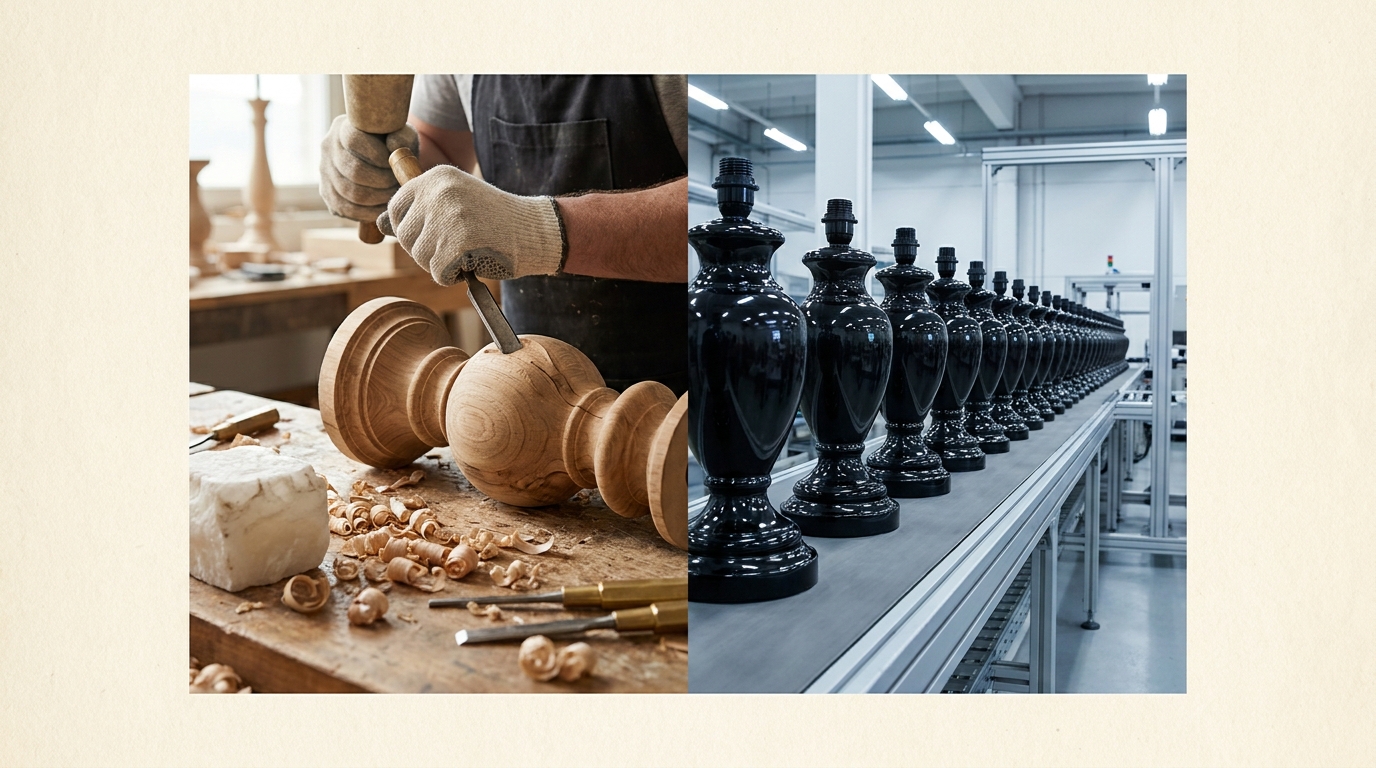
Handmade does not mean “no tools”. India’s office for handicrafts says a handicraft is made mostly by hand, even if some tools or machines were used. A chisel is a tool. A lathe is a tool too. A lathe is a machine that spins a block of wood while the craftsman holds the cutting blade.
So the real question is simple. Who does most of the shaping: a person, or a mould? A mould is a hollow shape. A factory pours liquid material into the mould, and every piece comes out the same.
Most lamps that India buys from abroad come from China. In 2023, close to 80 percent of the lamps and light fittings India imported, by value, came from China. Many of those lamps are well made. They are simply made in big numbers.
One export lamp factory near Shenzhen, for example, lists a minimum order of 50 pieces for each design. Fifty lamps of one design are meant to match. Matching is the whole point of a mould.
A handmade lamp works the other way. The craftsman looks at the wood or the stone first. The grain runs one way in one block and another way in the next. So each base comes out a little different, and the material shows its own face.
How to check handmade lamps yourself
You do not need to be an expert. These five checks work in a shop and on a phone.
- Ask to see two of the same lamp side by side, because handmade pieces differ a little in grain, veins or curves.
- Feel down the side for a thin raised line, which a mould leaves where its two halves meet.
- Read the material line on the page, and trust “solid wood” or “natural travertine” more than “wood look” or “stone finish”.
- Read the “Country of Origin” line, which Indian rules require on online listings, and then ask who made the lamp.
- Ask for a spare shade or base in writing, because the maker of a lamp can make the part again.
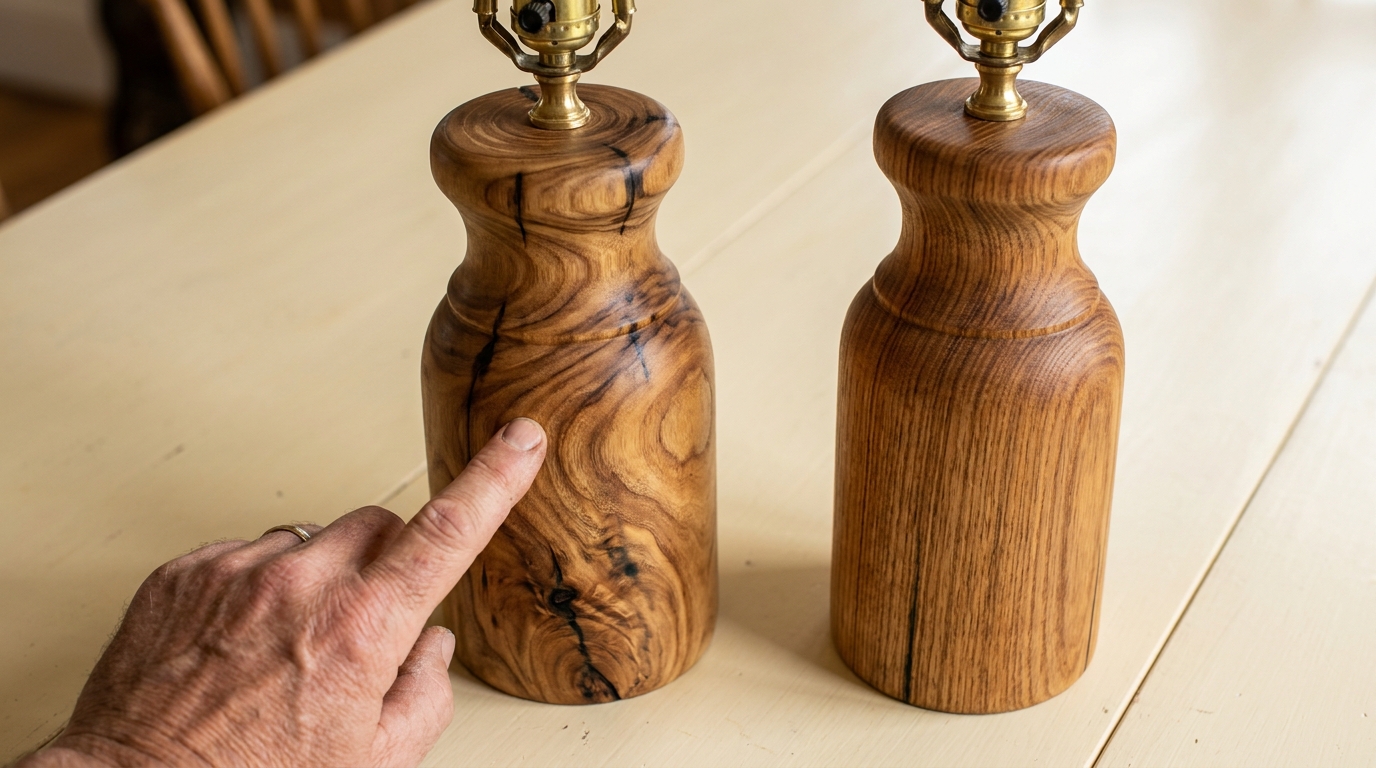
If a seller cannot answer the last two checks, you have your answer. A seller who did not make the lamp can only check the stock in the store.
Side by side
| What you care about | JagMag handmade lamp | Mass-made imported lamp |
|---|---|---|
| Who shapes it | A craftsman in our Greater Noida factory | A mould or a machine run |
| Two of the same design | Close, never identical | Identical |
| Made where | India | Mostly China, for imports |
| A spare part years later | Kept for 10+ years | Only if the seller still has stock |
| Ready to ship | Within 4 working days, in stock | Same day, if the shop has it |
Where mass-made lamps are better
Mass-made lamps win on sameness. If you need twenty identical lamps for a hotel corridor, a mould gives you exactly that.
Mass-made lamps also come in a huge range of designs, and a shop can hand one over the same day. We say this plainly, because you should buy the right lamp for the job.
What we do at JagMag
JagMag Lights is a decorative lighting maker in Greater Noida, Uttar Pradesh. We have made lights in our own factory since 2015. Our lamps start with a real material and a pair of hands.
Our sculptural table lamp stands on a hand-carved solid wood base. Our travertine table lamp has a base of natural stone, polished by hand. Our alabaster mushroom lamp is carved from translucent natural stone, so the veins glow when you switch it on.

A craftsman reads the material before he cuts. He checks where the grain runs, where a knot sits, and which part to leave alone. Nature gives the material, and human hands give it meaning.
Every one of these product pages says the lamp is made in India, with spare parts kept for 10+ years.
Where a JagMag light has metal parts, the metal is 304 stainless steel, the same grade as a good kitchen sink. Those stainless steel parts carry a lifetime warranty against rust on orders from 4 October 2026, as our legal policies set out in section 4.1A.
Natural wood and stone under warm light bring the kind of harmony Vastu thinking has always valued. We do not promise luck. We promise a lamp that someone shaped with care.
FAQs
What are handmade lamps?
Handmade lamps are lamps shaped mostly by a person, not by a mould. India’s handicraft definition allows some tools or machines, as long as the main work is done by hand. So two handmade lamps of one design never match exactly.
Are handmade lamps better than machine-made lamps?
Handmade lamps are better for character, real materials and repairs from the maker. Machine-made lamps are better when you need many pieces that match exactly. Pick by the job the lamp has to do.
How can I tell if a lamp is really handmade?
Put two pieces of the same design side by side and look for small differences. Then check for a mould seam, read the material and Country of Origin lines, and ask who made the lamp.
Does handmade mean no machines at all?
No, handmade does not mean no machines. A craftsman may use a lathe, a chisel or a polisher. The lamp still counts as handmade when a person does most of the shaping.
Are JagMag lamps made in India?
Yes, JagMag lamps are made in our own factory in Greater Noida, Uttar Pradesh. Our product pages say “Made in India”, and we keep spare parts for 10+ years.
Nature gives the material. Human hands give it meaning. Light brings it to life. That is JagMag.
Browse our handmade lamps in wood and rattan, or see our alabaster lighting. Want to know how to spot a real stone? Read our guide to real vs faux alabaster, or real rattan vs plastic rattan. Not sure? Video-call us.
Sources
- Office of the Development Commissioner (Handicrafts) – definition of handicrafts
- EPCH – definition of handicrafts and the Supreme Court test
- TrendEconomy (UN Comtrade) – India imports of lamps and lighting fittings, HS 9405, 2023
- HKTDC Lighting Fair – export lamp maker listing (MOQ 50 pieces, 15-day production)
- Wikipedia – parting line on moulded products
- The Week – e-commerce rules require country of origin on listings (2020)