
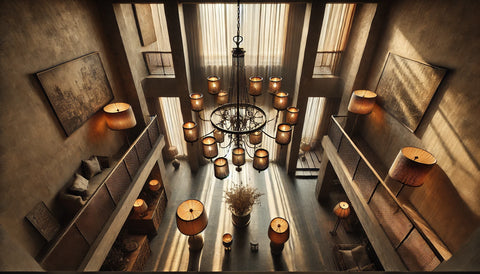
There’s a moment that happens in a room with a crystal chandelier. Someone walks in for the first time, and before they say a word, they look up. The light has caught the crystal and scattered it across the ceiling in soft little flecks, and the whole room suddenly feels like it was waiting for them. That is the quiet magic a crystal chandelier brings — not just brightness, but a sense of occasion, every single evening.
And yet crystal is the fixture people second-guess the most. Is it too much? Will it date? Is it a nightmare to clean? Those worries are fair, and this guide answers all of them — gently, the way a designer would over a cup of chai — so you can choose the one that makes your home glow and never look back.
Why a crystal chandelier still feels like nothing else
Plain metal and glass fixtures light a room. Crystal performs in it. Each faceted drop bends and bounces light, so even when everything is still, the ceiling shimmers with movement. It’s the reason crystal has hung in palaces, hotel lobbies and grand Indian homes for centuries — from the Mughal courts that first imported it, right through to the living room you’re imagining now. It reads as warmth and welcome, not just wealth.
The beautiful part is that crystal is no longer reserved for ballrooms. A small raindrop flush-mount over a dining table, a single sparkling pendant in an entryway — the magic scales down to real homes just as easily as it scales up.
The little mistakes that make crystal feel wrong
Most people fall in love with a chandelier in a showroom and meet the surprises later. The usual ones are easy to avoid once you know them.
The first is going too small. A crystal piece that looks generous in a shop can shrink to a sad little sparkle once it’s up against your ceiling and furniture. The second is the opposite — a giant fixture crammed into a room with no breathing space, so it overwhelms instead of enchants. The third, and the one that quietly ruins the whole effect, is harsh, bluish “cool white” light. Crystal was made to glow like candlelight; a cold bulb makes it look like cut glass in a hardware store. Warm light is what gives crystal that honeyed, romantic shimmer.
None of these are hard to get right. They just need a little thought before you click buy.
Getting the size right (the easy version)
Here’s the only maths you need. Add your room’s length and width in feet, and that number in inches is a flattering chandelier diameter. A 12 by 14 ft living room? Around a 26-inch fixture feels just right. Over a dining table, go narrower — about half to two-thirds the width of the table — and hang it so the bottom sits roughly 30 to 36 inches above the surface, close enough to feel intimate, high enough to see across.
For a tall foyer or a stairwell, think in drops rather than width: a cascading crystal column that pours down through the open height turns a plain entrance into a moment. If you’d like the full room-by-room breakdown, our chandelier size guide walks through every space.
Not all crystal is equal — what actually matters
This is the one place a little knowledge saves you money and disappointment, so here it is in plain language. Most quality chandeliers today use K9 crystal — a beautifully clear optical crystal that catches light brilliantly and costs far less than the old leaded glass. Step up from there and you reach Asfour (the famous Egyptian crystal, denser and even sparklier) and finally Swarovski at the top. For almost every home, well-cut K9 gives you that gasp-worthy sparkle without the heirloom price tag.
What to look at when you compare: clarity (the glass should look like spring water, never cloudy or greyish), the cut (more facets mean more fire), and how densely the drops are packed. If you want to go deeper on the materials, our honest crystal vs glass comparison lays out exactly where each one shines.
The styles we love — and who they’re for
Crystal isn’t one look anymore, and that’s the joy of it. A few of our favourites for real homes:
If you want the timeless one — the chandelier that will still look right in fifteen years — a raindrop design is hard to beat. Our K9 Crystal Raindrop Chandelier is the piece we recommend most often: clear, generous tiers of crystal that flatter a dining room or living room without shouting, available as a flush mount for normal ceilings. It’s the safe, beautiful default for a reason.
For a double-height foyer or a staircase that deserves drama, the Spiral Raindrop Chandelier falls like a ribbon of light through the open space. Guests look up the second they walk in — which is exactly the point of an entrance.
And if your home leans warm and romantic rather than cool and modern, the Amber Crystal Chandelier in gold glows like late-afternoon sunlight even when it’s switched off. It’s the one that makes a room feel like a hug. For something softer and more organic, the Wisteria Crystal Branch Chandelier trails crystal along a slim linear bar — lovely over a long dining table.
But will it be a pain to clean?
This is the worry that stops people, so let’s settle it. A crystal chandelier needs proper cleaning roughly once a year — sometimes only once every two — with a light dust in between using a soft feather duster. You don’t have to take it down. A simple spray-and-drip method (a little distilled water and alcohol, a sheet to catch the drips) brings the sparkle back in well under an hour. That’s genuinely it. Our step-by-step on how to clean a crystal chandelier makes it foolproof.
The honest truth: a crystal chandelier asks for less upkeep than a houseplant, and gives back a great deal more.
So which crystal chandelier should you buy?
If you want one confident answer: for most living and dining rooms, choose a K9 raindrop chandelier sized by the add-the-room formula, fitted with warm-white LED bulbs (around 2700K — think soft sunset, not office). It’s timeless, it’s easy to live with, and it delivers that ceiling-full-of-sparkle moment from day one. Going taller or grander? Reach for a spiral cascade for the foyer or an amber piece for warmth. You really can’t pick a wrong one once the size and the light are right.
For more on getting the glow right, our guide to crystal versus glass pairs nicely with this one.
Frequently asked questions
Are crystal chandeliers out of date?
Not at all — they’re one of the few fixtures that never really goes out of style. Classic ornate designs stay elegant, while modern raindrop and linear crystal pieces sit beautifully in minimalist and contemporary homes. Crystal is timeless precisely because it does something no trend can copy: it plays with light.
What does a good crystal chandelier cost in India?
It depends mostly on size and crystal type. K9 crystal gives you stunning sparkle at a very reasonable price, which is why it’s the most popular choice; Asfour and Swarovski cost more for extra brilliance. A compact flush-mount is an easy first chandelier, while large foyer cascades are the bigger investment. Browse the crystal chandelier collection to see options across budgets.
How do I clean a crystal chandelier without taking it down?
Lay a sheet underneath to catch drips, lightly mist the crystals with a distilled-water-and-alcohol solution (or a dedicated chandelier spray), and let them drip-dry. Dust gently with a soft cloth or feather duster between deep cleans. Once or twice a year is plenty.
What bulbs make crystal sparkle most?
Warm-white LED bulbs around 2700K. They mimic candlelight and bring out crystal’s honeyed, romantic glow. Cool or daylight bulbs flatten the effect and make crystal look cold — the single most common mistake people make.
Which crystal chandelier is best for a living room?
A K9 raindrop chandelier sized to your room (add the length and width in feet for a diameter in inches) is the most reliable choice — generous sparkle, easy maintenance, and a look that flatters almost any décor.