
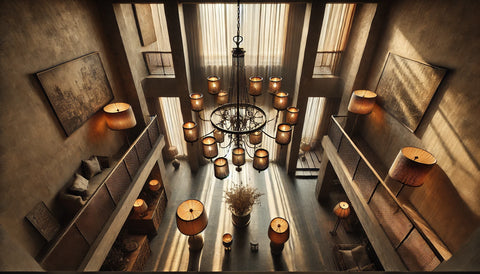
There’s a particular kind of quiet disappointment that comes when a chandelier finally arrives, you hang it up, step back… and the room just doesn’t sing. The fixture is lovely. The room is lovely. But together they feel slightly off, like a jacket a size too small or a rug that stops just short of the sofa. Nine times out of ten, the design wasn’t the problem at all. The scale was.
Getting the proportions right is the difference between a jhumar that looks like it was made for your home and one that looks like it wandered in from somewhere else. The good news: it isn’t guesswork, and you don’t need a designer’s eye to nail it. A little simple maths and a few honest questions about your room will get you there. Here’s the friendly version of a chandelier size guide — the one we wish every customer had before they fell in love with the first sparkly thing they saw.
The little sizing mistakes almost everyone makes
Most people pick a chandelier the way they pick a dessert — with their eyes, in the moment. Then they live with the surprises. The most common one is going too small: a dainty fixture floating in a big room looks lonely, like a single earring. The opposite happens too, especially in India where a grand jhumar feels celebratory — a piece so large it crowds the ceiling and you find yourself ducking on the way to the sofa.
Then there’s hanging height. A chandelier hung too high disappears into the ceiling and loses all its drama. Hung too low over a walkway, it becomes something you flinch around. None of this is about expensive taste. It’s just about matching the fixture to the room’s actual bones — its size, its ceiling, and how people move through it.
The one formula that does most of the work
If you remember nothing else, remember this. Measure your room’s length and width in feet, add the two numbers together, and that total in inches is roughly the diameter your chandelier should be. A 12 ft by 14 ft living room? 12 + 14 = 26, so a fixture around 26 inches wide will feel beautifully in proportion. Simple as that.
For the fixture’s own height, a gentle rule helps: allow about 2.5 to 3 inches of chandelier height for every foot of ceiling. With a standard 10 ft ceiling, something in the 25–30 inch tall range looks confident without dominating. Taller ceiling, taller fixture — tall rooms can carry far more presence than people expect, so don’t be shy.
And the hanging height most people get wrong? In an open living room or hallway, leave at least 7 to 7.5 feet of clear space from the floor to the bottom of the fixture, so it reads as a centrepiece rather than an obstacle. Over a dining table the rules change, which brings us to the rooms themselves.
Room by room: finding the size that feels right
The dining room is where sizing gets delightfully specific, because here the table sets the rule, not the room. Aim for a fixture roughly half to two-thirds the width of your table — or simply about 12 inches narrower than the tabletop, so it never overhangs the edges. Then hang it so the bottom sits 30 to 36 inches above the table (add a few inches for every foot of ceiling above 8 ft). That’s the sweet spot where light pools warmly over dinner without anyone staring into a bulb. A long rectangular table loves a long fixture: our Linear LED Chandelier in chrome stretches a soft band of light right down the centre of the table, which is exactly what a six-seater wants. If you’d like to go deeper on this one room, our dining room chandelier guide walks through it step by step.
The living room or hall is your stage for a statement. Use the length-plus-width formula, then let yourself lean a touch larger if the room is the heart of the home — a generous jhumar here signals warmth and welcome. The Modern Jhumar for Hall, with its cascade of white glass leaves, was made for exactly this moment: big enough to hold the room together, soft enough to never feel heavy. For a glossier, more modern hall, the Gold Fluted Glass Sputnik throws light in every direction like a small sun. (Our full living room chandelier guide has more on layering it with the rest of your lighting.)
The bedroom wants gentleness over grandeur. Size down a little from what the formula suggests, and choose a fixture whose light feels like a held breath at the end of the day. The Shadalia fabric-shade chandelier diffuses everything into a soft, sleepy glow — lovely above the foot of the bed where it won’t shine in your eyes as you read.
Low ceilings (under about 9 feet) are not a no — they just call for a semi-flush design that hugs the ceiling instead of dropping down. The Black Glass 6-Light Smoke Globe gives you all the romance of a chandelier with none of the head-clearance worry, which is why it’s a favourite for bedrooms, compact dining rooms and entryways alike.
Tall foyers and stairwells are the opposite problem, and the most exciting. A double-height entrance can swallow a normal fixture whole. Here you want height and drama — something seen beautifully from the door, halfway up the stairs, and from the landing above. A draped, vertical piece like the Pearl Necklace Chandelier fills that tall volume gracefully, and its bottom should still clear 7.5 feet above the floor. If your space is truly grand — a banquet hall, a hotel lobby — our guide to large-space chandeliers covers sizing for those soaring ceilings.
So which size should you actually buy?
If you want one confident takeaway: run the length-plus-width formula for the width, allow 2.5–3 inches of fixture height per foot of ceiling, and keep the bottom around 7.5 feet off the floor (or 30–36 inches above a dining table). When you’re genuinely torn between two sizes, choose the larger one. An under-scaled chandelier almost always looks like a mistake; a slightly generous one reads as intentional and a little luxurious. Rooms can carry far more light and presence than we instinctively give them credit for.
Measure twice, picture the room with the fixture glowing in it of an evening, and trust the numbers a little. Get the scale right and even a simple chandelier will look like it was always meant to hang exactly there.
Frequently asked questions
What size chandelier do I need for my room?
Add your room’s length and width in feet, then read that number as inches — that’s a great target diameter. A 13 ft by 15 ft room suits a chandelier around 28 inches wide. For the fixture’s height, allow roughly 2.5 to 3 inches per foot of ceiling.
How big should a dining room chandelier be?
Size it to the table, not the room. Pick a fixture about half to two-thirds the width of your dining table, or roughly 12 inches narrower than the tabletop so it never overhangs the edges.
How high should a chandelier hang?
In an open room or hallway, keep at least 7 to 7.5 feet of clearance from the floor to the bottom of the fixture. Over a dining table, hang it 30 to 36 inches above the tabletop, adding a few inches for every foot of ceiling above 8 feet.
What size jhumar suits a tall or double-height space?
Go taller and bolder than you think. A double-height foyer or stairwell needs a vertical, cascading fixture that fills the height and looks intentional from every level — while still clearing about 7.5 feet above the floor at its lowest point.
Is it better to size up or size down if I’m unsure?
Size up. A chandelier that’s slightly too large reads as confident and premium, while one that’s too small tends to look lost and leaves the room feeling unfinished.