
You walk through a light market. A big chandelier hangs at a price that looks too low. You think, “How can anyone make this for so little?”
Maybe the metal is thinner. Maybe there are no spares. Or maybe the maker sold it to India for less than it sells at home. Trade law has a word for that last case: dumping.
India has an answer to dumping, called anti-dumping duty. Here we explain what the duty is and who decides it. You will also see what it has meant for lights, and what to check before you buy.
The short answer
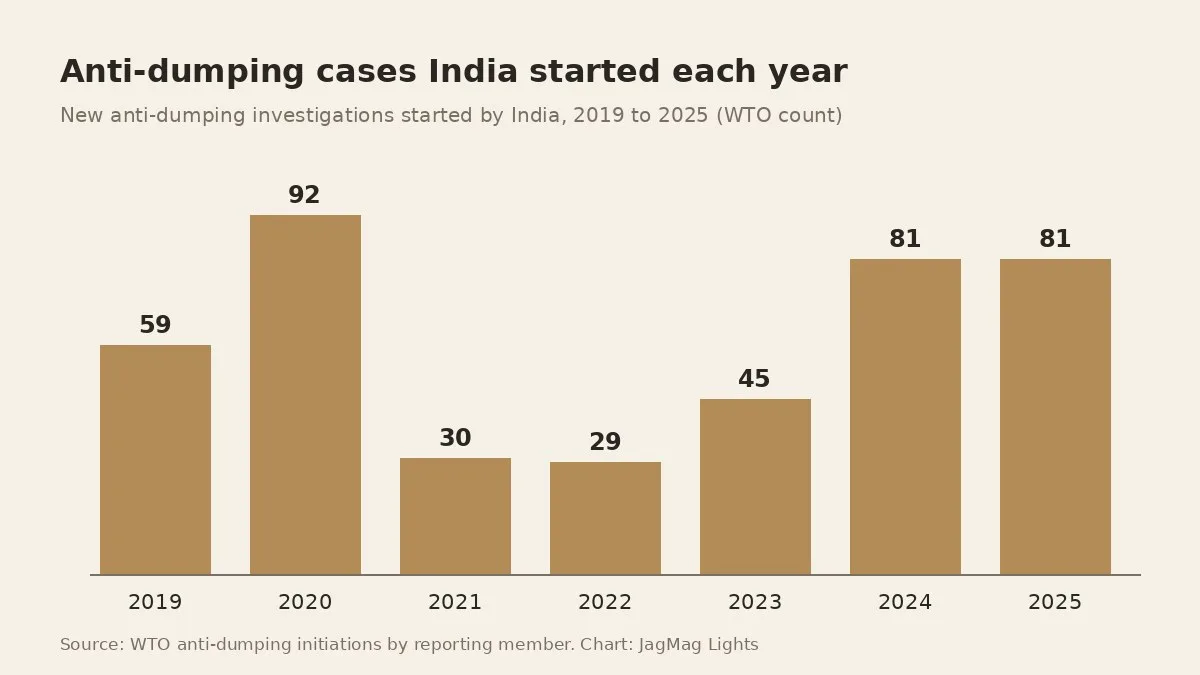
Anti-dumping duty is an extra customs duty. India adds it when an inquiry finds a product was sold here below its normal price at home. The DGTR investigates, the Finance Ministry imposes the duty, and it usually lasts 5 years. By the WTO count, India started 81 new cases in 2024, up from 45 in 2023. Lights have been covered before: CFL bulbs from China in 2002.
What is really going on with anti-dumping duty
By the numbers:
- India started 1,337 anti-dumping cases from 1995 to 2025, says the WTO.
- The whole world started 7,471 cases in the same years.
- The WTO records 81 new Indian cases in 2024 and 81 again in 2025.
- The DGTR itself started 43 investigations in 2024 up to 10 December, the Commerce Ministry told the Lok Sabha.
- India collected 3,169 crore rupees of this duty from 2015-16 to 2017-18, says the CAG.
- India imported US$195.4 million of electric lamps and light fittings under code 940540 in 2024.
- China sent 76.7% of those 2024 imports.
Dumping means a seller exports a product to India at less than its “normal value”. Normal value is usually the price at home. The CAG audit report uses exactly this test.
The DGTR, the Directorate General of Trade Remedies, runs the inquiry. The DGTR is an office of the Commerce Ministry. If the DGTR finds dumping and harm to Indian makers, the Finance Ministry issues a customs notice. The duty is generally in force for 5 years.
India uses this tool a lot. India started 1,337 cases out of 7,471 in the world. Divide 1,337 by 7,471 and you get about 18%. So about 18 of every 100 anti-dumping cases in the world since 1995 came from India.
The WTO counts each country in a case on its own. One inquiry into three countries counts as 3. The Commerce Ministry counts inquiries instead, so its number for 2024 is 43.
The pace is rising too. By the WTO count, India started 45 cases in 2023 and 81 in 2024. The jump is 36 cases, which is 80% more in one year.
Lights have been part of this story. In 2002, the authority found that CFL bulbs from China and Hong Kong were dumped. A Lok Sabha answer from 2005 gives the rule. For a lamp without a choke, the duty was the gap between US$1.256 and the landed value.
In 2007, a review fixed one Chinese exporter’s duty at US$0.16 per lamp. A trader who brought in 1,000 of those lamps paid 1,000 × 0.16 = US$160 extra.
Today, imports of these lamps and fittings are smaller. India bought US$341.96 million worth in 2019 and US$195.40 million in 2024. The fall is about 43% in five years. China’s share went from 82.5% to 76.7%.
Even with no dumping duty, an imported light pays normal customs duty. For luminaires, basic customs duty is 20%. A light valued at 100 at the port becomes 120 before any GST. GST then comes on top, just as it does on a light made in India.
One more point matters. A low price alone does not prove dumping. Only a DGTR inquiry can find it. A light can be cheap for other reasons, such as thinner metal or no spares.
How to check it yourself
- Read the “Country of Origin” line on the listing or the box. Online sellers in India must show it.
- Search the DGTR case list for the product name. The list shows the product, the countries and the date.
- Ask which metal the frame is, and which grade. Our guide to 202 vs 304 stainless steel explains the difference.
- Ask who keeps spare parts, and for how many years. Ask for the answer in writing.
- Ask how long a custom size takes. A maker in India can quote 15–20 days. An import can take 60–120 days.
On 25 Oct 2026 we read the 30 newest cases on the DGTR anti-dumping case list. 27 of the 30 named China. 0 of the 30 were lights or lamps. Most were chemicals, medicines and factory metals.
Side by side
| What you care about | JagMag | Imported light |
|---|---|---|
| Where it is made | Our factory, Greater Noida, since 2015 | Abroad; 76.7% of 2024 imports from China |
| Customs duty on the finished light | None, made in India | 20% basic customs duty at the port |
| Custom size or finish | 15–20 days | 60–120 days |
| Spare parts | Kept 10+ years | Ask the seller |
| Rust cover | Lifetime on 304 steel parts | Ask the seller |
Where the other side is better
Price and choice. A Bhagirath Palace shop owner told China Daily that the same festive lights, made in India, would cost double or triple.
A Mumbai trade leader told the same paper that for variety, buyers have few options beyond Chinese products.
The duty has a cost as well. Many of the 30 cases we read cover steel, copper tubes and chemicals that Indian factories buy. A duty on those inputs can raise costs for Indian makers too.
What we do at JagMag
JagMag Lights, a decorative lighting maker in Greater Noida, makes every light in its own factory. We have done this since 2015, so 11 years now. Our certifications page lists CE, UL and ZED marks and our DPIIT recognition.
Take our antique brass lantern chandelier. The chandelier is 52 cm wide and 82 cm tall. Clear borosilicate glass rods sit in a 304 stainless steel frame with an antique brass finish. The lamp holders are E14, and bulbs are not included.
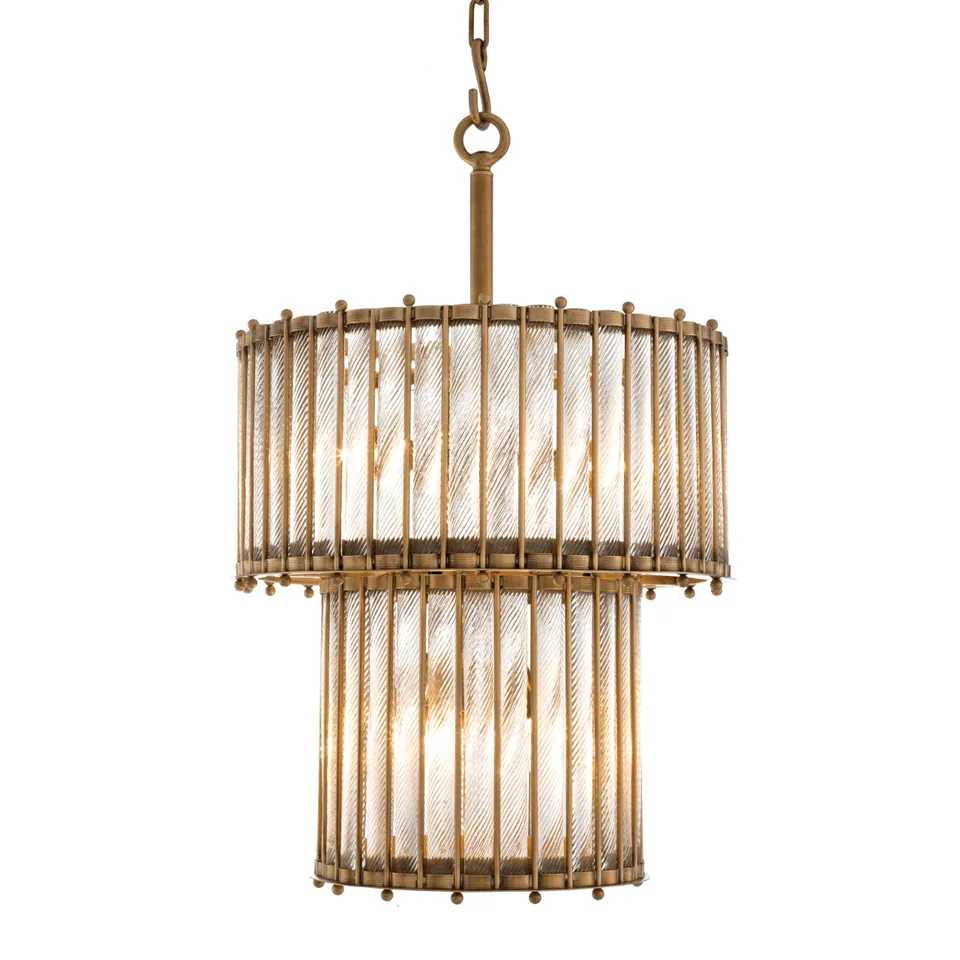
We make every part ourselves, so one broken part never means a new chandelier. We keep spares for 10+ years. The steel frame carries a lifetime warranty against rust, for orders from 4 Oct 2026.
In stock, a light ships in 4 working days. Made to order takes 12–15 working days. A custom size or finish takes 15–20 days.
Real glass, real steel and warm light give a room a grounded feel. Vastu thinking has long valued that kind of harmony.
FAQs
What is anti-dumping duty?
The duty is an extra customs charge on a product that an inquiry finds was sold to India below its normal value. In India it is generally in force for 5 years.
Who decides anti-dumping duty in India?
The DGTR, under the Commerce Ministry, investigates and recommends the duty. The Finance Ministry then imposes it through a customs notification.
Is there anti-dumping duty on lights from China?
We found no light or lamp among the 30 newest DGTR cases on 25 Oct 2026. In 2002, India did put a dumping duty on CFL bulbs from China and Hong Kong.
How many anti-dumping cases has India started?
India started 1,337 anti-dumping cases from 1995 to 2025, per WTO data. The United States started 1,027 and the European Union 616 in the same years.
Does a cheap price mean a product is dumped?
No. A low price alone does not prove dumping; only a DGTR inquiry can find it. A light can also be cheap because of thinner metal, no spares or no warranty.
Nature gives the material. Human hands give it meaning. Light brings it to life. That is JagMag.
See our brass and metal chandeliers and our full range of chandeliers, all made in India. Thinking of importing? Read import from China to India first. Not sure? Video-call us.
Sources
- WTO: Anti-dumping initiations by reporting member, 1995-2025 (read 25 Oct 2026)
- CAG Report No. 17 of 2019, Chapter 3: Levy of anti-dumping duty
- Lok Sabha Unstarred Question 5764, 3 May 2005: anti-dumping duty on CFLs
- Customs Notification 119/2007, 18 Dec 2007: anti-dumping duty on CFLs (Osram China, US$0.16 a piece)
- PTI via The Week, 10 Dec 2024: DGTR initiated 43 anti-dumping investigations in 2024 so far
- DGTR anti-dumping case list, pages 1 and 2 (30 cases read, 25 Oct 2026)
- World Bank WITS: India imports of HS 940540, 2024 (read 25 Oct 2026)
- World Bank WITS: India imports of HS 940540, 2019 (read 25 Oct 2026)
- EximPe: Duty rates for HS 94051900, as at 13 May 2026 (citing CBIC)
- The Week, 25 Jul 2020: E-commerce rules require country of origin
- China Daily, 13 Nov 2023: Indian traders on Chinese festive lights
- Business Standard column via VisionIAS, Jun 2025: India’s anti-dumping response and protectionism