

Here is the quick answer: A banquet hall chandelier has one job most home fixtures never face — to look right from across a huge, often double-height room. Get four things in order — scale, hanging height, light quality and how you will clean it — and the fixture will carry the whole space. Get them wrong and even an expensive piece looks lost or, worse, becomes a maintenance headache.
Choosing a banquet hall chandelier (or a chandelier for a hotel lobby) is a genuinely different job from picking one for a living room. These are big, tall, public spaces where the light is seen from a distance, photographed all night at weddings and events, and expected to say something about the brand the moment a guest walks in. This guide walks through the real decisions — with the actual numbers designers use — in plain English, so you can specify with confidence rather than guesswork.
What this guide covers
- Why a banquet hall chandelier is a different problem
- Getting the size right (the two formulas that work)
- Banquet hall vs hotel lobby: what changes
- Brightness, colour and CRI — the light itself
- Materials, weight and safe mounting
- Planning for cleaning and maintenance
- Modern banquet hall lighting: layers and dimming
- Where to start with JagMag
- FAQ
Why a banquet hall chandelier is a different problem
In a home, a chandelier is viewed up close in a room with an 8–10 ft ceiling. A banquet hall chandelier lives in a volume that can be three or four times taller, seen mostly from 10–30 metres away. That single fact changes everything: a fixture that looks generous in a showroom can vanish in a double-height hall, and a delicate detail that dazzles up close simply disappears at distance.
So the first mental shift is to stop thinking about the ceiling and start thinking about the volume of the room — its length, width and height together. The best large-space installations support the architecture instead of fighting it: they create a clear focal zone, sit in proportion to the space, and read cleanly from far away.
Getting the size right (the two formulas that work)
Lighting designers lean on two quick formulas. They are not magic, but they get you into the right range fast — and in a big room, being in the right range is most of the battle.
1. Diameter (how wide)
Add the room’s length and width in feet, then read that number in inches — that is a sensible fixture diameter. A 20 × 30 ft hall (20 + 30 = 50) suggests roughly a 50-inch chandelier. For rooms that open into other areas or have ceilings above 12 ft, increase the result by 10–20%. Very large halls often look best with several coordinated fixtures rather than one impossible giant.
2. Drop (how tall)
Multiply the ceiling height in feet by 2.5 to 3 to get a maximum fixture height in inches. A 16 ft ceiling (16 × 3) supports a fixture up to about 48 inches tall. For ceilings above 14 ft, you can add another 20–30% for presence. Whatever the maths says, keep the lowest point of the fixture at least 7–7.5 ft (≈2.2 m) above the floor in walkways — and well clear of doorways and the heads of guests on a stage.
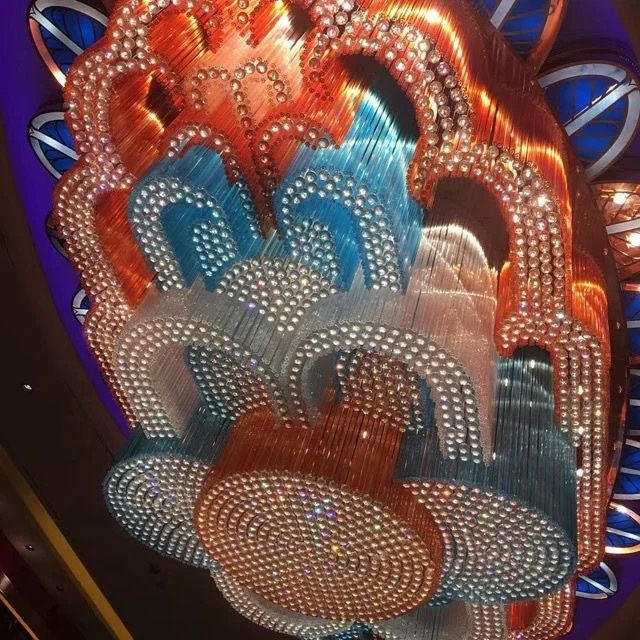
Here is a quick reference for matching ceiling height to fixture type:
| Ceiling height | Best fixture approach |
|---|---|
| Under 10 ft (≈3 m) | Flush or semi-flush fixtures, drop no more than ~20–31 in |
| 10–16 ft | Single statement chandelier; mind the 7.5 ft clearance |
| 16–25 ft | Tall multi-tier or elongated cascade; plan a maintenance lift |
| Over 25 ft | Oversized custom piece or a cluster of coordinated fixtures |
Banquet hall vs hotel lobby: what changes
Both are large public rooms, but they ask for slightly different things. A banquet hall chandelier is usually allowed more spectacle — it is part of the event, the backdrop to a thousand photographs, and it often needs to dim down for dining and speeches then brighten up for dancing. A hotel lobby fixture, by contrast, works around the clock and leans on understated elegance and brand fit; it should still impress at 3 a.m. with no crowd to fill the room.
Practically: in a hall, prioritise drama, dimming and the photograph; in a lobby, prioritise consistency, low-maintenance materials and a look that ages well. A tall, narrow lobby suits a vertical cascade fixture, while a wide hall suits a broader, more horizontal piece. Leave at least 1 metre between the fixture and any wall, and centre it on the focal zone — not always the geometric centre of the ceiling.
Brightness, colour and CRI — the light itself
A beautiful fixture with the wrong light spoils the room. Three numbers matter.
Brightness. Big rooms are planned in lumens and lux — lumens are what the lamp emits; lux is what actually lands on the floor or table. Contemporary hospitality practice targets roughly 150–300 lux in lobby and circulation zones, with brighter pools for tasks like a reception desk. One chandelier rarely delivers that across a hall, which is why it is one layer of several, not the whole plan.
Colour. Colour temperature — measured in Kelvin, from candle-warm to daylight-cool — sets the mood. Hospitality almost always lives in the warm band, 2700K–3000K, because warm light feels welcoming and flatters skin and food. For Indian wedding venues, designers recommend staying in the 2000K–3500K warm range and avoiding harsh colour casts that make food and guests look odd.
Colour accuracy. The most overlooked number is CRI, the Colour Rendering Index — a 0–100 score for how truthfully a light shows colour. For any space that is photographed or serves food, specify CRI 90+ (95+ where food is served). It is the difference between a hall that photographs beautifully and one that looks flat and grey in every picture.
Materials, weight and safe mounting
At small scale, material is a style choice; at banquet scale it is also a structural one. Crystal and glass read as luxury and throw beautiful sparkle, but they are heavy and need careful cleaning. Metal-and-glass cluster designs and art-glass pieces are lighter and simpler to live with — a good route when ceilings soar above 5 metres.
Always confirm the fixture’s loaded weight and have the ceiling structure checked: large fixtures are mounted to concrete slabs, steel structures or reinforced timber with proper accessories, never to a plasterboard box. Insist on LED lamping — cool-running, long-life chips instead of hot bulbs — so a fixture with dozens of lamps does not bake the room or demand constant bulb changes. Pair it with an LED-compatible dimmer from day one.
Planning for cleaning and maintenance
This is the step everyone forgets and everyone regrets. A banquet hall chandelier hung 6–10 metres up will gather dust, and someone has to clean it without closing the venue and erecting scaffolding. The professional answer is a motorised chandelier lift — a ceiling winch that lowers the whole fixture to a safe working height, then raises it back.
Commercial lift systems carry loads from around 100 kg up to 450 kg or more, and the better ones lock onto rigid ceiling supports once raised rather than hanging on the cable. Deciding this before installation is far cheaper than retrofitting a lift later — so size the fixture and the lift together, and choose materials you can actually wipe down.
Modern banquet hall lighting: layers and dimming
The single biggest upgrade to modern banquet hall lighting is to stop relying on one source. Designers layer three: ambient light for the overall glow (often concealed or recessed), decorative fixtures like the chandelier for the wow factor, and accent light to pick out architecture, a stage or a head table. Layering gives you flexibility — dim the room warm for dinner, lift it for dancing, all from one chandelier on a good dimmer.
A few field-tested tips: keep bold coloured LEDs for walls and ceilings, never the dining light, or food and skin tones look wrong; use a few well-chosen effects rather than a nightclub of moving heads at a traditional banquet; and put your money into permanent fixtures — chandeliers, sconces, dimmable pendants — before portable uplights. In Indian venues, a custom jhumar-style fixture with warm LED cores under wooden rafters is a reliably gorgeous look once dimmed for the reception.
Where to start with JagMag
If you want crystal drama for a hall, the Spiral Raindrop Crystal Chandelier and the K9 Crystal Long-Raindrop Chandelier give vertical sparkle that reads well at distance. For double-height lobbies and stairwells, the long Murano-glass staircase chandelier is built for the drop, while the Glass Globe Brass Cluster offers a lighter, contemporary alternative. Browse the full chandelier collection to filter by size and finish, and remember every JagMag piece can be customised in scale for a specific hall.
Still working out the details? Our guides on chandelier brightness and light spread, finding the right chandelier or jhumar size, and hanging a chandelier safely go deeper on each step.
Frequently asked questions
What size chandelier suits a banquet hall? Add the room’s length and width in feet and read it in inches for diameter (a 20 × 30 ft hall ≈ a 50-inch fixture), then size height as ceiling-feet × 2.5–3 in inches. For very large halls, use several coordinated fixtures rather than one oversized piece.
How high should a banquet hall chandelier hang? Keep the lowest point at least 7–7.5 ft above the floor in walkways, higher over stages and doorways. In double-height rooms, hang it to define a focal zone rather than to fill the ceiling.
What colour temperature is best for a hall or hotel lobby? Warm white, 2700K–3000K (and as low as 2000K for wedding ambience), on a dimmer. Avoid cool, bluish light in spaces where people gather, dine and are photographed.
How do you clean a chandelier hung very high? Specify a motorised chandelier lift at the design stage. It lowers the fixture to a safe height for cleaning and bulb changes, avoiding scaffolding and venue closures.
Crystal or glass for a large space? Crystal gives maximum sparkle but is heavier and needs more cleaning; metal-and-glass or art-glass clusters are lighter and easier to maintain in very tall rooms. Match the choice to your ceiling and maintenance plan.
Planning a hall, hotel or banquet project? Explore JagMag’s chandeliers or get in touch for a custom design sized to your space.