
Pick up a glass globe and it feels like nothing from the earth. Yet the globe started as sand. Anyone asking how is glass made is really asking how sand turns clear. Heat does most of the work, and patience does the rest.
Every glass shade we sell went through the same journey. Below you will find the raw materials, the steps, three small sums, and the science of why glass lets light pass. By the end you will know what you are looking at when a globe glows.

The short answer
Glass is made by melting silica sand with soda ash and limestone at about 1,500 °C, then shaping the melt and cooling it slowly. Soda ash lowers the melting point, and limestone makes the glass last. The glass in our chandeliers is borosilicate glass, which swaps in boric oxide so it handles heat better.
What is glass made of? Sand, soda ash and limestone
Britannica names three main materials: sand, limestone and soda ash. A Penn State University course gives the rough share of each in a factory batch.
| Material | Job | Share of batch |
|---|---|---|
| Silica sand | Forms the glass | About 45% |
| Soda ash | Lowers the melting point | About 15% |
| Limestone | Makes the glass durable | About 10% |
| Cullet, or recycled glass | Melts sooner and saves fuel | Can reach 90% |
Finished everyday glass holds about 70 to 74% silica by weight. The batch share looks lower because the batch also carries cullet, and cullet is already glass.
Now follow the steps.
- Weigh and mix the raw materials with the cullet.
- Melt the mix in a furnace. Soda-lime glass, the everyday kind, can reach 1,675 °C in parts of the furnace.
- Shape the melt. Workers blow it, press it, draw it or float it.
- Anneal the shape, which means cooling it slowly in a long hot oven.
- Finish the piece, then check it for faults.
About 90% of modern glass is soda-lime glass. Lab glass and our shades use a different recipe. Borosilicate glass is roughly 80% silica, 13% boric oxide, 4% soda or potash and 2 to 3% alumina. Our own glass is melted from silica sand, boric oxide, soda ash and alumina. Colour goes in during melting, so opal, smoked and amber glass all start as the same clear glass.
How is glass made with less heat? Three small sums
Each sum shows why one material earns its place.
Sum 1: what soda ash does.
- Pure silica melts at 1,723 °C, says Britannica.
- About 25% sodium oxide brings the melting point down to 850 °C.
- So 1,723 − 850 = 873 °C less heat, a drop of 51%.
Sum 2: what cullet saves.
- Penn State says each 10% of cullet saves up to 2.5% of the energy. The Glass Packaging Institute says nearly 3%.
- Take a batch with 30% cullet, our example. Then 30 ÷ 10 = 3 steps.
- So 3 x 2.5 = 7.5%, and 3 x 3 = 9%. The furnace burns about 7.5 to 9% less energy.
Sum 3: why boric oxide matters in a lamp.
- Take our 12.5 cm opal globe, or 125 mm. Warm the glass by 60 °C, our example.
- Borosilicate glass grows by 3.3 parts in a million for each degree. So 125 x 0.0000033 x 60 = 0.025 mm.
- Soda-lime glass grows by about 9 parts in a million. So 125 x 0.000009 x 60 = 0.068 mm.
- Everyday glass grows about 2.7 times more for the same heat.
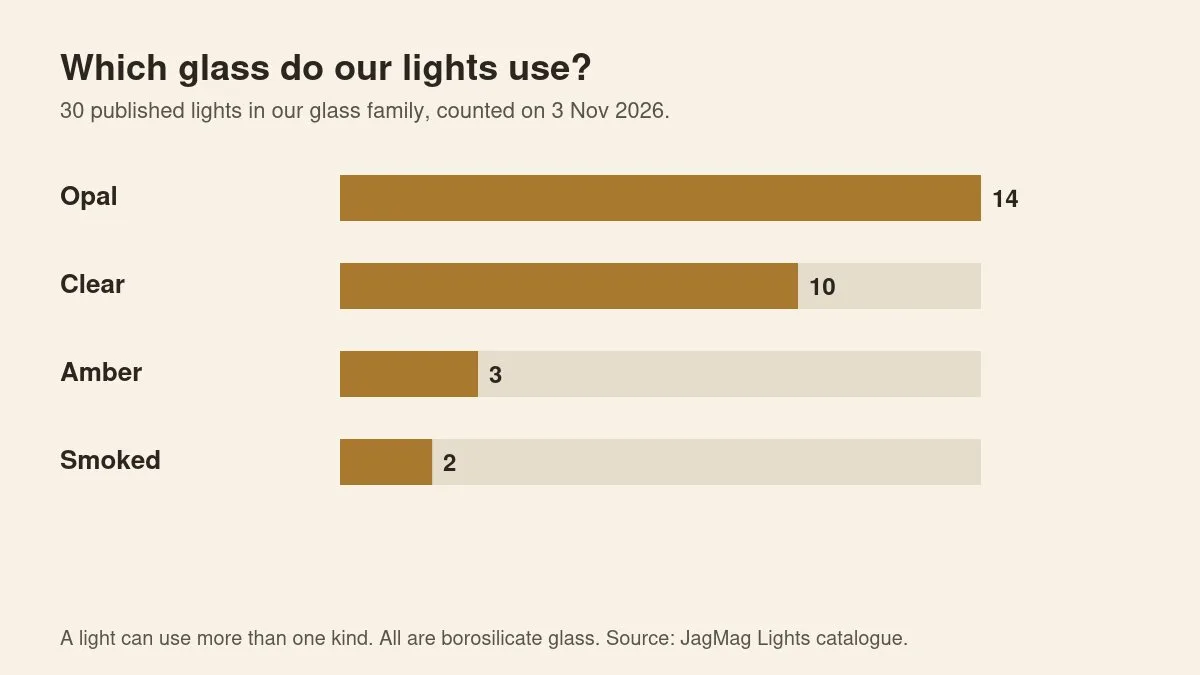
We counted our own range on 3 Nov 2026. Of our 30 glass lights in that family, 14 use opal glass, 10 use clear glass, 3 use amber and 2 use smoked. A few use more than one kind.
Why annealed glass does not crack: the logic and the science
Follow the chain. Hot glass cools from the outside first. The outside shrinks and turns stiff while the inside stays soft. Then the inside shrinks and pulls on the stiff skin. The pull stays locked inside as stress, and stress waits for a knock or a heat change to crack the glass.
Annealed glass avoids the trap. The piece sits in an oven just hot enough to let the stress relax, and then it cools slowly. Inside and outside shrink together, so nothing stays locked in. Wikipedia’s entry on annealing says unannealed glass stays weaker for good.
Guides quote different annealing heats, and both can be right. Most glass anneals at 454 to 482 °C. Valley Design lists 560 °C for Pyrex 7740, a borosilicate glass. The recipe sets the heat, so a higher number is not a mistake.
Most solids are crystals, with atoms in neat rows, like bricks in a wall. Glass is an amorphous solid, which means the atoms sit in a jumbled network, more like a frozen crowd. The melt cools too fast for the atoms to line up.
Light is a stream of tiny energy packets called photons. A material goes dark when its electrons can swallow those packets. Penn State explains that the energy gaps in glass are too wide for visible light. An electron cannot jump the gap, so the photon carries on through.
Ultraviolet light carries more energy, so glass does absorb it. Penn State gives an easy test: you cannot get a suntan through glass. Clear glass therefore passes the light you see and stops much of the light you do not.
Opal glass works in a different way. Tiny particles inside the glass scatter the light in all directions. Edmund Optics gives 30 to 40% of visible light passing through an opal diffuser. The bulb disappears, and the whole globe glows instead.
Nature gives the sand, hands shape it, light passes through
Sand does not know it can become a globe. A person decides that. Our glassblowers shape many of our globes and domes by breath and by hand, so no two come out exactly the same. Nature gives the material, human hands shape it, and light connects the two.
- Our Semi-Flush Smoked Glass Globe Chandelier is 61 cm wide and 42 cm high, with six smoked borosilicate glass globes.
- Our Modern Opal Glass Globe Chandelier is 70 cm wide, with 12.5 cm opal borosilicate glass globes.
- Our Fluted Glass Chandelier uses clear fluted borosilicate glass on a 65 cm top tier.

All three take a bulb you fit yourself. The bulb is not included, so fit a 3000K warm-white LED. Every frame is 304 stainless steel, made in our own factory in India since 2015, with free shipping across India. You can read our certifications too.
Sand is earth, and the furnace is fire. Vastu thinking looks for harmony between such elements in a home, and we take it as inspiration, not a promise.
FAQs
How is glass made, step by step?
Glass is made in five steps. Mix sand, soda ash and limestone, melt the mix, shape it, cool it slowly, then finish it. Most furnaces run at about 1,500 °C.
What is glass made of?
Everyday glass is made of silica sand, soda ash and limestone, often with recycled glass added. Finished glass holds about 70 to 74% silica. Borosilicate glass adds about 13% boric oxide.
What is annealed glass?
Annealed glass is glass cooled slowly in an oven to remove stress trapped inside. Most glass anneals at 454 to 482 °C. Without this step, the glass stays weaker.
Why is glass transparent?
Glass is transparent because visible light cannot lift its electrons across their energy gap. So the light passes through instead of being absorbed. Ultraviolet light has more energy, and glass absorbs it.
Is all glass the same?
No, and recipes differ a lot. About 90% of modern glass is soda-lime glass, while borosilicate glass grows about 2.7 times less with heat.
Nature gives the material.
Human hands give it meaning.
Vastu inspires harmony.
Light brings it to life.
That is JagMag.
See our glass chandeliers, then read what borosilicate glass is and whether it is safe near a bulb. Not sure? Video-call us.
Sources
- Britannica, glass, read 3 Nov 2026.
- Penn State MATSE 81, ceramic fabrication and glass making, read 3 Nov 2026.
- Penn State MATSE 81, why is glass transparent, read 3 Nov 2026.
- Glass Packaging Institute, glass recycling facts, read 3 Nov 2026.
- Wikipedia, annealing (glass), read 3 Nov 2026.
- Wikipedia, soda-lime glass, read 3 Nov 2026.
- Wikipedia, borosilicate glass, read 3 Nov 2026.
- Wikipedia, glass, read 3 Nov 2026.
- Valley Design, properties of 7740 Pyrex glass, read 3 Nov 2026.
- SCHOTT BOROFLOAT 33 data sheet, read 2 Nov 2026.
- Edmund Optics, diffuser types, read 29 Oct 2026.