
Walk down Marine Drive in Mumbai in the evening. The buildings facing the sea share bold lines and geometric details. The look has a name: Art Deco style. Many Indian homes want a little of it inside, often through one light over the dining table or in the hall.
Below you will see where Art Deco came from and how to spot it. You will also get the sums for sizing a Deco light, and the science of why it glows.

The short answer
Art Deco style is a design style of the 1920s and 1930s, named after the 1925 decorative arts exhibition in Paris. You spot it by its geometry, its stepped and repeated shapes, and its rich materials such as marble, polished metal and glass. In a home, one Deco light can carry the whole look.
Art Deco style: where it came from and how to spot it
Britannica traces the name to the 1925 Paris exhibition, the Exposition Internationale des Arts Décoratifs et Industriels Modernes. The style began in the 1920s and peaked in the 1930s. Britannica describes simple, clean shapes, often with a streamlined look.
The V&A museum in London adds a surprise. The term Art Deco was coined only in the 1960s. In 1925 people called the look Style Moderne. The V&A says geometric forms worked their way into all parts of life.
So Art Deco design is easy to read once you know the signs.
- Geometry first. Straight lines, zigzags, octagons and stepped tiers, set in balanced, mirror-like order.
- Rich, real materials. Marble, alabaster, bronze, chrome, lacquer and mirrored glass, says the Kovels collector guide to Deco lighting.
- Light that goes up. Kovels notes Deco uplights, with bulbs shining upward for indirect light.
- Strong colour contrast. The Smithsonian design library points to bold yet balanced lines and saturated colour fields.
India has a rich Art Deco architecture story too. UNESCO added the Victorian Gothic and Art Deco Ensembles of Mumbai to the World Heritage List on 30 June 2018. UNESCO says the Deco buildings blend Indian design with Art Deco imagery, a mix it calls Indo-Deco. The Art Deco Mumbai trust says the city has the second-largest collection of Art Deco buildings in the world, with over 650 identified.
Art Deco interior design brings the same ideas indoors: a symmetrical room, one strong light, and a high-contrast palette. Many people start with one of our chandeliers in a Deco shape.
How big should an Art Deco chandelier be?
Our dining room chandelier page gives a simple rule: pick a light roughly half to two-thirds the width of your table. The sum works like this for two real Deco shapes.
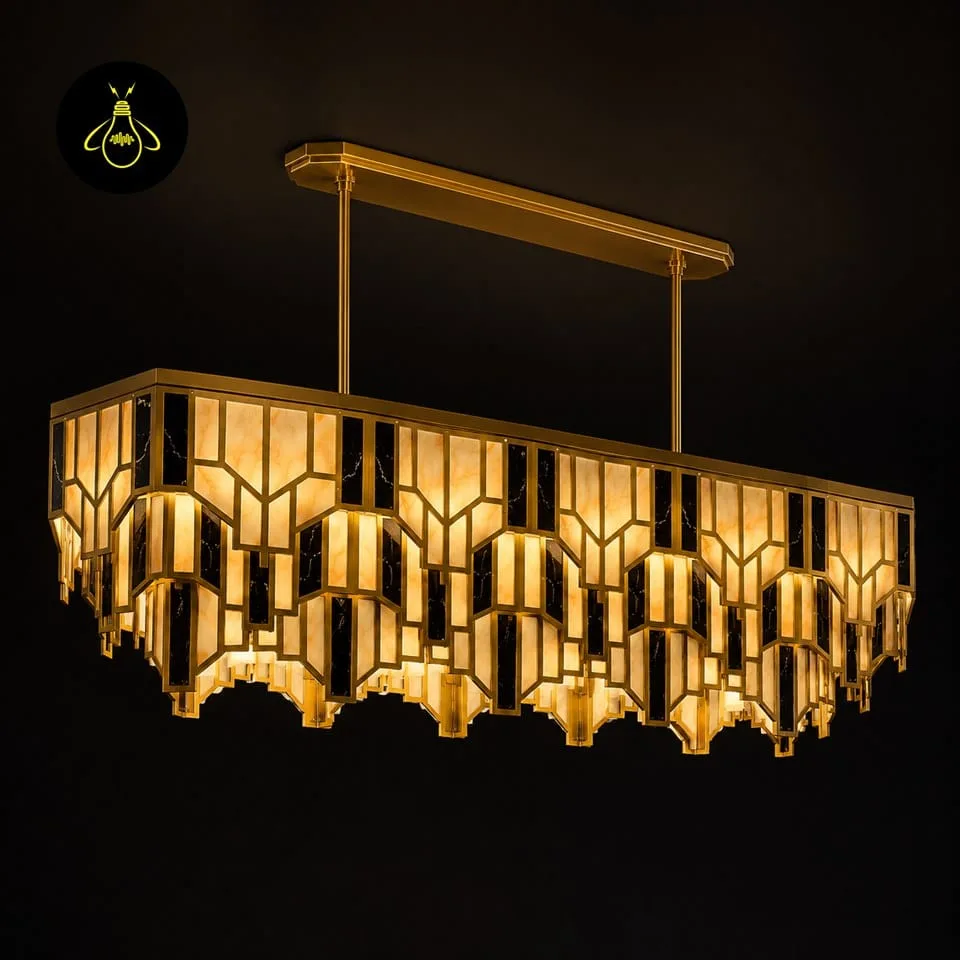
- Long table, 210 cm. Two-thirds of 210 is 140 cm. Our Art Deco Linear Chandelier is 149.5 cm long, so 149.5 ÷ 210 = 0.71, or 71% of the table. The light sits just above two-thirds, which suits a table for 8 to 10.
- Square table, 90 cm wide. Our round Art Deco chandelier is 50 cm across, so 50 ÷ 90 = 0.56, or 56%. The ratio sits inside the half to two-thirds band.
- Check the shape. The linear piece is 149.5 cm long and 50 cm wide: 149.5 ÷ 50 = 2.99, close to 3 to 1. A long, narrow table suits that ratio.
The dates add up neatly too. From the 1925 exhibition to the 2018 UNESCO listing is 2018 − 1925 = 93 years. In 2026 the style turns 101.
We counted our own Brass & Metal Chandeliers on 31 October 2026. Of 43 published lights, 39 wear a brass or gold-tone finish on their steel (91%). Only 3 are labelled Art Deco (7%). So most of our metal chandeliers share Deco’s warm metal, while only a few follow its full stepped geometry.
Why Deco metal and stone look so rich when lit
The logic of Deco light is a chain. Polished metal throws back sharp highlights. Stone and glass soften and colour the light. The repeated geometry gives those highlights a pattern. So a Deco light sparkles in lines, not in random dots.
The science starts with reflection. HyperPhysics at Georgia State University states the law of reflection: the angle of incidence equals the angle of reflection. Light hits a smooth surface and bounces off at the same angle, like a ball off a wall. OpenStax, the Rice University textbook, adds that rough surfaces scatter light, while smooth ones show clear reflections.
Numbers make this clear. A University of North Carolina Greensboro lighting page lists stainless steel at 55–65% reflectance and white plaster at 90–92%. Reflectance is the share of light a surface sends back. Plaster spreads its light evenly in all directions. Polished steel sends it back in one direction, as a bright line. A brass-finish steel frame gives the glints. Your white walls give the soft fill.
The stone adds contrast. The US Geological Survey describes marble as calcite crystals locked together like a jigsaw. The University of Pittsburgh explains that marble is limestone changed by heat and pressure. Alabaster is a fine-grained form of gypsum and is translucent, says Britannica. Translucent means light passes through but you cannot see clearly through it, like a paper lampshade.
So in a Deco light, the cream alabaster glows from inside while the black marble stays dark. The black-and-cream contrast comes from nature, and light switches it on.
When guides differ, start with your room. A plain modern room needs only one Deco piece to carry the style. A room already full of pattern does better with a simpler Deco shape, such as a glass lantern.
The JagMag philosophy: stone, glass and steel in Deco order
Nature gives the material. Human hands shape it. Light connects it to your evening. Art Deco suits this idea well, because the style was always about real stone, real metal and careful handwork.
The Round Art Deco Brass Chandelier is 50 cm across and 49 cm tall, with three tiers of alabaster and black marble panels. The frame is 304-grade stainless steel in an antique brass finish. The four E27 holders come without bulbs; fit 3000K warm-white LEDs.
For a long table, the Art Deco Linear Chandelier runs 149.5 cm with three stepped tiers. The piece weighs about 55 kg and hangs on two rods, so ask your electrician to anchor it into the concrete slab.
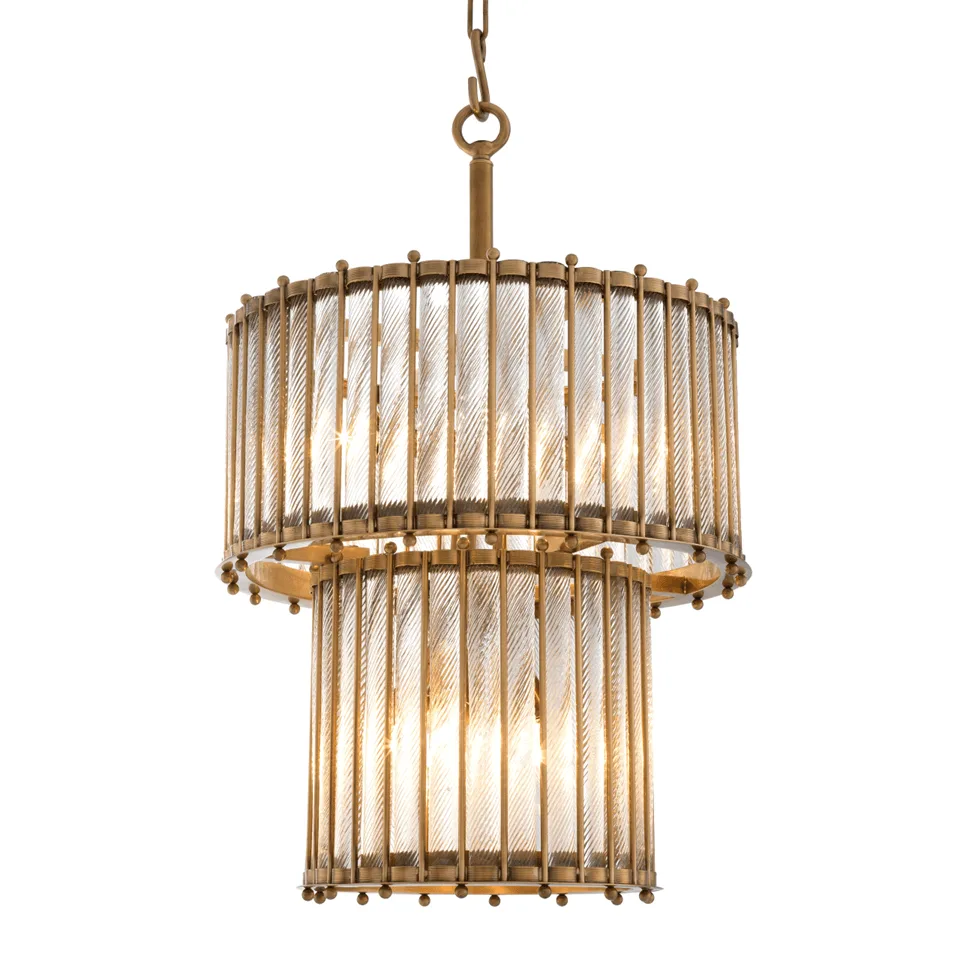
For Deco without stone, the Antique Brass Chandelier, Tiziano, is a two-tier lantern, 52 cm wide and 82 cm tall. Its twisted clear borosilicate glass rods are set upright by hand. For a bedside or console, the art deco table lamp carries the same alabaster and black marble tiers on a 56 cm brass-finish steel stem.
Our craftsmen cut, bend and join each frame by hand in our own factory in India, where we have made lights since 2015. Every marble and alabaster panel looks a little different, because nature makes the veins. The steel carries a lifetime warranty against rust, as our Legal Policies state for orders from 4 October 2026.
Balanced shapes and warm light also suit Vastu thinking, which values order and harmony in a space. We do not promise luck. We make a room feel settled.
FAQs
What is Art Deco style in simple words?
Art Deco style is a 1920s–1930s look built on geometry, symmetry and rich materials such as marble, polished metal and glass. The name comes from the 1925 decorative arts exhibition in Paris.
What colours are used in Art Deco interior design?
Art Deco interior design uses saturated colour and strong contrast, as the Smithsonian design library notes. Black marble with cream alabaster and a brass-finish frame is one classic pair.
Where can I see Art Deco architecture in India?
Mumbai has the best-known examples, along Marine Drive and the Oval Maidan. UNESCO listed the Victorian Gothic and Art Deco Ensembles of Mumbai as World Heritage in 2018.
When did Art Deco start?
Art Deco began in the 1920s, showed its full form at the 1925 Paris exhibition and peaked in the 1930s. The name itself was coined only in the 1960s, says the V&A.
Nature gives the material.
Human hands give it meaning.
Vastu inspires harmony.
Light brings it to life.
That is JagMag.
Explore our metal chandelier range, then read solid brass or brass finish or the best metal for a chandelier. Not sure? Video-call us.
Sources
- Britannica, Art Deco (read 31 Oct 2026)
- V&A, An introduction to Art Deco (read 31 Oct 2026)
- Smithsonian Libraries, Art Deco at the Cooper Hewitt Design Library (read 31 Oct 2026)
- Kovels, Lighting: Mid-1920s to the 1960s (read 31 Oct 2026)
- UNESCO, Victorian Gothic and Art Deco Ensembles of Mumbai (read 31 Oct 2026)
- UNESCO World Heritage Centre news, 30 June 2018 (read 31 Oct 2026)
- Art Deco Mumbai on Google Arts & Culture (read 31 Oct 2026)
- HyperPhysics, Georgia State University, Reflection (read 31 Oct 2026)
- OpenStax, The Law of Reflection (read 31 Oct 2026)
- UNC Greensboro, Material Properties (page no longer online) (read 31 Oct 2026)
- US Geological Survey, Marble (read 31 Oct 2026)
- University of Pittsburgh, Marble (read 31 Oct 2026)
- Britannica, Alabaster (read 31 Oct 2026)