
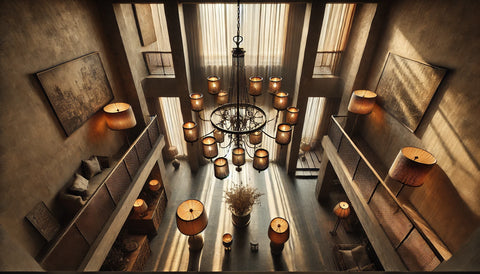
Matching wall lights with chandeliers is not about buying identical fixtures. It is about making the room feel coherent. A chandelier sets the visual tone from the ceiling, while wall lights support the room at eye level. When the two are chosen well, the result feels layered, balanced, and intentional. When they are not, the room can feel visually confused even if each fixture looks good on its own.
Key Takeaways
- Matching does not mean identical.
- Finish, shape language, and light quality matter more than exact duplication.
- Wall lights should support the chandelier, not compete with it.
- Layered lighting improves both atmosphere and usability.
- Scale mistakes are more damaging than small style differences.
Start with the Chandelier?s Role
The chandelier is usually the primary decorative light in the room. It sets the mood and often defines the ceiling story. Before choosing wall lights, decide what role the chandelier is already playing. Is it formal, minimal, soft, sculptural, rustic, or luxurious? Wall lights should reinforce that language.
What Actually Needs to Match?
- Finish family: brass with brass-like warmth, black with darker accents, chrome with cooler metals.
- Shape language: curved with curved, geometric with geometric, soft-glass with soft-glass.
- Light quality: warm light should stay warm across all fixtures in the room.
- Level of ornament: a minimal chandelier usually wants restrained wall lights, not heavy traditional sconces.
Exact duplication is optional. Visual harmony is the real goal.
Why Layered Lighting Works Better
A chandelier alone rarely solves a room perfectly. Wall lights help because they add lower-level illumination, reduce contrast, and make the room feel more complete. This is especially useful in living rooms, dining spaces, corridors, lounges, and hospitality-style interiors.
Scale Rules
Wall lights should be subordinate to the chandelier in most rooms. If the sconces are too large, they compete. If they are too small, they feel accidental. A good rule is to let the chandelier lead the room visually, while wall lights support the perimeter.
Examples That Usually Work
- a warm brass chandelier with soft opal-glass sconces
- a black geometric chandelier with restrained linear wall lights
- a crystal chandelier with elegant but quieter glass sconces
- a rustic chandelier with wall lights that share the same warm material direction
Common Mistakes
- trying to force exact fixture duplication across the whole room
- mixing very different color temperatures
- using wall lights that visually overpower the chandelier
- matching finishes but ignoring shape language
- forgetting that the room still needs functional lighting, not just decorative styling
Frequently Asked Questions
Do wall lights and chandeliers need to be from the same collection?
No. They just need to feel visually related through finish, form, and lighting behavior.
Can I mix metal finishes between chandeliers and wall lights?
Yes, but keep the mix disciplined. Two coordinated finish families can work better than one forced exact match.
Should wall lights be as bright as the chandelier?
Usually not. Wall lights often work best as supportive layers rather than the main decorative focus.
What matters more: finish or shape?
Both matter, but shape language often has the bigger visual effect. A fixture can survive a finish variation more easily than a major style conflict.
Further Reading
Explore More
Explore Jagmag Lights? chandelier collection, wall lights collection, and the project archive for real layered-lighting references.