
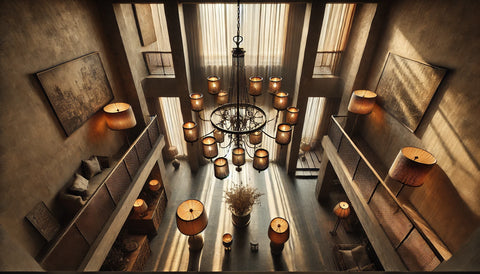
It is the hour after dinner. The big light is off, the chandelier glows at half its strength, and a single lamp on the side table throws a soft pool of gold over the sofa. Nobody planned that scene, exactly — and yet the room feels finished, like everything in it belongs to the same family. That quiet sense of “this all goes together” is what people are really after when they start matching lamps with chandeliers. Not twins. A feeling.
The good news: you almost never need fixtures from the same collection. A room reads as cohesive when the pieces share a mood, a finish family, and a sense of scale — even when the chandelier overhead and the lamp beside the armchair look nothing alike up close.
The little mistakes that make a room feel “off”
Two things tend to go wrong, and they pull in opposite directions.
The first is buying the matched showroom set — same metal, same shade, same everything, copy-pasted around the room. It looks safe on the shelf and strangely flat at home. The eye has nothing to travel to. The room feels like a catalogue page instead of a place someone lives.
The second is the opposite: a rustic wood lamp on one table, a sleek chrome lamp on the other, a crystal chandelier above, and nothing tying any of it together. Each piece is lovely alone. Together they bicker. Designers will tell you the fix is almost always one shared thread — a repeated metal, a common warmth of light, shades cut from the same cloth of mood — and suddenly the argument settles into a conversation.
Match the mood and the finish, not the shape
Here is the shift that makes the whole thing easy: stop trying to match the shape of your lamps to your chandelier, and start matching the feeling. A warm-brass chandelier with curved arms doesn’t need a brass lamp that mimics those arms. It needs a lamp that lives in the same world — warm metal, soft glow, a base with a little character.
Think of the chandelier as the lead singer and the lamps as the band. The chandelier is the showpiece, the thing you look up at when you walk in. The lamps are the harmony at eye level and seated height, doing the quiet work of making the room comfortable. They should clearly belong to the same song without all singing the same note.
A simple way to hold this in your head: let one finish lead. Pick the metal or tone you love most — the one on your chandelier is usually the natural choice — and let it be the dominant note. Then bring in one or two supporting finishes through the lamps. Most rooms look best with two finishes, three at the very most. More than that and the eye stops trusting the room.
A word on mixing metals (the part everyone worries about)
You can absolutely mix metals — warm brass with a touch of black, gold with a hint of bronze. The trick is balance: one tone clearly in charge, the other playing support, and each one repeated at least twice so it feels intentional rather than accidental. If your chandelier is warm brass, a brass-stemmed table lamp on one side and a gold-framed floor lamp in the reading corner make the brass feel deliberate, like a decision rather than a leftover.
What you don’t want is a single lonely silver lamp marooned in a room of warm gold. One orphaned finish is what makes people say a room looks “a bit random” without being able to explain why.
One warmth of light across the room
This is the most overlooked half of matching lamps with chandeliers, and it costs nothing to get right. Even with finishes beautifully coordinated, a room falls apart the moment one bulb glows warm honey and another beams cool blue-white. The eye reads it instantly as “two rooms in one.”
So keep the light itself consistent. For living rooms and bedrooms, choose warm white bulbs (around 2700K — think soft candlelight, not office light) in the chandelier and every lamp. Put the chandelier on a dimmer if you can, so the overhead light can drop down to meet the lamps in the evening instead of fighting them. That single habit — one warmth everywhere, dimmed at night — does more for a cohesive room than any amount of finish-matching.
Pairings we love
The easiest way to see how this works is to build around one warm-metal family. Here is a grouping that comes together almost on its own.
Start overhead with the Wood and Brass Arlo Chandelier. Its warm brass arms and bronze reflectors set the tone for the whole room — natural wood, soft metal, nothing cold. Once that’s your anchor, the lamps almost choose themselves.
On the side table, the Mini Brass Table Lamp Sasa, with its slim bamboo-stem base, echoes the chandelier’s brass without copying it — small, quiet, and exactly the right scale for a console or a bedside. In the reading corner, the Triple Amber Glass Floor Lamp repeats the gold and adds a layer of warm glass that catches the chandelier’s glow beautifully. And for a bedroom that needs to feel like the same world as the living room, the Amber Glass Boudica bedside lamp carries that honey warmth right up to the pillow.
None of these are identical. They simply share a family — warm metal, amber glass, a soft glow — and that is exactly why they look intentional together.
Room by room
In the living room, let the chandelier anchor the centre and place lamps at the edges — a table lamp at sofa-arm height for reading, a floor lamp uplighting a dark corner. You want light at three levels: overhead, seated, and low. That layering is what makes an evening room feel deep and calm instead of flat. (If you’re still choosing the chandelier itself, our living room chandelier guide walks through size and placement.)
In the bedroom, a pair of matching bedside lamps is the one place twinning genuinely works — symmetry beside a bed feels restful. Just make sure they share the chandelier’s finish family and warmth, not a different mood entirely.
In the entryway or dining area, where a chandelier or wall lights often do the heavy lifting, a single well-chosen lamp on a console keeps the welcome soft. If wall lights are part of your scheme, the same harmony rules apply — our guide to matching wall lights with chandeliers covers that pairing in detail.
So which should you buy?
If you want the simplest path to a room that looks pulled together, choose your chandelier first and let it set the finish — then buy lamps from the same warmth and metal family rather than the same collection. A warm-brass chandelier like the Arlo, a brass-stemmed table lamp, and a gold-and-amber floor lamp will read as one considered scheme without ever looking matchy. Keep every bulb at the same cosy 2700K, put the chandelier on a dimmer, and you’ve done the work that separates a styled room from a furnished one. If you’d like help choosing the finish before you shop, our chandelier colour and finish guide is a good next read.
Frequently asked questions
Do my lamps have to match my chandelier exactly?
No — and it’s usually better if they don’t. Identical fixtures all over a room tend to look flat. What matters is that your lamps and chandelier share a finish family (the same warm or cool metal world), a similar level of warmth in the light, and a sense of scale. Match the mood, not the shape.
Can I mix metals between my chandelier and my lamps?
Yes. Mixing two metals — say warm brass with a little black or bronze — adds depth, as long as one tone clearly leads and you repeat each finish at least twice in the room so it looks deliberate. Stick to two finishes, three at the absolute most.
Should both my bedside lamps match?
Beside a bed, a matching pair is the one spot where twinning genuinely looks best — the symmetry feels calm and restful. Elsewhere in the home, lamps should complement each other rather than be identical.
How do I stop my lighting from looking disjointed?
Keep one warmth of light everywhere. The fastest way to make a room feel like “two rooms” is to put a warm bulb in the chandelier and a cool white bulb in a lamp. Choose warm white (around 2700K) for every fixture, and put the chandelier on a dimmer so it can soften to meet the lamps at night.